Skip to content

Productivity Commission Report on Parallel Importation released

The intertubes are alive with the news that the Productivity Commission has released the discussion draft of its report into easing the restrictions on the Parallel importation of books into Australia. Pleasingly, despite the push by Dymocks and Bob Carr, the draft largely supports the view advanced by many authors, the Australian Society of Authors, the Australian Booksellers Association and the Australian Publishers Association, in recommending the current regime be retained, with the possible exception of an easing of the restrictions after a book has been on the market for more than twelve months. I posted about this a while back, but you can now read the report here, Stephen Romei has a good precis of its contents on A Pair of Ragged Claws, and Tim Coronel from Australian Bookseller and Publisher has been bookmarking relevant articles on Delicious as they appear. I assume Henry Rosenbloom will be posting about it in due course as well, so perhaps keep an eye out there as well.

Break text

addthis

.

Butchering remainders

penelope-fitzgerald

Penelope Fitzgerald

I’m reading J.L. Carr’s A Month in the Country at the moment, for reasons which really aren’t worth going into, but the Penguin Classics edition is enlivened by a slyly humorous introduction by the late Penelope Fitzgerald, an introduction which opens with this little gem:

“I first heard of J.L. Carr through a apassage in Michael Holroyd’s Unreceived Opinions. Holroyd had had, from George Ellerbeck, a family butcher in Kettering, a letter telling him he had won the Ellerbeck Literary Award, consisting of a non-transferable meat token for one pound of best steak and a copy of Carr’s novel The Harpole Report . . . The letter went on: ‘The prize is only awarded at infrequent intervals, and you are only its third recipient. The circumstances are that Mr Carr, who makes a living by writing, is one of my customers and pays me in part with unsold works known, I understand, as Remainders.’ Never before or snce have I heard of anyone who managed to settle up with a butcher, even in part, with Remainders. It is a rational and beneficial idea, but it took Jim Carr to carry it out.”

Break text

addthis

Middle Cyclone

Here’s a little promotional video for the glorious Neko Case’s new album, Middle Cyclone.

Break text

Break text

addthis

Dress sexy for my funeral

I was reminded today of a story a friend once told me about a funeral he attended several years ago. The deceased was only in her twenties, and had died after a long and painful battle with cancer. Despite the difficulty of her last weeks, she’d asked her family to ensure her funeral was a celebration, and more specifically, that there be singing and dancing. And so, after various bands and singers had performed, music began to play and the MC asked people to push back the seats and dance. Row by row they began to comply, uneasily at first, but gradually with more vigour. And then, without warning, her father and brothers and the other pallbearers lifted the coffin onto their shoulders and began sway through the congregation towards the door in a sort of shuffling dance, pausing now and then to dance with one person or another as they went.

For my friend, who’d known the deceased since she was a child, the experience was completely overwhelming; joyous, heartbreaking and unlike anything he’d ever felt before, so much so that even 48 hours later he was still barely able to speak about it without weeping.

Anyway, the story got me thinking. If I were to die, what would I want played at my funeral? Setting aside the many classical pieces I’d choose, what songs would sum up the way I wanted people to remember me? Would it be obvious things like Bob Dylan’s ‘Knocking on Heaven’s Door’? Or less obvious things like ‘Somewhere’, from West Side Story or ‘Our Time’ from Merrily We Roll Along? Would it be ‘Bridge Over Troubled Water’ or ‘Mrs Robinson’? Otis Redding doing ‘A Change is Gonna Come’ or The Flaming Lips doing ‘Do You Realize?’ Nick Cave’s ‘Into My Arms’? The Beach Boys’ ‘God Only Knows’? The possibilities are almost endless.

And so, as an exercise, I tried compiling a list of five songs:

The Rolling Stones, ‘You Can’t Always Get What You Want’
Elton John, ‘Rocket Man’
Louis Armstrong ‘What a Wonderful World’
Lou Reed, ‘Satellite of Love’
Perry Como, ‘Moon River’

It’s not definitive, but it’s not a bad start. So I was wondering: do other people have playlists prepared for their own demise? And if they do, what are they?

Break text

Break text

(Apologies for the crappo video but it was the best I could find).

Break text

addthis

Please do not adjust your console

abc-patternApologies for the silence – I’ve been in Beijing, and though I’d been hoping to do some posting from there the moment never came.

Normal service will resume shortly . . .

Break text

addthis

Sony World Photography Awards

'Bait Ball Symphony #1', Alexander Safanov

'Bait Ball Symphony #1', Alexander Safanov

If you’ve got a few moments you might want to check out the images shortlisted for this year’s Sony World Photography awards. There are shortlists for Professionals and Amateurs, as well as a separate selection of images chosen as part of the Prince’s Rainforest Project.

While many of the shortlisted images are striking, the Natural History images are particularly impressive, and include a remarkable pair of baitball images by Alexander Safanov in the Amateur category and sequences by two Australian photographers, Steve Merenos and Lisa Marie Williams in the Professional category.

Break text

addthis


Music for dummkopfs? What your musical tastes say about your IQ.

In a startlingly unscientific but highly amusing piece of research, US student Virgil Griffith has correlated Facebook entries with SAT scores in an attempt to establish whether musical taste is a predictor of intelligence (or vice-versa). And the results? Well, if you’re a fan of Beethoven, or the classier end of indie, chances are you’re smart. And if you like L’il Wayne or Beyonce (or jazz, heh heh) you’re probably not the sharpest tool in the box.

Read more at news.com.au.

Break text

addthis

This ship is dead: Battlestar Galactica and the tyranny of explication

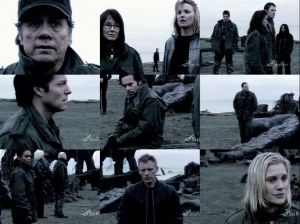
battlestargalactica-s4bLike most devotees of that most improbable of televisual phenomena, Battlestar Galactica, I’ve been blown every which way by the final episodes. With eight of the final ten down, the show has lurched from two of the most powerful and shocking hours of television I’ve ever seen (‘The Oath’ (4.15) and ‘Blood on the Scales’ (4.16)), to dot-point infodumps (‘No Exit’ (4.17)) and weird, slow car-crashes such as ‘Someone to Watch Over Me’ (4.19).

At one level the sheer haphazardness of these final episodes shouldn’t be surprising. For all its power as a series, Battlestar Galactica has always been pretty variable episode to episode. In part this is a consequence of the show’s very particular aesthetic, which discards almost all of the connective tissue and explication ordinarily expected in a television show. Combined with the claustrophobic intimacy of the handheld camerawork, this paring-back lends the show its extraordinary, almost hallucinatory intensity, but it can also leave individual episodes feeling surprisingly ragged.

But it’s difficult not to suspect the haphazardness is also at least partly a function of exactly the qualities that have made the show so remarkable. Despite its complex and deeply unsettling political subtext, much of Battlestar Galactica’s fascination has lain in its suggestiveness, and the constant, teasing implication that in the end its many elements will come to form a larger whole (not for nothing do the opening credits inform us that the Cylons “have a plan”).

The problem is of course that it is difficult to picture an explanation capable of drawing the show’s many elements together. Getting echoes of The Aeneid, The Book of Mormon, Paradise Lost, Exodus and other mythic sources, as well as post-9/11 anxieties about terrorism and loss and the War on Terror into the air together is one thing, but once they’re married to the mystery of the Cylons’ origins, the show’s own mythology, questions as to Starbuck’s true nature, the President’s visions, the political subtexts and most particularly the show’s constant, haunting refrain that “All of this has happened before, and will happen again” it’s difficult to see how the show’s creators can keep them all aloft at once.

Certainly the explanations offered thus far have been pretty unsatisfying. Quite aside from the jarring note of the Final Cylon’s identity, the attempt to explain the Cylons’ origins and the nature of the Final Five have managed to be both confusing and unsatisfying, managing to simultaneously reduce the show’s complex political allegory to a squabble between a spoiled son and his parents (as io9.com’s Annalee Newitz has observed) and to make the uncanny and profoundly disturbing Cylons oddly mundane. Then there’s the slightly too literal metaphorical business of Galen repairing Galactica by grafting Cylon biotechnology into her body, and the messy process of reorganizing the Council to reflect the changed composition of Human/Cylon society. And then, for every great moment, such as last week’s funeral for the crew killed trying to repair the damage caused by Boomer’s escape, and its glimpse of three separate belief systems struggling to make sense of the same questions of mortality, and loss, there’s a bum note such as Baltar’s speech at the funeral’s conclusion (though I think this most recent incarnation of Baltar is pretty unconvincing in general).

As I’ve observed elsewhere, there’s always been something slightly unnerving about the show’s creator, Ronald D. Moore’s openness about the casual manner in which many of the crucial decisions about the show are made. We want, as viewers, for it all to connect in a meaningful way, and more importantly, in a manner which allows the explanation to be more interesting than the process of getting there. But the fact is, with a show like Battlestar Galactica, where the ambiguities its political and mythic allegories suggest are much of the point, that’s unlikely to be a desire that’s compatible with resolution, or at least conventional resolution of the sort series television usually demands.

I want to write at more length about the final season once it’s done and dusted (I’ll probably wait for the Cylon-centric Edward James Olmos-directed telemovie which is apparently going to appear as a weird sort of coda somewhere between Saturday week and the DVD release of the spinoff series, Caprica) but in the meantime, Sophie Cunningham at Meanjin has very kindly given me permission to reproduce a piece I wrote about the show, ‘All Of This Has Happened Before And Will Happen Again: Humanity, Inhumanity and Otherness in Battlestar Galactica for the magazine’s December 2008 issue, which I’ve made available via my Writing page. The piece was written in the interregnum between the first half of Season Four and the second, so parts of it have been oveertaken by the developments in recent episodes, but the bulk of it is still current, and may be worth a look if you’re a fan of the show.

Break text

addthis

Watching the Watchmen: Part 2

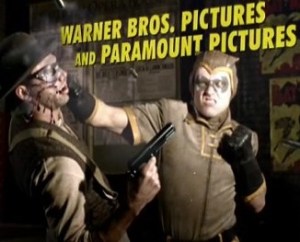
watchmenOn the weekend I linked to the wonderful credit sequence of Zack Snyder’s Watchmen. Now io9.com are offering a blow by blow guide to the many visual gags and references contained in the credits. It makes delightful reading, though I also suspect the attention to detail the article unpacks, and its deliberate echoing of the visually encoded and layered complexities of Alan Moore and Dave Gibbon’s original graphic novel is one of the qualities which makes the film itself such an oddly enervating experience.

Break text

addthis

Watching the Watchmen: Part 1

I’m planning to write something about Watchmen in the next couple of days, but one of the things I won’t be able to do is avoid echoing the view of critics as disparate as The New Yorker’s Anthony Lane and io9’s Meredith Woerner that in many ways the best thing about the film is its marvellous credit sequence. It’s certainly not the first time the heroes of the Golden Age have been lovingly invoked so their nostalgic glow can be undercut by a later, and darker reality — you only have to look to Michael Chabon’s The Amazing Adventures of Kavalier & Clay or Alex Ross’ Marvels for two examples — but I suspect for sheer compression and beauty there’s nothing to equal Watchmen‘s montage of three-dimensional photographs and their sense of gathering darkness and loss, not least because of the inspired choice of Bob Dylan’s ‘The time’s they are a changin’ as the backing track.

Break text

Vodpod videos no longer available.

Break text

addthis


Vampire discovered in mass grave?

vampireFriday’s New Scientist has a tantalizing little item about the supposed discovery of the skeleton of a “vampire” in Venice. The body, which was discovered during the excavation of mass graves dating from the plague of 1576 on the island of Lazaretto Nuovo, was found buried with a brick forced into its open mouth, as the rather unsettling image to the right depicts.

Sadly I don’t have a decent cultural history of vampires to hand (though if you’re after one, Amazon is up to their eyeballs (or is that eye teeth?) in them) but it’s difficult not to be struck by the manner in which the vampire myth continues to infect our culture. Quite aside from the not-insubstantial literature of the gothic underground, the past few years have seen at least two television series (Buffy the Vampire Slayer and True Blood), the Twilight phenomenon and a slew of novels ranging from J.R. Ward’s erotic Black Dagger Brotherhood series to Peter Watts’ hard-edged (and all the more terrifying for it) neurobiological take on the vampire myth in the Hugo Award-nominated Blindsight (if you’re interested in taking a look, Watts has published the novel online under a Creative Commons license — I particularly recommend his ‘Brief Primer on Vampire Biology’ if you want to see someone take a serious stab at making the myth make scientific sense).

The reasons for this are complex, but I suspect they’re also oddly basic. The vampire myth, whether in its contemporary, Western form or its various variants and precursors draws together the two deepest elements of the human psyche, sex and death, and binds them together (indeed in a very real sense it is the distorted mirror image of that other great ritual of blood and death and the acceptance of another’s flesh into one’s own body, the Christian communion). It’s a potent brew, so potent, in fact, that in some very real sense the vampire is a kind of universal signifier, able to accommodate almost any anxiety about sex or death, from Dracula’s fin de siecle anxieties about sexuality and moral decline, to anxieties about homosexuality, and blood, and disease, to the images of a death-obsessed Old World which drive Christos Tsiolkas’ Dead Europe. It can also, in the manner of these things, become so overdetermined as to signify not much at all, as the oddly engaging but essentially silly True Blood demonstrates.

All the same, it’s chastening to be reminded of the extent to which, even now, in a world transformed by technology, we are still creatures of our biology, driven by the primitive urges of fear and desire, and haunted by nightmares that, for all that their digital sophistication, are essentially the same as the fears that drove the plague-battered people of Venice to bury a woman with a brick rammed in her mouth four and a half centuries ago.

Break text

addthis

Time travel

timetravel1

Break text

addthis

Do you realize?

yoshimiWho says Okies are backwards? Today’s Entertainment Weekly reports:

“Wonderfully weird rockers the Flaming Lips have been given their home state’s ultimate seal of approval: The song ‘Do You Realize’ (from the band’s 2002 opus Yoshimi Battles the Pink Robots) has been named Oklahoma’s Official State Rock Song. (Its main state song remains Rogers & Hammerstein’s musical-theater behemoth ‘Oklahoma’; there are also sanctioned picks for folk, children, and country-western songs.)” (Read more)

Now from my point of view it sounds like a pretty sensible choice – if you were to make a shortlist of songs that make me happy every time I hear them the bittersweet ‘Do You Realize’ would be right at the top – but an officially sanctioned state song? I know the Americans have a long history of using popular music in a political context, but it still doesn’t sound very rock and roll to me.

But it did make me wonder. If the Australian Parliaments were to start choosing state songs, what would they be? Paul Kelly’s ‘Adelaide’? The Go-Betweens ‘Cattle and Cane’ or ‘The Streets of Your Town’? ‘From St Kilda to Kings Cross’? ‘Flame Trees’? And what would the dead hand of official approval mean for songs so deeply ingrained in the Australian consciousness? Would it rob them of their magic? Or would nobody even notice?

Anyway, here’s the Flaming Lips on Letterman:

Break text

Break text

addthis

Things I’m in love with this week

Thing #1: M. Ward’s new album, Hold Time. The thing’s an absolute joy.

And there’s a nice little interview with the man himself in The Guardian.

Break text

Break text

Break text

addthis

Phantom Shanghai

Phantom Shanghai

In 2005 I spent three months attached to the East China Normal University in Shanghai as an Asialink resident. Perhaps fortuitously, we didn’t end up living in one of the newer parts of the city, but in an apartment at the top of an alley house not far from the corner of Huaihai Lu and Shanxi Nanlu in the old French Concession.

The dodgy wiring and rats aside, it was a fascinating place to stay, not least because it gave me the opportunity to get to know some of the last remnants of Old Shanghai. For all its well-deserved reputation for criminality and vice, Old Shanghai was also the site of an incredibly fertile collision between European and Chinese modernity. This collision gave birth to writers such as Shi Zhecun, and Liu Na’ou (I’d probably also lump Eileen Chang in there as well, since although her work concentrates on the years of the Occupation, and was published in the 1940s, it exists in the shadow of the Shanghai of the 1920s and 1930s she grew up in), nurtured political radicals such as Mao and his wife, and most visibly these days, resulted in the peculiarly Shanghainese fusion of European and Chinese architecture that can be seen in the remaining pieces of the pre-1989 city.
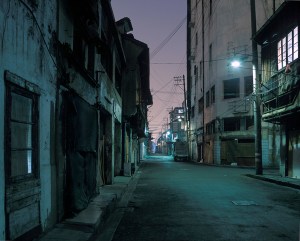
'Alley (Yangshuo Lu, looking north), 2006', © Greg Girard, 2006

'Alley (Yangshuo Lu, looking north), 2006', © Greg Girard, 2006

Even in 2005, when I was there, these remnants of the old city were vanishing fast. The pace of change in China is (or was, until recently) dizzying, and the Chinese have little interest in preserving what they see as the European city (Shanghai may have been the site of the most potent encounter between Europe and China, but it is also, for that very reason, seen by many Chinese as a symbol of the West’s exploitation of China: not for nothing were the towering buildings of Pudong built straing back across the river at the symbols of European power and wealth that dominate the Bund).

The process has created a city which is very much in flux. Buildings, streets, even whole neighbourhoods seem to vanish overnight, swept away without trace. The results can be startling, shocking, and just plain disconcerting: my partner and I often ate in a restaurant a few blocks from our home; a few weeks after we left a friend who’d eaten there with us was back in Shanghai, and he discovered that not only the restaurant was gone, but everything within a radius of a few hundred metres had also been demolished, apartment blocks already rising on the site.
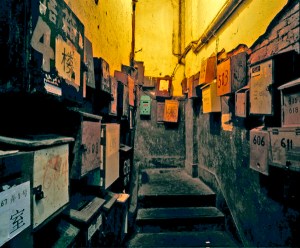
'Fuzhou Lu Mailboxes, 2005', © Greg Girard, 2006

'Fuzhou Lu Mailboxes, 2005', © Greg Girard, 2006

One of the ironies of this process is that it is largely undocumented. Images of Shanghai tend to fall into one of two categories, seeking to capture either the gleaming modernity of the new China, or the elegance and mystery of Old Shanghai.

In a very real sense this is a reflection of a more profound double-vision that afflicts most Western interest in Shanghai. Whether in guidebooks or literature, Western eyes seem unable to see that there are other Shanghais lurking beneath the surface of the city, histories and realities laid down during the Occupation and the Cultural Revolution which exist alongside the more comfortable images of Old Shanghai’s glitter and decadence and New Shanghai’s shining skyscrapers and designer boutiques.
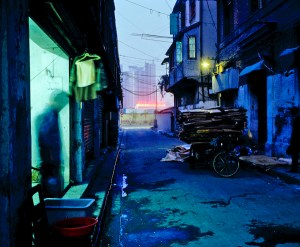
'600 Things, 2005', © Greg Girard, 2006

'600 Things, 2005', © Greg Girard, 2006

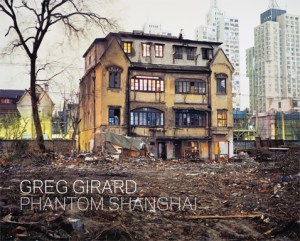
These questions are on my mind because I’ve been working on a non-fiction piece about the city, but they’ve also reminded me about the one book I’ve ever seen that seems to me to catch something of the accretive nature of Shanghai as a city, its sense of layered history, which is Greg Girard’s splendid Phantom Shanghai. The images in Greg’s book show a city in flux, a place where the past is being gradually wiped away, yet they also show the many, often enigmatic, traces its past has left. Somewhere – and it may be in Denton Welch’s marvelously strange Maiden Voyage, but I can’t find the reference – there’s a wonderful description of the way Chinese cities and towns often seem to be constructed out of detritus, repaired and repurposed, yet still resembling nothing so much as a conglomeration of offcasts and broken things, and there’s something of this in the images in Phantom Shanghai, as well as a sense of the almost surreal light of the city at night, the reflected glow of the pollution and the neon. But there’s also a sense of the ghostliness of the city, of the way its seems haunted by its past, and by the simultaneous closeness and irretrievability of that past.

With Greg Girard’s permission I’ve reproduced several images from the book in this post, and you can see more by visiting the Monte Clark Gallery website, or Greg Girard’s website (where you can also read William Gibson’s introduction) but I really do urge anyone with an interest in Shanghai to buy the book, – it’s a remarkable document of a city in transition, and of a world which is vanishing even as we speak.

Break text

addthis