Skip to content

Posts from the ‘Stuff’ Category

Face Off: Breaking Bad and the liberating power of violence
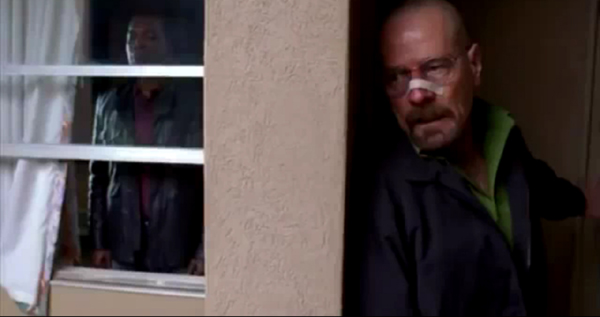
As I’m sure many of you did, I spent yesterday evening watching the season finale of Breaking Bad. As season finales go it was one of the great ones, not least because it managed the often difficult trick of concluding a long and suspenseful narrative arc without either seeming too neat and convenient or fumbling the ball at the last moment. But it also contains one of the most gruesome – and the most exhilarating – scenes I’ve seen on television in a long while.

What follows is going to be at least technically spoiler-free, since I’m not going to describe the scene, but if you’d like to go into the episode completely free of information you should look away. But basically it’s a moment of sudden and surprising violence involving one of the central characters.

The scene was interesting to me for a couple of reasons. One was how brilliantly orchestrated it was. Despite all the scheming and mind games part of the strength of this season of Breaking Bad has been the growing sense of chaos surrounding Walt, and the manner in which his actions have disrupted the operations not just of his family but Gus and the cartels in increasingly dangerous and unpredictable ways. Certainly it’s been difficult not to be aware of the steady escalation of the risk to Gus and his operations as the DEA (or at least Hank) gradually became aware of the possibility that Gus might not be quite what he seems to be.  Yet as the final episode revealed, the season has also been incredibly tightly plotted, not just in the narrow sense of Walt having a plan, but in the larger, narrative sense of tracing out arcs and story lines that converge in a manner that’s both inevitable and surprising (to borrow Cocteau’s formulation).

But what also struck me was the sheer delight of the moment I’m talking about. When it came I quite literally jumped in the air and cried out, not once but twice. And despite the absolute horror of what had happened my reaction wasn’t disgust, it was exultation.

It’s a reaction you only normally get in dramatic forms like film, television and theatre (although there’s a scene in Deborah Moggach’s novel, Tulip Fever, which tends to generate the same response). There are several such moments in The Sopranos (Tony picking the tooth out of the cuff of his pants while talking to AJ’s psychiatrist, Paulie’s mother’s friend catching Paulie in her house, Ralphie’s head falling out of his toupee), but there’s also the lawnmower scene in Mad Men and any number of such scenes on film (oddly the one that come to mind immediately is the moment the shark grabs Samuel L. Jackson in Renny Harlin’s Deep Blue Sea, but there’s also the much-imitated scene in Raiders of the Lost Ark in which Indy shoots the swordsman by the plane).

What’s fascinating about all of them is that they’re moments in which the violence or grostesquerie comes as a surprise, and is often designed to elicit something like humour. Yet the sort of surprise they depend upon is often one that goes beyond the surprise that comes with the revelation of something unexpected: instead it’s the sort of surprise that subverts our expectations about the conventions of the genre. We don’t expect that shark to grab Samuel L. Jackson in Deep Blue Sea because he’s in the middle of giving the big “we’ll fight them on the beaches” speech every action movie needs (and the fact Jackson is a big star and a major character). Likewise the lawnmower scene in Mad Men doesn’t just involve the eruption of violence in a show that’s largely about the workplace, it involves the maiming of a character we’ve been led to believe will be significant. And while the scenes in The Sopranos are less overtly subversive, they exist within the framework of a show which often used violence to remind us of the randomness and chaos of the world as a whole.

But they’re also fascinating because they’re not just about doing unexpected or unpredictable things. Just maiming people at random simply doesn’t work as storytelling, however subversive it might seem. Whether it’s the scene from last night’s Breaking Bad or the shark chomping on Samuel L. Jackson, such scenes tend to jolt our expectations and assumptions within the narrative as well, by revealing the plot is not quite (or not at all) what we’d been assuming.

It’s this part of the process that’s particularly tricky. The director of In Bruges, Martin McDonagh, is also a playwright, and the author of a series of remarkable (and remarkably violent) plays which depend at least in part upon eruptions of violence that are at once shocking and hilarious. Of these the second in his Leenane Trilogy, A Skull in Connemara, is particularly interesting. The plot centres on a gravedigger charged with clearing out an overcrowded graveyard, and involves a subplot about his murdered wife, although as becomes clear later on, none of this is really the point. Instead the point is the bones – and more particularly the skulls – the gravedigger keeps accumulating, and the question of what is to be done with them, a question that’s answered very graphically towards the end of the play when, in an explosion of violence, the gravedigger begins to smash the skulls to pieces with a mallet.

It’s an extraordinary scene, and an incredibly liberating and exhilarating one. The sheer anarchy and release of it is hard to describe. But part of what makes it so exhilarating is precisely that sense of release, of knowing, at some intuitive level, that whatever you may have assumed this moment was the point all along.

The scene in last night’s Breaking Bad shares this quality, because it’s also the moment you realise things have not been what you’d assumed. Yet by releasing the tension that’s built up over so many episodes in such an unexpected way, it transforms something that should be horrible into something that’s exciting and even grotesquely funny. Anthropologists talk about liminal moments, points in time when the assumptions that govern our interactions are suspended, and we enter a state of possibility, and change, and I suspect that beneath the gruesomeness there’s an element of that at play in these moments too, a sense in which the ordinary rules are suspended, and we glimpse something of the possibility of change and transformation that is embedded in the heart of all narrative. And, paradoxically, where our extremely sophisticated awareness of the cultural conventions of genre and narrative (because without that awareness the subversion couldn’t work) also makes it possible for us to encounter the most uncritical feelings of wonder and release that narrative depends upon.

(Diehard Breaking Bad fans might like to check out the first part of AV Club’s four part interview with the show’s show runner, Vince Gilligan)
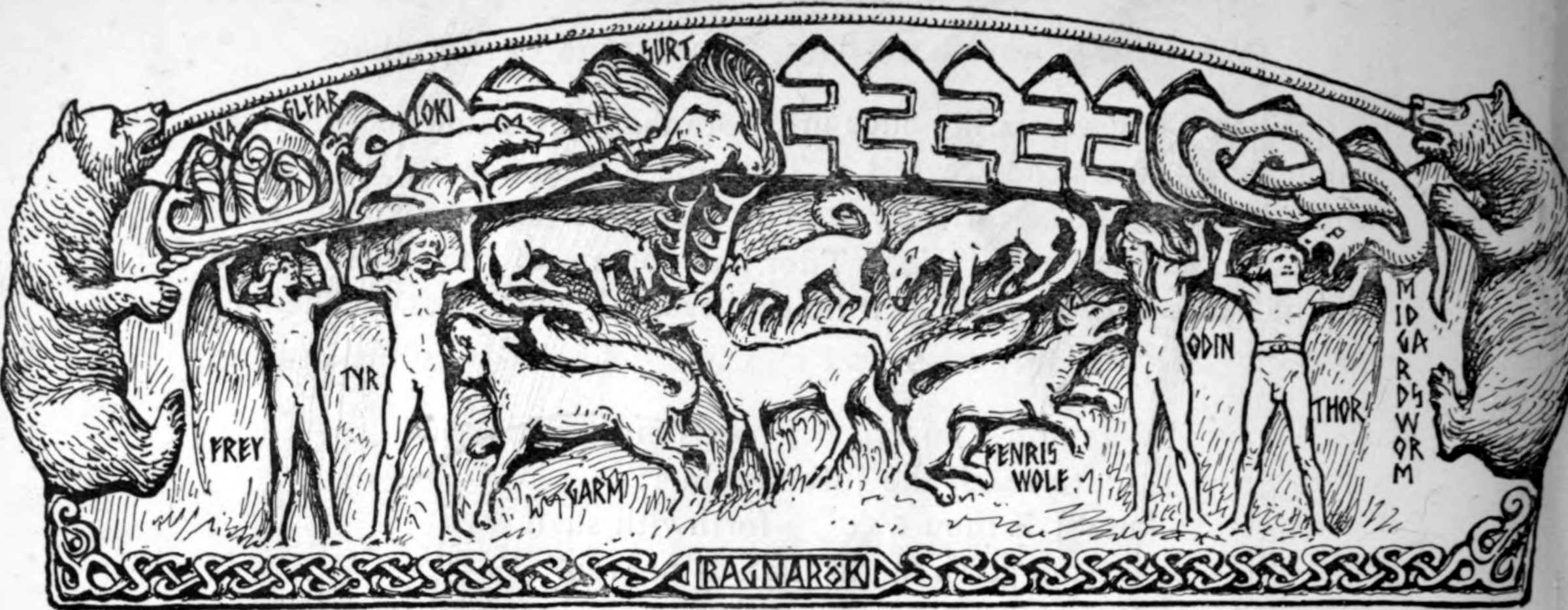
Ragnarok

W.G. Collingwood, Ragnarök (motive from the Heysham hogback), 1908

“The black thing in her brain and the dark water on the page were the same thing, a form of knowledge. This is how myths work. They are things, creatures, stories, inhabiting the mind. They cannot be explained and they do not explain; they are not creeds or allegories. The black was now in the child’s head and was part of the way she took in every new thing she encountered.”

A.S. Byatt, Ragnarok

The view from above

Sorry for the dearth of posts but I’ve been madly writing (well on the way to four new short stories, which is nice). Hopefully I’ll be back on air next week but in the meantime you might want to check out this amazing time-lapse footage of the Earth in darkness taken from the International Space Station. If you’re trying to work out what’s passing underneath the Youtube page says the movie:

“begins over the Pacific Ocean and continues over North and South America before entering daylight near Antarctica. Visible cities, countries and landmarks include (in order) Vancouver Island, Victoria, Vancouver, Seattle, Portland, San Francisco, Los Angeles. Phoenix. Multiple cities in Texas, New Mexico and Mexico. Mexico City, the Gulf of Mexico, the Yucatan Peninsula, El Salvador, Lightning in the Pacific Ocean, Guatemala, Panama, Columbia, Ecuador, Peru, Chile, Lake Titicaca, and the Amazon. Also visible is the earths ionosphere (thin yellow line), a satellite (55sec) and the stars of our galaxy.”

But basically it’s amazing.

Borders, REDgroup and Parallel Importation Take 2

Just a quick note to apologise to anybody who’s been caught out by the antics of yesterday’s post about the collapse of Borders. After I posted it I discovered the system had somehow posted an unedited version of the text. Because I was out of the house I was reduced to trying to fix it on my phone, which made the formatting go berserk.
Deciding it wasn’t a problem I could fix sitting on a train, I trashed the post, intending to repair the problem later in the day, but in the end I didn’t get back to it until today, and at this point the prospect of manually repairing the formatting feels like more than I can face.
So, apologies to anybody who’s had the damn thing pop up in their RSS and then disappear. If I get really excited I might fix it tomorrow, but I suspect my energy for the question may have already dissipated.

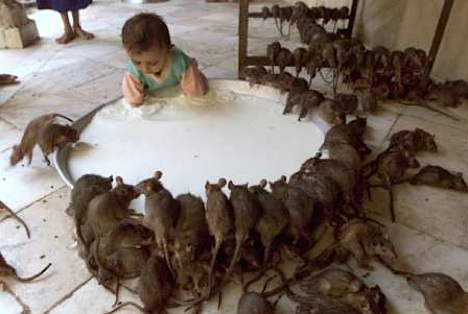
The Rat-King is dead, long live the Rat-King!

If like me you’re a little bit phobic about rats you probably don’t want to read this story about the rat plague afflicting the Myer Building in Sydney, or the swarms of them that rise up out of the foundations every night to take over the Food Court. And you definitely don’t want to read this piece by Sean Wilsey about the rats of New York City. Or hear the story I heard years ago about the tide of rats that swept across the lane behind the old Rex Hotel and into the building opposite when demolition began (apparently it looked like the ground was moving). And you absolutely, positively don’t want to read my Rat-King post again.

Do you?

2011 and all that

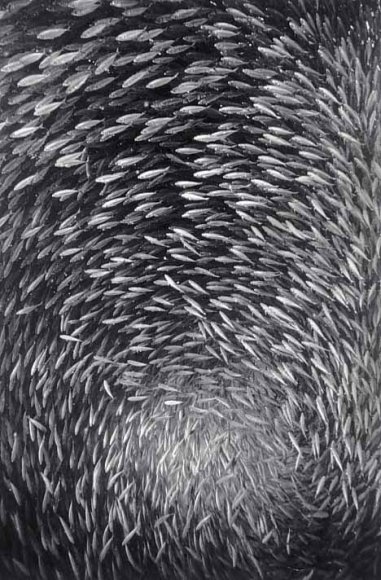
Wayne Levin, 'Circling Akule', © Wayne Levin (click to embiggen)

Despite having given myself an open-ended holiday from the site I think there’s no denying that even in the Antipodes the summer is over once Australia Day has passed. To which end I’m getting back on the blogging horse. I suspect things will stay a little bit slow around here for the next week or so (my daughter doesn’t go back to school for another week and a half) but I’m still aiming to get a few things up in the not too distant future.

That said, 2011 is looking like a big year for me in general. Unfortunately it looks like my new novel, Black Friday, may now not be on shelves until early 2012, but I’m about to launch into editing it, and once that’s done I’ve got two more books I’m hoping to knock over reasonably rapidly, which will make for a busy year.

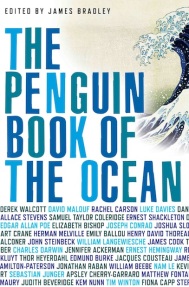
Elsewhere, The Penguin Book of the Ocean has been going gangbusters, with one reprint already under its belt, and a brace of very, very positive reviews. I’ll pull together some links for those soon, and if I can find it links to the interviews I’ve been doing about it over the break, but in the meantime if you’d like to buy a copy you can check prices on Booko.

Some other bits and pieces that might be of interest. First of all, I’m planning to post something about it soon, but in the meantime you might want to check out Wayne Levin’s stunning new book, Akule. Anyone who’s seen a copy of The Penguin Book of the Ocean, or read some of my previous posts about Wayne and his work will have a sense of how extraordinary his work is, but if not check out the sample pages and if you get a chance, order a copy: it’s wonderful, and like all of Wayne’s books comes with a terrific essay by another of the writers featured in The Penguin Book of the Ocean, Tom Farber.
To continue with The Penguin Book of the Ocean theme, Kevin Hart, whose pulsing, luminous poem, ‘Facing the Pacific at Night’ also appears in the collection has a new book, Morning Knowledge on the way as well. It’s not out for another week or so but it’s already possible to pre-order copies.

And finally, since I’m about to go and tidy up a long piece I’ve written about ghosts and ghost stories, you might want to check out my review of Peter Ackroyd’s The English Ghost: Spectres Through Time, which appeared in The Australian a couple of weeks ago.

I hope you’re all well, and have survived the summer, particularly if, like many Australians, you or your family have been caught up in the flooding and fires of recent weeks. And however it began, I hope 2011 is a great year for all of you.

So you want to write a novel?

I’m still laughing.


What is it about men and bad sex?

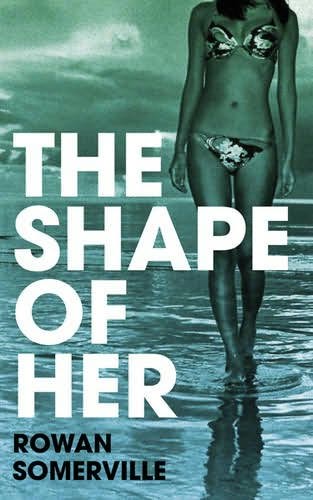
News this morning that relatively unknown Irish author Rowan Somerville is the winner of this year’s Bad Sex in Fiction Award for his novel, The Shape of Her, beating off stiff opposition (ooh-er) from a shortlist dominated by heavy-hitters like Jonathan Franzen and Christos Tsiolkas.

I’ll let others discuss the merits or otherwise of the various nominees; what interests me is the fact that the winner is a bloke. At one level that’s not a surprise, especially given the shortlist of eight included only one book by a woman, but it starts to look more striking when you glance down the list of writers who have won the award since it was inaugurated in 1993, and absorb the fact that of nineteen winners to date, only two have been women.

So what is it about men and bad sex? I’ve got a few ideas of my own but I’m guessing many of you have thoughts on the subject as well. Is it just the inherent sexism of the literary and cultural world on show in an amusing and ironic way? Or are men predisposed to write awful sex (or to put it more accurately, since most winners of the Bad Sex Award win for descriptions of what they think of as good sex, are men predisposed to write good sex badly?). And if they are, do women write it better? Or do they just avoid writing about it at all?

Thoughts, please . . .

The Northern Lights

Some of you may have seen them already, but if not these images of the Aurora Borealis by photographer Tor Even Mathisen are truly magical.

Be sure to embiggen for the full effect (via io9).

Vodpod videos no longer available.

From the sublime to the ridiculous . . .

Sometimes the juxtapositions the web throws up are just too good to be true, and these two galleries, which I stumbled upon within minutes of each other a couple of days ago, are a case in point. The first is a selection of photos from Translocations, a new book by UK-based photographer, George Logan, which place wild Asian and African animals in the British countryside. The effect is both beautiful and oddly unsettling, rather like the images of escaped lions prowling through ruined London or jackals on the streets of New York City one often comes across in post-apocalyptic fiction. You can check out a selection of the photos at Smashing Pics, or on Logan’s website. Copies of the book are available from Logan’s website as well. Proceeds from the project go to the Born Free Foundation.

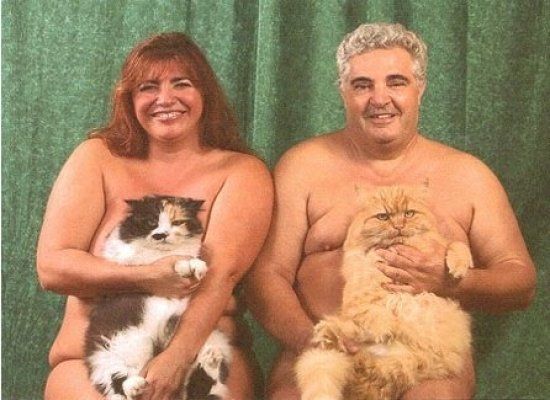
And then there’s Awkward Family Pets, the new project from the geniuses (genii?) behind the toe-curling Awkward Family Photos (if you’ve never been, you must). I’m not going to try and preempt the horrors that wait there, but let me just say you won’t be the same afterwards.


Called to Glory

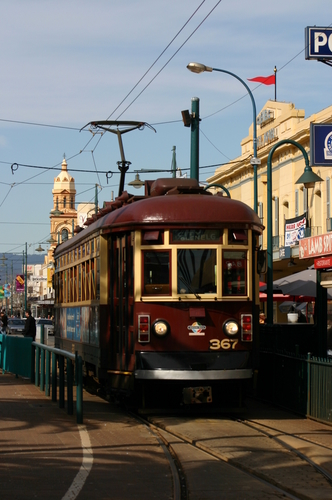
Family history is one of those things you should never inflict upon people you like or respect, but this little story I learned last week is too good to let pass. It concerns my Great-Grandmother, Adelaide Bradley, who was run over by a tram on Jetty Road in Glenelg in 1942. Sad, obviously, but it’s difficult not to wonder what the family (who were Church of Christ in those days) were thinking when they drafted her death notice, which read, in one of those delightful collisions of religion and modernity, that she’d “been called to glory after contact with a moving vehicle.”

Break text


Corporate comedy? Microsoft’s official guide to humour.

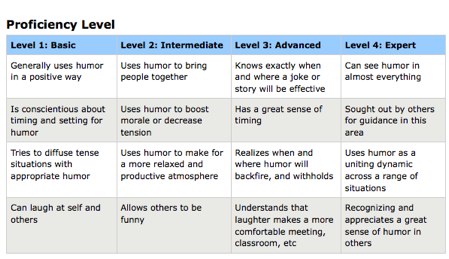
A few years back I had a friend who claimed her employer was been working on  list of officially-sanctioned jokes to be used with clients, a notion so bizarre I was never quite sure whether to believe it or not. Now, via Holy Kaw, comes the revelation that Microsoft has not only formalised the use of humour in the workplace, they’ve come up with a ranking system. Which is hilarious in itself, but only slight less hilarious than the total lack of irony on the part of those who created it.

Break text

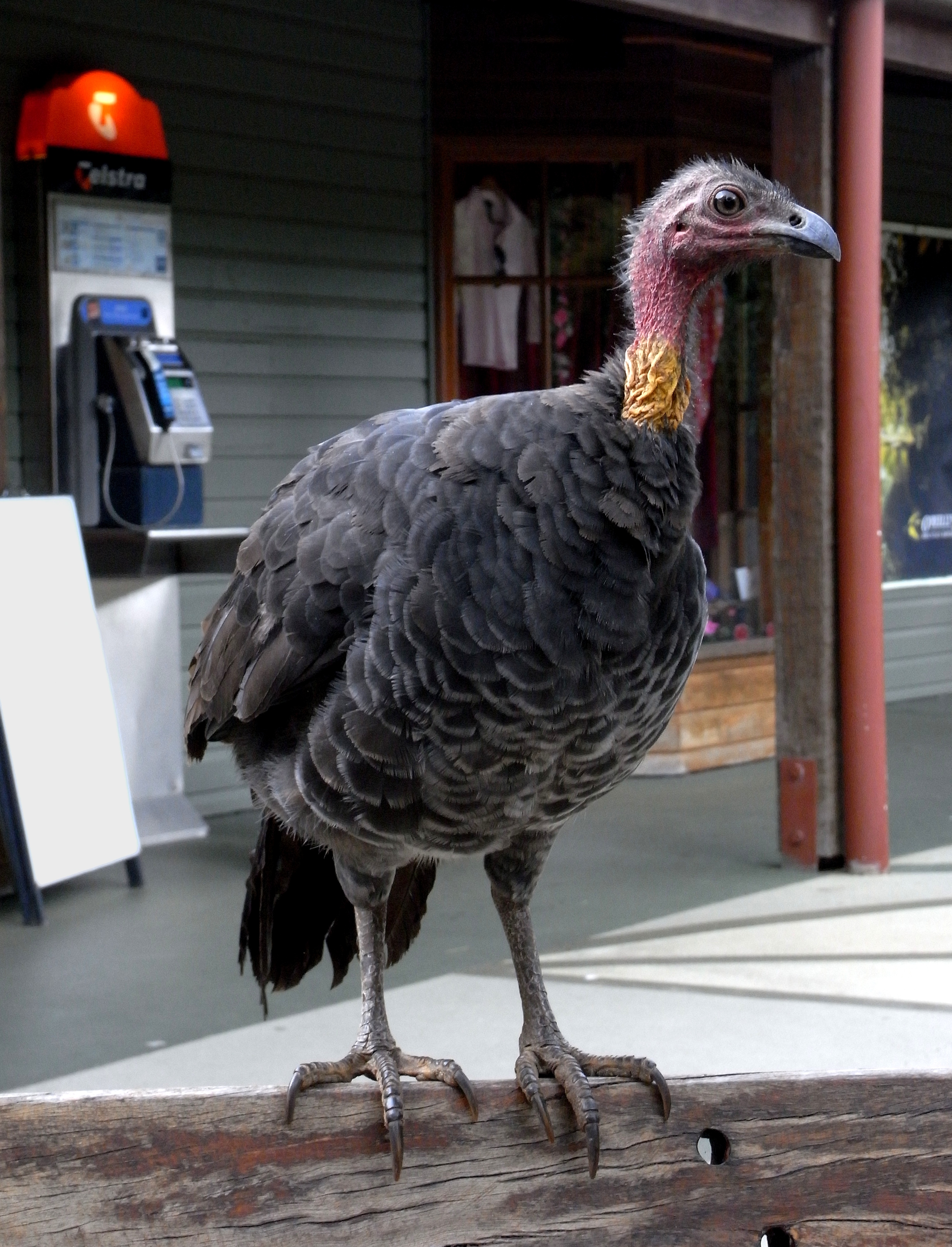
Is that a turkey in your pocket or are you just pleased to see me?

Brush Turkey phone home?

So, I’m driving through East Sydney at about 5:15 last night, on my way to pick my daughter up from childcare, when I look out the window and see a Brush Turkey trotting along the footpath. Not a bird that looked like a brush turkey, or some other random Megapode, but an honest-to-Betsy, full-grown, black and red Brush Turkey.

Now I have to confess that threw me a bit. Sydney’s blessed with an abundance of bird life, including a number of quite large birds (Black and Sulphur-Crested Cockatoos, Channel Billed Cuckoos, even the omnipresent Sacred Ibises) but a Brush Turkey? In the inner city? If nothing else Brush Turkeys are pretty much flightless, so it would have to cross the road on foot to get anywhere. And where on earth would it nest? (for those of you overseas, Brush Turkeys nest in huge (and I mean HUGE) mounds of leaves and sticks). Bizarre.

Pleasingly though, it reminded me of one of my favourite stories, which concerns the bird painter John Gould, and is to be found in Isabella Tree’s biography, The Bird Man. The story stems from Gould’s visit to Sydney in the late 1830s, a visit which saw Gould visit many of the local worthies, including one (who if memory serves was Alexander Macleay, one of the founders of the Australian Museum and the original owner of Elizabeth Bay House) who Gould was delighted to discover had a Brush Turkey nesting in his garden.

Gould spent some time observing the turkey and made some sketches of it, but the real treat comes later in a footnote by Tree, in which she notes (rather sardonically if I remember correctly) that despite its success on the day of Gould’s visit, the Brush Turkey later met with an unfortunate end, when it drowned attacking its own reflection in a bucket of water, a fate that suggests a degree of focus that’s not so much admirable as alarming.

Break text

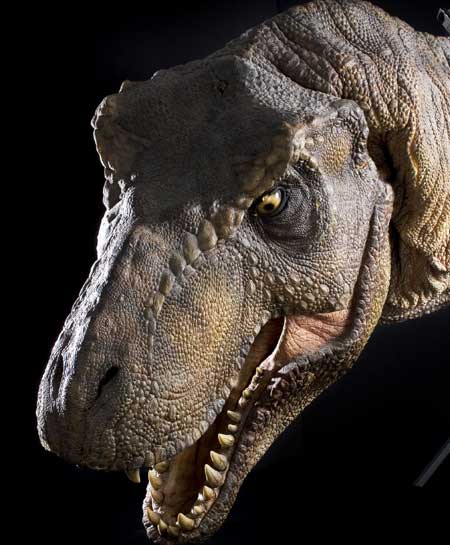
Fair suck of the sav (or the revenge of the poo dinosaur)

"Grr, baby."

On Twitter the other day, Angela from Literary Minded pinged me for wrongly attributing her quip about this year’s male-dominated Miles Franklin shortlist being a sausagefest to Kerryn Goldsworthy.

Angela was joking, but I know where she’s coming from. Every writer’s got stories about having ideas pinched or misattributed. And though it happens less often than a lot of people think, it does happen. I keenly remember pitching a story to a TV show and being told it wasn’t for them, only to see the same story turn up a few eps later in the season, virtually unchanged.

For the most part though, I try not to get too hung up about these things. But a few years ago I had the very disconcerting experience of sitting down to read a new book of essays by a highly celebrated Australian writer, only to come across two pages that had been transcribed pretty much verbatim from a conversation I’d had with them at Adelaide Writers’ Week a year or 18 months previously.

It’s difficult to know what to do in this sort of situation, since squealing just makes you look over-sensitive, so I just copped it. But it meant that when my friend Delia Falconer called me a couple of weeks later to ask whether I wanted to be acknowledged as the source for a section in her novel, The Lost Thoughts of Soldiers, I told her I did. Definitely. No questions asked.

The catch was that the section in question was based on a story from my brother’s time working as a bouncer in an Adelaide pub. One night, at closing time, he went to check the toilets, and there on the cistern was a sleekly glistening brown dinosaur crafted from human shit. Disgusting, yes, but what was worse was the care its creator had lavished upon it, inserting little sticks for arms and match-heads for eyes. That and the fact that the tap in the toilet was broken, so whoever had made it had gone back out into the pub without washing their hands.

Of course in Delia’s hands the story gained a literary patina the original lacked, but all the same I was pleased when my copy of the novel arrived to see my name in black and white in the acknowledgements page. This time at least I’d kept control over my material.

Or so I thought. A couple of weeks later I went to the launch of the book, and quickly became aware people were looking at me strangely. At first I thought I was being paranoid, but then, during the speeches I realised what was going on. Having read the story and the acknowledgements people had put two and two together and decided it was me personally who’d made the dinosaur. Appalled at the notion I might have become known as some sort of demented coprophiliac, crafting little animals out of poo in between writing books, I told people they were wrong, it was a story my brother had told me, to which they smiled patronisingly, and said, ‘Oh right, whatever you say’.

But worse was to come. A few months later, when the book came out in the US, Delia did an interview about it which mentioned the story, and namechecked me as the source. which meant that for a long time afterwards if you googled my name and “poo dinosaur” you pulled up multiple hits (all gone now, I note with relief).

Oh yes, me and Auguste Rodin, artists of the living clay.

Break text

Sunday ephemera

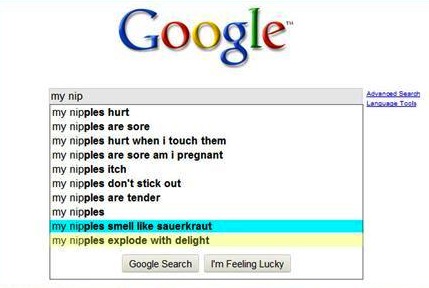
"my nipples smell like sauerkraut"

After a very rewarding morning washing a tub of Vaseline out of my three year-old’s hair (in case you’re interested shampoo is useless but talcum powder and then shampoo seems to have helped) I thought I’d chuck up a few links to liven up your Sunday.

The first is a delicious new site called Autocomplete Me, which I found via Spike (who found it via The Millions), which uses the Google’s autocomplete function as a device to peer into the murky depths of the collective subconscious. Having confessed before to the voyeuristic pleasures of eavesdropping on other people’s search terms it’s the sort of site I can’t help but enjoy, but I challenge anybody not to be both fascinated and bemused by the fragmentary glimpses of people’s private worlds the site throws up. Some are cute (“What do you feed a Yeti anyway?”), a lot are weird (“Cheese is the devil’s plaything”) and  some are just plain worrying (“I’ve just had a conversation with my cat in the shower about pancakes. We both like them a lot”).

I also thought in the light of my post a few weeks back about the death of the letter it might be worth pointing to Stacy Schiff’s wonderful review of Thomas Mallon’s equally wonderful-sounding Yours Ever: People and their Letters, a book written in the shadow of the disappearance of the form to which it is devoted. Schiff reads Mallon’s book as an elegy for a dying art, suggesting in closing:

“It is next to impossible to read these pages without mourning the whole apparatus of distance, without experiencing a deep and plangent longing for the airmail envelope, the sweetest shade of blue this side of a Tiffany box. Is it possible to sound crusty or confessional electronically? It is as if text and e-mail messages are of this world, a letter an attempt, however illusory, to transcend it. All of which adds tension and resonance to Mallon’s pages, already crackling with hesitations and vulnerabilities, obsessions and aspirations, with reminders of the lost art of literary telepathy, of the aching, attenuated rhythm of a written correspondence.”

To which, my suggestion that blogs and Twitter might, in a very small way, be replacing the letter notwithstanding, I can only say, ‘Amen’.

And finally, a little Sunday song. I know this video’s done the rounds a lot of times already, I know it’s just marketing, but it’s a wonderful thing all the same. Enjoy.

Break text

Break text