Doctor Who Season 7 Teaser Trailer
“Give me a Dalek any day …”

Mar 27
May 12
 Just a reminder that if you’re in Sydney over the weekend you might want to head over to Shearer’s Bookshop in Leichhardt for When Genres Attack, a pre-Sydney Writers’ Festival event exploring a series of hot-button issues to do with genre, literary status, women’s writing and the state of literary culture generally. It’s an event I’m really excited to be part of, not just because they’re a series of questions dear to my heart, but because I’ll be sharing the stage with the irrepressible Sophie Hamley and two of the smartest writers I know, P.M. Newton (author of one of my favourite books of last year, The Old School) and Kirsten Tranter (whose debut novel, The Legacy, I’m in the middle of as we speak and am enjoying very much). If you’d like a taster of the evening Kirsten’s written a fascinating piece about the way setting up oppositions between genre fiction and “literature” impoverishes our understanding of both for the Shearer’s Bookshop Blog.
The event kicks off at 7:30 tomorrow night. Tickets are $7.00 and are available from Shearer’s Bookshop on (02) 9572 7766. It’d be great to see you there.
Apr 1

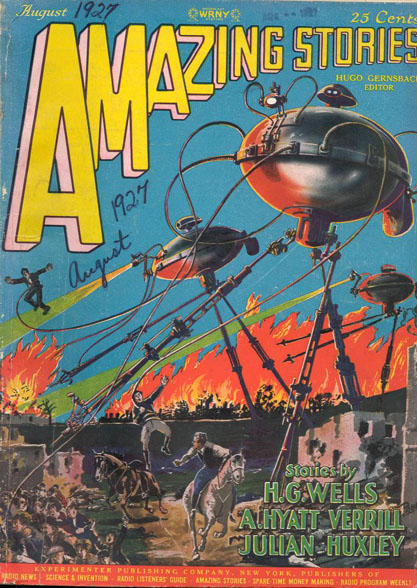
Bruce Pennington,
As some of you probably know, I’ve spent a lot of the last year or two reading and thinking about SF. I’m still grappling with a number of questions about the relationship between SF and more conventional literary fiction (for what it’s worth I do think it makes sense to speak of the two as discrete, if overlapping entities), but I’ve been very taken by three things I’ve read in recent months.
The first is from Ken MacLeod, a writer I admire very much (and anybody who’s trying to think through the longer terms implications of Wikileaks could do worse than read his excellent 2007 novel, The Execution Channel), who concludes a discussion of Andrew Crumey’s Sputnik Caledonia by making a point that’s been made before but deserves to be made again:
“SF literalises metaphor. Literary fiction uses science as metaphor. In Sputnik Caledonia, the parallel world is a metaphor of what is lost in every choice. That’s why the book is literary fiction and not SF, and is all the better for it. ‘What might have been’ functions in SF as a speculation. In Sputnik Caledonia, as in life, it’s a reflection that we seldom have occasion to make without a sense of loss.”
The second is from Paul McAuley’s blog, Unlikely Worlds (McAuley has been one of my favourite SF writers since the mid-1990s, and as I mentioned in my Best Books of 2010 post a while back, his most recent novel, Gardens of the Sun, is both beautiful and very moving). Responding (with what seems to me considerable forbearance) to Edward Docx’s idiotic piece about the crapness of genre fiction Paul suggests Docx’s argument proceeds from a false assumption about the relationship between genre writing and its audience:
“Bad genre writers pander to the expectations of their readers; good genre writers subvert those expectations; great genre writers, like Philip K Dick, J.G. Ballard, or John Crowley, transcend them, completely rewriting conventions or using them for their own ends. And while there may not be any genre writers who can match, sentence for sentence, literary writers at the top of their game – Saul Bellow, say, or Gabriel Garcia Marquez – there are certainly a good number who can match the middle ranks of their literary counterparts. Who aren’t content with utilitarian prose and (quoting Wood again) “selection of detail [that] is merely the quorum necessary to convince the reader that this is ‘real’, that ‘it really happened’”, but want to bring life to their pages by selecting the best possible words in the best possible order.”
And finally there is this, from Frederic Jameson’s Archaeologies of the Future, also quoted recently on Paul’s website:
“The conventional high-culture repudiation of SF – its stigmatization of the purely formulaic (which reflects the original sin of the form in its origin in the pulps), complaints about the absence of complex and psychologically “interesting” characters (a position which does not seem to have kept pace with the postcontemporary crisis of the “centred subject”), a yearning for original literary styles which ignores the stylistic variations of modern SF (as Philip K. Dick’s defamiliarization of spoken American) – is probably not a matter of personal taste, nor is it to be addressed by way of purely aesthetic arguments, such as the attempt to assimilate selected SF works to the canon as such. We must here identify a kind of generic revulsion, in which this form and narrative discourse is the object of psychic resistance as a whole and the target of a kind of literary “reality principle”. For such readers, in other words, the Bourdieu-style rationalizations which rescue high literary forms from the guilty associations on unproductiveness and sheer diversion and which endow them with socially acknowledged justification, are here absent.”
Or, as Paul pithily puts it:
“attempts to appeal to the gatekeepers of the high literary citadel by pointing out that SF is firmly rooted in the present, that it extrapolates and amplifies current nightmares and obsessions, or that it explores alternate social structure through utopian or dystopian constructions, are, even though valid, pointless. . . Better to turn away from that and address the great luminous question that SF should make its own: what do you mean by reality, anyway?”
Oct 3
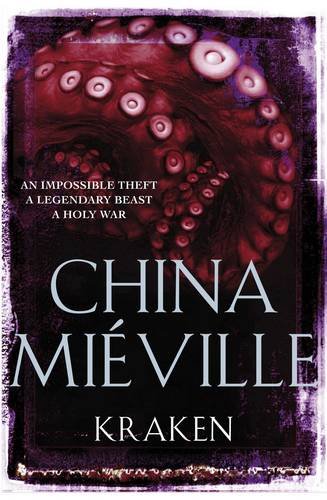 Just a quick note to say I’ve got reviews in both The Australian and The Sydney Morning Herald this weekend. The first, in The Australian, is of Michael Cunningham’s rather underwhelming new novel, By Nightfall. As someone who admires a lot of Cunningham’s work (especially his last book, the gloriously weird Specimen Days) I wanted to like By Nightfall more than I did, but in the end it’s just too finely wrought and exquisitely felt to ever quite come to life.
The second, in The Sydney Morning Herald, is of China Miéville’s Kraken. Some of you may have seen my review of the nominations for the 2010 Hugo Award for Best Novel a few weeks back, which talked a bit about Miéville’s last book, The City And The City, which went on to share the Hugo with Paolo Bacigalupi’s The Windup Girl. As I said in that review one of the things that’s fascinating about The City And The City is how thoroughly it expunges the glitter of Miéville’s earlier work, and in that sense Kraken reads like a return to more familiar territory for Miéville (if a writer as restlessly imaginative as Miéville could ever be said to have a “territory” in any meaningful sense). But it’s also a much more light-hearted and playful book than many of Miéville’s earlier books, a quality which is oddly disarming at first but which (at least to my mind) means the book never seems prepared to fully commit to its own existence in some deep sense.
Break text
Mar 20
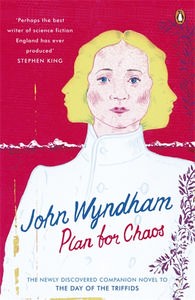 I’ve got a long piece about Penguin’s “new” John Wyndham novel, Plan for Chaos, in this morning’s Weekend Australian. As I say in the review, it’s a pretty dreadful book, but if you’re an admirer of Wyndham (as I am) it’s not entirely without interest, if only for the way it offers a link between his career as a pulp novelist before World War II and the amazing run of novels that begins with The Day of the Triffids and ends with The Midwich Cuckoos.
If you’re in the mood for a Wyndhamesque Saturday you might also want to check out my post from a while back about The Day of the Triffids, and why British visions of the end of the world differ so much from American fantasies about the apocalypse. Or you could take a look at David Ketterer’s excellent introduction to the Liverpool University Press edition of Plan for Chaos. And if you’d like to take a look at the rather fab Brian Cronin covers Penguin have commissioned for the reissued set of Wyndhams they’re available on Penguin’s blog, and make an interesting contrast to the covers I remember from the 1980s (Penguin’s UK site also features a rather fun historical index of all Penguin’s SF covers for those who want to take these things to extremes).
Break text


Jan 18

Neytiri (Zoe Saldana) and Sully (Sam Worthington)
Given the sheer volume of discussion of Avatar online, and the fact that it’s now a month since the film was released, I’ve been a little reluctant to chip in with my two cents worth. But while the time for anything like a straight review is long past, I feel like there are some things worth saying about it that don’t seem to have been said to date.
Because what I want to say is reasonably extended, I’ve decided to break it up into two (or just possibly three) posts. The first – this one – is about the 3D technology of the film; later in the week I want to say a few things about the film’s broader message, and perhaps about what it is that seems to work (and not work) in it.
To begin with, I think it’s worth observing just how overwhelming the response to the film has been. I can’t think of another film in recent years which has generated anything like as much commentary as Avatar, or (perhaps more interestingly) which has managed to chew up so much bandwidth across so many channels. You’d expect a genre film, especially a genre film as expensive and technically striking as Avatar to be generating a lot of commentary on sites which cater to fanboys, but it’s a lot less usual for a genre film (or indeed any film) to be generating continuing commentary on the opinion pages of the major international broadsheets.
At least part of this can be attributed to the film’s politics, which have enraged right-wing commentators around the world (or at least inspired the sorts of absurd posturing that passes for outrage in right-wing circles). I’m not going to rehash their arguments here, which mostly turn on the mawkishness of the film’s ecological and political subtexts, but I would observe that there’s something telling about the sheer ferocity of the Right’s hostility to messages which are, at one level, so unexceptional (after all, as Elvis Costello almost asked, what’s so threatening about peace, love and understanding?).
But I’m not sure the somewhat confected political debate about the film’s politics really explains its transformation into a full-blown cultural phenomenon. Certainly it’s difficult to imagine the armies of people who’ve trooped off to see the film having a Road to Damascus moment as they head home to their houses filled with the sort of consumer technologies that made the film possible and deciding to give it all away for a simpler life (nor, I suspect, would the many corporations with a stake in its success be impressed if they thought its anti-consumerist message was actually hitting home).
Instead the film’s impact seems to be a result of the technologies that make it so striking, in particular Cameron’s extremely sophisticated fusion of 3D and digital special effects.
In itself this is hardly a remarkable observation, but stay with me for a moment. 3D isn’t new, but after the success of Avatar I think we can assume it’s here to stay. There have already been announcements that films ranging from the new Bond film to 2012’s Star Trek 2 and the now-Sam Raimi-less Spiderman 4 will be shot in 3D, and while the technology will presumably take a while to trickle down into smaller, less spectacle-driven productions, I think there’s little doubt it will.
To my mind the interesting question isn’t whether 3D will gradually displace older, 2D technologies, but what that will mean for the way we see and experience film (or indeed whether it is fair to continue to describe the future of visual storytelling as “film”). As anyone who’s seen it knows, what’s really exciting about Avatar isn’t the story (though to tell the truth, I found it completely absorbing, all my caveats about the woodenness of its storytelling notwithstanding) or even the effects (which are, quite simply, extraordinary) but the sense of immersion. As many before me have observed, the film largely declines to employ the sort of cheesy things-shooting-out-of-the-screen-at-you gimmicks 3D films have usually confined themselves to, and instead concentrates on creating a world you enter as if it were real.
Interestingly, I think the sheer novelty of the experience rather overwhelms the fact that as a simulation of real space the film is actually rather crude. There’s depth, but objects and figures often seem more like planes moving in space than actual three-dimensional things (rather like a $300 million Captain Pugwash cartoon, I suppose). That’s not to say it isn’t amazing, and – as the film’s publicity reminds us – unlike anything we’ve seen before, but it is to be reminded that for all its wonder to an audience in 2010, within a decade Avatar is likely to look as crude as the original Star Wars does now. Likewise I suspect it’s fair to assume that 3D film and television are probably only transitional technologies, and that the future lies in holographic projection or some similar technology.
But crude or not, I think there’s little doubt Avatar is the embodiment of Cameron’s recognition that cultural forms are, in a very deep sense, artefacts of the technology that create them. Novels take the form they do because of the codex book, movies the cinema (and increasingly, television) screen, video games the computer screen. So moving from 2D to 3D isn’t just about adding depth to films, it’s about creating something new, something unlike anything we’ve had before.
In a minor way this is visible in the textures of the film itself. Despite the immersiveness of the 3D Avatar often seems curiously flat texturally. Given the riot of colour that is Pandorum, it would be impossible to describe it as washed-out, but more than once I found myself nostalgic for the vivid density of colour digital images and digital film have made us familiar with. There are a few moments that have it – most memorably the early scenes in space, which draw upon NASA’s photographs of the ISS and shuttle missions – but for the most part Pandorum (and by extension the film itself) doesn’t look dense or vivid enough to be “real”.

Arrival at Pandorum
But this density of colour is itself new, a consequence of the shift to digital imaging, and the increasingly blurry line between reality and representations of reality, a line films like Avatar are making even blurrier. What looked “real” to an audience familiar with Technicolor looks strange to us, just as the more liquid surfaces of analog photography seem increasingly other-worldly to a culture more accustomed to digital reproduction.
This is doubly true of Avatar’s use of 3D, which breaks the fourth wall in a truly revolutionary manner. Instead of watching the film, the audience are in the film. I’ve not read everything that’s been written about the film, but it seems odd to me that people haven’t made more of the fact that Cameron quite deliberately situates a second, imaginary immersive technology at the centre of the film, as if to suggest the film is, in some small way, a very crude version of what Sully and the others experience “dreamwalking” in the avatars themselves.
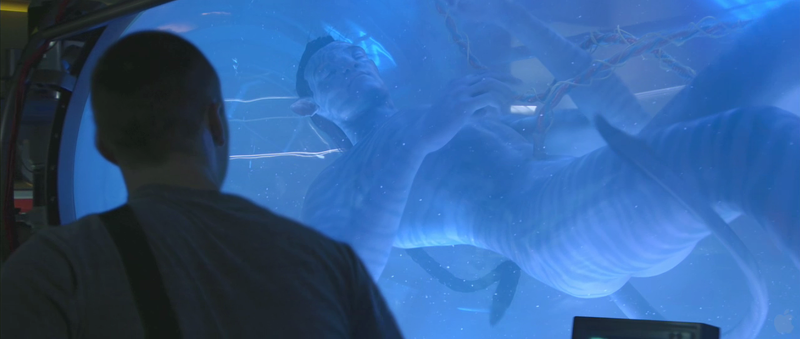
Sully (Sam Worthington) and his avatar
But the avatar technology also – and importantly to my mind – invokes the computer game. I don’t mean by this that the film is intended to celebrate gaming or leverage a computer game (though it’s certainly not too cynical to suggest there’s nothing accidental about the very obvious continuity between the textures of the film and the textures of Avatar: The Game). Instead I think Cameron invokes gaming because he understands – whether consciously or not – the synergies between the immersiveness of 3D moviemaking and the computer game.
In a very crude sense, computer games and film have been converging for some time. In the gaming world it’s long since ceased to be surprising for a game to be “cinematic”, and, conversely, I think it’s fair to say the largely digital textures of a lot of action and science fiction films often seem to resemble those of the more sophisticated games.
Critics of games and gaming usually point to the crudeness of the interactions, or the lack of interiority in games as a sign of their inferiority to older forms such as fiction and film. But that seems to me to miss the point. Games aren’t about interiority, they’re about agency, and often, the creativity of the player. They are an experience, a means of entering another world.
Of course this is precisely what Sully does in the film when he steps into his avatar’s body (and again when he leaves the control of the mission and becomes one of the Na’vi), and what, in a cruder sense, the film allows the viewer to do. And while the agency enjoyed by a player is absent, the sense of immersion moves the experience beyond that of passive consumption, suggesting something more like possibility, or even escape. Indeed the film very deliberately suggests this longing for freedom, and for escape through its early concentration on Sully and his ruined body, and the sense he only becomes fully alive, and fully real in the moment he steps into the avatar.
Which brings us back, I think, to the question of what 3D will do to film, and perhaps more profoundly, film’s storytelling. All forms of fictional narrative – novels, films, television series, even fairy tales and folk stories – create worlds. But the shift to 3D makes this process central, emphasising the viewer’s immersion in the world of the film, just as computer games emphasise the player’s immersion in the world of the game. It also, in the longer term, suggests new forms of interactivity, and, I suspect, narrative possibilities (at the very least POV pornography is unlikely to ever be quite the same). And, more deeply, it hastens our transition into a world where the virtual and the real are essentially indistinguishable, and where our sense of what is real is hopelessly enmeshed in the technologies we use to reproduce it. As filmmakers like Cocteau understood long ago, 2D film has always, at some deep level, been about a kind of dreaming, a way of projecting our fantasies onto the screen (it’s not accidental we watch movies in the dark, or that film is essentially insubstantial, a play of light upon a screen); with 3D those dreams cease to be insubstantial, and begin to populate the world around us.
Break text
Aug 30
In his novel, The Day of the Triffids and its vision of a world struck blind and menaced by carnivorous plants, John Wyndham created one of the most enduring nightmares of the Atomic Age. Nearly 60 years later, his vision might equally serve not just as a warning of the perils of genetic engineering, but as a powerful reminder of the very different ways British and American writers imagine the end of the world.
Jun 14
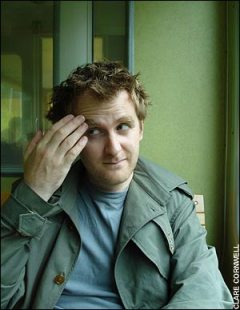
Nick Harkaway
First a quick apology for the slightly sporadic posting over the past week. I’ve been a bit overwhelmed with work, and though I think I can see the light at the end of the tunnel (which excitingly means I might manage to snatch a few days to work on my novel before I go on holiday the week after next) I’m still about 5,000 words from freedom, so the patchy posting may continue for a while yet. Once I’m back online and have a bit of time to spare I’ve got some things coming I think people will like – a review of Caprica and a long piece on The Day of the Triffids (you know you want to know why), as well as some thoughts about (not) teaching the canon – but for the time being it’s all work, work, work in my world.
Anyway – having pieces spiked is an occupational hazard for reviewers. You slug your way through a book, write a review, and then for some reason – space, time, budget pressures – it doesn’t run. It doesn’t happen often, but when it does you can guarantee it’s a piece you either spent quite a lot of time on or you thought was pretty good (which may say something about my judgement, but we won’t go there).
The piece below is one of those pieces. It was written to coincide with the hardback release of Nick Harkaway’s The Gone-Away World last year, but in the end it didn’t run. At the time that seemed a pity, not least because the book is, in its own mad way, both ambitious and interesting (certainly as picaresque romps go, it beats Steve Toltz’s A Fraction of the Whole hands down for sheer energy and inventiveness). So, since the paperback has just been released, I thought it might be worth giving the piece a run here.
For anyone who’s interested, Harkaway has a pretty classy website, and runs a blog. The site also has some videos of him reading from the book. He’s also written about the complicating fact of his (extremely famous) father’s identity here.
Break text
The Gone-Away World
Nick Harkaway
I once had a conversation with the adult son of a famous writer. He was a nice guy – bright, funny, thoughtful – but when I asked him what I wanted to do with his life he froze. ‘Write,’ he said in a small voice after a moment, ‘though it’s sort of weird when I try to’.
It was a conversation that came back to me while reading Nick Harkaway’s debut, The Gone-Away World. Because as anxiety of influence goes, Harkaway – the son of David Cornwell, or John Le Carré – must have had it in spades.
Perhaps unsurprisingly, in interviews Harkaway seems to strike a slightly uneasy balance between filial affection and a desire to distance himself from his famous forebear, no doubt seeking to have his book assessed in its own right: a famous father is, as Harkaway discovered after the novel sold for a staggering £300,000, inevitably something of a double-edged sword. Yet faced with the book itself, in all its joyous, exuberant improbability, there can be little doubt Harkaway’s success is of his own making and no-one else’s.
Something like a cross between The Road and Kung Fu Panda, The Gone Away World is a crazed, shaggy-dog post-apocalyptic picaresque, with more than enough brio and cheek to leap its improbabilities in a single bound. Insofar as it lends itself to précis, it begins in a near-future in which Cuba has entered into a political union with Great Britain, thereby creating the United Island Kingdoms of Britain, Northern Ireland and Cuba Libré, or, as the wits would have it, Cubritannia (a move which delights the Cubans for its economic and political possibilities and the British because it guarantees “an influx of well-trained, educated people of pleasing physical appearance who have rhythm”).
In this future the narrator – who for reasons which become clear later in the book remains nameless – and his best friend Gonzo Lubitsh grow up in sleepy Cricklewood Cove, a place mostly notable for being home to Assumption Soames’ Soames School for the Children of Townsfolk, and the academy of Master Wu, of the Way of the Voiceless Dragon.
When a flirtation with university politics and Zaher Bey, the leader in exile of the tiny Central Asian country of Addeh Katir leads to the narrator’s arrest by a privatised extra-legal but government-sanctioned anti-terrorist squad and leaves him virtually unemployable, the narrator finds himself working in a high-tech special forces and weapon research unit. Under the command of Professor Derek, this team has invented the Go Away Bomb, a device which strips the information out of the matter comprising its target, converting it into what they think is undifferentiated nothing, but is really – as the narrator and the rest of the world discover when the Go Away Bomb is simultaneously (and surprisingly) deployed by most countries in the world at once in a good old-fashioned bout of what used to be known as MAD, or Mutually Assured Destruction – actually converts it into Stuff, a denatured form of matter which has the unfortunate tendency to take on whatever form flits through the mind of the creatures closest to it. In the ruined and depopulated world left behind, the only refuge from the nightmares that spring from Stuff is found along the edges of the Pipe, a conduit laid by the mysterious Jorgmund Corporation.
In the hands of a lesser – or at least a less confident – writer, such a plot might seem ridiculous, but Harkaway approaches his subject matter with such joyous abandon and good humour it’s impossible not to respond in kind. And while the novel’s influences – which run the gamut from Don Quixote to Fight Club, and The Karate Kid to William Gibson and take in almost everything in between – are clear, it never feels freighted down by them, or derivative.
None of which is to say it all works. Certainly the book’s weakest section is its final 50 pages, though that is as much a function of the picaresque form’s natural lack of interest in narrative closure as any weakness in the novel itself – but for the most part it does, bouncing with the sort of careless ease that necessarily belies the authorial control underlying it from digressions about the nature of politics to self-mocking kung fu parables, from bawdy Harry Potteresque university high-jinks to a chilling vision of a world gone mad.
Yet underpinning it – and if one was looking for an echo of Harkaway père this might be it – is an unswerving moral clarity. For all the geekish delight Harkaway takes in his inventions, The Gone-Away World’s comedy is rooted in a powerful sense of the corrupted and corrupting nature of power, and of its indifference to individual freedom, or even existence. And it is in this respect that The Gone-Away World’s picaresque pleasures most truly, and most brilliantly repays its debt to the steely satire of Fielding and Swift and even Rabelais.
Break text
Apr 22
 Although I’m still waiting for my copy to arrive, the first reviews of the DVD-release version of the Battlestar Galactica spin-off/prequel, Caprica
Created by Ronald D. Moore and David Eick, the driving forces behind the revisioned Battlestar Galactica, Caprica looks like being a very different creature from its parent, even as it explores similar – and similarly troubling – territory. Set 60 years before the events of Battlestar Galactica, and starring the man with the charisma bypass, Eric Stoltz and Polly Walker, who lit up the screen as Rome’s scheming Atia, it focuses on the creation of the first Cylons (or the first non-Final Five, Earth that wasn’t Earth Cylons, but we won’t go there) and the lives of two families, the Greystones and the Adamas. Like the troubled Ian McShane vehicle, Kings (which has already been shifted to Saturday nights in the US, usually the prelude to a show being taken round the back and put out of its misery) it depicts a science fictional version of contemporary America, a place of almost unbridled wealth and decadence riven by religious extremism and the perils of technology. These are of course questions explored with great power and suggestiveness in Battlestar Galactica, but as the trailer below suggests, Caprica has ambitions to be more than a simple companion piece to its parent series, even as it draws on its aesthetic and mythology.
I’m sure more reviews will appear in coming days, but thus far the word is broadly positive, if not actually ecstatic. Wired’s Underwire gives it a 8 out of 10, suggesting it’s a little on the slow side but praising its intelligence and preparedness to tackle difficult issues. Wired‘s Geekdad is similarly positive, saying that while “it’s not the kind of action-packed, thrilling, anyone-really-could-die-at-any-moment kind of show Battlestar Galactica fans have been, well, fanatic about these past four seasons,” it is “a very good drama, with good science fiction thrown in”. Slashfilm goes further, saying it asks “some deep questions about the morality of creating artificial life,” adding that while “[i]t’s rare for a sci-fi show to attempt drama with very little action . . . it manages stay compelling without much reliance on ’splosions”. And io9’s resident smart cookie, Annalee Newitz, thinks it “works incredibly well, despite a few hiccups, helped along by some brilliant worldbuilding and terrific acting from stars Esai Morales and Eric Stoltz”.
Perhaps almost as interesting as the release itself is its nature. The version just released is not a pilot, but a special DVD-only movie release, complete with R-rating. And while the series itself is already in production, and is currently scheduled to screen in 2010, the version available now will not be seen on television. Instead the producers will reshape the television pilot (and presumably the series) on the basis of responses to the DVD version. Whether you see its release as a cynical cashing in on the gaping hole left in many fans’ lives by the end of Battlestar Galactica or an interesting use of the different delivery technologies is proably a matter of perspective.
Caprica is available from Amazon.
break text
Break text

Mar 11
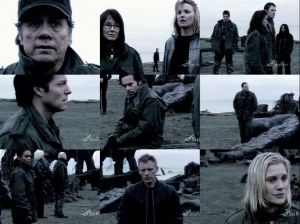 Like most devotees of that most improbable of televisual phenomena, Battlestar Galactica, I’ve been blown every which way by the final episodes. With eight of the final ten down, the show has lurched from two of the most powerful and shocking hours of television I’ve ever seen (‘The Oath’ (4.15) and ‘Blood on the Scales’ (4.16)), to dot-point infodumps (‘No Exit’ (4.17)) and weird, slow car-crashes such as ‘Someone to Watch Over Me’ (4.19).
At one level the sheer haphazardness of these final episodes shouldn’t be surprising. For all its power as a series, Battlestar Galactica has always been pretty variable episode to episode. In part this is a consequence of the show’s very particular aesthetic, which discards almost all of the connective tissue and explication ordinarily expected in a television show. Combined with the claustrophobic intimacy of the handheld camerawork, this paring-back lends the show its extraordinary, almost hallucinatory intensity, but it can also leave individual episodes feeling surprisingly ragged.
But it’s difficult not to suspect the haphazardness is also at least partly a function of exactly the qualities that have made the show so remarkable. Despite its complex and deeply unsettling political subtext, much of Battlestar Galactica’s fascination has lain in its suggestiveness, and the constant, teasing implication that in the end its many elements will come to form a larger whole (not for nothing do the opening credits inform us that the Cylons “have a plan”).
The problem is of course that it is difficult to picture an explanation capable of drawing the show’s many elements together. Getting echoes of The Aeneid, The Book of Mormon, Paradise Lost, Exodus and other mythic sources, as well as post-9/11 anxieties about terrorism and loss and the War on Terror into the air together is one thing, but once they’re married to the mystery of the Cylons’ origins, the show’s own mythology, questions as to Starbuck’s true nature, the President’s visions, the political subtexts and most particularly the show’s constant, haunting refrain that “All of this has happened before, and will happen again” it’s difficult to see how the show’s creators can keep them all aloft at once.
Certainly the explanations offered thus far have been pretty unsatisfying. Quite aside from the jarring note of the Final Cylon’s identity, the attempt to explain the Cylons’ origins and the nature of the Final Five have managed to be both confusing and unsatisfying, managing to simultaneously reduce the show’s complex political allegory to a squabble between a spoiled son and his parents (as io9.com’s Annalee Newitz has observed) and to make the uncanny and profoundly disturbing Cylons oddly mundane. Then there’s the slightly too literal metaphorical business of Galen repairing Galactica by grafting Cylon biotechnology into her body, and the messy process of reorganizing the Council to reflect the changed composition of Human/Cylon society. And then, for every great moment, such as last week’s funeral for the crew killed trying to repair the damage caused by Boomer’s escape, and its glimpse of three separate belief systems struggling to make sense of the same questions of mortality, and loss, there’s a bum note such as Baltar’s speech at the funeral’s conclusion (though I think this most recent incarnation of Baltar is pretty unconvincing in general).
As I’ve observed elsewhere, there’s always been something slightly unnerving about the show’s creator, Ronald D. Moore’s openness about the casual manner in which many of the crucial decisions about the show are made. We want, as viewers, for it all to connect in a meaningful way, and more importantly, in a manner which allows the explanation to be more interesting than the process of getting there. But the fact is, with a show like Battlestar Galactica, where the ambiguities its political and mythic allegories suggest are much of the point, that’s unlikely to be a desire that’s compatible with resolution, or at least conventional resolution of the sort series television usually demands.
I want to write at more length about the final season once it’s done and dusted (I’ll probably wait for the Cylon-centric Edward James Olmos-directed telemovie which is apparently going to appear as a weird sort of coda somewhere between Saturday week and the DVD release of the spinoff series, Caprica) but in the meantime, Sophie Cunningham at Meanjin has very kindly given me permission to reproduce a piece I wrote about the show, ‘All Of This Has Happened Before And Will Happen Again: Humanity, Inhumanity and Otherness in Battlestar Galactica‘ for the magazine’s December 2008 issue, which I’ve made available via my Writing page. The piece was written in the interregnum between the first half of Season Four and the second, so parts of it have been oveertaken by the developments in recent episodes, but the bulk of it is still current, and may be worth a look if you’re a fan of the show.
Break text
Feb 11

For anyone who’s interested, William Gibson has started posting excerpts from his new novel on his blog at www.williamgibsonbooks.com. The first was posted on New Year’s Day, and there have been several more substantial pieces over the past couple of weeks.
The excerpts suggest the new book picks up somewhere after Gibson’s last novel, Spook Country

Gibson experimented with the same practice during the writing of Spook Country, and though a lot of his fans were excited by it, I felt it was better to stay away and wait for the real thing. Perhaps I’m just too busy, perhaps it’s a more deepseated, novelist’s prejudice against the idea of wiki-ing a book (though I’d be interested to know how many of the responses the excerpts receive Gibson will take on board).
break text
For those wanting more Gibson paraphernalia, here is the very stylish video Gibson’s publishers released to coincide with the publication of Spook Country in 2007.
break text
break text
And here is a short review of Pattern Recognition I wrote for The Sydney Morning Herald in 2003. It’s still available online, but for some reason the quotes in the version on the SMH website have dropped out, rather changing the sense of the piece. That being the case I’ve taken the liberty of reproducing my original review below with the missing quotes reinstated (I hope the SMH won’t mind).
Break text
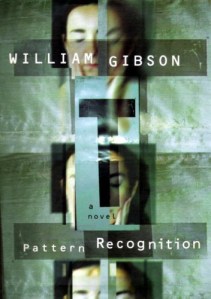 Pattern Recognition
By William Gibson
Somewhere in the middle of Pattern Recognition, William Gibson’s seventh novel, the central character, Cayce Pollard, describes her memories of that day in New York, of the impact of the second plane. The experience, related in a fragmented, dream-like language, seems to collapse time, collapse meaning. It is “like watching one of her own dreams on television. Some vast and deeply personal insult to any ordinary notion of interiority. An experience outside of culture.”
What Gibson’s language strains to reveal in that event, or more properly, in our experience of it, is the sense of vertigo it induced, of the collapsing of boundaries: political, geographical, personal, ethical, its singularity lying not in its death toll, or in its nature but in our experience of it, the way it unmade the certainties that not just our present but our future were grounded in.
Whether it was begun before or after September 11, this sense of our experience of reality exceeding itself is wound deeply into Pattern Recognition. Not only is it the first of Gibson’s novels to take place in the immediate present, it also seems to represent the closure of some kind of circle in his writing, not least in the allusive play between the names of its protagonist, Cayce and the anti-hero of his groundbreaking first novel, Neuromancer, Case.
Of course to call Gibson a writer of science fiction has always been to misunderstand him. Gibson’s antecedents lie more in Burroughs and Pynchon than Arthur C. Clarke, their strange, essentially poetic assemblages of image and echo designed to explore the inner textures of a culture which exists increasingly outside of time and space. The effect is probably nearest to that of an intellectually rigorous brand of video-art: suggestive, unsettling, and unresolved, its meanings arising out of the interplay between the elements rather than residing within them.
And so, despite its contemporary setting Pattern Recognition is classic Gibson. Moving between London, Tokyo and Moscow, it turns upon a series of film fragments which have been appearing anonymously upon the internet. These fragments, in an echo of the Joseph Cornell-like assemblages of Count Zero’s artificial intelligence, are possessed of a mute, almost inexplicable power, a power attested to by the global underground following they have attracted. Carefully denuded of any identifiable signs of context or origin, the fragments may or may not be part of some larger work, yet regardless their power stems from their sense of compression, the way they seem to signify the possibility of a meaning which they simultaneously deny.
Cayce, a follower of the footage herself, is commissioned by her sometime boss, the wonderfully-named Belgian market-guru, Hubertus Bigend (who “seems to have no sense at all that his name might be ridiculous to anyone, ever”) to establish the identity of the footage’s creator. Bigend’s motives for doing so are ambiguous to say the least, but Cayce accepts nonetheless, a decision which drops her deep into a world of obsessed footage-heads, industrial espionage, Russian mafia and cryptography, only to fetch up, finally, in the painful truth of the footage’s origins.
Woven through this are a collection of images which play off each other with ever-increasing subtlety and power. The pictures of the missing pinned to windows and walls and doors in New York. An amateur archaeological dig near Stalingrad, where guns and badges, uniforms and eventually an entire Stuka, its pilot still in its cockpit are being drawn from the suffocating, erasing mud by Russian skinheads. Diagrams of the arming mechanism of antiquated American explosives are uncovered coded deep inside the footage. Mechanical calculators designed in Buchenwald are traded to collectors from car boots, resembling nothing so much as grenades. And everywhere, out of the fragments of the past, the present and the future, meaning suggests itself, elusive, partial yet possessed of a strange and ultimately deeply moving poetry.
Like Gibson’s futuristic novels, which refract the present hauntingly through the lens of their possible futures, there is something at once utterly immediate and strangely timeless about Pattern Recognition. It captures the fluidity of meaning and the sense of shifting certainties which infect our historical moment, strung between the unrecoverable past and the nascent future. ‘“The future is there . . . looking back at us,” as Cayce herself says. “Trying to make sense of the fiction we have become. And from where they are, the past behind us will look nothing at all like the past we imagine behind us now.”
First published in The Sydney Morning Herald, 15 March 2003.
© James Bradley, 2003.
break text




 city of tongues