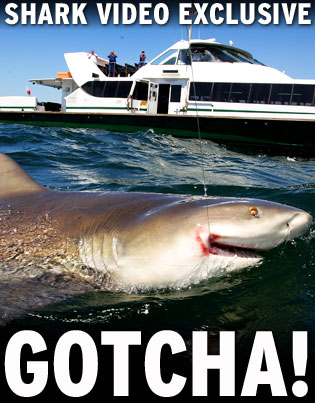
The front page of this morning’s Daily Telegraph is given over to a photo of a huge bull shark struggling on a hook in Sydney Harbour. The face of the shark, which is somewhere between 2.7 and 3.0 metres long (about 9-10 foot to those of you on the old system) is a ghastly sight, its pale, corpse-like eye swivelling downwards, its mouth twisted back by the line.
It’s a horrible image, but not, I suspect, for the reasons it graces the paper’s front page. Instead it’s horrible because the shark is so obviously frightened and in pain, and because there’s something grotesque about presenting an animal’s panic and fear as a sort of theatre (there’s video of the capture in case the photo doesn’t satisfy your blood lust).
There’s a lot of agitation about sharks in Sydney at the moment, following two attacks in the last fortnight. In the first, which took place in Woolloomooloo Bay, Navy diver Paul de Gelder lost his right hand and right leg, reportedly to a bull shark like the one in the photo, in the second, which took place at Bondi Beach, surfer Glenn Orgias had his hand torn off by what seems to have been a Great White. The hand was subsequently reattached and while there was some initial doubt the operation seems to have been a success, with a report in this morning’s Sydney Morning Herald that he’s already moving his fingers.
I’m sure I’ll be almightily rubbished by many people for feeling sympathy with the shark in the photo. Sharks are unlovely creatures in many ways, not least because they are Nature at her most utilitarian and functional. I’ve written elsewhere about my first encounter with a Great White, and the way the brutish reality of the creature stripped away my romantic preconceptions.
But for all their brutishness they are also creatures perfectly designed to do what they do, and it’s hard not to feel that in them we glimpse something of a world in which we are simply another creature among many, and reminded of what it is to exist in a world where we are prey as well as predator. This is a chastening realization, but it’s also, as the excitement of the reporter in the video and his rapturous text suggests, exhilarating.
Of course there’s an irony in using images of an animal we regard as monstrous being tormented as theatre. In the incessantly moralizing but curiously Old Testament world of the tabloid, the shark is a monster, and so whatever we do to it is justified. But I think there’s a more disturbing set of assumptions in play as well. There’s something profoundly alien about sharks, some sense in which they are unsettlingly blank and unknowable, and to some extent this justifies the use of the image. Certainly an image of a dog being tormented on the front page would provoke an appalling outcry, and I’m reasonably confident the same response would be provoked even if the image were of predatory animals such as tigers or orcas.
Some might argue there’s a qualitative difference between tormenting a shark and tormenting a dog or a tiger or an orca because of the disparate levels of intelligence. Perhaps. Certainly dogs, tigers and particularly orcas are more intelligent than sharks. But intelligence is less quantifiable than we usually assume, and what exactly it means in animals is particularly problematic. The shark is what it is because of its ecological niche, and its intelligence is a function of that niche. As with most animals, once closely observed, sharks begin to reveal complexities and subtleties of behaviour which suggest they exist in a more complex world than we would have assumed.
In fact it’s the alienness, the Otherness of the shark that makes it possible for its pain and suffering to be presented as moral theatre. We do it because sharks are unlike us, and outside the circle of human sympathy.
History has taught us the danger of this kind of thinking, but the problem is more that our thinking around animals and their treatment is hopelessly incoherent. I feel sympathy for the shark but I’ll settle down to a meal of salmon for dinner tonight, and there’s no reason to think the experience of being hooked and killed was any more pleasant for the salmon than it was for the shark (for the record the shark in the photo actually escaped alive). Likewise we recoil from fox-hunting and battery hens, while comforting ourselves that farm-fed meat is acceptable because it’s humanely slaughtered (which is a weasel word on a par with friendly fire and inhumane torture).
I’m no better than anyone on this question. I eat meat, though not a lot of it, as well as fish and other creatures. I could go vegetarian but I haven’t, mostly because I’m too lazy and I like meat and fish. I also have a series of completely incoherent ideas about food that has been hunted and caught using relatively traditional methods being somehow okay, while factory fishing and slaughterhouses aren’t. And although I give it less thought than I should, I have my moments when I feel like Elizabeth Costello in J.M. Coetzee’s profoundly disquieting The Lives of Animals, when she cries out:
“It’s that I no longer know where I am. I seem to move around perfectly easily among people, to have perfectly normal relationships with them. Is it possible, I ask myself, that all of them are participants in a crime of stupefying proportions? Am I fanatasizing it all? I must be mad! Yet every day I see the evidences. The very people I suspect produce the evidence, exhibit it, offer it to me. Corpses. Fragments of corpses that they have bought for money.”
Coetzee is, of course, drilling down into something deeper than the simple question of whether the industrialized slaughter of animals and aquaculture is morally comparable to genocide (a connection he makes explicit, without ever committing himself to it). Instead he is drawing forth the forces of violence and subjection that lie not far beneath the surface of every human society, and offering us a glimpse of the hidden engine of human culture, just as Benjamin did when he observed, “there is no document of civilization which is not also a document of barbarism”.
I have little doubt what Coetzee would make of the image of the shark. But what would he make of the shark itself, and of our relationship to it? Nature is amoral, but our relationship with it, and in many ways our understanding of it, is deeply moral, and not just because we so routinely use the natural world to illustrate our moral arguments. In a crude sense our relationship with the natural world is moral because we are now custodians of it, by default if nothing else, simply because our actions will determine so much of what happens over the next century or so. The wrong decisions will have appalling consequences, not the least of which will be runaway climate change.
It’s usual to try and found arguments for our custodianship in notions of nurture and balance. There’s little doubt these have intuitive and sentimental appeal, but I think we should be wary of them as well. We are custodians by default, but if we make the wrong decision, we will suffer as well as the planet, and it’s always dangerous to overestimate our importance in the scheme of things. Certainly it’s safe to assume that just as rabbit and lemming plagues spike and then collapse, if we push the planet’s systems too far they will regulate themselves, a process that might take millions of years to play out, but which is unlikely to be pleasant for humanity as we know it.
I don’t want to push this point too hard, but I do wonder whether there is soemthign we could learn by looking at both way we treat the shark and the shark itself. The first reveals something uncomfortable about the nature of humanity, and society. But the latter reveals something about the dangers of romanticizing the natural world, or of overestimating our importance in the scheme of things. For as we watch the shark move through the water, scavenging and hunting in its casual, opportunistic way, we see the amorality of the natural world made manifest, and its ultimate disinterest in us and our fate.
Break text




 really set my world on fire) but I’d forgive almost anything for
  . And then there’s this wonderful video of ‘Rise up with Fists’, from
  (for what it’s worth, I think the crappy lip-sync is deliberate) . . .
 I promise I’ll stop after this, but EW has an
 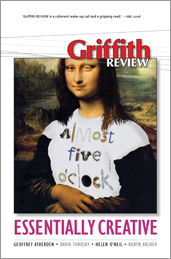 I’ve got a piece about depression and creativity in the latest Griffith Review, Essentially Creative. The piece explores the links between mood disorders and creativity, and asks what we’re losing when we define behaviours intimately connected with creativity as disorders. It’s also a very personal piece, and one I found quite confronting to write.
 I was listening to Bruce Springsteen belt out ‘Radio Nowhere’, the opening track to his 2007 album, Magic, the other day, and as I did I was struck by how archaic it felt. Not in terms of its energy – as anyone who heard him perform ‘The Rising’ at the concert to celebrate Obama’s inauguration a few weeks ago knows, Bruce can still crank out the tunes like nobody’s business – but in terms of its invocation of the radio as a vehicle of connection.
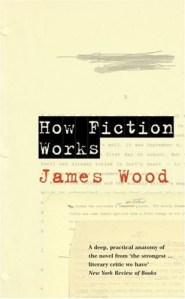 There’s no question that, for good or ill, James Wood has reigned supreme amongst literary critics for more than a decade. At least in part this state of affairs is a reflection of Wood’s missionary fervour, his sense that literature – and the novel in particular – must fill the gap left by the death of religion. But it is also testament to the thrilling force and acuity of his writing. Certainly I remember the excitement of encountering his first book, The Broken Estate, and the chastening realization that the person speaking with such eloquence and ferocity was only a year or so older than myself.
 Now this is just getting silly.
  I meant to post this link a couple of weeks ago when it was first published, but




 city of tongues