Skip to content

Screw the Emmys

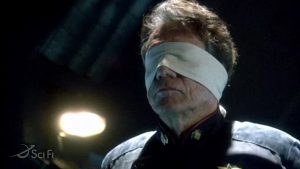
AdamaAfter my little spit about the Emmy nominations a week or two back, it’s nice to see something like justice prevail at the Television Critics’ Association Awards, where the final season of Battlestar Galactica was named Program of the Year. The members of the Association, which is made up of approximately 200 American and Canadian journalists and critics covering television, followed in the footsteps of the Emmys in recognizing Mad Men, which took out the award for Outstanding Achievement in Drama, and Bryan Cranston, who took out the award for Individual Achievement in Drama for his work in Breaking Bad. True Blood took out the award for Outstanding New Program.

The full list of awards is available here.

Break text

addthisTweet this

2009 Man Booker longlist announced

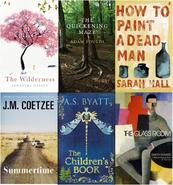
6jacketsforsiteFor those of you who haven’t seen it, the longlist for the 2009 Man Booker Prize has been announced. The judges are calling it “one of the strongest lists in recent memory” (which I’m sure isn’t meant to sound as much like faint praise as it does), and at one level they’re right, since it’s headed up by previous winners such as J.M. Coetzee, William Trevor and A.S. Byatt, but to my mind it’s an oddly subdued list.

I’m sure I’ve aired my views about the Australian fixation on the Booker before, but there’s something oddly colonial about the way we fetishize it, particularly given our relative lack of interest in American awards such as the Pulitzer and the National Book Award. No doubt that’s got a bit to do with the fact that the Booker admits Australian writers, while the major American awards don’t, but I suspect it’s got rather more to do with our lingering attachment to old prejudices.

That said, there’s no doubt that as literary horse races go, the Booker is one of the best. Artfully stage-managed until recently by administrator Martyn Goff, it has made an art form of the contrived controversy (for a more in-depth analysis of the reasons for the Booker’s pre-eminence you might want to read John Sutherland’s 2008 analysis of the prize’s evolution and Goff’s role in that process, ‘The Booker’s Big Bang’).

As for this year’s list, it’s nice to see my Faber stablemate, Sarah Hall get a guernsey for How to Paint a Dead Man. I was an admirer of her dystopian fable, The Carhullan Army, a book which took the allegorical power of Atwood’s The Handmaid’s Tale and married it to an incredibly fine-grained sense of the textures of the landscapes it inhabited. Likewise Colm Toibin’s quietly brilliant Brooklyn has to be a serious contender for the shortlist, if not the prize itself, as does the new Coetzee, Summertime. If these things really came down to quality, I’d say the Byatt was in with a chance as well, but remarkable as it is it’s such a deliberately unfashionable and idiosyncratic creation that it’s difficult to see it edging out more audience-friendly books like the Toibin.

But if I were a betting man, my money would be on the Mantel, Wolf Hall. It is, quite simply, a magnificent book: effortlessly intelligent, beautifully written, pulsing with life, and proof positive (if anyone had any doubt) that Hilary Mantel is one of the best writers working anywhere at the moment.

Anyway, the full longlist is:

A.S. Byatt, The Children’s Book (Chatto and Windus)
J.M. Coetzee, Summertime (Harvill Secker)
Adam Foulds, The Quickening Maze (Jonathan Cape)
Sarah Hall, How to paint a dead man (Faber and Faber)
Samantha Harvey, The Wilderness (Jonathan Cape)
James Lever, Me Cheeta (Fourth Estate)
Hilary Mantel, Wolf Hall (Fourth Estate)
Simon Mawer, The Glass Room (Little, Brown)
Ed O’Loughlin, Not Untrue & Not Unkind (Penguin)
James Scudamore, Heliopolis (Harvill Secker)
Colm Toibin, Brooklyn Penguin (Viking)
William Trevor, Love and Summer (Viking)
Sarah Waters, The Little Stranger (Virago)

Break text

addthisTweet this

Excitement plus!

I’ve just learned (via Hang the DJ) that there’s a new Richmond Fontaine album due in September, rather wonderfully entitled We Used to Think the Freeway Sounded like a River. And to whet the appetite of RF tragics like me the first single is already out, and there’s even a video for it.

Break text

Break text

addthisTweet this

From Auschwitz to Ipswich

That Jarvis Cocker’s a clever bastard . . .

Break text

And the winners are . . .

bsgbloodscalesThe nominations for the 2009 Emmys have just been announced. Unsurprisingly (and deservedly) Mad Men has done exceptionally well, taking four of the five nominations for Outstanding Writing for a Drama Series, one of the Directing nominations, and a number of other, smaller nominations (including Outstanding Hairstyling – woo-hoo!) as well as a nomination for Outstanding Drama Series.

The other standout drama of the year, Breaking Bad, does less well (how its amazing pilot didn’t get nominations for Outstanding Writing and Outstanding Directing is beyond me) but does pick up a nomination for Outstanding Drama (along with the neglected but brilliant Big Love) and a couple of smaller nominations.

At the other end of the spectrum, Battlestar Galactica has been almost completely ignored once again, picking up only one major nomination, for Michael Rymer’s direction of ‘Daybreak Part 2’. The take-home message? That even when a science fiction show produces episodes of the calibre of ‘Revelations’, ‘The Oath’ or ‘Blood on the Scales’, all of which are, quite simply, some of the best television produced in the last ten years, it’s still not enough to find mainstream recognition.

Not, it must be said, that the literary world is much better.

Break text

addthisTweet this

Artistic tendencies linked to ‘schizophrenia gene’

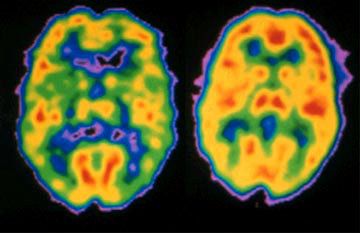
PET scans of a schizophrenia sufferer's brain (left) and normal brain (right).

PET scans of a schizophrenia sufferer's brain (left) and normal brain (right).

New Scientist is reporting a fascinating study suggesting a statistical correlation between a gene linked to schizophrenia and creativity. The study, conducted by Szabolcs Kéri, a researcher at Semmelweis University in Budapest, Hungary:

“examined a gene involved in brain development called neuregulin 1, which previous studies have linked to a slightly increased risk of schizophrenia. Moreover, a single DNA letter mutation that affects how much of the neuregulin 1 protein is made in the brain has been linked to psychosis, poor memory and sensitivity to criticism . . .

“To determine how these variations affect creativity, Kéri genotyped 200 adults who responded to adverts seeking creative and accomplished volunteers. He also gave the volunteers two tests of creative thinking, and devised an objective score of their creative achievements, such as filing a patent or writing a book.

“People with two copies of the neuregulin 1 mutation – about 12 per cent of the study participants – tended to score notably higher on these measures of creativity, compared with other volunteers with one or no copy of the mutation. Those with one copy were also judged to be more creative, on average, than volunteers without the mutation. All told, the mutation explained between 3 and 8 per cent of the differences in creativity”.

I’m always a little sceptical of such studies, not least because of the reductive assumptions inherent in their methodology. But this research fits neatly with a number of other studies suggesting a link between mood disorders and creativity (some of which I’ve mentioned before).

You can read more at New Scientist. And while you’re there, take a minute or two to read this story about researchers turning brain scans into sound, a process which not only reveals patterns and rhythms not always visible to the eye, but also allows the “unsteady rhythms and cadences” (a lovely expression) of dysfunctions such as schizophrenia to emerge. Stranger still is the fact the music of the (hemi)spheres sounds just like early Philip Glass.
Break text

addthisTweet this

Everything Ravaged, Everything Burned

Wells Tower

Wells Tower

I’ve been meaning to read the improbably named Wells Towers’ debut collection, Everything Ravaged, Everything Burned, for a while now, but having knocked over the first two stories last night I’m now sorry I waited so long. The thing’s a joy: smart, muscular without being showy and brilliantly observed. It’s also very, very funny, as these three quotes from the first few pages of the first story, ‘The Brown Coast’, demonstrate:

Break text

“Not long after the affair had run its course, Bob and his wife were driving into town when Vicky looked up and saw the phantom outline of a woman’s footprint on the windshield over the glovebox. She slipped her sandal off, saw that the print did not match her own, and told Bob that he was no longer welcome in their home.”

Break text

“Above the kitchen sink was a painting of a beer can with Randall’s signature in the bottom right hand corner. Randall has done a good job with the Budweiser script, but he’d had to stretch out the can’s midsection to accommodate all the letters, so it bulged in the middle, like a snake swallowing a rat.”

Break text

“By the window, a woman was sitting in a recliner and sucking on a cigarette. She was pretty, but she’d spent too much time in the sun. She was pruned over and nearly maroon, like a turkey beard.”

Break text

Like I said, the thing’s a joy. You can buy it from Readings, The Book Depository, or Amazon.

Break text

addthisTweet this

Rethinking Parallel Importation

booksAs many of you would be aware, on Tuesday Australia’s Productivity Commission recommended lifting the existing restrictions upon the parallel importation of books into Australia. Those interested in reading the full text of the Report can find it on the Commission’s website, but essentially it makes three recommendations. Firstly that the existing restrictions on parallel importation be lifted after a three year period to allow the industry to prepare for the change. Secondly that the Government review the current subsidies aimed at encouraging Australian writing and publishing, with a view to better targeting of what are rather opaquely described as “cultural externalities”. And finally that the new regime be monitored and assessed five years after implementation.

There’s already been a lot of commentary on the recommendations, most of which falls into two fairly predictable camps. On one side Bob Carr and his mates at Dymocks and the Murdoch Press are characterizing it as a win for consumers and literacy. On the other, publishers, authors and most of Australia’s booksellers are appalled by the decision, describing it variously as cultural vandalism, economic rationalism gone mad and free-market lunacy.

I won’t point you to the articles in the papers, though if you’d like to get a sense of the anger and despair amongst writers it’s worth checking out Spike. Likewise Henry Rosenbloom at Scribe always makes perfect sense on this issue and is worth a look, as does Jeff Sparrow at Overland. Or for a rather different take, check out Michael Duffy or Crikey’s Bernard Keane.

For my part I’m in furious agreement with the ASA, the APA, the ABA and everybody else lined up against the Productivity Commission on this issue. If implemented the recommendations would be catastrophic for the Australian book industry and for our literary culture. But at the same time I do worry whether we – the writing and publishing community – aren’t getting this one wrong at some level.

For obvious reasons writers and publishers are trying to frame this as an issue about our capacity to sustain a literary and publishing culture in this country. If one wanted to be crude about it, what we’re really arguing for is a form of cultural nationalism. Certainly it’s no accident the writers who are being rallied to speak are all ones who are identifiably and iconically Australian.

This is the same argument we run every time changes to public policy threaten to make life harder for the already pretty marginal lives of Australian creators. And while I think it’s correct, I’m not sure it necessarily plays the way we think it does anymore, if only because appeals to Australian nationalism seem outdated in the global world of 2009. And – to be perfectly frank – demanding protection in a globalized economy is a bad, bad look.

Part of the problem is we’re being shoehorned into an argument about book prices. As people keep pointing out, it’s extremely difficult to compare book prices, and there’s some pretty selective data doing the rounds.

But this isn’t about book prices and it never was. It’s about Australia’s capacity to compete in a global knowledge economy, and, more importantly, the right of Australian creators to commercialize their work. Nor is it about open or protected markets. It’s about ensuring we have a policy framework in place which will foster creativity and maximize the benefit of that creativity to the Australian economy.

Let me explain. At present, when I finish a book I set about trying to sell it. Since the copyright belongs to me, I sell licenses to publishers to print the English-language version of the book. These licenses are geographically defined. In the best of all possible worlds I will sell the Australian and New Zealand rights to an Australian publisher, the UK and Eire rights to a UK publisher (these usually allow the UK publisher to distribute the English-language version of the book through Europe and a number of small countries like Bermuda and the Falkland Islands as well) and and the rights to sell the book in the US and various small countries like Guam to an American publisher. Canada will usually end up parcelled off with the US or the UK rights.

The license I grant my various publishers is exclusive. That means the American publisher can’t try and sell the book into Australia or the UK, and the British and Australian publishers are similarly precluded from trying to sell their editions into the other English language markets. This exclusivity is defined contractually, but is made possible by the copyright provisions of the relevant countries, which create frameworks within which the right of creators to dispose of their work as they see fit is enshrined.

The reason for this is obvious. Imagine I take my book to an Australian publisher and ask them if they’d like to publish it. They say they would, but then I tell them I’ve already sold the rights to an American and a British publisher, and because the restrictions on parallel importation have been lifted, those publishers are likely to be importing books into Australia as well. Odds are the Australian publisher would laugh in my face, but even if they didn’t, my capacity to commercialize my work has obviously been severely diminished.

As the example above demonstrates, the exclusivity created by territorial copyright (or, to describe it as the Productivity Commission does, the restriction on parallel importation) is not trivial, it’s the basis of the market. Without exclusivity the rights are, if not quite worthless, then certainly much less valuable. And, commensurately, the capacity of Australian creators to commercialize their work is severely constrained.

For a writer such as myself, who publishes overseas, the abolition of territorial copyright will mean I lose not only that portion of my income I derive from selling Australian rights, but that the economic benefit of my work will end up offshore, in the hands of a foreign publisher, as will the economic benefit of every single Australian writer with even the smallest amount of international success.

More importantly though, the example above demonstrates why this isn’t an argument about protectionism, despite all the talk about “opening markets”. Territorial copyright would only be protectionist if it didn’t exist elsewhere. But at present the only English language market which allows parallel importation is New Zealand, a country which is of such minimal importance that Australian writers routinely dispose of New Zealand rights in a job lot with our Australian rights. Abolishing it here won’t open our markets in any meaningful sense, all it will do is create a situation where American and British publishers have access to our markets without Australian publishers having access to theirs, which would be a bizarre outcome.

It would also decimate the local industry, which, like the British and American industries, derives much of its income from managing rights to books written elsewhere. Independent publishers would either go under, or shift their focus to publishing work with absolutely no international potential, while the larger multinationals would become little more than clearing houses for books written elsewhere.

One obvious response to the arguments above is to point to the coming revolution in publishing (something I’ve done myself from time to time). As national barriers fall, one might think, so too will seemingly outdated provisions such as territorial copyright. But as anyone who’s gazed longingly at a movie or TV episode for sale on the US iTunes Store knows to their cost, territoriality is alive and well in the digital world, and while that may change, it’s not going to happen soon.

I don’t want to waste my time engaging with the Commission’s risible suggestion that greater public assistance would produce better outcomes for Australian creators. I don’t want a handout and I don’t know any writer who does. But I do think it would be useful if we stopped talking about this issue as a contest between economic rationalism and cultural nationalism. Because for as long as we do we’re missing the real point, which is about the capacity of Australia and Australian creators to succeed in a global knowledge economy, and about ensuring we harmonize our policy settings with those of our major competitors overseas.


A change is gonna come . . .

The late, great Otis Redding . . .

Break text

Break text

addthisTweet this

Ricky Gervais and Ralph Fiennes in Cemetery Junction

If you haven’t seen it, this teaser for the new Ricky Gervais movie, Cemetery Junction, is rather good . . .

Break text

Break text

addthisTweet this

Literary Bloodsport Part 3: The Writers Strike Back

Star-Wars-The-Empire-Strikes-BackI’ve been meaning to do a follow-up on my post about literary hatchet jobs for a while now, but the story in yesterday’s Gawker about Alice Hoffmann’s colossal dummy-spit (or is that dummy-twit?) is so hilarious I can’t hold back any longer. As the story explains, Hoffman took great exception to what sounds like a classic “mixed” review, and proceeded to slag off the reviewer on Twitter, even going so far as to twit the reviewer’s phone number and suggest people ring her up and set her straight. Hoffman is now backtracking, but it’s a little difficult to come back from “Now any idiot can be a critic”.
What’s particularly striking is that it’s only one of several cases of writers losing their cool about reviews in recent weeks. Last week MediaBistro reported that Alain de Botton (who I once heard a middle-aged lesbian describe as the thinking woman’s crumpet) took violent exception to Caleb Crain’s review of his new book, The Pleasures and Sorrows of Work, taking time out from his clearly hectic schedule to blast Crain in the comments section of Crain’s blog, Steamboats are Ruining Everything (Botton’s killer barb? “I will hate you till the day I die and wish you nothing but ill will in every career move you make”). And in a rather more succinct comment upon a review of her new book, author Ayelet Waldman twitted, “May Jill Lepore rot in hell. That is all”.

Of course there’s a long and (ig)noble tradition of authors slagging off critics. But I suspect there’s a good chance these rather undignified displays say as much about people’s unfamiliarity with the technology as anything. With any new form of communication it takes a while to learn what’s smart and what’s not (ask yourself how long it too you to learn not to email when angry, or to reply all carelessly). And if there was ever a technology for which the old adage, flame in haste, repent at leisure was appropriate, it’s Twitter (at least with Facebook status updates you have some control over who’s listening, and you can quietly delete them if you think you’ve gone too far). Certainly the rapidity with which the story of Hoffman and de Botton’s dummy-spits has spread is a reminder of the capacity of the online world to regulate itself, and of the democratizing nature of the net more generally. Indeed I suspect Hoffman and de Botton’s real crime isn’t being intemperate, but assuming their status as authors gave them the right to be uncivil (that and the fact they look ridiculous).

Of course I would say that. I’ve always cleaved to Disraeli’s famous dictum, “Never explain, never complain”, and while I’ve had plenty of reviews I could have done without, my general view is that it’s not just undignified to get into a stoush with a reviewer, it’s a fight you’re almost guaranteed to lose. At best you’ll give a bad review oxygen, at worst you’ll look petulant and egomaniacal.

Of course de Botton and others might argue that in the new media environment the relationship between writers and critics is altering, and there’s now a place for more direct discussion and engagement. And they’d probably be right, at least with respect to non-fiction, though as I’ve observed above, authors who assume their status as authors grants them any particular cultural authority are likely to be pretty quickly disabused of that notion. Indeed at a very crude level the shift from physical books and newspapers to electronic books and websites is eroding the distinction between the cultural authority of different media, and promoting a situation where what matters is the quality of your commentary, not the publishing house behind you, or your visibility on bookshop shelves.

But I think the situation is very different with fiction. I’ve spent years avoiding explaining my books in interviews (contextualize, expand upon, talk about process, but never, if you can help it, explain them) partly out of a deep, and essentially uncritical unease with doing so, and partly out of a view that to do so reduces them somehow. However often my views about other aspects of writing change, I’ve always believed novels and stories are living things: mysterious, ineffable, prismatic, and that while writers may be required to promote them, ultimately the book will take on its own life separate from them. It’s possible our culture is increasingly inimical to that sort of indeterminacy, but take it away and a work of fiction is inevitably, and fatally, reduced.

For those wanting to read more about the Hoffman/de Botton imbroglio, Salon’s Mary Elizabeth Williams has a few choice words to say on the subject, and later, on Ayelet Waldman’s intemperate remarks. The Literary Saloon also has views on the matter, as do The Afterword and Edward Champion (thanks to GalleyCat for the links). Likewise Motoko Rich has some interesting reactions in The New York Times. And if you want to see Alain de Botton repenting at leisure, you can read the excerpts from his twitterfeed at The New York Observer.

Break text

addthisTweet this

Not so happily ever after . . .

645759_13649_72c2b1c3f0_p

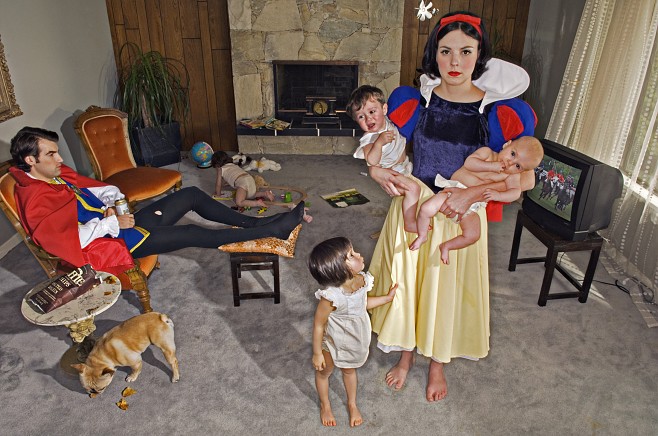
Dina Goldstein, 'Snowy'. Click to enlarge

I wonder if I was the only one who found the first half of The Incredibles incredibly distressing. It may just be that I found myself identifying a little too much with Mr Incredble’s expanding waistline, but the sequences in which he and his wife struggle to come to terms with their life in suburbia seemed pretty close to the bone for something that is supposed to be a kid’s movie.

Anyway – what happens after happily ever after is a rich theme, and one explored to great effect in this wonderful series of images by artist Dina Goldstein. The images:

“place Fairy Tale characters in modern day scenarios. In all of the images the Princess is placed in an environment that articulates her conflict. The ‘. . . happily ever after’ is replaced with a realistic outcome and addresses current issues”.

Goldstein might have been thinking about one of my favourite Ondaatje poems, ‘Late Movies with Skyler’, which ends:

“In the movies of my childhood the heroes
after skilled swordplay and moral victories
leave with absolutely nothing
to do for the rest of their lives”.

Break text

addthisTweet this

On the eve of destruction . . .

Funny how the great ones never date . . .

Break text

Break text

addthisTweet this

Vampires, killing and a new online magazine

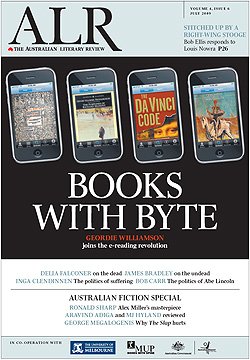
0,,6696106,00I didn’t get a chance to post at the time because I was away (which is also the explanation for my extended silence) but for those who are interested the new issue of The Australian Literary Review was published last Wednesday. As usual some of the highlights are available online, but given the discussion on this site a few weeks back about good and bad reviewing I’d particularly recommend Delia Falconer’s searching review of Jeff Sparrow’s new book, Killing: Misadventures in Violence, a piece which provides an extremely lucid example of the capacity of really good criticism to be both highly critical and highly engaged. I’m not sure it’s exactly the review Jeff would have wanted, but as a reader it makes me even more curious to read the book (anyone interested in another perspective might want to check out this interview with Jeff, or buy a copy from Readings).

Other highlights include Ronald A. Sharp’s essay about Alex Miller, the always-interesting George Megalogenis on The Slap, and Geordie Williamson’s thoughts about the ereader and its implications for literary culture.

The issue also contains my piece about vampires and vampire literature, a piece which grew out of a post I made months back about the discovery of a “vampire” in a mass grave in Venice earlier this year. I’ll let you read the piece for yourselves, but I will say it was one of those pieces where I went in with one view about the subject under discussion and came out with another entirely.

And, for anyone looking for yet more reading, I’d very much recommending checking out The Group. The brainchild of Larry Buttrose, The Group is a new online magazine which brings together the best writing from around the world. Curated by Larry, John Birmingham, Mark Mordue, Billy Marshall Stoneking and myself, each of  its monthly issues will feature a different guest editor, and will reflect their interests and ideas. Issue 1 is out now; you can subscribe via RSS or you can join on Facebook, which will allow you to receive information about upcoming issues etc.

Break text

addthisTweet this

A couple of updates

Just a quick note to say I’ve added links to two pieces of mine published last year in The Australian Literary Review to the site. The first, ‘Stealing Memory’s Thunder’, is a review of James Frey’s novel, Bright Shiny Morning and a discussion of the growing phenomenon of fake memoir, the second, ‘Perfect Worlds in Miniature’, is a review of recent short story collections by Annie Proulx, Michael Chabon, Robert Drewe and the frighteningly talented Anne Enright.

Break text

addthisTweet this