Sydney Story Factory
Watch this. Then donate.

Oct 14
Watch this. Then donate.
Dec 8
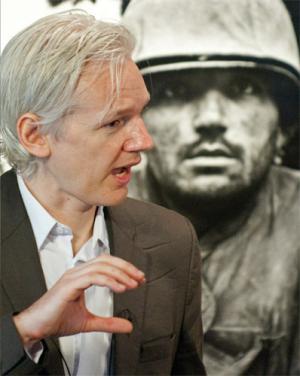 As most of you will be aware, last night Julian Assange surrendered to police in London on sexual assault charges. Like many others I’m deeply perturbed by this development, especially given the pretty clear evidence the charges are weak at best and that the Swedish Government (which has been significantly embarrassed by the revelations in the latest round of document dumps) has interfered with the process underlying them.
For what it’s worth, my views about Wikileaks are complex. I’m not convinced total transparency is either practical or desirable. But by the same token confidentiality and control over the flow of information is one of the tools governments and other interests employ to control the public and manipulate public discourse and opinion.
All of which is a long-winded way of saying Wikileaks is an imperfect creation, but one of immense importance. It heralds a profound rewriting of the relationship between the individual and the state, the governed and the governing. By fatally undermining the capacity of the powerful to mislead the public it embodies precisely the values a free media – and by extension a free society – should aspire to.
This is not to say it’s perfect. Unlike the evidence of malfeasance and illegal action by governments around the world, I’m unconvinced much of the tattle in the diplomatic cables is valuable or newsworthy. But that’s not an argument against Wikileaks more generally: freedom of expression and a free media necessarily assumes ongoing debate about the limits of public interest, and commensurately, errors in judgement about those limits. A free media is by its nature a ragged and disputational creature.
Part of what makes Wikileaks genuinely revolutionary is its refusal to accept that there is a public interest beyond the right to know. By rejecting this notion they also reject the collusive relationship with power that undermines the effectiveness of so much media. This fundamentally alters many aspects of our public discourse, and will, over time, alter the very nature of society, both for the better and, I suspect, the worse. It is also, to my mind, an unsustainable and utopian ideal: the proper functioning of democratic society is incompatible with total transparency. But by redefining the limits of our right to know it creates a new standard to which free societies should aspire, and simultaneously provides a disruptive corollary to that freedom which will help safeguard it.
That our politicians have been slow to grasp the larger implications of Wikileaks is hardly surprising. I think it’s increasingly obvious we’re in a moment of historical transition, a transition which will be shaped both by forces beyond our control, such as climate change, and by the economic and social effects of new technology and global media. Neither our governments nor our political and social institutions are showing much sign of being up to either set of challenges, and our politicians are manifestly inadequate to both.
Here in Australia the response has been slipshod and cynical, demonstrating the worst aspects of the Labor Party’s increasingly reactionary and paternalistic mindset. Prime Minister Julia Gillard looked ridiculous last week parroting the American line that Assange was a criminal, and compounded the blunder yesterday with her assertion that the release of information was illegal because it relied upon an illegal act.
The exact seriousness of the threat to Assange is unclear, and will in the first instance depend upon whether British courts uphold an extradition order to return him to Sweden. What is clear is that a writer and journalist has been imprisoned on charges which are self-evidently connected to his work as a writer and journalist, and to his part in revealing evidence of illegal and unethical behaviour by the powerful. In such a context the obligation upon the Australian government, and indeed all people who claim to support freedom of expression and the free media is to protest as loudly and as vociferously as possible.
Having been involved off and on with Sydney PEN Centre over the years, I’m painfully aware of the difficulty of embarrassing governments which abuse freedom of expression. But I’m also aware that protesting does help, and that despite its statements to date, the Australian Government and Prime Minister Gillard may yet see their way to do what is right by Assange.
To this end I was one of the more than 200 people who signed the open letter to Prime Minister Gillard by Jeff Sparrow and Lizzie O’Shea that was published on the ABC’s The Drum yesterday.
Open letters of this sort always seem to me to be oddly quixotic creations, more symbolic of the powerlessness of those who sign than any real influence. But this time I’m not so sure. As of a moment ago there were more than 4000 comments, and the response was overwhelmingly supportive. That’s not to say there aren’t detractors, but it’s difficult not to wonder whether Assange’s newfound celebrity will prove a lightning rod for the changes that are clearly beginning to take place. As the events of the last two and a bit years and from the GFC on in particular have demonstrated, the rules that have defined our world for the best part of half a century are breaking down, and the relationship between the public and those in authority is growing increasingly poisonous.
This isn’t always a good thing – certainly the crazed, reactionary convulsions of the Australian and American political landscapes in 2010 have not made our societies happier or suggested our politicians and media have any real idea about how to deal with what’s happening. But it’s also increasingly difficult to ignore the fact that the ground is shifting beneath our feet.
Having said all that I’d like to ask three things. The first is that you visit The Drum and read Jeff and Lizzie’s letter, which makes a series of unexceptional demands relating to Assange’s rights as an Australian citizen, and the obligations of the Australian Government to safeguard his liberty. As it indicates at the beginning, many of the signatories are not uncritical of the larger Wikileaks project, but the principles set out in the letter transcend those differences.
The second is that you take a few minutes to read some of the better commentary about Wiileaks. I’m going to suggest you begin with Assange’s own essays about authoritarianism, conspiracy and transparency. As anyone who reads them will be able to see, Assange is neither a terrorist nor a Cold War villain out of a James Bond movie, but a serious thinker with profound and revolutionary ideas about the relationship between the state and information. If the essays themselves seem too daunting I’d urge you to at the very least skim the analysis of their content on zunguzungu.
I’d also suggest reading three pieces by Guy Rundle, Bernard Keane and Clay Shirky, all of which offer interesting and provocative perspectives on the question (Rundle and Shirky in particular do useful work placing the events of recent weeks in historical context and trying to think through their larger implications).
You should also be sure you read Assange’s op-ed in this morning’s Australian, which was written in the hours before his arrest. Given The Australian’s behaviour and pronouncements during the Groggate and TwitDef scandals of recent weeks it may come as a surprise to many that it’s clearly placing its not inconsiderable weight behind Assange (though perhaps not as big a surprise as it may have been to many of its subscribers, who are no doubt choking on their cereal as I type). But I’m not sure it’s that surprising, not just because it’s a reminder of the The Australian’s more general mercurialness, but because as Assange himself points out, a belief in the importance of a free and unfettered media is one of News Limited’s fundamental principles (even if it’s not always demonstrated by their actions or drive for market dominance).
Finally, the third thing I’d like you to do is suggest things you’ve seen or read that add substantially to this debate. I’m sure the days and weeks to come will produce a torrent of coverage, and it’s be nice to aggregate – or indeed wiki – it here. So if you have links, bring them; I want to see them.
Jul 29
Not sure the world needed another series of The Chaser? Think again.
I’m still laughing.
Break text
Apr 14
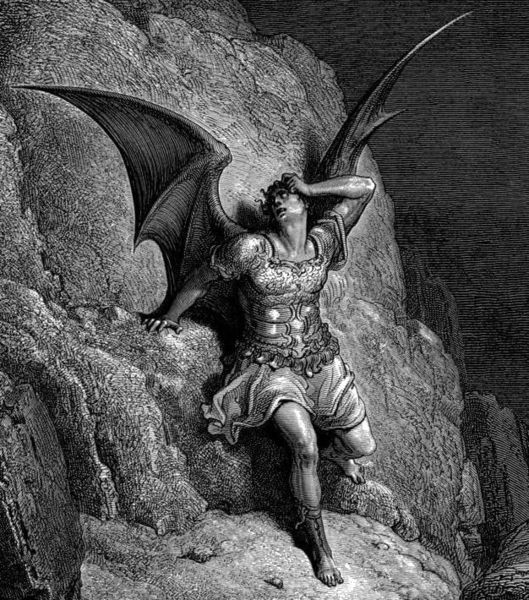
Satan realises Peter Jensen has seen through his evil scheme
Yesterday’s Sydney Morning Herald had a short piece about the decision of New South Wales Premier Kristina Keneally to allow the Archbishop of Sydney, Dr Peter Jensen, to “vet” the ethics course the NSW Government is considering introducing to NSW schools.
I’ve written before about my general irritation with the influence the Church continues to exercise over NSW politics, and just how unhealthy I think it is, but this is one of those stories that shits me in so many ways I hardly know where to begin.
Perhaps the best way though is with a quick bit of context. For reasons which are themselves difficult to understand, students in NSW public schools are expected to spend part of each week in religious education classes. My understanding is that these classes are offered on the basis of demand, or, to put it more simply, if there are a lot of Catholic kids at a school a priest comes in once a week, if there are a lot of Muslim kids a mullah is organised, etc etc.
That of course leaves open the question of what happens to kids whose religion isn’t catered for by a particular school (I’m guessing there aren’t a lot of Zoroastrians in the eastern suburbs, for instance) or kids whose parents are not religious.
The solution until very recently was that they did nothing. And by nothing I mean nothing. Not only is no alternative is offered, the system explicitly prohibits them from taking other classes or activities while the other kids are doing religion classes.
Not surprisingly, this has been a bone of contention for the parents of these children. And so in 2009 the NSW Minister for Education and Training Verity Firth agreed to trial an ethics course in ten schools, a move which was bitterly opposed by a number of churches and religious organisations.
So, where to begin? Perhaps with the fact that they’re still teaching religion in public schools in the first place, which, quite frankly, appalls me. Quite aside from the question of whether it’s an appropriate use of the already limited time available for actual education, it’s deeply inappropriate for public schools to be facilitating religious education. Schools are not the place for religious instruction: parents who want their kids to have a religious education should send them to a private school, or do it outside of school hours. (I’d also be curious to know exactly what some of the more fundamental churches are teaching in these classes, not least since more than a few of them cleave to literal interpretations of the Bible).
Then there’s the notion that children whose parents are not religious, or who choose to opt out of the lessons, should be prohibited from doing something else in its place, which is just disgusting. Why should children of atheists be discriminated against? Because that’s really what this prohibition is about: the denial of education on the grounds of religion.
Of course discrimination is something the Church, and Peter Jensen in particular, knows more than a little about. He is, after all, the man who has spent most of the last decade trying to block the ordination of women and homosexuals, and who regards homosexuality as “not very different to something like alcoholism”.
Yet despite all this, Kristina Kenneally thinks he should be given input into the ethics course? Why? On what possible grounds? After all, I’m assuming atheists like myself aren’t about to be given the opportunity to have input into the classes run by Anglicans. And why Jensen and not the Catholics, or indeed representatives of the various Synagogues and Muslim organisations?
The answer, of course, is that religious organisations continue to exercise an unhealthy and largely unscrutinised degree of influence over our public life and institutions. A great deal is made of Tony Abbott’s Catholicism, but that debate mostly serves to obscure the fact there are any number of Labor politicians who allow religious figures considerable access, and the preparedness of figures such as John Howard and Peter Costello to play footsie with fundamentalist groups like the Exclusive Brethren and Catch the Fire.
But it also underlines exactly why we shouldn’t be allowing characters like Jensen to be involved in these processes. Because this is a man who is so intolerant of the beliefs of others that he’d deny children access to education because their parents’ beliefs differ from his own. Which says it all, really.
If you’d like to know more about the Ethics Course, which was designed by the philosopher Professor Phil Cam, from the University of NSW, there are some FAQs and a couple of sample lessons available on the St James Centre website (in a slightly odd move the Centre has declined to post the full course for copyright reasons).
break text


Feb 13

The other day, over at Spike, the delightful Jessica Au posted some thoughts about genre, and the rather vexed question of its changing relationship to the literary.
Jess’ thoughts were sparked by China Mieville’s The City and the City, but they echoed a series of questions I’ve been pondering for a while now. Certainly a cursory glance across the bookshelves of your average reader is likely to reveal a rather more catholic collection of books than one might have found there a generation ago. Where once the white spines of Picadors jostled with writers such as Peter Carey and Raymond Carver, now one is apt to find Harry Potter jammed next to Cormac Mccarthy and Stiegg Larsson.
The usual reaction is to say one of two things. On the one hand, people will argue that the literary as a category is changing, growing more diverse and inclusive. And to an extent that’s true: Philip K. Dick and Ursula Le Guin are in the Library of America these days, and literary readers seem perfectly willing to embrace work that is essentially SF from writers such as Cormac McCarthy and Margaret Atwood. But while I think the category may be more inclusive than it was a decade or two ago, I suspect it’s always admitted work which drew on the fantastical and SF (Angela Carter, anyone? Riddley Walker?). And I think it’s important not to overstate the extent to which the category has actually changed: conventional literary fiction is, 99% of the time at least, still conventional literary fiction (and, as a quick flick through the prize lists of the last year or two will demonstrate, in surprisingly and even counter-intuitively good health).
The other response usually comes from those outside the literary world, and takes one of two tacks. One is to argue, as writers such as Kim Stanley Robinson and Adam Roberts (author of the rather excellent Yellow Blue Tibia) do in articles published in New Scientist and The Guardian last year, that the literary novel has already been so efficiently colonized by science fictional conceits it’s already dead, and it’s only the insularity and elitism of the literary world that stops us acknowledging that fact. The other is essentially the line that Jess runs on Spike, that what we’re seeing is a larger breakdown of the categories that once structured and organised our reading, and that the whole idea of SF, or Crime, or even the literary is now essentially meaningless, and what matters is story.
I have some sympathy with both points of view, not least because I think both are, to some extent, correct. But I also think that by continuing to understand this in terms of the comparative merits and businesses of genre they put the cart before the horse. The shift in reading habits and tastes in recent years isn’t about reality and SF becoming indistinguishable, or the old canard of readerly impatience with unreadable literary novels, it’s part of a much larger shift in the power structures that underpin our culture, a shift that’s as visible in the increasingly belligerent populism you see on display amongst younger Australians (the “Aussie Aussie Aussie, Oi Oi Oi” and tattoos of the flag crowd) and the manner in which the outside-the-Beltway world of new media keeps pushing back against old media’s highly controlled, scripted and insider-friendly coverage of politics as it is in shifting reading habits.
That may sound like a long bow to draw, but I’m not sure it is. One of the signal features of political and social discourse in recent years has been the accelerating pushback against traditional loci of cultural authority. The increasing sophistication and power of the new media, and in particular the rise of political blogs and websites such as Crikey!, Mumble and Possum’s Pollytics in Australia and Huffington Post and Talking Points Memo in the US, are probably the most visible aspect of this process (if you’re interested in exploring this question a bit further you could do a lot worse than read Michael Massing’s recent piece in The New York Review of Books, ‘A New Horizon for the News?’). But I think it’s also visible in the rise of right wing populism: Fox News and Sarah Palin are signal example, but here in Australia it’s also pretty clear that a lot of the fairly belligerent populism is about an anti-politics pushback by working class and lower middle class people once excluded from the political process (here in Australia I think that process is being amplified by the boom of the last few years, and the now not-inconsiderable wealth of many such people: once you’ve got a big house and kids in private school you’re probably a little less likely to put up with being told what to think by the educated middle classes).
While it might be a sideshow, reading tastes are being transformed by the same process. While it’s fashionable these days to deride the “literary” as simply a marketing term, it’s in fact much more than that. “Literature”, like high culture in general, is one of the more significant repositories of cultural power. What you read matters (or did until very recently), not least because it’s a powerful signifier of membership of the educated middle classes. It’s certainly not accidental that the boundaries of what’s acceptable was (again until very recently) pretty ruthlessly policed by academics and critics writing for major broadsheets and magazines such as The New Yorker, The Monthly and The New Statesman, since those publications are read by the educated middle classes. I don’t want to sound too much like some Refectory Trot, but basically the middle classes are a club, and you get in by going to the right schools and universities, and by reading and watching the right things.
But in recent years these loci of cultural authority in the literary world have been experiencing exactly the same pushback as the newspapers and the accepted boundaries of political discourse. Critics no longer make or break books, TV shows such as Oprah and Richard and Judy do, reading groups and word-of-mouth are on the rise, as are any number of online services allowing readers to share and disseminate their own views on what’s good and what’s not. Indeed what’s really interesting is the way the last decade has seen not just the rise of the Harry Potter/Da Vinci Code-style literary blockbuster, a phenomenon which seems to have almost nothing to do with the way books once found success, but also any number of reader-driven, word-of-mouth successes such as Markus Zusak’s The Book Thief. Part of it’s certainly about the increasing preparedness of publishers to explore non-traditional avenues of distribution, such as supermarkets and petrol stations, and the increasing sophistication of marketing, but most of it’s about the rise of the reader.
At this point in the argument a lot of people are likely to start banging on about the rise of the reader being a reassertion of the power of story over the dreary worthiness critics and academics once foisted upon us, but – not to put too fine a point on it – that whole line of argument is anti-intellectual crap. Reading pleasure and sophistication aren’t mutually exclusive. Sure there are lots of boring literary novels, but there are just as many boring SF novels, or boring Crime or Fantasy books.
But I think it is worth recognising there’s another factor at play here, which is education. “Literature”, and the literary may be socially contingent cultural constructs, but they’re not arbitrary, at least within the context of our culture. What’s good and what’s bad is defined by relation to the canon, and by standards of judgement which (while they change over time) have been developed over hundreds of years.
Nor do they come for free. Until very recently our education system, both at a secondary and a tertiary level, placed great emphasis upon understanding literary tradition. That didn’t just mean reading the canon, it meant learning how to read, a process which embraced an understanding of Latin grammar, the memorisation of slabs of poetry by Homer and Shakespeare and Tennyson, a grasp of the Bible, and the Classics, and an attentiveness to the way language works on the page.
Things might be different overseas, but nobody in Australia gets this sort of education anymore. In its place we have a system of literary education that emphasises personal response and personal expression, and which privileges comparison of groups of texts over close reading of particular texts. At one level this is great, since it opens us up to new forms of expression and empowers the individual, as well as breaking down the hegemony of the literary, but it also means almost all of the criteria that once allowed us to define “Literature” have slipped away, and our judgements about books and writing are now made on quite different criteria.
I should emphasise this isn’t meant as a jeremiad or a lament: it seems to me there are now extremely sophisticated cultures of critical judgement and appreciation operating within forms such as SF, cultures which have their own criteria and agendas. And while I want to scream every time I hear a reader talk about a character’s “journey”, I recognise they’re using a critical language that makes sense to them, and which they find enriches their reading experience, which is, at the end of the day, what criticism should be about.
But it does mean that at almost every level our capacity to regulate or even define the boundary of the literary is diminished. What’s good is no longer defined by gatekeepers schooled in the right universities and armed with an intimate knowledge of Renaissance poetry and the Russian novel (though there are plenty of them out there). Instead it’s defined from the ground up, by readers, who are finding ways of communicating and sharing things they like online and elsewhere, and bypassing traditional organs of cultural authority such as the newspapers. And, perhaps unsurprisingly, part of that process has been the falling away of many of the old status anxieties about genre and the literary, and a freeing up of readers to seek out books unhindered by those anxieties.
Break text
Jan 12
 Am I the only one who’s completely horrified by the Australian media’s embrace of the ongoing publicity campaign by the Catholic Church over the canonisation of Mary MacKillop? Not content with wall-to-wall coverage of the announcement just before Christmas, we’re now being treated to nonsense like this and this (and this!) on the front pages of the newspapers.
Rather than fulminate at length, I’m going to confine myself to a few questions. How is it even remotely okay for major newspapers to be publishing uncritical articles about “miracles” on their front pages in 2010? Have we really lost the fight against the anti-science mob that comprehensively? If such claims were made by another, less established religion or belief-system (let’s say Scientology, or perhaps the Exclusive Brethren) would they be allowed to go through to the keeper so easily? And what does that tell us about the power and influence of the big churches, and the Catholic Church in particular? And finally, and perhaps most pertinently, why are editors who are so resistant to the scientific evidence surrounding climate change so uncritical when it comes to this sort of religious claptrap?
Break text
Dec 1
Thought Tony Abbott as Opposition Leader was the nuttiest piece of right-wing nonsense you’d see this week? Think again . . .
Break text

Break text
Nov 30
 Like everybody else in Australia I’ve spent the last couple of weeks mesmerised by the spectacle of the Liberal Party coming unravelled over the question of their position on the Rudd Government’s Carbon Pollution Reduction Scheme and climate change more generally. Watching open warfare break out between what the media politely describe as the conservatives (I suspect reactionaries is probably closer to the truth, but perhaps a little inflammatory for the broadsheets to use on a daily basis) and the moderates I’m reminded of an interview I heard with The Sydney Morning Herald’s Political Editor, Peter Hartcher at the time of Turnbull’s elevation to the leadership, in which he was asked whether he thought Turnbull was ready to lead the Liberal Party. To his credit Hartcher just laughed. ‘I think the real question is whether the Liberal Party is ready for Malcolm Turnbull’.
Aside from the fact somebody’s usually done something totally insane by lunchtime (and yes, Tony Abbott, I’m looking at you) one of the really fascinating things about the whole schemozzle is the way it’s highlighted just how entrenched climate change denialism is in the ranks of the Liberal Party.
Now I’d be the last to claim the views of our elected representatives are particularly representative of the views of the community at large. On a range of issues, from religion to abortion and euthanasia, they are, for the most part, markedly more conservative than most Australians. And if the polling is to be believed, they’re similarly out of step on climate change, as polls such as this one in today’s Sydney Morning Herald showing two thirds of Australians support the ETS, demonstrate.
But on the question of climate change I suspect they’re providing a useful reminder that despite the increasing acceptance in the community at large that climate change is happening, and fast, there is a small and entrenched minority who reject the science.
What’s interesting to me is the distribution of these beliefs across the community. A few weeks ago Roy Morgan released some polling data about the question, which Crikey’s Possum has offered some useful commentary on. Several things stand out in the Morgan data. First, belief in climate change and the need for action divides pretty cleanly across party, gender and demographic lines. Labor and Green voters are much more concerned than Liberal voters, women are more concerned than men, and people in the capital cities are more concerned than those in regional and rural areas. Second, and more worryingly, these positions are hardening and polarising: there has been a small increase in the number of people who disapprove of the CPRS in the last few months, and these new initiates into the ranks of the climate change denialists are mostly Liberal-voting men from outside the capital cities (I appreciate disapproval of the CPRS and climate change denialism are not precisely the same thing, but I think we can assume the two are closely connected in this context).
These are, of course, precisely the same people who were the backbone of One Nation a decade ago. Older white men from outside the capital cities.
One of the things I remember most keenly about the rise of Pauline Hanson was the way it blindsided conventional public opinion. For middle-class elites it seemed to come out of nowhere, a furious, incoherent cry of unreason which deliberately rejected the foundations of their world view in favour of views which seemed to inhabit a netherworld somewhere between the laughable and the poisonous.
I suspect the rising tide of climate change denialism is catching middle-class elites off-guard in exactly the same way. That Andrew Bolt’s blog is a haven for denialist maddies is no secret, but I’d suggest anyone who thinks there’s broad-based support for action on climate change spend some time trawling the comment strings on The Daily Telegraph or The Punch, or maybe tune into 2GB for an hour or two.
Of course I’m well aware that an awful lot of what passes for commentary on news sites is the work of formal and semi-formal political operatives. But the sheer ferocity of the comments about Turnbull and Rudd, and the persistent suggestion that the science of climate change is a lunatic conspiracy, and the CPRS some kind of plot to destroy (white) Australia is pretty striking. More broadly, climate change denialism exhibits many of the same characteristics that made Hansonism so potent: the rejection of evidence-based policy, suspicion of expert opinion, dislike of what was seen as the preaching of the self-appointed guardians of public morality. And, judging by the polls on different news sites, it’s catching elite opinion off-guard in exactly the same way Hansonism did: earlier today I compared two polls about the Liberal leadership: The Sydney Morning Herald was registering close to 70% support for Malcolm Turnbull, while support for Turnbull over at The Daily Telegraph was running at about 31%.
All of which suggests there is something fundamental happening out on the fringes of public debate. It may not have a name yet, or a figurehead, but it’s not too much of a stretch to see the beginnings of a larger political movement, grounded in climate change denialism and resonating with older anxieties about immigration, refugees and Aborigines (for what it’s worth I don’t think it’s a coincidence we’ve seen an uptick in anti-immigration sentiment in recent months, or that portions of the Liberal Party are running so hard on refugees again).
There are some important differences between Hansonism and the new movement, not least the fact that whatever else it was, Hansonism was, in a very real sense, a grass roots movement, while climate change denialism has been assiduously fostered by powerful interests with a lot at stake (if you’re interested in tracing the role of big business in stalling action on climate change and discrediting the science I thoroughly recommend you check out the relevant chapter in George Monbiot’s Heat). And unlike Hansonism, the ranks of the climate change denialists are swollen by a solid cohort of wealthy older men. But I suspect that in some deep sense climate change denialism is drawing on the same discontent that Hansonism drew upon, and that despite the now-overwhelming scientific evidence, in the months and years to come it may well begin to gain ground in much the way Hansonism did a decade ago.
Break text
Sep 27
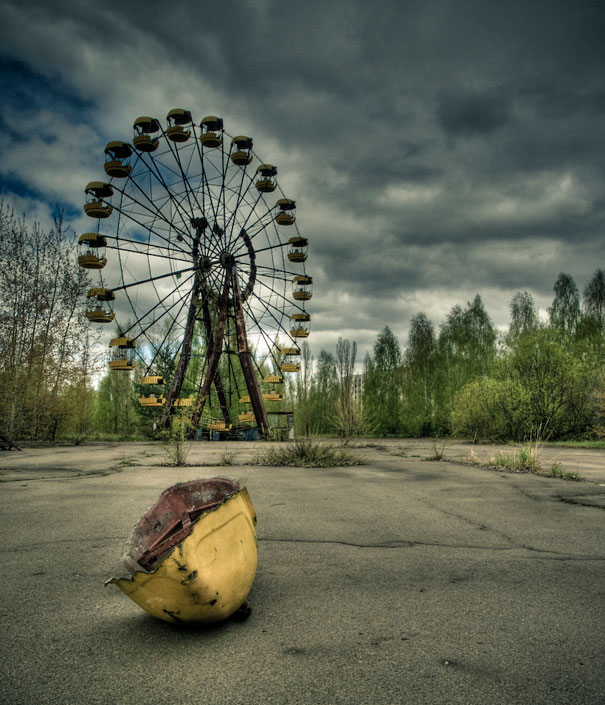
Pripyat Funfair, © Ben Fairless
One of the more bizarre side-effects of the climate change debate is the fact that it’s given new life to the nuclear power lobby. Indeed it sometimes seems that every time I turn on the ABC or open a newspaper there’s some talking head doing his utmost to convince us that not only is nuclear power now safe, it’s also the only technology capable of offering emission-free alternative to fossil fuels. Never mind that we still have no way of dealing with the waste (at least until Generation IV technology becomes a reality), never mind that the emissions generated by extracting and processing uranium far outstrip the emissions generated by coal-fired stations, never mind the possibility of accidents or sabotage, nuclear power is the way to go. (I suppose the one point in their favour is that nuclear technology actually exists, unlike the ludicrous fantasy of “clean” coal).
Of course nuclear power is precisely the sort of boysy technology that appeals to a particular kind of smart man, not least because it allows them to do their “I’m the sort of man who’s prepared to take hard decisions without being fazed by silly, sentimental anxieties about the environment,” routine, but you’d think even they’d be able to hear themselves when they declare that the technology is now foolproof (like that unsinkable ship, the Titanic, I suppose).
Anyway – I thought in the context of that debate it might be worth linking to this remarkable series of photographs of Chernobyl. Gathering together work by a number of photographers, some born in the area, others not, they speak not just to the destructive force of the accident, and the scars it left on the place and its inhabitants, but in their haunting reminder of the way the forest is reclaiming the Exclusion Zone, to the hubris of presuming human society and its creations are anything more than a hiccough in the larger cycle of life and time.
(via io9).
Break text
Sep 8
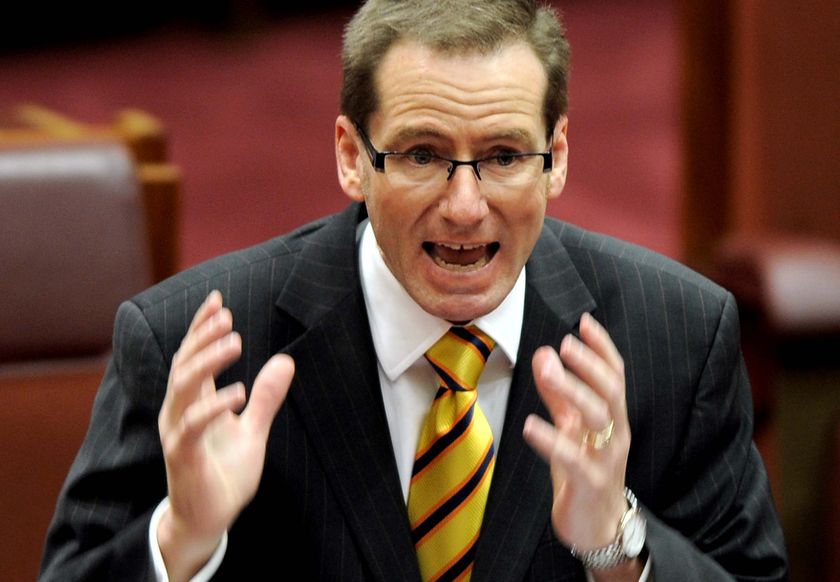 I know it’s wrong to make fun of the intellectually challenged, but this story about the Senate’s Dickhead Numero Uno, Steve Fielding is just too good to pass up:
“Family First Senator Steve Fielding is having trouble describing and spelling the arm of government policy which influences the economy.
“When asked about a proposed Upper House inquiry into Labor’s economic stimulus spending, Senator Fielding said it was crucial to get “physical” policy working.
“‘We need to get the physical and monetary policy working,’ he said.
“Asked if he meant to say fiscal policy he said yes, before attempting to correct himself by spelling the word out.
“‘I will make it quite clear…F..I..S..K..A..L.'” (via AAP and The Australian)
And this is the man who controls the balance of power in the Australian Parliament.
Break text
Sep 7

The swearing-in of the NSW Government
So I’m reading the front page of this morning’s Sydney Morning Herald, trying to make sense of the increasingly bizarre circumstances surrounding the gangland-style execution of Sydney property developer, Michael McGurk, a scandal which already boasts an alleged tape of senior members of the NSW Government accepting bribes, blackmail and links to everyone from Socceroo Captain, Lucas Neill to former ALP powerbroker, Graham Richardson, and there, alongside the revelation that Michael McGurk was not actually Michael McGurk, but a New Zealander Scot named Michael Rushford, who boasted several identities, is this marvellous titbit:
“Private detective Warren Mallard said yesterday that McGurk had hired him to go to a property near Bathurst to ensure the owners had vacated. McGurk had acquired the property when the owners fell behind in their repayments.
“Mr Mallard said he was aghast to find that the owners had been devil worshippers who had a pit filled with blood and surrounded by bones.”
Say what?
Break text
Aug 26
Some of may have noticed this story in The New York Times, detailing the CIA’s outsourcing of a secret program to locate and assassinate Al-Quaeda leaders to that most gloriously sinister of private security contractors, Blackwater (never heard of them? Then read Jeremy Scahill’s book


Of course all this talk of mercenaries and private armies puts me in mind of Elvis Costello (and yes, that is The Kenny Everett Video Show in the background) . . .
Break text
Break text
Jul 16
 As many of you would be aware, on Tuesday Australia’s Productivity Commission recommended lifting the existing restrictions upon the parallel importation of books into Australia. Those interested in reading the full text of the Report can find it on the Commission’s website, but essentially it makes three recommendations. Firstly that the existing restrictions on parallel importation be lifted after a three year period to allow the industry to prepare for the change. Secondly that the Government review the current subsidies aimed at encouraging Australian writing and publishing, with a view to better targeting of what are rather opaquely described as “cultural externalities”. And finally that the new regime be monitored and assessed five years after implementation.
There’s already been a lot of commentary on the recommendations, most of which falls into two fairly predictable camps. On one side Bob Carr and his mates at Dymocks and the Murdoch Press are characterizing it as a win for consumers and literacy. On the other, publishers, authors and most of Australia’s booksellers are appalled by the decision, describing it variously as cultural vandalism, economic rationalism gone mad and free-market lunacy.
I won’t point you to the articles in the papers, though if you’d like to get a sense of the anger and despair amongst writers it’s worth checking out Spike. Likewise Henry Rosenbloom at Scribe always makes perfect sense on this issue and is worth a look, as does Jeff Sparrow at Overland. Or for a rather different take, check out Michael Duffy or Crikey’s Bernard Keane.
For my part I’m in furious agreement with the ASA, the APA, the ABA and everybody else lined up against the Productivity Commission on this issue. If implemented the recommendations would be catastrophic for the Australian book industry and for our literary culture. But at the same time I do worry whether we – the writing and publishing community – aren’t getting this one wrong at some level.
For obvious reasons writers and publishers are trying to frame this as an issue about our capacity to sustain a literary and publishing culture in this country. If one wanted to be crude about it, what we’re really arguing for is a form of cultural nationalism. Certainly it’s no accident the writers who are being rallied to speak are all ones who are identifiably and iconically Australian.
This is the same argument we run every time changes to public policy threaten to make life harder for the already pretty marginal lives of Australian creators. And while I think it’s correct, I’m not sure it necessarily plays the way we think it does anymore, if only because appeals to Australian nationalism seem outdated in the global world of 2009. And – to be perfectly frank – demanding protection in a globalized economy is a bad, bad look.
Part of the problem is we’re being shoehorned into an argument about book prices. As people keep pointing out, it’s extremely difficult to compare book prices, and there’s some pretty selective data doing the rounds.
But this isn’t about book prices and it never was. It’s about Australia’s capacity to compete in a global knowledge economy, and, more importantly, the right of Australian creators to commercialize their work. Nor is it about open or protected markets. It’s about ensuring we have a policy framework in place which will foster creativity and maximize the benefit of that creativity to the Australian economy.
Let me explain. At present, when I finish a book I set about trying to sell it. Since the copyright belongs to me, I sell licenses to publishers to print the English-language version of the book. These licenses are geographically defined. In the best of all possible worlds I will sell the Australian and New Zealand rights to an Australian publisher, the UK and Eire rights to a UK publisher (these usually allow the UK publisher to distribute the English-language version of the book through Europe and a number of small countries like Bermuda and the Falkland Islands as well) and and the rights to sell the book in the US and various small countries like Guam to an American publisher. Canada will usually end up parcelled off with the US or the UK rights.
The license I grant my various publishers is exclusive. That means the American publisher can’t try and sell the book into Australia or the UK, and the British and Australian publishers are similarly precluded from trying to sell their editions into the other English language markets. This exclusivity is defined contractually, but is made possible by the copyright provisions of the relevant countries, which create frameworks within which the right of creators to dispose of their work as they see fit is enshrined.
The reason for this is obvious. Imagine I take my book to an Australian publisher and ask them if they’d like to publish it. They say they would, but then I tell them I’ve already sold the rights to an American and a British publisher, and because the restrictions on parallel importation have been lifted, those publishers are likely to be importing books into Australia as well. Odds are the Australian publisher would laugh in my face, but even if they didn’t, my capacity to commercialize my work has obviously been severely diminished.
As the example above demonstrates, the exclusivity created by territorial copyright (or, to describe it as the Productivity Commission does, the restriction on parallel importation) is not trivial, it’s the basis of the market. Without exclusivity the rights are, if not quite worthless, then certainly much less valuable. And, commensurately, the capacity of Australian creators to commercialize their work is severely constrained.
For a writer such as myself, who publishes overseas, the abolition of territorial copyright will mean I lose not only that portion of my income I derive from selling Australian rights, but that the economic benefit of my work will end up offshore, in the hands of a foreign publisher, as will the economic benefit of every single Australian writer with even the smallest amount of international success.
More importantly though, the example above demonstrates why this isn’t an argument about protectionism, despite all the talk about “opening markets”. Territorial copyright would only be protectionist if it didn’t exist elsewhere. But at present the only English language market which allows parallel importation is New Zealand, a country which is of such minimal importance that Australian writers routinely dispose of New Zealand rights in a job lot with our Australian rights. Abolishing it here won’t open our markets in any meaningful sense, all it will do is create a situation where American and British publishers have access to our markets without Australian publishers having access to theirs, which would be a bizarre outcome.
It would also decimate the local industry, which, like the British and American industries, derives much of its income from managing rights to books written elsewhere. Independent publishers would either go under, or shift their focus to publishing work with absolutely no international potential, while the larger multinationals would become little more than clearing houses for books written elsewhere.
One obvious response to the arguments above is to point to the coming revolution in publishing (something I’ve done myself from time to time). As national barriers fall, one might think, so too will seemingly outdated provisions such as territorial copyright. But as anyone who’s gazed longingly at a movie or TV episode for sale on the US iTunes Store knows to their cost, territoriality is alive and well in the digital world, and while that may change, it’s not going to happen soon.
I don’t want to waste my time engaging with the Commission’s risible suggestion that greater public assistance would produce better outcomes for Australian creators. I don’t want a handout and I don’t know any writer who does. But I do think it would be useful if we stopped talking about this issue as a contest between economic rationalism and cultural nationalism. Because for as long as we do we’re missing the real point, which is about the capacity of Australia and Australian creators to succeed in a global knowledge economy, and about ensuring we harmonize our policy settings with those of our major competitors overseas.
Apr 11
 Today’s LA Times has a story which purports to explain the truth (or should that be “Truth”?) behind that Holy Grail of conspiracy theories, Area 51, and it’s almost as improbable as the crazy talk of flying saucers and alien technology. That crashed UFO? A disk shaped, Lockheed-designed stealth aircraft called OXCART. Those reports of secret engineering? True, but they were reverse-engineering Soviet technology. And there’s even sodium pentathol-fuelled interrogations and men in black dumping drug-addled test pilots on their wives’ doorsteps. And why are we hearing this now? Because the US Government wants to set the record straight. Hmm.
Text break
The intertubes are alive with the news that the Productivity Commission has released the discussion draft of its report into easing the restrictions on the Parallel importation of books into Australia. Pleasingly, despite the push by Dymocks and Bob Carr, the draft largely supports the view advanced by many authors, the Australian Society of Authors, the Australian Booksellers Association and the Australian Publishers Association, in recommending the current regime be retained, with the possible exception of an easing of the restrictions after a book has been on the market for more than twelve months. I posted about this a while back, but you can now read the report here, Stephen Romei has a good precis of its contents on A Pair of Ragged Claws, and Tim Coronel from Australian Bookseller and Publisher has been bookmarking relevant articles on Delicious as they appear. I assume Henry Rosenbloom will be posting about it in due course as well, so perhaps keep an eye out there as well.
Break text
.




 city of tongues