Skip to content

Posts from the ‘Books’ Category

Ron Charles on book reviewing

The Washington Post’s Short Stack blog alerted me to this footage of Ron Charles accepting the Nona Balakian Citation for Excellence in Book Reviewing at the National Book Critics’ Circle Awards earlier this month. Aside from serving as a textbook example of how to accept an award, Charles has some salutary things to say about the changing role of the critic in an age of ubiquitous opinion.

More information on Charles and the Nona Balakian Citation is available on Critical Mass, and the Washington Post’s Book World helpfully provides a digest of his reviews and articles for those interested in exploring his writing. And if you want a reason beyond his speech to warm to him, there’s always this wonderful piece about why Pottermania isn’t necessarily a sign of the health of our literary culture.

And then there’s the video:

Break text


Break text

addthis

Photography in Australian Fiction

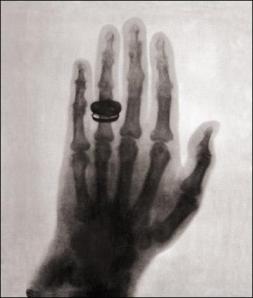
X-Ray image of hand, Wilhelm Konrad Roentgen

Wilhelm Konrad Roentgen, X-Ray image of hand

Last year I met an Italian student called Giorgia Tolfo from Bologna University, who was in Australia to research her thesis, The Photographic Act in Contemporary Australian Fiction. As part of her research she interviewed me and a number of other Australian writers (Delia Falconer and Gail Jones amongst others) who have used photographic motifs in their work.

She’s not the first person to write on this subject. Paul Genoni published a paper in Antipodes in 2002 exploring the use of photography in novels such as my second novel, The Deep Field, Gerald Murnane’s The Plains, Liam Davison’s Soundings, and Thea Astley’s Reaching Tin River (you can access the paper via the Curtin University Library site, though you’ll need to click the pdf symbol in the top right corner to actually read it). But it was interesting to find an Italian student struck by the same resonances between the various works she was writing about (she’s also incredibly bright and very charming, which never hurts either).

Anyway – I just received an email from Giorgia, telling me not only has she passed, but she’s received the highest mark, which is fantastic news. And, since I suspect her thesis isn’t likely to find its way into print in English in a hurry, I thought I might reproduce some extracts from the written interview I did for her after we spoke.

1. What is it that interests you about photography and what was it about photography you set out to investigate in your novel? Was there a particular influence or reference that urged you to write about photography?

I initially became interested in using photography as an element in the novel after looking at a book of photos of museum exhibits by Rosamund Purcell. The images were largely of objects from 18th century cabinets of curiosity, but there were images of fossilized ammonites amongst them, something about those images of ancient stone shells struck a chord with me..

Over time this idea of photographing fossils merged with the ideas I was also interested in exploring, about endings, and continuance, and deep time, and the idea that our own presence in the world might be part of a larger cycle, and a larger order. I remember reading Sontag, and Barthes, and being struck by their insistence that photography must be a representation of death. That seemed right to me, but also wrong – photos are also, necessarily, a form of connection to the past, a kind of persistence through time, in the same way a fossil is, and they connect us to the past, even as they remind us it is gone, and in so doing suggest something about the way loss is always with us, but part of us, and the capacity of things to go on, and endure.

2. In your novel, The Deep Field, Anna begins taking pictures of ammonites and fossils, but only after a scene in which the shells are explored by the blind character with his hands. Was this an attempt to link the idea of tactile memory to the idea of fossils as tactile memories of now vanished organic organisms? What do you see as the best form of memory – visual, tactile, emotional?

I was interested in different ways of being in the world, and particularly by the idea that the blind inhabit a non-spatial world made up of tactile and auditory experience connected in time, rather than spatially. Like virtual reality and cyberspace, that seemed ot me to suggest a very different way of being in the world, and one it might be useful to understand better as technology continues to alter the contours of our identity and the world we inhabit. But I also wanted to connect this idea of the new, and the futuristic to the very ancient, hence the shell on Mars, and the high tech photos of fossils. By doing that, and by playing on the way the blind inhabit their temporal and experiential world I thought it might be possible to suggest something of the way we exist within memory, and experience, rather than the other way around.

3. What do you think about the relationship between fiction and photography? Do you think that the former can help people to better understand the social, emotional and private value of the latter? Do you agree on the fact that fiction is more powerful than theory in exploring the possibilities of photography, being able to create new and not necessarily real situation?

Fiction and photography are necessarily very different. Fiction is narrative-based, and is therefore connected to change. Photography is something sliced free of time we must project a narrative, or meaning into. One explains us to ourselves, the other denies explanation (a process you can see at work in Sebald). But at the same time, both work by opening up imaginative possibility.

That said, I’m always a little wary of the use of photography in fiction. Photography is necessarily documentary and ambiguous, and there seems something dishonest, or sentimental about the impulse to invent stories which displace that ambiguity and fill it in with invented meaning.

As for the question of whether theory or fiction is more useful for exploring the possibilities of photography, I’m not sure either is particularly useful in that context – it’s photography that will explore its own possibilities most usefully. Theory may help us understand it better, criticism may help us understand particular works and practitioners, but I’m really not sure fiction has much of a role to play at all – its interest in photography is almost always for its own, imaginary ends.

4. Do you think there is a peculiarly Australian way of thinking about photography evident in Australian fiction, or do you think the use of photography in fiction is more universal?

I do wonder whether there is a a peculiarly Australian way of thinking about photography you see coming through in writers as diverse as Gail Jones, Delia Falconer, Liam Davison and myself. All of us are interested in exploring a photography as a way of making sense of loss, and transience, rather than as a simplistic memento mori. If this differs from its use in fiction from overseas (and I’m a bit short on ideas for examples to be sure it does) I wonder whether it has something to do with the fact that if you’re in Europe, particularly, or connected by the Jewish diaspora to that European experience, photography might well offer rather starker reminders of the past. Australians are, at some level, interested in finding a way to make sense of their past, and to find reconciliation with it in the present; it’s possible that for Europeans and others the past is something that needs to be put behind them.

Break text

addthis

Even more 2666?

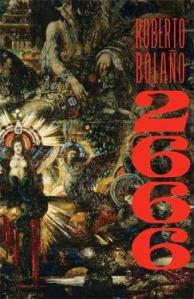
26661The Telegraph is reporting that two new novels have been found amongst the late Roberto Bolano’s papers. Reportedly entitled Diorama and The Troubles of the Real Police Officer, the two come hard on the heels of another unpublished novel, The Third Reich, which was made available at last year’s Frankfurt Book Fair.

Bolano would have to be one of the most improbable literary success stories of all time. Barely published at the time of his death in 2003, posthumous translations of Nazi Literature in the Americas, The Savage Detectives and most recently 2666 have seen him acclaimed as one of the leading lights of world literature, with 2666 winning this year’s National Book Critics’ Circle Award in the US, and becoming an international bestseller.

But what we’re to make of the suggestion that one of these new novels is a sixth part of the cycle of five novels that make up 2666 I’m not sure. Having read all five, and seen them as part of one whole, it’s difficult to imagine where or how another novel might fit in the sequence. Despite famously being unfinished at the time of his death, the work as it stands seems to have a sort of unity, particularly in the relationship of the fifth novel, The Part About Archimboldo (a work of genius in its own right) to the preceding four.

But is it possible my reading of it was conditioned by the belief the five parts were all there is? How different would another part make it? And what have I missed? And given the damn thing was 900 pages long to start with, does it really seem fair to suggest there might be more of it?

Break text

addthis

Productivity Commission Report on Parallel Importation released

The intertubes are alive with the news that the Productivity Commission has released the discussion draft of its report into easing the restrictions on the Parallel importation of books into Australia. Pleasingly, despite the push by Dymocks and Bob Carr, the draft largely supports the view advanced by many authors, the Australian Society of Authors, the Australian Booksellers Association and the Australian Publishers Association, in recommending the current regime be retained, with the possible exception of an easing of the restrictions after a book has been on the market for more than twelve months. I posted about this a while back, but you can now read the report here, Stephen Romei has a good precis of its contents on A Pair of Ragged Claws, and Tim Coronel from Australian Bookseller and Publisher has been bookmarking relevant articles on Delicious as they appear. I assume Henry Rosenbloom will be posting about it in due course as well, so perhaps keep an eye out there as well.

Break text

addthis

.

Butchering remainders

penelope-fitzgerald

Penelope Fitzgerald

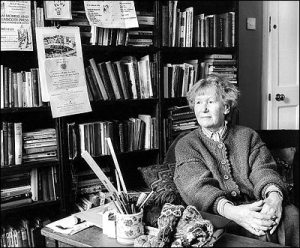
I’m reading J.L. Carr’s A Month in the Country at the moment, for reasons which really aren’t worth going into, but the Penguin Classics edition is enlivened by a slyly humorous introduction by the late Penelope Fitzgerald, an introduction which opens with this little gem:

“I first heard of J.L. Carr through a apassage in Michael Holroyd’s Unreceived Opinions. Holroyd had had, from George Ellerbeck, a family butcher in Kettering, a letter telling him he had won the Ellerbeck Literary Award, consisting of a non-transferable meat token for one pound of best steak and a copy of Carr’s novel The Harpole Report . . . The letter went on: ‘The prize is only awarded at infrequent intervals, and you are only its third recipient. The circumstances are that Mr Carr, who makes a living by writing, is one of my customers and pays me in part with unsold works known, I understand, as Remainders.’ Never before or snce have I heard of anyone who managed to settle up with a butcher, even in part, with Remainders. It is a rational and beneficial idea, but it took Jim Carr to carry it out.”

Break text

addthis

Vampire discovered in mass grave?

vampireFriday’s New Scientist has a tantalizing little item about the supposed discovery of the skeleton of a “vampire” in Venice. The body, which was discovered during the excavation of mass graves dating from the plague of 1576 on the island of Lazaretto Nuovo, was found buried with a brick forced into its open mouth, as the rather unsettling image to the right depicts.

Sadly I don’t have a decent cultural history of vampires to hand (though if you’re after one, Amazon is up to their eyeballs (or is that eye teeth?) in them) but it’s difficult not to be struck by the manner in which the vampire myth continues to infect our culture. Quite aside from the not-insubstantial literature of the gothic underground, the past few years have seen at least two television series (Buffy the Vampire Slayer and True Blood), the Twilight phenomenon and a slew of novels ranging from J.R. Ward’s erotic Black Dagger Brotherhood series to Peter Watts’ hard-edged (and all the more terrifying for it) neurobiological take on the vampire myth in the Hugo Award-nominated Blindsight (if you’re interested in taking a look, Watts has published the novel online under a Creative Commons license — I particularly recommend his ‘Brief Primer on Vampire Biology’ if you want to see someone take a serious stab at making the myth make scientific sense).
The reasons for this are complex, but I suspect they’re also oddly basic. The vampire myth, whether in its contemporary, Western form or its various variants and precursors draws together the two deepest elements of the human psyche, sex and death, and binds them together (indeed in a very real sense it is the distorted mirror image of that other great ritual of blood and death and the acceptance of another’s flesh into one’s own body, the Christian communion). It’s a potent brew, so potent, in fact, that in some very real sense the vampire is a kind of universal signifier, able to accommodate almost any anxiety about sex or death, from Dracula’s fin de siecle anxieties about sexuality and moral decline, to anxieties about homosexuality, and blood, and disease, to the images of a death-obsessed Old World which drive Christos Tsiolkas’ Dead Europe. It can also, in the manner of these things, become so overdetermined as to signify not much at all, as the oddly engaging but essentially silly True Blood demonstrates.

All the same, it’s chastening to be reminded of the extent to which, even now, in a world transformed by technology, we are still creatures of our biology, driven by the primitive urges of fear and desire, and haunted by nightmares that, for all that their digital sophistication, are essentially the same as the fears that drove the plague-battered people of Venice to bury a woman with a brick rammed in her mouth four and a half centuries ago.

Break text

addthis

Phantom Shanghai

Phantom Shanghai

In 2005 I spent three months attached to the East China Normal University in Shanghai as an Asialink resident. Perhaps fortuitously, we didn’t end up living in one of the newer parts of the city, but in an apartment at the top of an alley house not far from the corner of Huaihai Lu and Shanxi Nanlu in the old French Concession.

The dodgy wiring and rats aside, it was a fascinating place to stay, not least because it gave me the opportunity to get to know some of the last remnants of Old Shanghai. For all its well-deserved reputation for criminality and vice, Old Shanghai was also the site of an incredibly fertile collision between European and Chinese modernity. This collision gave birth to writers such as Shi Zhecun, and Liu Na’ou (I’d probably also lump Eileen Chang in there as well, since although her work concentrates on the years of the Occupation, and was published in the 1940s, it exists in the shadow of the Shanghai of the 1920s and 1930s she grew up in), nurtured political radicals such as Mao and his wife, and most visibly these days, resulted in the peculiarly Shanghainese fusion of European and Chinese architecture that can be seen in the remaining pieces of the pre-1989 city.

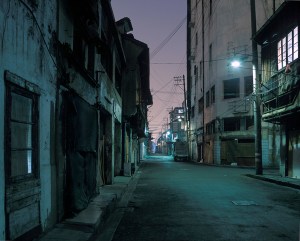
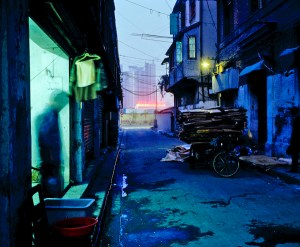
'Alley (Yangshuo Lu, looking north), 2006', © Greg Girard, 2006

'Alley (Yangshuo Lu, looking north), 2006', © Greg Girard, 2006

Even in 2005, when I was there, these remnants of the old city were vanishing fast. The pace of change in China is (or was, until recently) dizzying, and the Chinese have little interest in preserving what they see as the European city (Shanghai may have been the site of the most potent encounter between Europe and China, but it is also, for that very reason, seen by many Chinese as a symbol of the West’s exploitation of China: not for nothing were the towering buildings of Pudong built straing back across the river at the symbols of European power and wealth that dominate the Bund).

The process has created a city which is very much in flux. Buildings, streets, even whole neighbourhoods seem to vanish overnight, swept away without trace. The results can be startling, shocking, and just plain disconcerting: my partner and I often ate in a restaurant a few blocks from our home; a few weeks after we left a friend who’d eaten there with us was back in Shanghai, and he discovered that not only the restaurant was gone, but everything within a radius of a few hundred metres had also been demolished, apartment blocks already rising on the site.

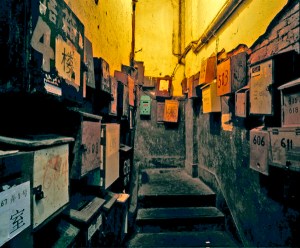
'Fuzhou Lu Mailboxes, 2005', © Greg Girard, 2006

'Fuzhou Lu Mailboxes, 2005', © Greg Girard, 2006

One of the ironies of this process is that it is largely undocumented. Images of Shanghai tend to fall into one of two categories, seeking to capture either the gleaming modernity of the new China, or the elegance and mystery of Old Shanghai.

In a very real sense this is a reflection of a more profound double-vision that afflicts most Western interest in Shanghai. Whether in guidebooks or literature, Western eyes seem unable to see that there are other Shanghais lurking beneath the surface of the city, histories and realities laid down during the Occupation and the Cultural Revolution which exist alongside the more comfortable images of Old Shanghai’s glitter and decadence and New Shanghai’s shining skyscrapers and designer boutiques.

'600 Things, 2005', © Greg Girard, 2006

'600 Things, 2005', © Greg Girard, 2006

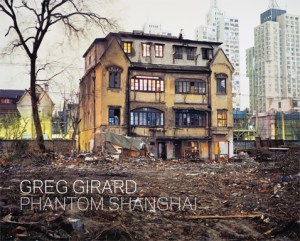
These questions are on my mind because I’ve been working on a non-fiction piece about the city, but they’ve also reminded me about the one book I’ve ever seen that seems to me to catch something of the accretive nature of Shanghai as a city, its sense of layered history, which is Greg Girard’s splendid Phantom Shanghai. The images in Greg’s book show a city in flux, a place where the past is being gradually wiped away, yet they also show the many, often enigmatic, traces its past has left. Somewhere – and it may be in Denton Welch’s marvelously strange Maiden Voyage, but I can’t find the reference – there’s a wonderful description of the way Chinese cities and towns often seem to be constructed out of detritus, repaired and repurposed, yet still resembling nothing so much as a conglomeration of offcasts and broken things, and there’s something of this in the images in Phantom Shanghai, as well as a sense of the almost surreal light of the city at night, the reflected glow of the pollution and the neon. But there’s also a sense of the ghostliness of the city, of the way its seems haunted by its past, and by the simultaneous closeness and irretrievability of that past.

With Greg Girard’s permission I’ve reproduced several images from the book in this post, and you can see more by visiting the Monte Clark Gallery website, or Greg Girard’s website (where you can also read William Gibson’s introduction) but I really do urge anyone with an interest in Shanghai to buy the book, – it’s a remarkable document of a city in transition, and of a world which is vanishing even as we speak.

Break text

addthis

Consumption as (small-scale) spectacle

Online bookseller, The Book Depository, have introduced a voyeuristic new page which plots who’s buying what onto a map of the world in real time. It’s not the World Cup, by any means, but it’s weirdly mesmerizing to watch a window pop up and tell you someone in Ireland has bought The Road, and someone in Norway has bought Experiencing Father’s Embrace, and someone in Portugal has bought Quilting in No Time. Oh, and someone in South Korea has bought a self-help book called Happiness . . .

Break text

addthis

James Wood on The Book Show

James Wood

James Wood

Further to my post earlier this week about James Wood, the ABC’s Book Show ran this interview with him this morning. In it Wood talks about How Fiction Works (often sticking pretty closely to the text of the book itself) but that’s not so much a problem as a reason for listening, since in so doing he offers a reminder of exactly the breadth and attentiveness that so distinguish his writing.

Anyone after more information about Wood could do worse than checking out the links on his Wikipedia page.

Break text

addthis

Pride and Prejudice and Zombies author speaks!

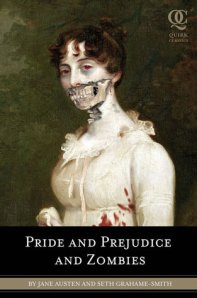
prideprejudicezombiesI promise I’ll stop after this, but EW has an interview with the improbably named author of Pride and Prejudice and Zombies, Seth Grahame-Smith, about his book and discovering his wasn’t the only Jane Austen mash-up on the market. (I’ve also rather belatedly realized he’s the same Seth Grahame-Smith who blogs on Huffington Post, which probably reveals some unexamined snobbery on my part, but we won’t got there).
Break text

addthis

Never real and always true

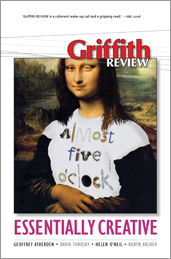
edition_imagephpI’ve got a piece about depression and creativity in the latest Griffith Review, Essentially Creative. The piece explores the links between mood disorders and creativity, and asks what we’re losing when we define behaviours intimately connected with creativity as disorders. It’s also a very personal piece, and one I found quite confronting to write.
As I say in the article:

I am not sure that if, fifteen or twenty years ago when I began writing, I was asked whether it was connected with my troubled moods, I would have seen the connection. Yet, looking back, it seems obvious. I came to writing almost by mistake, stumbling on it in my final year at university. At first I wrote poetry, partly as a way of sublimating desire, partly because it seemed to offer the most immediate vehicle for the feelings and experiences I sought to explore. Later, when I began to write fiction, my motivations were more complex, but the writing remained grounded in these same feelings and experiences.
But these feelings and experiences, and more particularly their intensity and what seemed to me their singularity, were inextricably bound up with the cyclic episodes of sadness and irrationality that have afflicted me since I was twelve.

Unfortunately the piece isn’t available online, but you can buy Essentially Creative from Readings or Gleebooks, as well as in any decent bricks and mortar bookshop. Or you can subscribe to Griffith Review on their website.

Break text

addthis

Felling James Wood

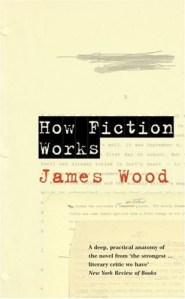
41r46nfjbdl_ss500_There’s no question that, for good or ill, James Wood has reigned supreme amongst literary critics for more than a decade. At least in part this state of affairs is a reflection of Wood’s missionary fervour, his sense that literature – and the novel in particular – must fill the gap left by the death of religion. But it is also testament to the thrilling force and acuity of his writing. Certainly I remember the excitement of encountering his first book, The Broken Estate, and the chastening realization that the person speaking with such eloquence and ferocity was only a year or so older than myself.

Yet for all his brilliance Wood is an oddly blinkered reader (and to some extent, writer). This is especially apparent in his recent How Fiction Works, a Ruskinesque disquisition on the rights and wrongs of fiction, which manages, by virtue of its narrowness of focus and its curious lack of interest in examining its own intellectual underpinnings, to lay bare something unsettlingly reactionary at the heart of Wood’s thinking.

It’s difficult not to contrast its fusty fury with the increasingly expansive and nuanced work of one of Wood’s first scalps, Zadie Smith, whose White Teeth Wood famously dismissed as “hysterical realism”. In a series of essays in The New York Review of Books (in particular, her review of Joseph O’Neill’s Netherland, ‘Two paths for the novel?’) Smith has sought to tease out both the crisis afflicting the novel and – whether successfully or not – to make sense of what a new mode of fiction might look like.

I’m not the only one made increasingly uncomfortable by Wood’s certitudes. John Banville wrote a typically slippery but sceptical review of How Fiction Works in The New York Review of Books (sadly not online) and here in Australia both Delia Falconer and James Ley articulated similar reservations in a pair of stringently argued reviews (Delia’s is especially worth reading).

There’s also Edmond Caldwell’s Contra James Wood, a gloriously obsessive but brilliant blog devoted to picking Wood and his pronouncements apart (although like any such endeavour, Caldwell’s relentless shadowing of his quarry is itself a sort of tribute) and now Daniel Miller has published an excellent piece in Prospect attempting to draw together the various strands of the growing resistance to Wood’s reign.

Miller’s piece is well worth a read, as is Contra James Wood, but it’s difficult not to wonder whether the pre-eminence of Wood isn’t itself a symptom of precisely the exhaustion of the novel, and in particular the realist novel Zadie Smith explores in her piece for The New York Review of Books. I wouldn’t for a moment want to diminish Wood’s very real achievements as a critic, or the capacity of the force of his conviction about literature’s necessity to remind us why novels matter, but the ease with which it is possible to caricature him as a glittering ultra deploying his rhetoric to rally the forces of the past against the inexorable logic of the future should give us pause, if nothing else. And, as Miller points out, in many ways Wood’s thundering only underlines how isolated he has become, and how much more attuned to our cultural moment critics (and indeed novelists) such as Smith, Benjamin Kunkel and others like them are.

Break text

addthis

Pride and Prejudice and Zombies?

Now this is just getting silly. Sean Williams has very kindly pointed me to an article in io9 explaining that Pride and Predator is only one of three science fictional reworkings of Jane Austen which are in the pipeline. I have to say that while Pride and Prejudice and Zombies sounds good to me, Pride and Predator still pips it at the post.

Three Jane Austen Science Fiction Movies In The Pipeline?

Break text

Update: I now discover that Pride and Prejudice and Zombies is an adaptation of an existing novel (“The Classic Regency Romance—Now with Ultraviolent Zombie Mayhem!” according to the publisher). I’m trying, but I’m just not sure I can keep my finger from the Amazon trigger . . .

Read more here.     

Break text

addthis

Pride and Predator

en...

Image via Wikipedia

Now this I like. Variety reports that Elton John’s production company, Rocket Pictures, are working on an adaptation of Jane Austen’s Pride and Prejudice in which proceedings are interrupted by the crash-landing of a hostile, flesh-eating alien. And if that doesn’t sound good enough all on its own there’s always the film’s title, Pride and Predator.

Apparently Sir Elton will compose the music (which I suppose has horrific possibilities all of its own).

Break text

addthis

Oliver Sacks on blindness and the mind

Tales of Music an...

Cover via Amazon

Oliver Sacks has used his own experiences to inform his thinking and writing about the mind before, most notably in a A Leg to Stand On, but also in Musicophilia’s discussion of disorders of musical perception. More recently though he has been diagnosed with ocular melanoma, and has since lost the sight in one eye. He spoke about the experience, and about blindness more generally in this recent interview with Wired.

Break text

addthis