Just a quick link to my review of China Miéville’s Embassytownin this morning’s Weekend Australian. As the review hopefully makes clear, I think it’s Miéville’s best book by some distance: brilliantly conceived, powerfully imagined, thrillingly fertile, and while I do think there’s a slight slackening in the second half, when the narrative frame opens out to take in the large-scale breakdown of the society it depicts, the first half is so good it hardly matters. All of which is a roundabout way of saying just read it, it’s fabulous.
Heartfelt congratulations to my friend, Delia Falconer, whose very personal tribute to her home town, Sydney, has been shortlisted for the Non-Fiction Category of the Prime Minister’s Literary Awards, along with Paul Kelly’s How to Make Gravy and Richard McGregor’s excellent study of the Chinese Communist leadership, The Party and books by Rod Moss and Patrick Wilcken.
I meant to write something about Delia’s book when it came out, and while that got away from me, I think it’s a terrific book: startlingly intelligent, idiosyncratic and written with a very striking blend of steel and fluidity. If you haven’t read it I very much recommend you do.
Congratulations also to the other shortlisted writers. I’ve only had a few moments to look at them, but at first glance I’d say two things. The first is that the Fiction shortlist is overtly and unashamedly literary. And the second is that these shortlists are likely to add fuel to the arguments about the under-representation of women writers that were triggered by last month’s announcement of the second all-male Miles Franklin shortlist in a row. I don’t want to suggest Young Adult Fiction isn’t serious writing, but I think it’s difficult not to be struck by the fact that the two shortlists that would usually be regarded as the more overtly intellectual and literary – Fiction and Non-Fiction – each contain four books by men and one by a woman, while the less overtly literary category of Young Adult Fiction contains five books by women and none by men (the Children’s category is rather more evenly split).
But all that said, my congratulations to all the shortlisted authors, and especially to Delia. I wish you could all win, but I guess it doesn’t work that way.
Non-Fiction Delia Falconer, Sydney Paul Kelly, How to Make Gravy
Richard McGregor, The Party
Rod Moss, The Hard Light of Day
Patrick Wilcken, Claude Levi-Strauss: The Poet in the Laboratory
Fiction shortlist Stephen Daisley, Traitor
Roberta Lowing, Notorious
Roger McDonald, When Colts Ran
David Musgrave, Glissando
Kim Scott, That Deadman Dance
Young Adult Fiction Shortlist Laura Buzo, Good Oil Cath Crowley, Graffiti Moon
Cassandra Gold, The Three Loves of Persimmon
Joanne Horniman, About a Girl
Melina Marchetta, The Piper’s Son
Children’s Fiction
Bronwyn Bancroft, Why I Love Australia
Lucy Christopher, Flyaway
Morris Gleitzman, Now
Bob Graham, April Underhill, Tooth Fairy
Boori Monty Prior and Jan Ormerod, Shake a Leg
How do you do that? she asks, seated on the stairs to his loft, How do you know which notes to play without sheets?
Memory, he says, I do it by memory.
It is Boxing Day, and Anna has woken to the sound of the piano. Downstairs Seth seated before it, his fingers moving slowly across the keys.
What is it? I’ve never heard anything like it.
Seth smiles, his fingers continuing to pick out the notes in ones and twos, each separated by a gap, the space between them seeming as important as the notes themselves, the way they fade into it, leaving the memory of their resonance hanging. She shivers.
It doesn’t have a name, he says, An artificial intelligence composed it.
In front of her she can see the muscles in his back shift beneath his skin, the articulated cage of his ribs beneath them.
I have a recording of it, but I prefer to play it myself. There’s an alien quality to it, a sense of another way of being I can get closer to.
It sounds . . . sad. No, she corrects herself, listening to the strange, ghostly sound of the piano, the dying notes, not sad, something else I can’t quite describe, Like the sound of wind in grass or moving water, that quietness, that colourless feeling. She hesitates. Maybe I can’t find the words because there are no words.
It’s like trying to describe the sound of geometry, isn’t it? Can you imagine what it must be like to be conscious, aware, but without matter, without form? Without place. A ghost in a machine.
Anna shakes her head. But listening to the slow patterns of this music she can hear the loneliness of this thing of bits and light, this artificial mind shifting like the aurora through the circuits of some optical computer, like the siren call of a whale in the oceanic night, the long, clicking song that goes unanswered.
There may have been higher profile events at Sydney Writers’ Festival, but as far as I’m concerned the one I was most pleased to be a part of was last night’s Pascall Prize Ceremony, at which it was announced Geordie Williamson has won the 2011 Pascall Prize for Criticism.
As with last year’s decision to hand the Prize to Mark Mordue, it’s a decision that’s immensely pleasing on two levels. First and foremost it’s an excellent decision: Geordie is, without a doubt, one of – if not the – best critic working in Australia at the moment. Whether on radio, in print or in person he brings a level of erudition, generosity and eloquence to his subject which is incredibly rare, and which is complemented by his genuine and passionate belief in the importance of writing and literature. More importantly though, he’s one of those rare critics for whom everything holds interest and value: at the ceremony last night he spoke of his belief that criticism should be an open hand rather than a fist, words that seem to me to sum up a lot of what’s wonderful about his writing (and indeed about Geordie himself).
That generosity of spirit is also manifested in Geordie’s passion for Australian writing. As anybody who’s heard his regular spot on ABC 702 will know, he’s a tireless advocate for Australian writers and Australian writing, but he also works incredibly hard behind the scenes. In recent years he’s been a judge on the Vogel Award, the NSW Premier’s Awards (both of which are gigs which involve a huge amount of work for almost no remuneration) as well as appearing almost constantly at Festivals and other events around the country.
But last night’s decision was also incredibly satisfying because Geordie is one of my closest friends, and if there’s one thing better than people who deserve good things getting them, it’s people you know getting good things they deserve.
All of which is a roundabout way of saying I’m delighted, both for Geordie personally and more generally, and that I’m sure I’m not the only one. As the old saying goes, it couldn’t happen to a nicer guy (and I couldn’t be more pleased).
If by chance you’re not familiar with Geordie’s writing, it appears regularly in The Australian, but he also a Tumblr page, Forest of Dead Words, and you can follow him on Twitter.
I’m sure I’m not the only one who’s a little bit in love with the new Fleet Foxes album, Helplessness Blues, which combines the intense, often haunted imagery of contemporary folk with the weird, questing traditions of the mountain music so much of it draws upon, and then –so effortlessly it’s almost scary – manages to transcend both. I often worry about just how much contemporary folk is basically pastiche, and fairly reactionary pastiche at that, but Helplessness Blues certainly isn’t: it’s something strange and beautiful and entirely itself, and I can’t recommend it enough.
If you’re not familiar with Fleet Foxes, or not in a hurry to front up the dollars for Helplessness Blues, you might want to download their recent BBC 1 session, which is available for free via We All Want Someone To Shout For.
And while you’re downloading free recordings of live sets you might also want to check out Blitzen Trapper’s 2008 Daytrotter session, which features two of my favourite Blitzen Trapper Tracks, ‘Furr’ and ‘Not Your Lover’.
And finally, while poking around trying to find clips from Helplessness Blues I discovered Vetiver have a new album on the way in a few weeks. Given what a joy Tight Knit was, that’s definitely something to look forward to.
My apologies for the flurry of posts, but I just want to recommend you take a look at Angela Meyer’s interview with my partner, Mardi McConnochie, about her fabulous new novel, The Voyagers, which explores not just the genesis of the novel, but some of the historical and sociological background underpinning it. And as I mentioned yesterday, if you’d like to catch Mardi at Sydney Writers Festival she’ll be appearing on a number of panels, including ‘A Question of Character’ tomorrow, Au Pairs’ on Saturday and ‘Over Here’ on Sunday, as well as in conversation with Sophie Cunningham on Friday. And if you haven’t bought The Voyagers yet you can grab the ebook from the Kobo Bookstore, check hard copy prices on Booko or read an extract on the Penguin website.
As I mentioned the other day, last Friday night I was part of a special event about genre at Shearer’s Bookshop in Leichhardt along with Sophie Hamley, P.M. Newton and Kirsten Tranter. Given my ongoing interest in the question it was a fascinating to hear Kirsten and Pam’s views on the subject, as well as to hear a bit from the very warm, engaged and surprisingly large audience (who I would have liked to have heard more from if we hadn’t run out of time).
This might also be a good moment to flag that once my edits on the new novel are done (oh, bright, blessed day) I’m planning on launching a new blog alongside this one, aimed at exploring SF and the classics of SF. It’s probably still a few months off, but I’ll let you know more once I’m a bit less overwhelmed by work.
I’m a little muzzy this morning from last night’s Sydney Writers’ Festival Opening Party (oh yes, the writer’s life is a fabulous one) but one thing I definitely remember from last night was a conversation in which I was recommending Ron Charles’ hilarious video reviews to somebody. Since that person’s identity has now fled my mind, I thought I might use that conversation as an excuse to post his rather fabulous review of Jonathan Franzen’s Freedom. Unfortunately Ron’s taking a breather from producing them for a while, but if you’d like to see more you can visit The Washington Post’s Totally Hip Book Review page or Ron’s Youtube Channel. In the meantime, enjoy!
If you’d like to catch me at the Festival I’m doing four events. On Thursday I’ll be discussing anthologising and The Penguin Book of the Ocean with Tim Herbert and Best Australian Stories editor and novelist Cate Kennedy in ‘On Our Selection’; on Friday I’ll be joining Malcolm Knox (whose new book, The Life, I’m halfway through and loving (info and ebook here, hard copy prices here)) and Lisa Pryor for a session about writers and fatherhood entitled ‘Daddy, Daddy, I …’, and on Saturday my partner Mardi McConnochie and I will join Mandy Sayer and Louis Nowra for ‘Au Pairs’, a session about life as one half of a literary couple. I’ll also be speaking to Georgia Blain about her fascinating new book, Too Close To Home on Thursday morning.
Just a reminder that if you’re in Sydney over the weekend you might want to head over to Shearer’s Bookshop in Leichhardt for When Genres Attack, a pre-Sydney Writers’ Festival event exploring a series of hot-button issues to do with genre, literary status, women’s writing and the state of literary culture generally. It’s an event I’m really excited to be part of, not just because they’re a series of questions dear to my heart, but because I’ll be sharing the stage with the irrepressible Sophie Hamley and two of the smartest writers I know, P.M. Newton (author of one of my favourite books of last year, The Old School) and Kirsten Tranter (whose debut novel, The Legacy, I’m in the middle of as we speak and am enjoying very much). If you’d like a taster of the evening Kirsten’s written a fascinating piece about the way setting up oppositions between genre fiction and “literature” impoverishes our understanding of both for the Shearer’s Bookshop Blog.
The event kicks off at 7:30 tomorrow night. Tickets are $7.00 and are available from Shearer’s Bookshop on (02) 9572 7766. It’d be great to see you there.
Over the last couple of days I’ve been reading (and loving) Joe Hill’s debut collection, 20th Century Ghosts.
I suspect Hill – who also happens to be the son of Stephen and Tabitha King – isn’t likely be familiar to a lot of literary readers, which is a pity, because he’s a seriously good writer. While I’ve only read about half of 20th Century Ghosts, it’s one of those books which fairly hums with energy and intelligence.
If I’m being honest about it part of what I like about 20th Century Ghosts is its subject matter. While I’m not suggesting for a moment there aren’t brilliant literary short stories being written, the literary short story (like the literary novel) feels increasingly mannered to me, a form distinguished by its careful, competent evocation of things we already know rather than the sort of excitement and danger I want writing to be about.
That’s obviously a conversation for another day, not least because at least part of the pleasure of 20th Century Ghosts does actually lie in the sort of subject matter literary stories tend to explore, in particular the awkwardness and loneliness of adolescence. But while that’s sometimes that’s an end in itself – ‘Better Than Home’, for instance focusses on a young boy whose sensitivity to sound underlines the mingled tenderness and neglect that characterise his relationship with his baseball player father – more often that alienation is evoked through the incorporation of elements of the surreal, such as Art, the inflatable boy in the ominously-titled ‘Pop Art’.
But the real joy of 20th Century Ghosts is its playful appropriation and subversion of the tropes of the Horror genre it inhabits, and more particular the pulpy, pop cultural version of it that arose in the 1950s and 1960s.
This is most overtly the case in the collection’s thrillingly clever opening story, ‘Best New Horror’, which manages to work not just as a genuinely chilling horror story, but as a elegant and uncomfortably acute satire of the both the niceties of literary culture (“people … who dreamed heartbreaking dreams about one day selling a poem to The New Yorker“) and the sub-culture that surrounds Horror fiction (“sweaty little grubs who get hard over corpses”).
As genres go, Horror is, of course, one of the more disreputable. Lurid, cannibalistic (in both senses of the word), often just gross, the very nature of its subject matter makes it uncomfortable and unpleasant reading. Yet its capacity to embody not just the deepest, most atavistic elements of the subconscious but also the most deep-seated anxieties of the culture it inhabits also lend it an immediacy and power more elevated forms often lack. Like SF it estranges by making metaphor literal, but unlike SF it also plays overtly upon the elision of the boundaries between life and death, human and inhuman, real and imaginary.
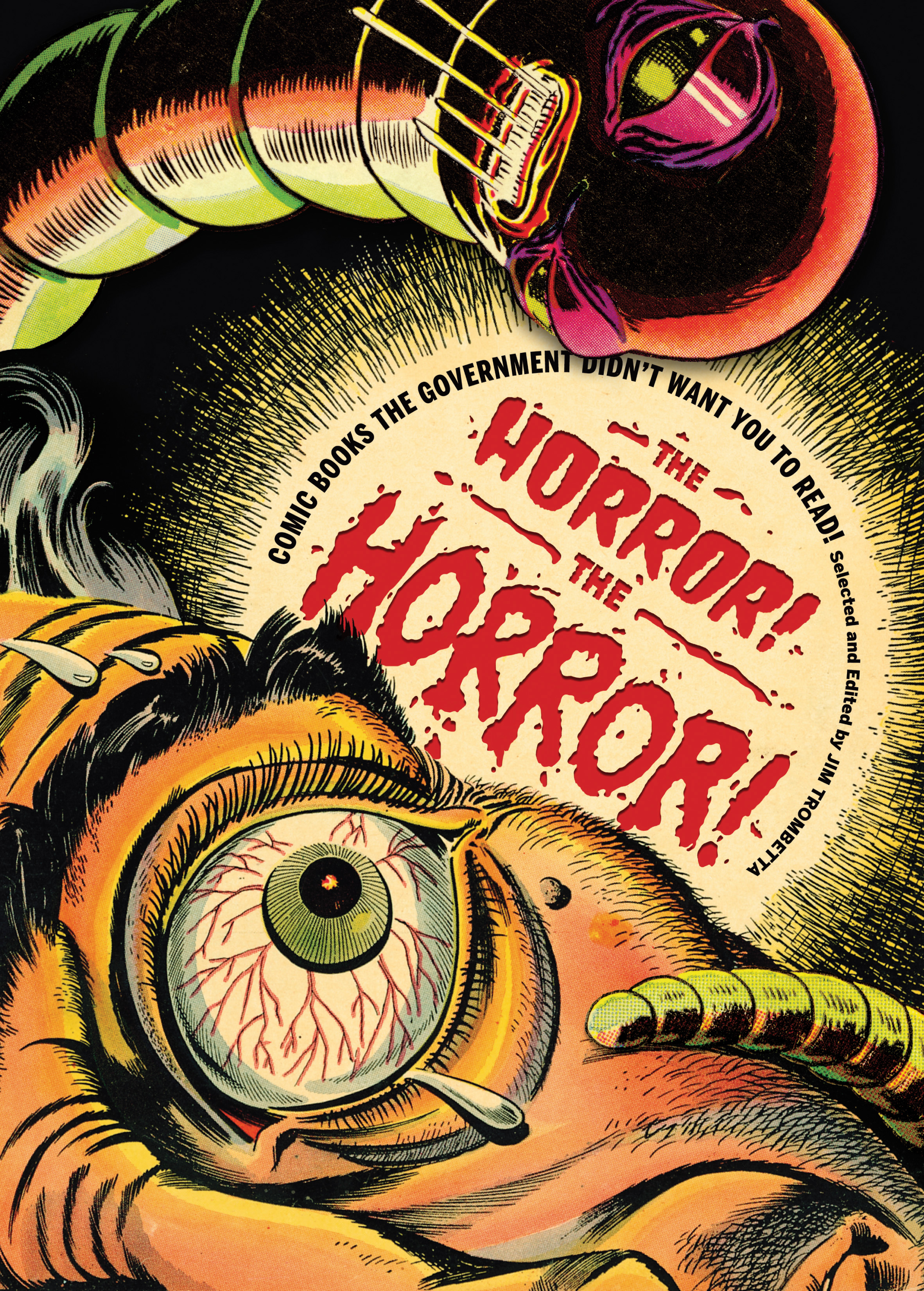
All of which brings me to another book I’ve been reading recently, Jim Trombetta’s lavish study of the pre-Comics Code horror comics of the 1950s, The Horror! The Horror!
Given the last publishers abandoned the Code earlier this year, The Horror! The Horror! is a historical artefact in more ways than one: not just the anxieties and the culture they were embedded within have long since vanished, but even the moral panic that suppressed them has subsided, if only to be replaced by different fears. Yet it’s also a wonderfully vivid and often marvellously immediate portrait of a cultural form that flowered only briefly before being pushed underground.
For me it’s also an exercise in nostalgia. Although I’m obviously too young to have read any of these comics in their original form, my childhood reading was augmented not just by the black and white reprints of old E.C. comics that could be found in Australian newsagents in the 1970s, but by several fabulous books about the history of comics my parents gave me as a child (the best of which, Les Daniels and John Peck’s Comix: A History of Comics in America is readily available in cheap second-hand editions via Amazon and AbeBooks).
But either way The Horror! The Horror! is a delight. While Trombetta has some acute (if sometimes rather over-theorised) things to say about the social and cultural conditions that gave birth to the horror comics of the 1950s (the idea of the passion for zombies as a response to the Korean War was new to me, for instance) and the campaign to suppress them (Trombetta rightly points out that the same culture which wanted to ban the weird horror of kid’s comics was also explicitly retailing its own officially-sanctioned nightmares about nuclear war and Communist infiltration) he largely lets the comics themselves do the talking, reproducing not just a host of covers but dozens of stories in full.
Viewed collectively it’s difficult not to be struck by the sheer energy and delight of the work on display. Partly that’s about the fact many of the artists and writers are ones who would go on to make their name as the architects of the Silver Age comics on the 1960s (the book’s magnificent cover is by the young Steve Ditko, who would go on to create Spiderman and Doctor Strange (who’s apparently getting a movie soon) with Stan Lee). But it’s also about the form itself, its fertility and openness to the charge of the forbidden and unsettling, and – something its detractors were right about – its explicit sexual overtones. Like the pulp fiction of the pre-war era the very nature of the industry, its speed, its dependence upon formula, allow the best of the work produced to mainline the deepest anxieties and fantasies of the culture it inhabited.
All of which is a roundabout way of saying it’s a book that’s very worth tracking down (the edition I have comes with a DVD of Paul Coates’ famous 1955 report on the industry, though that report is also available online and is embedded below). If you’d like to know more about it you might also want to read Graphic Novel Reporter’sinterview with Trombetta, or you can feast your eyes on the images in the promotional video below.
One side-effect of my sporadic posting over the last few months is the fact I haven’t had a chance to talk about my partner Mardi McConnochie’s new book, The Voyagers, which was released this week.
As Mardi’s partner I’m obviously biased, but I think she’s a wonderful writer and this is a particularly wonderful book. Like all her novels it’s not just beautifully constructed and written, but warm and funny and finally very moving. But it’s also very exciting to me because I think there’s little doubt it’s her richest and most emotionally rewarding novel to date.
As some of you may be aware, the novel focusses on an American sailor, Stead, who returns to Sydney in 1943 hoping to see Marina, a girl he met on shore leave during his last visit to Sydney five years earlier. Travelling to her mother’s house he is shocked to discover she is missing, and has been for several years, having disappeared not long after she arrived in London to study music. Knowing he needs to see her, to know she is alright, Stead sets off to find her, beginning a journey that will take him around the world.
As the description above makes clear the book is quite explicitly a romance, albeit a reasonably unconventional one. But it’s also much more than that. Like all Mardi’s novels it’s deeply concerned with the ways women’s lives are shaped by the societies they inhabit, and the choices and compromises they are required to make.
These are questions that are explored with great verve and wit in Mardi’s first novel, Coldwater, which transplants the Bronte sisters to a penal island off the Australian coast (and which was one of the Washington Post’s Books of the Year back in 2001) but in The Voyagers they’re given added heft by the effects of the war, and the way it allowed women freedoms that had never been available to them before.
Given the recent debate about the ways writing by women is still marginalised by the literary establishment I think it’s worth asking why exactly a novel about such questions is marketed as a romance, when a novel about men fighting would almost immediately be classed as capital “L” Literature, but I don’t want to push that point too hard here. What I do want to say is that despite its incredibly elegant plotting and structure the real strength of the book lies in the intelligent and unsentimental depiction of the relationships at its centre, and in particular the complexity of feeling it brings to bear on the relationships between the women whose lives occupy its final third, much of which takes place in a Japanese prison camp, and the children in their care.
Anyway, I won’t bang on too hard. Suffice it to say I think it’s a wonderful, funny and deeply moving book, and one everybody should read. If you’d like to know more about it there’s an interview with Mardi at Booktopia, and you can read an excerpt on Penguin’s website. And while the reviews haven’t really started to come in yet, there’s a very good (and very smart) one on the Readings site, and another in the May issue of Australian Book Review (sadly not online). And if you’d like to buy a copy it’s available from Readings and Booktopia, or you can check prices at Booko (where you can also check out prices for Mardi’s other novels, Coldwater, The Snow Queen and Fivestar). And finally, if all that’s not enough, Mardi’s also a guest at the Sydney Writers’ Festival.
A couple of posts ago I was talking big about returning to regular posting, something I managed for all of about a week before everything fell in a hole again. I’m not going to make any more rash promises for the moment, simply because I’m still caught in the perfect storm of work and external commitments that has made blogging difficult since the end of last year. But I will try and make sure I do a bit better than I have in recent weeks.
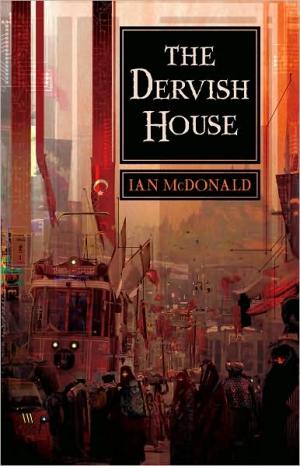
In the meantime, I’ve got a few things happening around the traps. Over at The Spectator’s Book Blog I’ve got a long piece on Ian McDonald’s The Dervish House, which despite being passed over for the Arthur C. Clarke Award in favour of Lauren Beukes’ rather fab Zoo City won the BSFA Award for Best Novel last week and is shortlisted for the Hugo Award for Best Novel. As I say in the piece it’s a travesty a writer of McDonald’s talents isn’t better known outside SF circles, especially given how little separates his work from that of writers such as Richard Powers and David Mitchell, so if you don’t know him I really do recommend checking the book (and indeed the review) out.
Elsewhere I’ve posted my review of Téa Obreht’s The Tiger’s Wife to the Writing page, something I promised to do weeks ago. Obreht is in Sydney for Sydney Writers’ Festival in a few weeks, and the book is both good and interesting, so take a moment to check it out if you get a chance.
And finally if you’re in Sydney you’ve got two chances to hear me gasbagging on in the next couple of weeks (and then about a thousand once the Festival begins, but I’ll do a separate post about that soon).
The first is on this week’s episode of TVS Channel 44’s Shelf Life, which features an interview with me about reviewing and writing online. I’ve not seen it, and the first screening was actually last night, but the show is on air three more times this week: today (Wednesday) at 1:30pm, Friday at 8:00am and Saturday at 12:30pm. If you don’t get Channel 44 or you’re outside Sydney you can stream the show from the TVS website.
And if that’s not enough I’ll be appearing alongside P.M. Newton, Kirsten Tranter and Sophie Hamley as part of When Genres Attack at Shearer’s Bookshop in Leichhardt at 7:30pm on Friday 13 May, a session devoted to exploring what it is that fascinates each of us about genre television and fiction, and to asking some questions about how we think and talk about genre, and how that’s changing as the cultural landscape changes.
And yes, I’ll be back later this week. At least I hope I will.
’The Changeling'
Appears in Jonathan Strahan's Fearsome Magics. Compare prices for the UK print edition and US print edition; also available for Kindle (US and UK) and most other ebook formats.

 Just a quick link to my review of China Miéville’s Embassytown in this morning’s Weekend Australian. As the review hopefully makes clear, I think it’s Miéville’s best book by some distance: brilliantly conceived, powerfully imagined, thrillingly fertile, and while I do think there’s a slight slackening in the second half, when the narrative frame opens out to take in the large-scale breakdown of the society it depicts, the first half is so good it hardly matters. All of which is a roundabout way of saying just read it, it’s fabulous.
 Heartfelt congratulations to my friend, Delia Falconer, whose very personal tribute to her home town,


 and
and 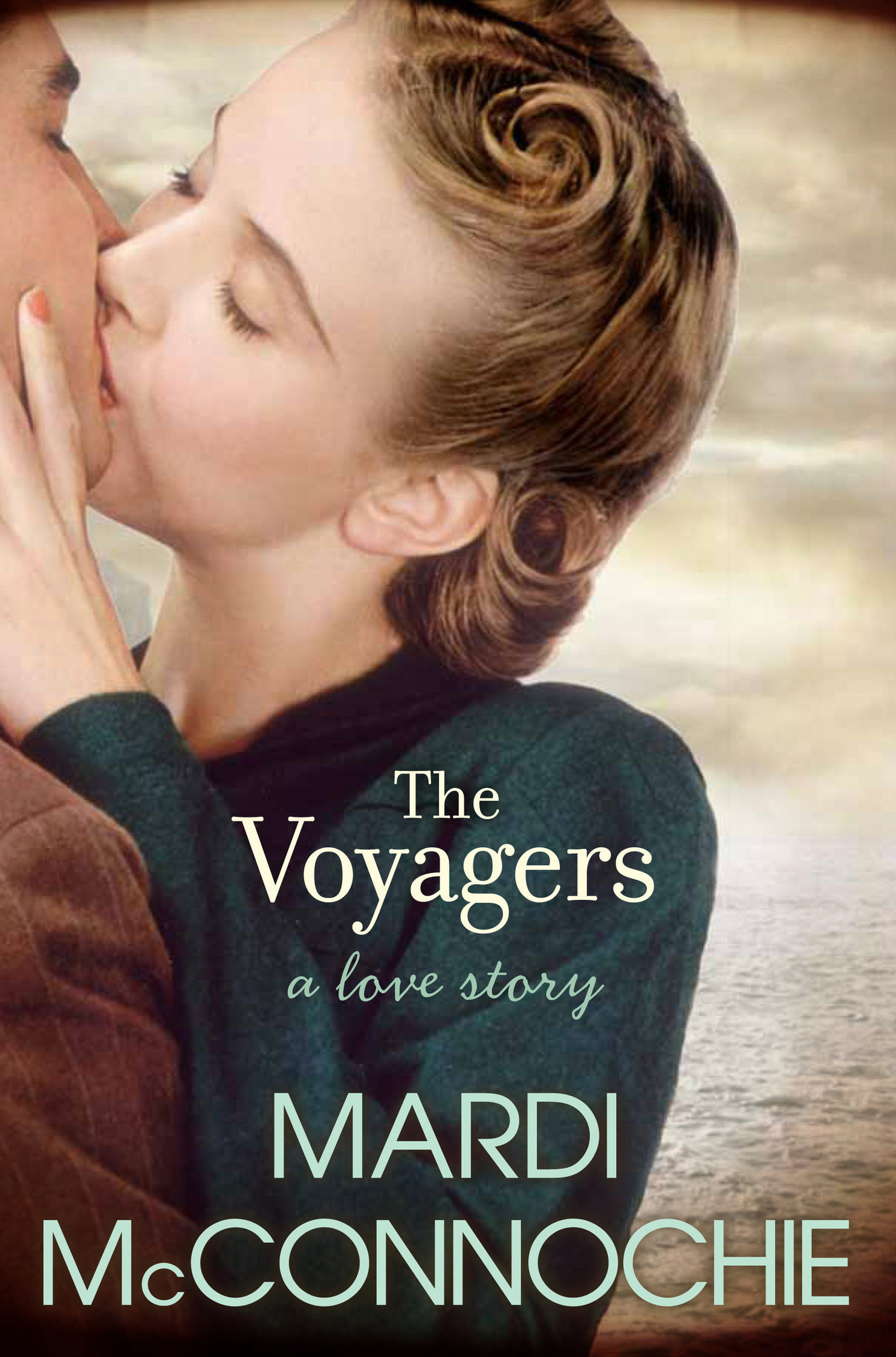



 city of tongues