Skip to content

Archive for

The Book of the Ocean

As I mentioned a while back, one of the projects I’ve been working on for a while now is an anthology of writing about the ocean for Penguin. It’s been a fascinating process, both because it’s given me a chance to revisit a number of books that have meant a great deal to me over the years and because it’s forced me to acquaint myself with many more I didn’t know, or only knew by reputation.

As the imbroglio over the Macquarie/PEN Anthology demonstrates, assembling anthologies is a perilous business. The bigger the subject, the more people have invested in it, the more likely you are to come in for a bucketing for mistaken emphases and omissions. And since the literature of the ocean is one of those subjects which is both vast and weighed down by its history it’s one that offers plenty of pitfalls.

As a result I decided early on that I had no desire to be either definitive or exhaustive. Instead my intention has been to assemble a relatively personal collection, which draws together a selection of writing I love. As someone whose life has been spent on the shores of the Southern and Pacific Oceans I also decided I wanted to put together a collection that spoke to and about that experience, rather than concentrating on the exploration of the northern seas that has traditionally preoccupied collections of this sort. In practice that’s meant letting go of a number of things I wanted to use, but it’s also helped give the collection a shape and cohesiveness it might not otherwise have had.

All of which brings me to the point of this post. The book’s now largely done, but I’ve still got space for a few more pieces, so I thought I might call upon all of you out there for suggestions. Is there anything you can think of that absolutely, definitely should be in a book of this sort? Or do you have ideas for things I might have overlooked? Because if you do I’d love to hear them.

A few caveats. I’m not looking for unpublished work or submissions. And while it doesn’t have to be Australian I’m very keen for a couple more pieces by Australians. Likewise, given the fact most of the pieces I’ve got so far are by men, I’m very interested in suggestions about work by women which might be suitable. And in the interests of preserving my sanity I’ve also limited the collection to writing in English, so no Jules Verne or Bachelard.

And please don’t assume I’m only after prose. Although the collection is predominantly prose it contains poetry, so suggestions for poems (especially Australian poems!) about the ocean are very welcome. Likewise I’m relaxed about whether it’s fiction or non-fiction, though since this is a book aimed at the general reader I’m not after academic writing, or monographs (which has, much to my regret, precluded a couple of idols of mine like Greg Dening I was hoping to include). What matters is that it feels urgent, and necessary, and – though obviously this isn’t something any of you are able to gauge – that it fit with what’s already in place.

I’ll look forward to your ideas.

Break text

Invasion of the Bodysnatchers

Donald Sutherland as Matthew in Philip Kaufman’s Invasion of the Bodysnatchers

I was reminded this morning (during a Twitter exchange about the iPad) of Philip Kaufman’s fantastic 1978 version of Invasion of the Bodysnatchers, a film which must rank as one of my all-time faves.

Kaufman’s wasn’t the first film based on Jack Finney’s 1955 novel, The Body Snatchers, nor was it the last. In fact there have now been four big-screen versions, beginning with Don Siegel’s classic 1956 version and ending with the lugubrious 2007 Nicole Kidman/Daniel Craig vehicle, The Invasion (if you’re interested in watching the set there’s also Abel Ferrara’s charmless 1993 version, a film whose chief distinction is that it’s mercifully short). But I think there’s little doubt it’s the best (with the original 1956 version running a close second).

While Kaufman would quickly go on to make his name as a director with films such as The Right Stuff and The Unbearable Lightness of Being, at the time of Invasion of the Bodysnatchers’ release he was mostly known for his low budget 1972 Jesse James film, The Great Northfield Minnesota Raid. Yet he nonetheless attracted a remarkable cast, headed up by Donald Sutherland and Brooke Adams as Matthew Bennell and Elizabeth Driscoll, Leonard Nimoy as self-help guru Dr David Kibner, and a then relatively unknown Jeff Goldblum as Jack Bellicec.

For those unfamiliar with the story, it’s devastatingly simple. Alien pods drift to earth, bringing plants which grow into copies of human beings, latching onto people as they sleep and absorbing their memories and appearance but none of their humanity. Gradually, but inexorably, they begin to infiltrate the population, replacing them, until the last vestiges of human individuality are wiped away.

A lot of the film’s pleasure lies in its understatedness. Set in a wintry San Francisco, amidst the already alien-looking buds of cropped plane trees and shot in a muted palette of browns and greys, it takes the anonymity of urban life and uses it to unsettling effect. As the characters go about their lives people push past them in the streets, their relentless movement and anonymity becoming increasingly disturbing; occasionally the steady, and increasingly deliberate movement of the passers-by is disturbed by a figure breaking and running, but for a long time the city might be any city, anywhere.

Pulling against this ordinariness Kaufman injects one horrible detail, which is the scream the replicants use to identify ordinary, unaffected humans, and which makes the film’s final, terrible denouement so chilling. I had hoped to provide a video of one of the characters screaming, but sadly the only one I could find is cut from close to the film’s end, and so I was reluctant to use it for fear of spoiling what is, surely, one of the great cinematic moments.

But there are other, wonderful details as well, not least the omnipresent garbage trucks, little emblems of ordinariness which take on a quite different meaning as the film progresses, and it becomes clear they are being used to dispose of the bodies of the replicated, or the bizarre use of bagpipes playing ‘Amazing Grace’.

Like John Wyndham’s The Day of the Triffids, which I’ve written about on this site before, part of what makes Invasion of the Bodysnatchers so chilling is the inexorability of it all. There is no plan, no strategy, there is just arrival and assimilation. Like the Borg in Star Trek, the pods seem to have no purpose but to absorb humanity, to make us like them.

But I suspect the real horror of the story in all its incarnations lies in the way it plays upon deepseated anxieties about absorption and loss of individuality. It’s not just that there’s something horrible and uncanny (in the full, Freudian sense of the word) about these emotionless copies, it’s that our anxieties about the erasure of individuality are so deep that any vehicle which triggers them can be redeployed over and over again in different contexts, bouncing off whatever fears are circulating in the culture. In the 1950s it was Communism (or its dark passenger, McCarthyism), the 1970s blank-faced hippies and Moonies, in the 2000s it was the notion of surveillance, of revealing oneself (a theme taken up to similar, but much more powerful effect in Richard Powers’ brilliant 2007 novel about brain damage and individuality in post-9/11 America, The Echo Maker): as a man advises the increasingly terrified and desperate Nicole Kidman on a train in The Invasion, “Don’t show any emotion, just look ahead. They can’t tell who you are if you don’t show any emotion”.

Break text

The Divine Miss Lewis

It’s been a while since I posted anything by the entirely fabulous Jenny Lewis, so since I’ve just stumbled across this rather nice live version of my favourite track off her last album, Acid Tongue, I thought it couldn’t hurt to share it. And despite spending half an hour trawling for information about new material, I couldn’t find any. Does anybody out there know if there’s a new album on the horizon?

Break text

Break text

Some thoughts about Avatar Part 1: 3D and reality

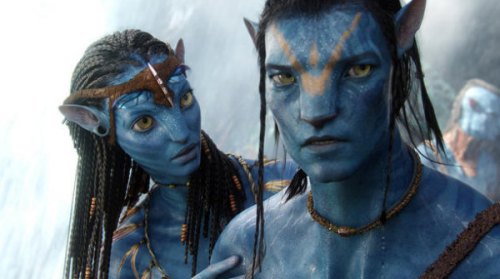
Neytiri (Zoe Saldana) and Sully (Sam Worthington)

Given the sheer volume of discussion of Avatar online, and the fact that it’s now a month since the film was released, I’ve been a little reluctant to chip in with my two cents worth. But while the time for anything like a straight review is long past, I feel like there are some things worth saying about it that don’t seem to have been said to date.

Because what I want to say is reasonably extended, I’ve decided to break it up into two (or just possibly three) posts. The first – this one – is about the 3D technology of the film; later in the week I want to say a few things about the film’s broader message, and perhaps about what it is that seems to work (and not work) in it.

To begin with, I think it’s worth observing just how overwhelming the response to the film has been. I can’t think of another film in recent years which has generated anything like as much commentary as Avatar, or (perhaps more interestingly) which has managed to chew up so much bandwidth across so many channels. You’d expect a genre film, especially a genre film as expensive and technically striking as Avatar to be generating a lot of commentary on sites which cater to fanboys, but it’s a lot less usual for a genre film (or indeed any film) to be generating continuing commentary on the opinion pages of the major international broadsheets.

At least part of this can be attributed to the film’s politics, which have enraged right-wing commentators around the world (or at least inspired the sorts of absurd posturing that passes for outrage in right-wing circles). I’m not going to rehash their arguments here, which mostly turn on the mawkishness of the film’s ecological and political subtexts, but I would observe that there’s something telling about the sheer ferocity of the Right’s hostility to messages which are, at one level, so unexceptional (after all, as Elvis Costello almost asked, what’s so threatening about peace, love and understanding?).

But I’m not sure the somewhat confected political debate about the film’s politics really explains its transformation into a full-blown cultural phenomenon. Certainly it’s difficult to imagine the armies of people who’ve trooped off to see the film having a Road to Damascus moment as they head home to their houses filled with the sort of consumer technologies that made the film possible and deciding to give it all away for a simpler life (nor, I suspect, would the many corporations with a stake in its success be impressed if they thought its anti-consumerist message was actually hitting home).

Instead the film’s impact seems to be a result of the technologies that make it so striking, in particular Cameron’s extremely sophisticated fusion of 3D and digital special effects.

In itself this is hardly a remarkable observation, but stay with me for a moment. 3D isn’t new, but after the success of Avatar I think we can assume it’s here to stay. There have already been announcements that films ranging from the new Bond film to 2012’s Star Trek 2 and the now-Sam Raimi-less Spiderman 4 will be shot in 3D, and while the technology will presumably take a while to trickle down into smaller, less spectacle-driven productions, I think there’s little doubt it will.

To my mind the interesting question isn’t whether 3D will gradually displace older, 2D technologies, but what that will mean for the way we see and experience film (or indeed whether it is fair to continue to describe the future of visual storytelling as “film”). As anyone who’s seen it knows, what’s really exciting about Avatar isn’t the story (though to tell the truth, I found it completely absorbing, all my caveats about the woodenness of its storytelling notwithstanding) or even the effects (which are, quite simply, extraordinary) but the sense of immersion. As many before me have observed, the film largely declines to employ the sort of cheesy things-shooting-out-of-the-screen-at-you gimmicks 3D films have usually confined themselves to, and instead concentrates on creating a world you enter as if it were real.

Interestingly, I think the sheer novelty of the experience rather overwhelms the fact that as a simulation of real space the film is actually rather crude. There’s depth, but objects and figures often seem more like planes moving in space than actual three-dimensional things (rather like a $300 million Captain Pugwash cartoon, I suppose). That’s not to say it isn’t amazing, and – as the film’s publicity reminds us – unlike anything we’ve seen before, but it is to be reminded that for all its wonder to an audience in 2010, within a decade Avatar is likely to look as crude as the original Star Wars does now. Likewise I suspect it’s fair to assume that 3D film and television are probably only transitional technologies, and that the future lies in holographic projection or some similar technology.

But crude or not, I think there’s little doubt Avatar is the embodiment of Cameron’s recognition that cultural forms are, in a very deep sense, artefacts of the technology that create them. Novels take the form they do because of the codex book, movies the cinema (and increasingly, television) screen, video games the computer screen. So moving from 2D to 3D isn’t just about adding depth to films, it’s about creating something new, something unlike anything we’ve had before.

In a minor way this is visible in the textures of the film itself. Despite the immersiveness of the 3D Avatar often seems curiously flat texturally. Given the riot of colour that is Pandorum, it would be impossible to describe it as washed-out, but more than once I found myself nostalgic for the vivid density of colour digital images and digital film have made us familiar with. There are a few moments that have it – most memorably the early scenes in space, which draw upon NASA’s photographs of the ISS and shuttle missions – but for the most part Pandorum (and by extension the film itself) doesn’t look dense or vivid enough to be “real”.
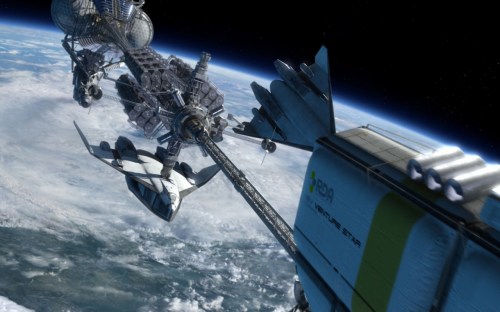
Arrival at Pandorum

But this density of colour is itself new, a consequence of the shift to digital imaging, and the increasingly blurry line between reality and representations of reality, a line films like Avatar are making even blurrier. What looked “real” to an audience familiar with Technicolor looks strange to us, just as the more liquid surfaces of analog photography seem increasingly other-worldly to a culture more accustomed to digital reproduction.

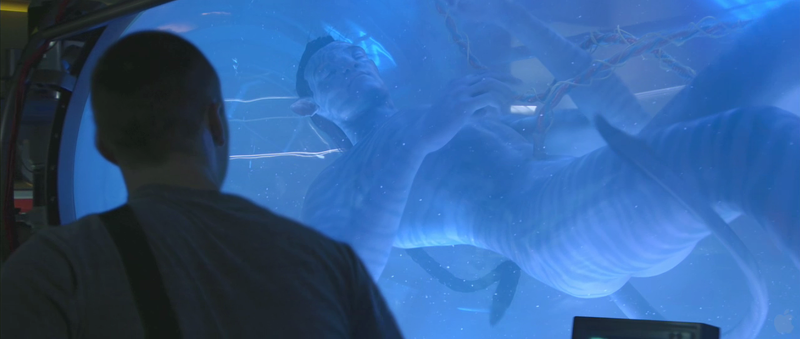
This is doubly true of Avatar’s use of 3D, which breaks the fourth wall in a truly revolutionary manner. Instead of watching the film, the audience are in the film. I’ve not read everything that’s been written about the film, but it seems odd to me that people haven’t made more of the fact that Cameron quite deliberately situates a second, imaginary immersive technology at the centre of the film, as if to suggest the film is, in some small way, a very crude version of what Sully and the others experience “dreamwalking” in the avatars themselves.
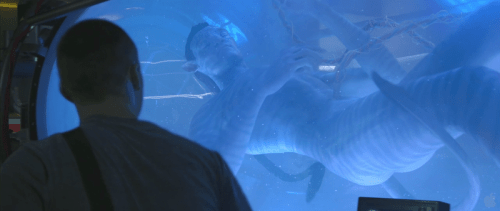
Sully (Sam Worthington) and his avatar

But the avatar technology also – and importantly to my mind – invokes the computer game. I don’t mean by this that the film is intended to celebrate gaming or leverage a computer game (though it’s certainly not too cynical to suggest there’s nothing accidental about the very obvious continuity between the textures of the film and the textures of Avatar: The Game). Instead I think Cameron invokes gaming because he understands – whether consciously or not – the synergies between the immersiveness of 3D moviemaking and the computer game.

In a very crude sense, computer games and film have been converging for some time. In the gaming world it’s long since ceased to be surprising for a game to be “cinematic”, and, conversely, I think it’s fair to say the largely digital textures of a lot of action and science fiction films often seem to resemble those of the more sophisticated games.

Critics of games and gaming usually point to the crudeness of the interactions, or the lack of interiority in games as a sign of their inferiority to older forms such as fiction and film. But that seems to me to miss the point. Games aren’t about interiority, they’re about agency, and often, the creativity of the player. They are an experience, a means of entering another world.

Of course this is precisely what Sully does in the film when he steps into his avatar’s body (and again when he leaves the control of the mission and becomes one of the Na’vi), and what, in a cruder sense, the film allows the viewer to do. And while the agency enjoyed by a player is absent, the sense of immersion moves the experience beyond that of passive consumption, suggesting something more like possibility, or even escape. Indeed the film very deliberately suggests this longing for freedom, and for escape through its early concentration on Sully and his ruined body, and the sense he only becomes fully alive, and fully real in the moment he steps into the avatar.

Which brings us back, I think, to the question of what 3D will do to film, and perhaps more profoundly, film’s storytelling. All forms of fictional narrative – novels, films, television series, even fairy tales and folk stories – create worlds. But the shift to 3D makes this process central, emphasising the viewer’s immersion in the world of the film, just as computer games emphasise the player’s immersion in the world of the game. It also, in the longer term, suggests new forms of interactivity, and, I suspect, narrative possibilities (at the very least POV pornography is unlikely to ever be quite the same). And, more deeply, it hastens our transition into a world where the virtual and the real are essentially indistinguishable, and where our sense of what is real is hopelessly enmeshed in the technologies we use to reproduce it. As filmmakers like Cocteau understood long ago, 2D film has always, at some deep level, been about a kind of dreaming, a way of projecting our fantasies onto the screen (it’s not accidental we watch movies in the dark, or that film is essentially insubstantial, a play of light upon a screen); with 3D those dreams cease to be insubstantial, and begin to populate the world around us.

Break text

Lean on Pete

Is Richmond Fontaine frontman Willy Vlautin the greatest writer you’ve never heard of? Judging by what I’ve read of his forthcoming novel, Lean on Pete, the answer may well be yes. I’m planning a longer post about Willy and his books and music sometime soon, but in the meantime you might want to check out this lovely little video of him reading from Lean on Pete, with backing music by Richmond Fontaine. And if you like what you hear, I thoroughly recommend checking out his first two novels, The Motel Life and Northline at Amazon, Readings or Book Depository, or dropping past Richmond Fontaine’s Myspace page. Or you could just go the whole hog and and download a copy of Richmond Fontaine’s fantastic 2009 album, We Used To Think The Freeway Sounded Like a River via their Bandcamp page. I promise you won’t be disappointed.

Break text

Break text

How does this uncritical anti-science nonsense end up on the front page?

Am I the only one who’s completely horrified by the Australian media’s embrace of the ongoing publicity campaign by the Catholic Church over the canonisation of Mary MacKillop? Not content with wall-to-wall coverage of the announcement just before Christmas, we’re now being treated to nonsense like this and this (and this!) on the front pages of the newspapers.

Rather than fulminate at length, I’m going to confine myself to a few questions. How is it even remotely okay for major newspapers to be publishing uncritical articles about “miracles” on their front pages in 2010? Have we really lost the fight against the anti-science mob that comprehensively? If such claims were made by another, less established religion or belief-system (let’s say Scientology, or perhaps the Exclusive Brethren) would they be allowed to go through to the keeper so easily? And what does that tell us about the power and influence of the big churches, and the Catholic Church in particular? And finally, and perhaps most pertinently, why are editors who are so resistant to the scientific evidence surrounding climate change so uncritical when it comes to this sort of religious claptrap?

Break text


This one’s for you, John, or “I built a sex robot in your memory”

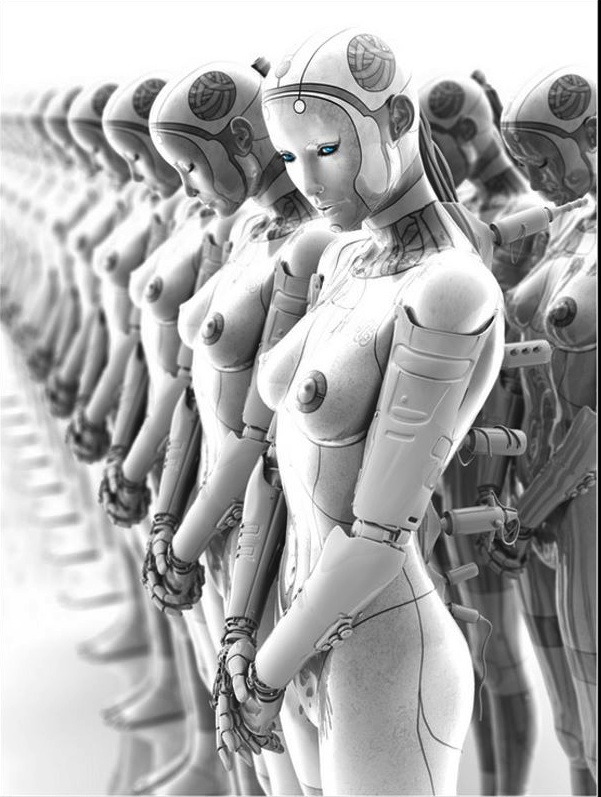
I’m sure more than a few of you will have seen the story out of this week’s Adult Entertainment Expo about the launch of TrueCompanion’s “anatomically consistent” artificial intelligence-driven sex robot, Roxxxy.

I’m reasonably unmoved by the story itself: sex robots aren’t new, and I think it’s safe to assume they’ll grow more sophisticated and lifelike in years to come (if you’d like to know more you might want to check out Shouting to hear the echoes as an introduction to the wild and wonderful world of Synthetiks).

But there’s a detail buried in The Sydney Morning Herald’s coverage of the launch which had me choking on my muesli. Apparently:

“Inspiration for the sex robot sprang from the September 11, 2001 attacks. ‘I had a friend who passed away in 9/11,’ [Roxxxy’s creator, Douglas Hines] said. ‘I promised myself I would create a program to store his personality, and that became the foundation for Roxxxy True Companion’.”

Now, quite aside from the fact this is pretty much the plot of Caprica (which I’ll be reviewing in the next couple of weeks), am I wrong in thinking there’s something splendidly weird about the idea of creating a sex robot to commemorate a friend’s passing? And, if we wanted to get all psychological for a moment, that there’s something about the way the idea mixes up subject and object (literally and metaphorically) which goes to the heart of pornography and the sex industries more generally? Or is it just that Marx was right all along, and all history, no matter how dreadful, is eventually and inevitably reborn as farce?

Break text

A sneak peek of Matt Smith as the Doctor

I’m just interrupting my desperate race to the end of a first draft imposed silence to let you know a trailer featuring Matt Smith as the Doctor has found its way onto the internet. I think David Tennant is going to be a hard act to follow (though after the truly ridiculous first part of ‘The End of Time’ I’m not sure the end of Russell T. Davies’ reign is necessarily such a bad thing) but any episode which features the Doctor hitting a Dalek with a sledgehammer has to be worth a look.

Break text

Break text