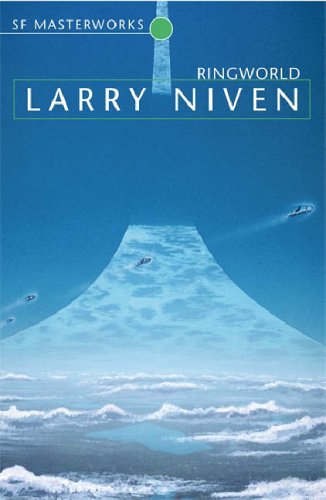
The air was warm and clean; it cleared some of the fumes from his head. He walked the brightly lighted slidewalks, adding his own pace to their own ten-miles-per-hour speed. It occurred to him that every city in the world had slidewalks, and that they all moved at ten miles per hour.
The thought was intolerable. Not new; just intolerable. Louis Wu saw how thoroughly Beirut resembled Munich and Resht … and San Francisco and Topeka and London and Amsterdam. The stores along the sidewalks sold the same products in all the cities of the world. These citizens who passed him tonight looked all alike, dressed all alike. Not Americans or Germans or Egyptians, but mere flatlanders.
In three and a half centuries the transfer booths had done this to the infinite variety of Earth. They covered the world in a net of instantaneous travel. The difference between Moskva and Sydney was a moment of time and a tenth-star coin. Inevitably the cities had blended over the centuries, until place-names were only relics of the past.
San Francisco and San Diego were the northern and southern ends of one sprawling coastal city. But how many people knew which end was which? Tanj few, these days.
Pessmistic thinking, for a man’s two hundredth birthday.
But the blending of cities was real. Louis had watched it happen. All the irrationalities of place and time and custom, blending into one big rationality of City, worldwide, like a dull grey paste. Did anyone today speak deutsch, English, francais, espanol? Everyone spoke Interworld. Style in body paints changed all at once, all over the world in one monstrous surge.”
Last week I mentioned that the September Meanjin has an essay by me about ghosts and ghost stories. At the time the piece was print-only, but I’m delighted to say it’s now available online in its entirety.
Obviously I think you should read it right away, but once you have I think you should come back here, because in the week since it was published it’s acquired an extremely unsettling postscript …
The new Meanjin is out today, and as well as being an incredibly gorgeous physical object, includes a piece by me about ghost stories and recent research suggesting many of our encounters with the uncanny may have a physiological basis. You can buy the issue in good bookshops, online or you can subscribe (a particularly good deal at present because Meanjin are offering five issues for the price of four during September), but if you’d like a taste, here are the first few paragraphs:
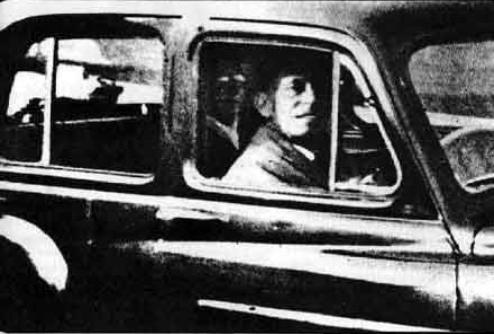
In 2007, while on a residency in Paris, my partner and I took time out to visit friends in London. It was August, and we were fortunate enough to be offered the opportunity to mind a friend’s mother’s house in Balham Hill. The first night we stayed we were tired; it had been a long day, travelling on the Eurostar with our fifteen-month-old, and so we ordered a pizza, watched television and went to bed early.
I have never been a good sleeper, especially in unfamiliar places, but that night I was asleep almost as soon as my head hit the pillow. For a time I slept undisturbed, but then, sometime deep in the night, I woke, falling out of a deep dreamless sleep into the sort of strange wakefulness jetlag induces. At first I was disoriented, the room unfamiliar in the darkness. Next to me I could hear my partner breathing. Gradually I realised where I was, but even as I did
I was gripped by the certainty I had not woken of my own accord, and that something, somewhere, was wrong.
And then, quite suddenly, I heard a child cry …
Update: the piece is now online, so you can read it at your leisure. But when you have make sure you come back and read the postscript. Alternatively you can buy Meanjin 71/3 online or subscribe.
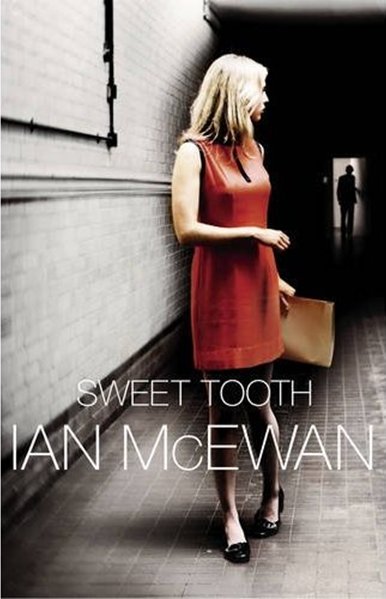
Some of you may have noticed I had a review of Ian McEwan’s new novel, Sweet Tooth in Saturday’s Weekend Australian.
I’ve reproduced the review over the fold in case you’d like to read it, but before you do I thought I might point you toward my reviews of Karen Walker’s vastly overhyped The Age of Miracles and Lauren Groff’s wonderful Arcadia, both of which appeard a few weeks ago, and both of which are books I want to fold into a longer piece I’m working on about the current fashion for dystopia, and what it tells us about the state of science fiction and our imagining of the future more generally.
And while you’re there you might want to check out my reviews of G. Willow Wilson’s Alif the Unseen, and Kim Stanley Robinson’s 2312, both of which I’ve now posted on the site.
I’m always slightly bemused by the fact it’s Middle Cyclone that’s ended up being Case’s breakout album, because if the truth be told the album I find myself going back to the most is the one before it, the brilliant and luminous Fox Confessor Brings the Flood, a disc that might be less polished than Middle Cyclone, but is starker and stranger and filled with that very special sense of magic and discovery you get when a writer or musician or artist is suddenly liberated into the possibilities of something new.
Here’s an interview and a live performance of ‘Hold On, Hold On’. Jump to 7:24 for the song.
And while I’ve got you can I recommend you check out the rather hilarious Nash Edgerton video clip for ‘Duquesne Whistle’, the first track from Bob Dylan’s new album, Tempest (and while you’re there Alexis Petridis’ review of the album, which pretty much nails my feelings about it (not least because I’ve spent a lot of the past week listening to the extraordinarily brilliant Highway 61 Revisited and Blonde on Blonde)) …
And because I can’t resist it, here’s Bowie’s ‘Song for Bob Dylan’, off Hunky Dory (another album I’ve been working hard lately) and a lovely HD video for ‘Life on Mars’.
I’ve got a story in the new Big Issue, which hits the streets today. Entitled ‘Solstice’, it’s part of the magazine’s annual Fiction Issue, which this year is focussed on fiction about the end of the world.
I’ve not had a chance to read the whole magazine yet but since it features stories from writers of the calibre of Margo Lanagan, Miles Franklin shortlistee Tony Birch and Sophie Cunningham, as well as an essay by the depressingly multi-talented James Franco I’m sure it’s brilliant.
Of course it’s always a buzz when a new story goes out into the world, but I’m particularly pleased about the publication of this one (which is set ten minutes from now amidst the melting glaciers of Antarctica) because it’s also the first part of the novel I’ve been working on for the past few months, and which I’m very, very excited about.
So what else can I say but do yourself a favour and grab a copy of the magazine today? After all, how often do you get to grab a pile of great stories and help people who really need it at the same time?
A while back I was plugging The Fabulous Ginn Sisters’ fantastic 2010 album, You Can’t Take a Bad Girl Home. There’s no sign of a new album by the sisters in tandem, but I’ve just discovered Tif Ginn released a solo record a couple of months back. Although it’s available for download on iTunes, it’s a little hard to lay your hands on the CD (I bought it from them direct), but it’s got the same mixture of sweetness, toughness and smarts that made You Can’t Take a Bad Girl Home so great. There’s a live version of one track below, and you can hear more on their website.
Oh – and apparently you pronounce their name with a hard “g”, as in “guilty”.
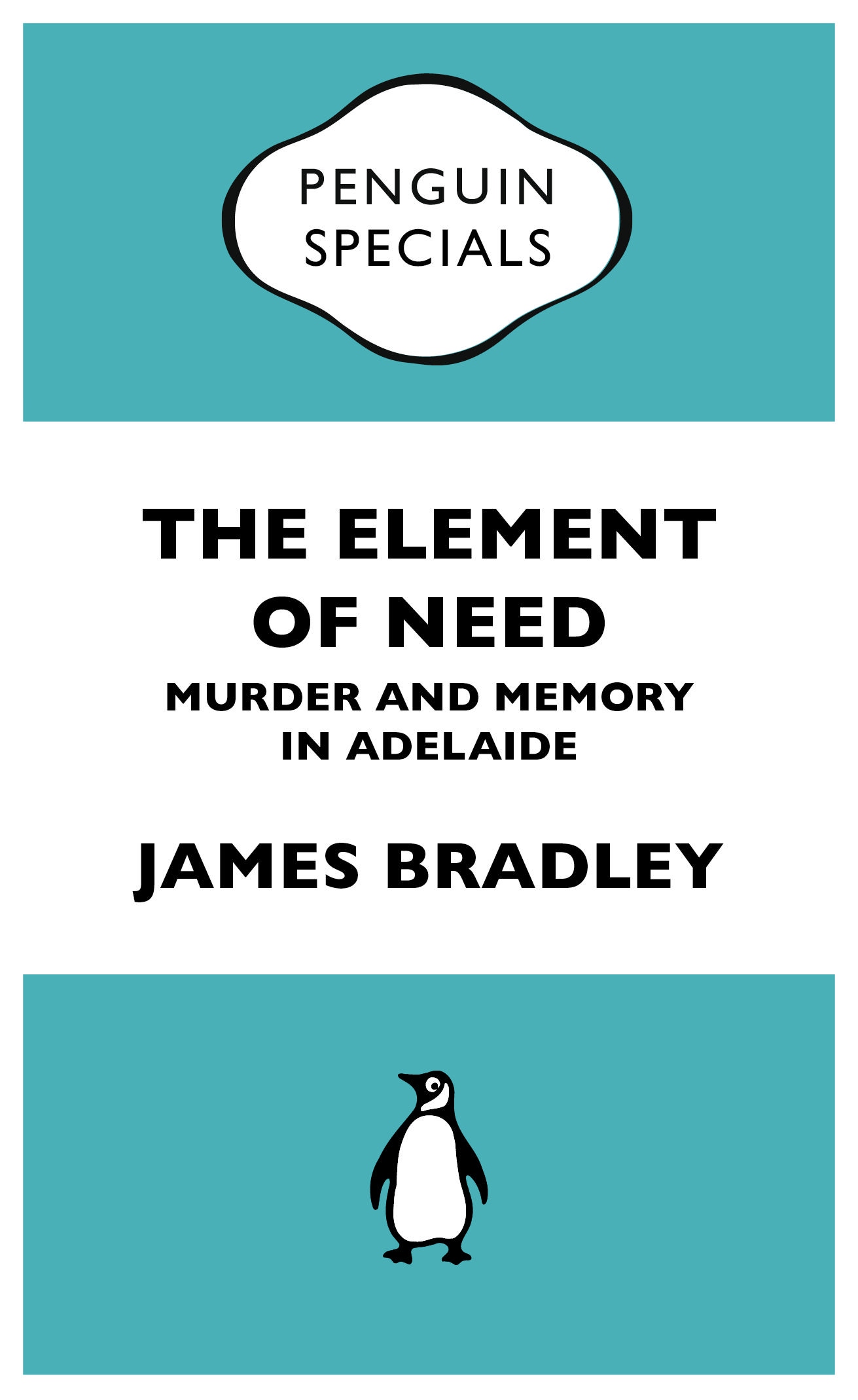
I’m delighted to be able to say my essay ‘The Element of Need’ has just been released as one of Penguin’s new digital-only Specials. Originally published in 2008 in Heat, and republished in Best Australian Essays 2009, it’s a work that matters very much to me, not just because I’m very proud of it as a piece of writing, but because I’ve lived with the material in it for a long time.
As you’ll probably guess if you read it, it was a very personal and quite confronting piece to write, not just because the material in it about the various murders and abductions that have taken place in Adelaide over the past four and a half decades is so unsettling, but because it’s very much about trying to tease out some things about my own past and identity that aren’t easy to talk about.
You can read the blurb for it on the Penguin website, but in case you’d like a sample here are the opening paragraphs:
“At night, in summer, gully winds push down out of the hills encircling Adelaide and swirl across the plain towards the sea. Produced by the weight of the cooling atmosphere above pressing down and forcing the warmer air trapped in the valleys outwards, they build through the evening and into the small hours, moving restlessly through the suburbs and parks with a sound that seems to belong somewhere else, somewhere far from human habitation.
“No doubt winds of this sort are a common enough phenomenon, but for me they are inextricably connected with the city of my birth, its peculiar geography and isolation. When I think back to my adolescence and the disrupted, disconnected years that followed, my memories are almost exclusively of the city at night, my own restless movement through its empty streets, the way the winds could make it seem a place of ghosts, its carefully planned grid of streets uninhabited.
“I suspect every adolescent knows this feeling, this need for motion, the restless search for something ill-defined. Sex, or desire, is part of it. But it’s not just about sex, it’s about the need for something to happen, something large enough, powerful enough to answer the need within.
“Of course this is not how it was, or not entirely. But memory deceives us, decomposing into textures, feelings, images. We remember who we were as much as what was, each of us carrying other versions of ourselves inside, things and thoughts we do not speak, or sometimes even fully understand.”
‘The Element of Need’ is available for Kindle, iBooks, Kobo, and Google Play in the next day or two. Sadly it’s only available in Australia for the time being, but international versions will be released soon.
You should feel very free to pick up the Penguin Special edition of my Rapunzel novelette, ‘Beauty’s Sister’, which is also available for Kindle, iBooks, Kobo and Google Play) at the same time. Or if you want to go really crazy, you can grab my short story ‘Visitors’, which was published in the Review of Australian Fiction in May). You might also want to read my 2009 piece ‘On Novels and Place’, which touches on some of the material explored in ‘The Element of Need’.
I don’t often come across books I think everybody should read, but Callum Roberts’ Ocean of Life, which I reviewed for Saturday’s Weekend Australian, is definitely one of them.
My desire for people to read it isn’t because it’s beautiful, or liberating or even particularly wonderfully written. It’s because it manages, better than almost any other book I’ve read, to communicate the sheer scale of the catastrophe that’s taking place beneath the waves.
As I say in my review, I think its contents are likely to prove deeply confronting for many people. Although much of the material Roberts gathers together will be familiar to anybody with an interest in marine ecosystems I suspect the urgency and complexity of the crisis will come as a shock to people who aren’t. I challenge anybody to read the sections on ocean acidification or anoxic dead zones and not feel disturbed, or to feel comfortable reading Roberts’ lucid analysis of the speed with which fish stocks are collapsing through overfishing.
But in a way the most shocking bits of the book aren’t the facts and figures but the allusions early on to the sheer fecundity of the oceans before humans began to harvest them. Early in the book there’s a remarkable pair of excerpts from a work by the Roman writer, Oppian of Corycus (somebody, I have to confess, I wasn’t familiar with prior to reading the book), describing the methods used to catch the huge schools of tuna that once existed in the Mediterranean.
Most of these involve nets, into which the tuna pour, “without end”, but one is more basic, and relies on the use of a heavy log with spikes in it which is then dropped into the water.
I found the idea that fish might have been so plentiful it was possible to catch them with a spiked log mind-boggling, as I’m sure many others will. But once one goes looking there are many such examples available.
One of my favourite concerns turtles. I have a longstanding fascination with turtles, which have always seemed to me to be creatures of great grace and beauty (I’ve wanted to write about them for years), and some of the most distressing material in Roberts’ book concerns them and the rapid declines taking place in many populations. Pacific populations of leatherback turtles, for instance, have declined more than 95% in the past 50 years.
But the example I’m thinking of doesn’t appear in Ocean of Life and doesn’t concern leatherbacks. Instead it relates to green sea turtles. These days there are estimated to be less than 90,000 nesting female green sea turtles left worldwide, yet when Europeans first arrived in the Americas 500 years ago it is believed there were 100 million in the Caribbean alone.
Exactly how reliable these sorts of estimates are is obviously an open question, and not one I’m in a position to assess. Ocean of Life includes an interesting discussion of attempts to derive historical fishing yields from extant data, while other studies have used at prices at market to estimate the same. But whether the figure was accurate or not, the fact is that turtles were once so common in the Caribbean that when Columbus arrived feeding groups often filled the ocean to the horizon, and as late as the eighteenth century ships that had lost their way to the Cayman Islands could steer there entirely by the noise of green sea turtles returning to nest.
If you’re staggered by that idea I suggest you read Ocean of Life, a book that doesn’t just make clear how much trouble the oceans are in, but goes one step further and offers an outline for a plan of action. And once you’ve read it, buy a second copy and send it to your local member of parliament, or hand it on to somebody else. Because as I say in my review, this is one of those rare books about the ocean that should be read not just by everybody with an interest in marine ecosystems, but by business leaders, politicians and policy-makers around the world.
Update: I’ve just discovered there’s an excerpt from Ocean of Life over at Newsweek. Please read it.
So, I’ve been away for a while. It wasn’t really intentional, but I’ve been completely overwhelmed by work and family commitments since about March, and this site is one of the many, many things that have fallen by the wayside. Things have eased off a little lately, but since I’m now working hard on a new book I’m not going to make any rash promises about how much I can manage on top of that.
I’m hoping I’ll get a few things up in the next week or two, but in the meantime I thought I’d link to my reviews Kim Stanley Robinson’s 2312, a book that seems to be getting fairly polarised reactions from readers and critics (for what it’s worth I thought it had extraordinary bits but was less good than I wanted it to be overall) and of G. Willow Wilson’s Arabian Nights/Arab Spring/tech thriller Alif the Unseen, a book that’s generating a huge amount of buzz overseas.
And I’ve plugged the Alabama Shakes before, but if you haven’t heard them, you might want to take a moment to check out this live recording of the title track from their new album, Boys and Girls. It’s a great song, and Britanny Howard’s voice is even more jaw-dropping live than in the studio.
Back next week (or just maybe the week after). In the meantime, here are three tracks from my current musical obsession, Cold Specks’ wonderfully-titled debut album, I Predict A Graceful Expulsion.
On Friday night I caught a preview of Ridley Scott’s much anticipated Prometheus, and since despite the slightly OTT security they didn’t make me sign anything agreeing to an embargo, I thought I’d record my thoughts about this flawed, frustrating but intermittently brilliant film.
The first thing to say is that you should ignore the misinformation about it not being a prequel to Alien, because it is, quite explicitly (and sometimes to its detriment). Indeed if you’ve seen the trailer you’ve probably got the basic idea: trail of archaeological clues lead humans to distant planet, hope turns to terror, horrible secrets consume them.
The film opens on a suitably epic note, with aerial images of a stark, volcanic landscape. The sense we are watching a sort of creation is powerfully evoked, partly by the stirring music, partly by the manner in which the landscape itself echoes the deep structure of biology. Eventually the camera moves in on a figure, which then casts off its cloak to reveal a figure both alien and familiar: a luminously pale, bald, over-muscled giant, who then decoheres, and is absorbed into the thundering water beside him.
In a way it’s a moment that sets the scene for all that follows, combining as it does the visual majesty and brilliance of the film as a whole and the disappointingly unadventurous set of ideas at its centre. Yet the viewer has only a few moments to think about it before the scene shifts to an archaeological dig on the Isle of Skye 70 years from now, and the discovery of what is revealed to be the latest in a series of ancient paintings depicting giant figures gesturing to a particular celestial formation, and then again to a ship en route to a moon orbiting a ringed planet around the stars shown in the painting.
It’s a narrative sequence that explicitly invokes 2001, a reference that is underlined both by the design of the ship and by the scenes of Michael Fassbender’s android character, David, moving through the empty ship, as Keir Dullea’s David Bowman and Gary Lockwood’s Frank Poole do in Kubrick’s film.
These scenes with Fassbender are masterly. As David moves restlessly through the ship, bouncing a basketball, monitoring the crew in cryostasis, studying ancient languages, we glimpse both his solitude and his slightly unsettling self-containment, a combination that is made the more disturbing by a pair of scenes in which he watches the dreams of Noomi Rapace’s archaeologist, Elizabeth Shaw and rehearses the voice of Peter O’Toole’s Lawrence of Arabia.
As ever Fassbender is completely magnetic. Given his capacity to project complexity and intelligence yet remain opaque, he is perfectly cast as the amoral David, yet in a way it’s his physical performance, from the oddly off-kilter squeaking of his slippers on the spaceship floor in the opening scenes (itself a playful reference to the sticky slippers of the space hostess in 2001, as well as a piece of pleasingly Kubrickian weirdness, I suspect) to the way his bleached hair and stick-insect delicacy seem to channel not just O’Toole’s Lawrence but David Bowie’s performance in Nicholas Roeg’s The Man Who Fell To Earth that are most memorable.
Yet like much else in the film, and the brilliance of Fassbender’s performance notwithstanding, David is a creation that gestures towards greatness without ever quite achieving it. Partly that’s because despite several great scenes (one in which he asks whether the humans might be disappointed to discover their alien creators, the “Engineers”, made them for the same reason they made him – because they could – is particularly impressive) his intentions and agenda are never really clear.
But it’s also because like so much in Prometheus it’s difficult not to feel we haven’t seen this before. Despite the brilliance of Fassbender’s performance, David feels like an ambulatory reworking of HAL, or indeed any number of unreliable, out-of-control androids in fiction and film.
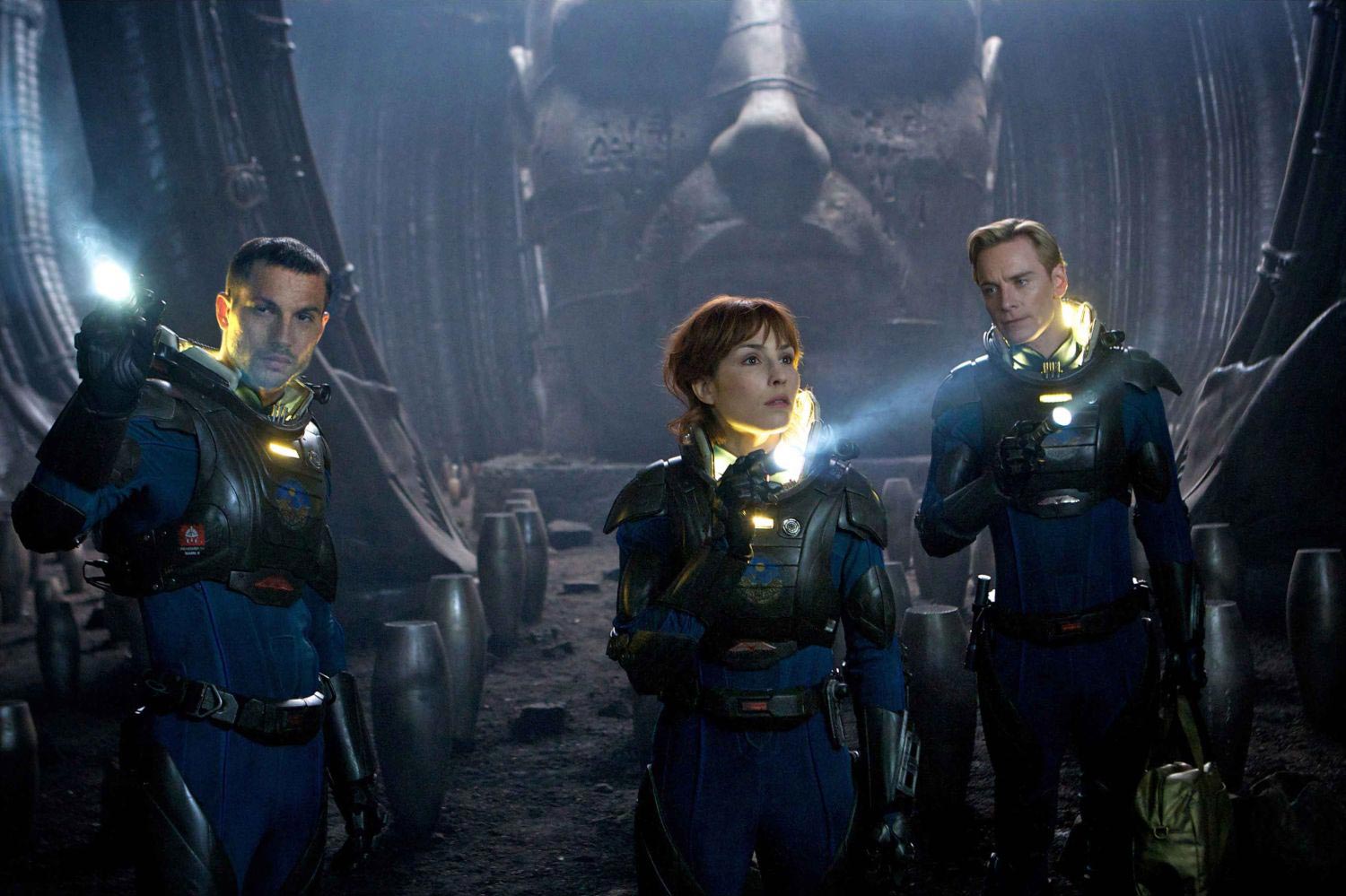
Archaeologists Charlie Holloway (Logan Marshall-Green) and Elizabeth Shaw (Noomi Rapace) explore the alien installation with the android, David (Michael Fassbender).
This sense the film is reworking extant themes is partly deliberate. As the title suggests it is a film grounded in other texts, some classical, some filmic. As well as the repeated invocations of the story of Prometheus (the story of the expedition, the story of the fate of the alien Engineers, the creation of David and David’s quest for knowledge) there are references not just to Old Testament sources and other religious sources (and indeed the work of Erich von Daniken, which draws upon both), the now-extensive mythology surrounding the original Alien and its sequels and spin-offs, films such as 2001 and finally to Scott’s own oeuvre (the opening scenes of the film, together with the brooding reminders of the mystery of the afterlife seem to speak to the scenes of the wind on the wheatfields and Russell Crowe’s monologue about the same in Gladiator).
This sort of textual overdetermination is common in SF, helping underpin not just the sorts of strategies of estrangement it employs but the extremely fertile and generative ways it relates to reality. Yet in Prometheus it often seems to do exactly the opposite, suggesting not new understandings but gesturing towards old ones, whether in the form of the repurposing of the plot of 2001 (ancient artifact, trip to stars, crazy computer, impossible secrets), or the reminders of Blade Runner,Alien and Aliens (psychopathic androids, greedy corporations etc etc). Even the soundtrack keeps sounding like it’s suddenly going to break into ‘The Flying Sequence’ from Superman: The Movie or the opening credits of Star Trek: The Next Generation.
This is a pity because so much of the movie is so good. Not only is it visually stunning, there are moments of pure horror (the first alien death isn’t something you’ll forget in a hurry) and – perhaps more importantly – a real sense of wonder and transcendence lurking between the banal debates about faith and origins (the scene in which David watches Elizabeth’s memories of a Hindu funeral is particularly well-judged in its subtle reminder not just of fire and death, but the many-faced nature of belief). This combination of genius and muddle (and indeed the preoccupation with death and transcendence and the afterlife) is present in a lot of Scott’s films, even the more successful ones like Gladiator, but it’s particularly evident in Prometheus.
But the real problem is that the ideas at the centre of the film just don’t measure up to the filmic firepower brought to bear on them. It’s not just that many of them aren’t very well-developed (I was fascinated by the suggestion all human languages were rooted in an alien tongue we could track back to, for instance). Or even that when you think about it the plot doesn’t make much sense: (comments invisotexted to hide spoilers – just highlight to read) why did the Engineers build the Aliens? To destroy us? But if they’d created us surely there were easier and safer ways of doing that? And why point us to the moon in the film if they only meant to destroy us? And more importantly, if the facility on the moon was destroyed 2,000 years ago, why are they pointing to it in 35,000 year-old paintings? Surely it didn’t take the Engineers 33,000 years to create the Aliens? Instead it’s that the set of questions the film is investigating are so utterly banal.
It’s a problem that’s obvious in the whole conception of the Engineers and our reaction to them. We’re told several times over the quest to find them is about understanding where we came from. But is that really the most interesting thing about discovering we are the products of an alien genesis? The film might be making a point about human solipsism here, but surely the most important thing about aliens is that they’re, well, alien? Isn’t contact with another species a more important and transformative possibility than discovering we are their progeny?
More deeply though, the alien Engineers aren’t very alien. Some of their tech is incredible – the navigation device David triggers in the starship is a remarkable creation – but there’s something both banal and slightly dispiriting about the fact the Engineers, once we see them, are basically large, over-muscled soldiers of some kind.
I assume this is partly about reinforcing the notion that they’re Titans in a Promethean sense (presumably the presence of Saturnian rings around the planet the moon orbits is meant to reinforce this as well), as well as some kind of Old Testament, Giants in the Earth kind of thing, but it also reveals a real paucity of imagination.
In a way this isn’t surprising to me, especially given the film was written by Damon Lindelof. Lindelof – who together with J.J. Abrams created Lost and helped produce Star Trek – is one of the wunderkind of contemporary Hollywood, not least because he’s revealed over and over again he, like Abrams, has a real knack for creating the sort of mind-bending situations that made Lost so tantalising, at least in its early stages.
I think it’s fair to say Lindelof, like Abrams, is an artist of the ephemeral. His worlds are ungrounded and ultimately meaningless because they don’t seem to connect with deeper images and archetypes. It’s a problem that’s very apparent in Lost, although perhaps more obviously in a film like Star Trek, in which an entire planet is destroyed and it barely resonates, either with the characters or the audience, but it’s also very evident when one compares a show like Fringe to The X-Files and sees the way the latter drew so much of its power from its capacity to tap into deep anxieties about surveillance and the uncanny. Time and again, in both Lindelof and Abrams’ films and shows, we see worlds that are constructed out of secondary sources, geektastic assemblages of gimmicks and references to other films that never exceed their source material (Cloverfield Super 8, a film that is designed not just to mimic the plots but the look and feel of E.T. and Close Encounters is particularly guilty on this score).
Equally important is the fact that Lindelof is much better at creating situations than resolving them. Almost every show he’s been involved with, from Lost to Once Upon a Time, has a brilliant set-up that is gradually revealed to be considerably less interesting than it promised to be (I’d exempt the unfairly-maligned and rather brilliant Cowboys and Aliens from this argument).
I’ve written before about this problem, which is at least partly a function of the way conventional narratives demand resolutions that are at odds with the possibilities they create, something that’s very true with Prometheus. Here the problem is compounded by the need to connect the film to the original Alien (and set up a new franchise) and the manner in which that connection’s explicitness undermines the film’s resolution by locking it into a plot-driven resolution. But it’s also a function of the film’s inability to find a deep, archetypal foundation for the sorts of questions it wants to explore.
This isn’t a problem for Prometheus alone. American film and television seems increasingly to fall back on asinine arguments about faith and belief when confronted with big ideas. “It’s what I choose to believe” the characters in Prometheus say more than once, as if this somehow answers any challenge to their beliefs, or is a meaningful answer to the somewhat sizeable question of what happens to us after death. But quite aside from the question of whether any scientist worth their salt would say something so stupid, this sort of declaration reveals the inanity of the sort of faith-based solutions being proposed. Belief isn’t enough on its own, and neither are the unanchored ideas of spirituality that recur in American film and television.
I suspect this inanity is partly about the manner in which consumer capitalism has decoupled culture and traditional religion. Despite its religiosity American culture has largely given away the symbols and narratives that underpin traditional religion. This might seem an odd thing to say given the rise in fundamentalism, but in fact the two aren’t incompatible: what matters isn’t the narratives but belief, not just in God but in America. A threat to one becomes a threat to the other.
The culture of Hollywood may be less religiose, but in many ways it’s part of the same phenomenon. Severed from the traditional narratives of religion, writers and filmmakers fall back on the inane language of personal growth and faith, a language and discourse that is incapable of plumbing deep because it’s essentially ungrounded. In place of the deep symbols of religion we have exhortations to belief and faith, as if these were ends in themselves.
It’s not helped by the weight of expectation and marketing behind Prometheus. I sometimes think there’s an argument to be made that SF, especially on film, works better when it’s essentially subversive: certainly films like Alien work at least partly because they’re so unexpected, a quality that is much rarer in the lumbering, carefully calibrated studio SF produced by contemporary Hollywood.
But either way it’s difficult to escape the feeling that unlike a film like Alien (or indeed Aliens) which remains fresh today at least partly because it’s so spare and direct and uncalculated, Prometheus pretends to a significance it doesn’t possess. Not just because when you strip away the brilliance of the craft and visual imagination that’s been brought to bear on it the ideas are, frankly, a bit naff, but because it’s so obviously a vehicle designed to set up a sequel, and to connect to the existing films. In doing this it certainly doesn’t damage the originals in the way George Lucas’ horrible and horribly misjudged Star Wars prequels did, but it does make the viewer uncomfortably aware that what they’re watching isn’t really a work of the imagination but the central plank in a vast marketing machine, and, because of that, essentially hollow.
’The Changeling'
Appears in Jonathan Strahan's Fearsome Magics. Compare prices for the UK print edition and US print edition; also available for Kindle (US and UK) and most other ebook formats.

 ) a book I can’t recommend enough. And if that’s not enough Bowie for one Monday perhaps you should take a look at this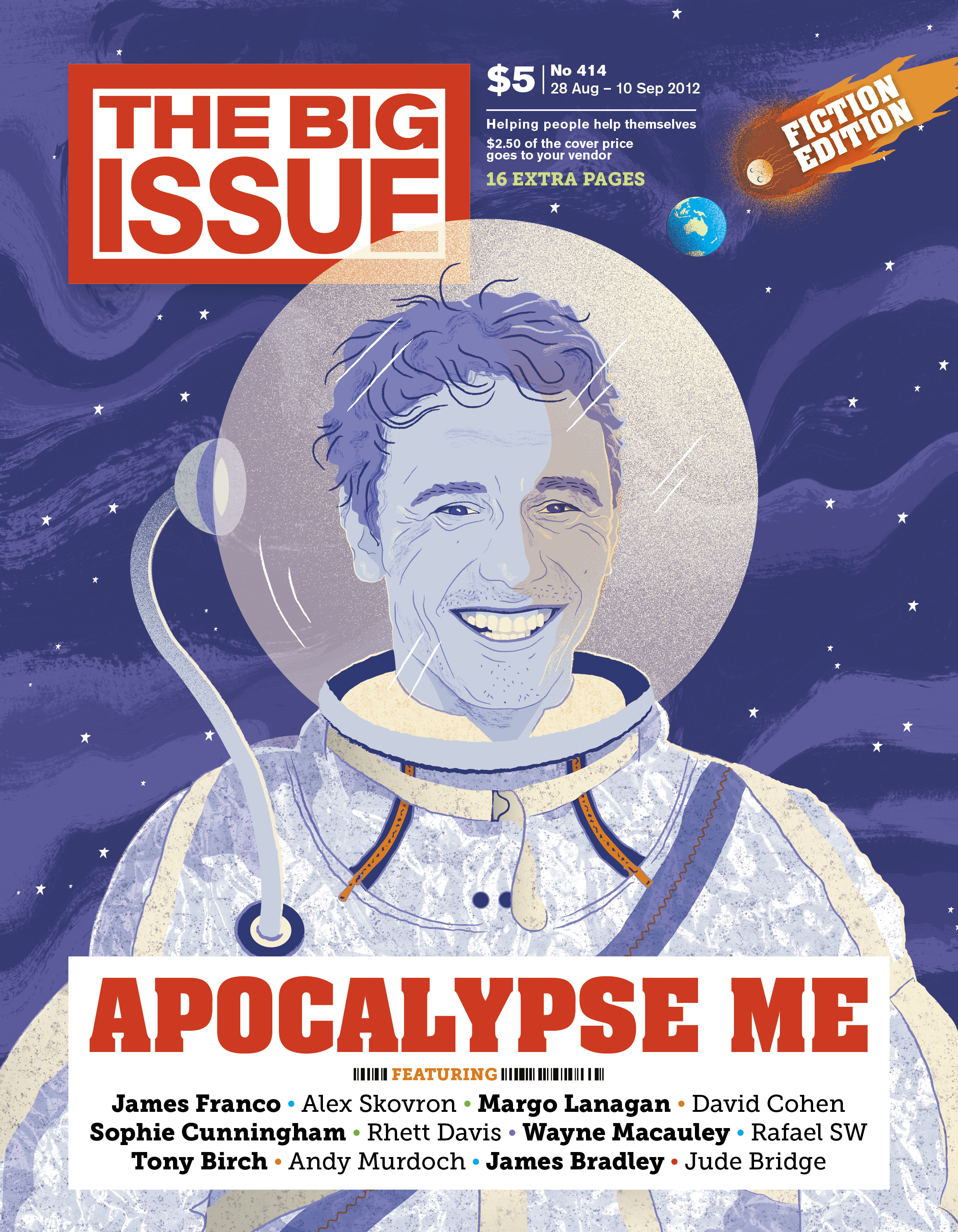





 city of tongues