Skip to content

The blog of my enemy is failing

Karen Andrews

Karen Andrews

Via Overland comes Karen Andrew’s sly update of Clive James’ poem, ‘The Book of my Enemy has been Remaindered’.

And here was me telling some students only a couple of days ago that one of the joys of blogging was that the status anxiety and envy that so shrivels novelists and poets’ hearts just evaporates in cyberspace. Oh foolish, utopian me.

Break text


Break text

addthisTweet this

The Day of the Triffids, 28 Days Later and the end of the world

In his novel, The Day of the Triffids and its vision of a world struck blind and menaced by carnivorous plants, John Wyndham created one of the most enduring nightmares of the Atomic Age. Nearly 60 years later, his vision might equally serve not just as a warning of the perils of genetic engineering, but as a powerful reminder of the very different ways British and American writers imagine the end of the world.

Read more

Three things

Three things I've liked this week.

Read more

Jack Kirby, Jonathan Lethem and Philip K. Dick

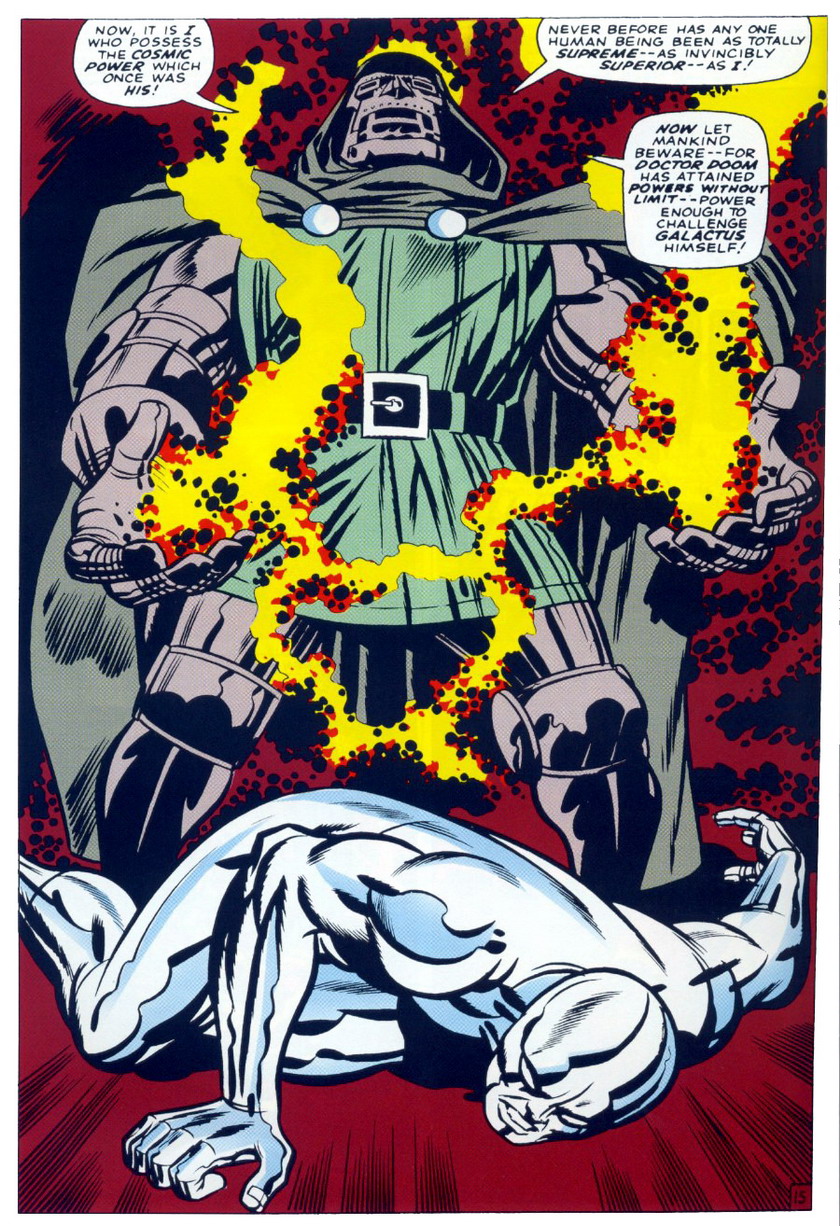
Dr Doom and Silver Surfer

Click to embiggen.

Via io9, a reminder that yesterday (28 August) would have been the 92nd birthday of the legendary Jack Kirby. To celebrate, they’ve assembled a gallery celebrating just some of the characters Kirby helped create over the years, from Captain America to the Fantastic Four, Spiderman and the Uncanny X-Men. It’s worth a look, if only to be reminded of just how significant a role Kirby has played in the creation of late-20th and early-21st century pop culture.

Pleasingly, Kirby’s birthday also gives me an excuse to link to Jonathan Lethem’s fabulous piece about Jack Kirby and the illusions of adolescence, and the mention of Lethem in turn gives me an excuse to link to Forward’s recent interview with him about Philip K. Dick and Lethem’s upcoming novel, Chronic City.

Break text

addthisTweet this

Dave Eggers vs the Wild Things

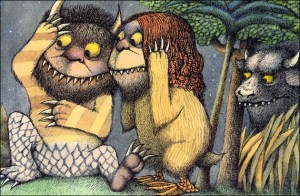
where-the-wild-things-are1If you’re not already feeling exhausted by the promotional campaign for Where the Wild Things Are, this week’s New Yorker has an interview with the freewheeling Dave Eggers, who has a lot of very interesting things to say about The Wild Things, his novelization of the script of Spike Jonze’s film adaptation of Maurice Sendak’s picture book. You can also read a chapter of Eggers’ novel here, or pre-order a special fur-covered edition from Amazon here (go on, you know you want to).

Meanwhile the extended trailer featuring interviews with Sendak and Jonze which was released a few weeks ago seems to have reappeared on Youtube (at the time of my last post it seemed to have been removed for copyright reasons). Hopefully it won’t vanish again, because it’s really rather wonderful to hear Sendak speak about his creation.

And if you’re a bit bemused by the notion of a novel based on a film adapted from a children’s book, perhaps I could point you to Bram Stoker’s Dracula, a book which was not, in fact, Bram Stoker’s Dracula, but Fred Saberhagen’s novelization of Francis Ford Coppola’s movie. Hollywood meet Irony. Irony, this is Hollywood.

Break text

Break text

addthisTweet this

I don’t think we’re in Kansas anymore

wizardOver at Hackpacker the irrepressible George Dunford has posted the text of a piece about the Australian litblogging scene. Originally published in The Big Issue a couple of weeks ago, it’s filled with sage and worldly pronouncements from such luminaries as Jessa Crispin and Yours Truly, but if that’s not enough to convince you to exercise your mousefinger, George’s description of Perry Middlemiss as the white-bearded Wizard of Oz litblogs definitely should.

Break text

addthisTweet this

Dr Strangelove eat your heart out

Some of may have noticed this story in The New York Times, detailing the CIA’s outsourcing of a secret program to locate and assassinate Al-Quaeda leaders to that most gloriously sinister of private security contractors, Blackwater (never heard of them? Then read Jeremy Scahill’s book, or for the crib sheet, James Meek’s review). Now I don’t want to get into a debate about the rights and wrongs of the War on Terrorism, or the implications of devolving military and intelligence work to private companies, but it’s always oddly comforting to be reminded that no matter how paranoid the Left’s fantasies about the military-industrial complex, they only ever seem to scratch the surface. Secret torture and rendition programs? Check. Psychic assassination? Check. Black magic and remote sensing? Check.

Of course all this talk of mercenaries and private armies puts me in mind of Elvis Costello (and yes, that is The Kenny Everett Video Show in the background) . . .

Break text

Break text

addthisTweet this

Go Sleepers go!

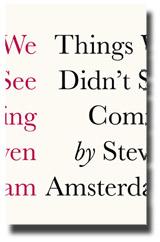
Things we didn't see comingNice to see Steven Amsterdam’s Things We Didn’t See Coming, the first full length piece of fiction from indie publisher, Sleepers Publishing, take out The Age Book of the Year Award on Friday night (Guy Rundle’s account of the US Presidential election, Down to the Crossroads took out the Non-Fiction Award, while Peter Porter’s Better Than God won the Poetry Award). It’s a fantastic result for Sleepers, and more particularly for Sleepers’ founders, Louise Swinn and Zoe Dattner, who seem to me to be an object lesson in just how much you can achieve if you set your mind to it. Six years ago they were organizing readings in a Melbourne pub, a year later they used the readings as the springboard for the first Sleepers Almanac, now they’re publishing full-length fiction and winning major awards. Bloody legends, both of them.

On a more personal note, I’d like to extend my congratulations to the organizers and judges of The Age Book of the Year Award for being prepared to accommodate books which – like Amsterdam’s post-apocalyptic narrative – venture beyond the usually fairly confined territory of literary fiction. As a past winner of the award, and a past winner who won for what was essentially a science fiction novel (The Deep Field), it’s really refreshing to see some of the old preconceptions about what constitutes capital “L” literature being set aside.

Break text

addthisTweet this

F%*k Superman

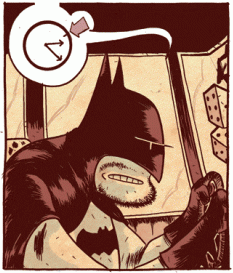
BatmanIf you’ve got a couple of minutes to spare you could do a lot worse than checking out Brazilian cartoonist Eduardo Medeiros’ delightful riff on Batman at Hellatoons. Forget Christopher Nolan’s single-minded Dark Knight, this is the real Batman: a foul-tempered crank in an ageing Cadillac, and it’s hilarious.

Page 1 is here. (Links to subsequent pages are above the image).

Thanks to io9.

Break text

Break text

Break text

addthisTweet this

Arctic Dreams

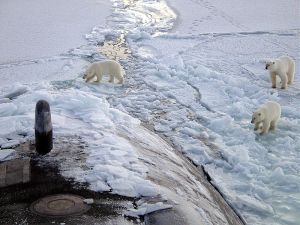
800px-Polar_bears_near_north_poleA while back I did one of those pieces for a newspaper about the books that changed me. Articles of that sort are always slightly weird exercises, as much about selling a version of yourself via your choices as really addressing the question, and I have to confess I don’t remember exactly what books I chose on the day in question (though it’s a fair bet Michael Ondaatje’s In the Skin of a Lion would have been on my list, since the experience of reading it was the thing that set me on the path to becoming a novelist). But I do know that if there’s one book that genuinely has a claim on having changed me, it’s Barry Lopez’s Arctic Dreams, a book which completely altered the way I thought about a whole series of questions about the environment and the way we understand it and our place in it.

Anyway – I wrote the following piece in 2001 for The Australian’s Review of Books, the forerunner to today’s Australian Literary Review, and I recently stumbled on a copy of it on my hard drive while I was working on a review I’ve got in the next issue of Australian Book Review. But what’s frightening about it is that the concerns it expresses were urgent then, eight years ago, yet we don’t seem to have moved any further towards addressing them.

Barry Lopez’s Arctic Dreams begins and ends with the same curious act of respect. A kind of bow, performed before the world he has encountered in the travels through the Arctic. “I took to bowing on these evening walks,” he writes. “I would bow slightly with my hands in my pockets, towards the birds and the evidence of life in their nests – because of their fecundity, unexpected in this remote region, and because of the serene arctic light that came down over the land like breath, like breathing.”

Much later this gesture is repeated, this time on the tip of St Lawrence Island, but in its later incarnation the gesture has moved closer to a kind of stillness, a loss of the self into the land and its rhythms:

“Glaucous gulls fly over. In the shore lead are phalaropes, with their twiglike legs. In the distance I see flocks of oldsquaw against the sky, and a few cormorants. A patch of shadow that could be several thousand crested auklets – too far away to know. Out there are whales – I have seen six or eight grey whales as I have walked this evening. And the ice, pale as the dove-coloured sky.”

The lyric beauty of Lopez’s writing helps transform this simple gesture into a literary artefact of great power and resonance. In his words we glimpse a world that trembles with life, and apprehend, within its detail an otherness we might not otherwise see, a kind of presence which the land embodies, ancient, complete unto itself.

Lopez is first and foremost a visual writer, possessed of a poet’s eye, and his account of the Arctic is anchored in his observation of its terrain, its light, and the animals that inhabit it. Yet it is observation rendered so as to make each moment transcend its detail. Whether it is golden plovers abandoning “their nests in hysterical ploys, artfully feigning a broken wing to distract . . . from the woven grass cups that couched their pale, darkly speckled eggs,” eggs which “glowed with a soft, pure light, like the window light in a Vermeer”, or “herds of belukha whale glid[ing] in silent shoals beneath transparent sheets of young ice”, his writing seeks out the moments when the land reveals itself, where the whole can be glimpsed in the part.

To see in such a way is to contain politics within aesthetics, to transform epiphany into manifesto. It is to suggest a way of seeing that is simultaneously a way of being, as if by seeing clearly we might find connection, and for a moment at least, glimpse the land as something which exists independently of us, possessed of its own meaning. It is, as Lopez puts it, “to be alert for its openings, for that moment when something sacred reveals itself within the mundane, and you know the land knows you are there.”

“You know the land knows you are there.” A notion both simple and strange. Yet this sense of knowing and being known, of seeing and being seen is a way of allowing the imagination to begin conceiving of our relationship with nature as a dialogue, and of nature itself, whether embodied in an owl or the movement of light across the tundra, alive in its own right, “an animal that contains all other animals”, and not something given to us to do with as we desire. This is not science, but in its desire to understand nature, complementary to science, a poetics perhaps, able to contain both the scientific and the moral. Witness Lopez’s description of the intricacy of the polar bear’s physiology and behaviour:

“The interplay here among rest, exertion and nutrition that carries them comfortably through life is something that cannot be broken down into pieces. Like the skater’s long, graceful arc, it is a statement about life, the full exercise of which is beautiful.”

This transformation of aesthetics into politics is central to the tradition of nature writing Lopez is a part of. Ever since Thoreau walked his mile and a half to Walden Pond, writing about nature has been a political act, the expression and the embodiment of a homespun radicalism of peculiarly mystical bent. To see differently, to extend the reach of our imagination through contemplation into other ways of being is to be able to transcend our self, and by moving outside ourselves be granted a new perspective upon our place in the scheme of things. It is to sense the smallness of human history against the story of the planet, and to be made aware of our own impermanence.

There might seem something almost trivial in this appeal to imaginative contemplation given the scale of the environmental catastrophe that surrounds us. The biologist Edward O. Wilson argues that the “maximally optimistic conclusion” is that some 27,000 species become extinct each year, or 74 each day, 3 each hour. Similar estimates put the loss of biodiversity in the next century at somewhere between 25 and 50 per cent, that is to say, one quarter to one half of all species gone forever through human agency within the next 100 years. Given that we have catalogued only the tiniest proportion of this diversity, the vast bulk of these species will vanish unrecorded and unlamented, lost forever.

But it is precisely through the exercise of the imagination that we become able to see the world in such a way as to make sense of this loss, and to understand the cost to ourselves of the failure of imagination that has allowed it to happen. By attending to detail, by learning to see things as they are, we learn to dissolve our selves into the landscape, to become inhabitants of a shared world which exists in its own right, apart from our use of it, one to which we owe a silent respect, and an allegiance.

First published in The Australian’s Review of Books, © James Bradley

Break text

addthisTweet this

I feel all kind of violated . . .

Cylon-cu-in-color_01

Concept art by Nathan Schroeder for Bryan Singer's 2001 Battlestar Galactica remake

After a week of rumours, Universal have announced that Bryan Singer is to produce and direct a cinematic adaptation of Battlestar Galactica.

It’s not the first time Singer (director of The Usual Suspects, the first two X-Men movies and most recently Valkyrie) has been attached to a remake of Glenn A. Larson’s 1970s television cheesetacular. In 2000 Singer developed a mini-series based on the original series for Fox, but despite being scheduled to go into production in November 2001, the project came unravelled in the wake of the September 11 terrorist attacks. In the aftermath of the collapse of Singer’s remake Ronald D. Moore and David Eick were commissioned to reimagine the franchise yet again, leading initially to the 2003 mini-series, starring Edward James Olmos and Mary McDonnell, and subsequently the recently concluded television series.

For those struggling to understand where a remake would fit in the Battlestar Galactica universe created by Moore and Eick, which ended (satisfactorily or not) with the remnants of the Human and Cylon civilizations finding Earth, they need struggle no longer, because it is clear Singer’s version, which is being produced in collaboration with Larson himself, will not be a continuation of Moore and Eick’s show, but a wholly new interpretation of the material.

Superficially at least it’s difficult to imagine why Universal, and more particularly Singer, would want to make a Battlestar Galactica without Edward James Olmos’ Adama, or Mary McDonnell’s President Roslin, or Katee Sackhoff’s Starbuck, to say nothing of their extraordinary vision of Cylon society, particularly given that, with at least one television movie, The Plan, still to screen, and the prequel spinoff, Caprica, scheduled to begin on SyFy next year, Moore and Eick’s version isn’t even cold in its grave yet. With what is now widely regarded as one of the most audacious and powerful television shows ever made so fresh in the memory, why make a movie the very existence of which seems certain to alienate much of the show’s fan base? And what, given the sheer complexity and metaphorical power of Moore and Eick’s version, does Singer think he can bring that is fresh to the material?

Of course there’s nothing new about the cannibalistic nature of science fiction, and science fiction film and television in particular. Like horror and fantasy, science fiction has a long tradition of freely borrowing, adapting and just straight appropriating tropes, devices and ideas. Remakes abound, as do thinly-disguised copies. Indeed the original Battlestar Galactica owes its existence to the success of Star Wars, and was the subject of a lawsuit by George Lucas for copyright infringement, a lawsuit which is itself ironic given the fact that it is difficult to imagine a film more aware of cinematic history, and more laden with appropriations than Star Wars itself.

As I’ve observed before, Moore and Eick’s version makes powerful, and often amusing use of this same history. Intended as a reboot rather than a sequel of Larson’s original 1970s version of the show, it incorporates elements of the original version without ever quite accepting the original series as prehistory. The basic premise, of a catastrophic attack on the Twelve Colonies, and the desperate search of the survivors for the lost Thirteenth Colony, Earth, is retained, as are the names and identities of many of the original characters, but simultaneously the now-dated futuristic technology of the original show is utilized as the technology extant in the Cylon Wars 40 years earlier, transforming the original series into something like mythological prehistory.

In places this prehistory is given playful, or ironic effect, as in the Cylon helmet on display in the museum in the mini-series, the chainsmoking Dr Cottle, or the antiquated computers of the ageing Galactica. And in this sense it is only one of a number of echoes of other science fiction texts within the fabric of Moore and Eick’s version of the show, in particular the appropriation of the term “skinjob” from Ridley Scott’s Blade Runner (itself, of course, an adaptation of Phillp K. Dick’s Do Androids Dream of Electronic Sheep?) or the use of Minority Report’s dreaming precogs (again themselves inspired by a Dick story) as the model for Battlestar Galactica’s Delphic Cylon Hybrids.

But more importantly, Moore and Eick’s play with the original series allows their reimagined version to incorporate the original series into their version’s already somewhat overdetermined mythic structure, joining texts as disparate as Virgil’s Aenied, Exodus, Paradise Lost, The Book of Mormon, more potent, contemporary anxieties about terrorism and the War on Terror, and the Classical, zodiacal associations invoked by the names of the Colonies and the characters as part of the dense web of allusion within which the show operates.

But the cannibalistic nature of the genre – and indeed the show itself – aside, it’s still difficult not to feel there’s something peculiar in the notion of rebooting the show again, so soon. Why, one wants to ask, what can a reboot do that Moore and Eick’s version didn’t?

The problem is that this is exactly the wrong question to ask. Universal aren’t interested in finding something new in the material, any more than the creators of Transformers or GI Joe were interested in the ideas behind them (such as they were). What they want is a property that will allow them to unleash the machinery of the contemporary Hollywood spectacular, together with the associated merchandizing and marketing campaign. The precise nature of the property is relatively unimportant in the whole equation. What matters is that it provides a canvas upon which the digital wizardry of contemporary filmmaking can be unleashed.

Looked at this way a number of the more puzzling revivals of recent years seem a little less peculiar. Land of the Lost didn’t come into being because someone had a burning desire to tell the story of the Sleestak on the big screen. It came into being because the studios knew they had the technology and the promotional machinery to create a summer blockbuster, and Land of the Lost provided a convenient tentpole for them to deploy them. And, by using an extant property, they didn’t even have to go to the trouble of creating something new.

With this in mind it’s not difficult to imagine what Singer’s Battlestar Galactica will be like. Say goodbye to Moore and Eick’s handheld camera work and silent, spinning space battles; say hello to digital explosions and monster robots. Say goodbye as well to the complex political subtexts: no doubt there will be gestures in that direction but the nature of the beast (and indeed the somewhat lugubrious nature of Singer’s filmmaking) almost ensures they will be little more than gestures; what Universal will want is Transformers in space, and that, presumably, is what Singer will give them.

Break text

addthisTweet this

Where the Wild Things Are

Hot on the heels of the extended interview feature comes a new, full-length trailer for Spike Jonze’s movie of Where the Wild Things Are. And, despite my longstanding scepticism about the notion of a movie of Sendak’s book, I have to say it looks amazing.

(And that wild, exultant music in the background? It might sound like Jonze’s old pals in The Polyphonic Spree, but it’s actually ‘Wake Up’, from Arcade Fire’s debut album, Funeral).

Break text

Break text

addthisTweet this

The shame of snip and share

Offscreen Film Festival 2008 @ Brussels. Photo: Jeffrey De Keyser.

Offscreen Film Festival 2008 @ Brussels. Photo: Jeffrey De Keyser.

When I started this blog I was worried it would distract me from what I rather stuffily thought of as my “real” writing. I don’t feel that way anymore. Indeed this odd little online creation isn’t just very definitely part of my real writing, it’s also often the bit I enjoy the most.

The thing I didn’t understand back then was that the real problem with blogging isn’t that it’s time-consuming, it’s that it’s completely tyrannical. Don’t post for a day and you feel bad about it, don’t post for a week and you start to feel like you’re letting everybody (including yourself) down. Half the time I feel like I’ve woken up to find myself playing the part of Seymour in an online version of Little Shop of Horrors.

Which is, of course, a roundabout way of apologizing for the fact the site’s been a bit neglected lately. It’s not intentional, just that between work and the fairly appalling schedule I’m on with my novel I’ve been struggling to find the time to post. I think – I hope – things have turned the corner a bit, and I’ll be getting some stuff up this week, but I’m not going to go making any big promises.

To which end I’m going to do something I generally avoid, which is offer a few links in place of content. I’ve got nothing against linking per se, but it always seems a bit like cheating, the sort of thing you do when you’re too busy to write something original. Which I am, of course, but if I keep typing fast enough perhaps I can distract you from that*.

So, without further ado. The most recent issue of The New Yorker has a fascinating interview with Ursula Le Guin, focussed in large part on her 1969 classic, The Left Hand of Darkness, and her feelings about its then-radical take on gender politics, and the manner in which they simultaneously reflect the more conventional attitudes of its times. They’re interesting questions, not least because they recur in the context of Le Guin’s revisionist re-entry into the world of Earthsea in Tehanu (and to a lesser extent, The Other Wind), a book which attempted to unpick the patriarchal underpinnings of one of fantasy’s most remarkable – and enduring – creations.

Meanwhile, over at Sight and Sound, you can read the single best piece of writing about television I’ve read this year, as Kent Jones probes the allure of The Wire. As I’ve said here before, despite my admiration for its many very real achievements, The Wire is a show I often find frustrating. Given the critical consensus that it is one of, if not “the greatest television show ever made”, that often leaves me feeling like a naysayer, but Jones very elegantly teases out many of what I’d see as the show’s weaknesses, while simultaneously illuminating the things which make it so remarkable.

In a completely different vein, at The Chronicle of Higher Education, Michael Ruse uses an exploration of the scientific and philosophical antecedents to James Lovelock’s Gaia hypothesis to examine what has always seemed to me to be one of the more oddly neglected aspects of the climate change debate, which is the manner in which it encapsulates a more fundamental argument about the nature of science itself. And, at The Guardian, Lovelock himself gives one of his trademark doomsayer interviews to celebrate his 90th birthday.

And finally, ever wondered about the link between heroic drinking and great writing? Well at Intelligent Life Tom Shone has some answers (and they may not be the ones you want to hear).

* The eagle-eyed amongst you may have noticed I’ve been using Delicious to post links in the right-hand column for a while now. Sadly they’re not that obvious (and I’m less diligent than I might be in keeping them up to date) but when I finally get my redesign off the ground I’ll be expanding that functionality.

Break text

addthisTweet this

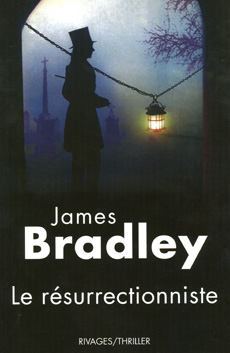
Le Résurrectionniste

Le Resurrectionniste

I’ve always taken a pretty hands-off attitude to translation and translation rights. That’s probably partly because I’m so embarrassingly monolingual, but it’s also about an awareness that you have so little control over the process that it’s better not to let yourself worry too much about it.

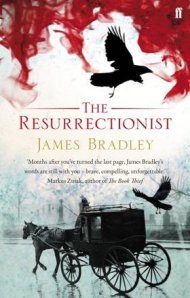
That’s not to say I don’t know any of my translators. I’ve recently been in correspondence with the Brazilian translator of The Resurrectionist and I had quite a bit to do with the German translator of my first two novels. In both cases the things they needed clarifying were small, culturally-specific details (most recently about the bonding of convicts in early New South Wales) or points of fact they were unsure about (or I’d not been as clear about as I might have been).

But the one foreign publisher I do have a relationship with is Payot & Rivages, who have just published The Resurrectionist in France.

It’s a relationship that came about largely by chance. Despite my execrable French, I was fortunate enough to spend the second half of 2007 at the Australia Council’s Keesing Studio in Paris, and since I’d sold the French rights shortly before I arrived I thought it couldn’t hurt to give my publishers a call.

Being as exquisitely courteous as most French people, they not only arranged to meet me, but made a great fuss of me, taking me to lunch and inviting me to their home for dinner.

That in itself was a wonderful gesture, and one made the more special by the somewhat hilarious moment when my translators (unusually they’re brothers who work together) asked me what music I listened to while I was writing the book. It seemed a bit of an odd question, but as I’ve mentioned before that I listened to a lot of Philip Glass while I was writing the book, partly because I found its almost hypnotic qualities helped me get into the right headspace, partly because there was something in the structure and texture of the music I wanted to emulate in the way the book’s parts moved against each other, and so I told them that, at which they laughed in triumph, and said ‘We knew it! We’ve been doing the translation listening to Philip Glass and we knew you’d been doing the same’.

Anyway – the other outtake from the night’s festivities came just before I ate, when I was spirited away to a back room and interviewed on camera. They didn’t tell me I was doing the interview until I’d drunk several glasses of wine, which may or may not be apparent in the excerpts that are now available on their website, but what is apparent is how much more clever and concise I am once somebody has translated me into French. Who knew my rambling, half-drunken words could be turned into such chiselled French prose? Or that I could be so suavely epigrammatic? I suppose the lesson is that I should speak in subtitles more often . . .


The post-newspaper world

metal_typeThe current issue of The New York Review of Books includes an excellent piece by Michael Massing about the future of news. In contrast to the angst and aggro that often surrounds the subject, Massing’s piece is laudably clear and uncoloured by either Wired-style techno-utopianism or stupidly reactive declaratons about the enduring importance of newspapers and the frivolousness and pointlessness of new media forms such as blogging.

To his credit Massing seeks to tease out the increasingly symbiotic relationship between bloggers and conventional journalists, and to emphasize the increasing role bloggers are playing in breaking news, both as part of the daily news cycle and in a more sophisticated, investigative mode. And, interestingly, he suggests the real danger in the shift to decentralized modes of news gathering and dissemination is less about the loss of the resources of the major media companies, and more about the sort of echo-chamber effect that too often predominates on the net, in which people balkanize into self-reinforcing conclaves of shared opinion.

In a way, of course, Massing’s article is a counterpiece to Clay Shirky’s now-famous article, ‘Newspapers and thinking the unthinkable’, which argued that the current convulsions in our media landscape are analogous to the convulsions which reshaped European society in the years following the invention of the printing press. Indeed Massing pushes Shirky’s argument one step further, suggesting a further analogy between the printing press’ role in loosening the grip of the Catholic Church on medieval society and the manner in which blogging and new media are undermining corporate and government control of the flow of ideas in contemporary society.

I don’t think either Massing or Shirky would argue they know what the future of media looks like. But as both make clear, we’re beginning to see some of its outlines. Fewer large media companies and fewer newspapers. More rapid dissemination of opinion and ideas. A shift away from professionalized news-gathering and opinion towards news-gathering and dissemination by amateur or non-traditional sources. The increasing predominance of news services defined by their ideological positions.

All of these make many of those familiar with old media such as newspapers deeply uncomfortable, just as the rise of television news has traditionally unsettled those who give primacy to the sorts of values that are supposed to prevail in print journalism. Yet for my part I’m broadly optimistic about the future. Partly this is about my feeling that newspapers have never been the paragons of liberty their defenders claim them to be. But it’s also about recognizing that what’s happening is, in some sense, inevitable and evolutionary. As the technological underpinnings of our society change, so will our society, and there’s a level at which it’s better to see that as a positive, rather than fighting a rearguard action you’re destined to lose. What’s happening is painful, but it’s also exciting, and creates new possibilities on every side.

None of which is to say I don’t have concerns about how we manage the process, not the least of which is the question of how we manage to finance new media organizations capable of breaking news and carrying out investigative journalism in smaller countries such as Australia. Massing goes to some lengths to point out that rather than being parasitic, as they are often accused of being, increasing numbers of American political bloggers are now generating sufficient revenue to take on larger and more complex stories, involving considerable research and travel.

This revenue seems to be being drawn from a range of sources, but the bulk of it still seems to be coming from donations. That’s not a problem in and of itself, but I do wonder whether it’s a model we’re capable of replicating in Australia, a country with a significantly smaller population than the USA, and a far less established philanthropic tradition.

This isn’t to say there aren’t already groups in Australia seeking to develop models to enable such projects. I mentioned Swinburne University’s new fund to support public interest journalism a while back, and there are certainly other such projects in development.

But I think there’s little question the difficulties associated with setting up and financing new media outfits in Australia are exponentially greater than in the US. While it’s partly a legacy of its history, it seems telling that the one really successful Australian non-traditional news organization, Crikey!, runs on a subscription model, rather than by allowing free access to all its content and financing that through advertising or other sources.

Some have suggested the solution is some form of state funding, whether via direct subsidy of the sort the French Government has offered the French newspapers, grant-based funding of the sort employed in the cultural sector, or some sort of public trust model. For myself, I’d be very surprised if any of these models were either politically palatable or even particularly workable, though I’d be lying if I said I knew what the alternatives were. But it does seem to me the question of how we finance new media news services in a small country such as Australia is a real issue, and one the American or even the British experience is unlikely to offer answers to.

Break text

addthisTweet this