Skip to content

Art criticism done right

piece

I’m planning to be back on deck later today (or just possibly tomorrow) but in the meantime I have to thank my friend Dionne for alerting me to Regretsy, absolutely the funniest thing I’ve seen on (or off, for that matter) line in a long while. It trawls handicraft site, Etsy, for masterpieces of naive and not-so-naive art in order to offer its own unique perspective on the items for sale. It’s vindictive, cruel, totally unfair and out-and-out hilarious.

I know, I’m cheap, but I laughed so much I cried (then again I’m the sort of crypto-philistine who got the giggles over this).

Break text

addthisTweet this

Peter Carey’s Gumtree

Jesters

There’s a nice little moment in this week’s episode of Movie Extra’s rather excellent new comedy, The Jesters, in which the Mick Molloy character, Dave Davies (a thinly disguised Doug Mulray) is informed by his agent, Di Sunnington (the marvelously deadpan Deborah Kennedy), that Jane Campion wants him to play the part of the villain in her new movie, Gumtree. Worried it’s an arthouse flick, Dave presses her for a bit more information, only to be told it’s based on a Peter Carey novel. “Have you read it?’ he asks, to which Di replies with haughty disdain, ‘Don’t be stupid, it’s a Peter Carey novel, nobody’s read it”.

It’s a cheap line, but it’s a funny one (it doesn’t hurt that every time I hear Deborah Kennedy say “Don’t be stupid,” I’m reminded of her fabulous performance opposite Sam Neill in Death in Brunswick), the only problem is that (a) the book they’re talking about doesn’t sound anything like a Peter Carey novel, and (b) from the plot description and the title it’s clearly meant to be Murray Bail’s Eucalyptus, which was famously about twelve hours away from being made into a movie starring Russell Crowe and Our Lady of the Immovable Face, Nicole Kidman, when it came suddenly and spectacularly unravelled a couple of years ago.

All of which does, in a way, make the joke even funnier. Because the laugh depends on the assumption no-one reads Peter Carey, and the general risibility of Australian writers and writing, but in fact they’ve had to change the name of the writer the joke is really about because while enough people will have heard of Peter Carey to make the joke work, absolutely nobody’s heard of Murray Bail.

Oh dear.

(Just btw, here’s a clip from this week’s episode, an “out-take” of Molloy’s Dave Davies doing his nut on set).

Break text

Break text

addthisTweet this

A three part musical interlude (or all retro, all the time)

In lieu of managing to post some actual content, I’m going to cheat and offer up some music I’m digging at the moment.

First up, the wonderful Pete Molinari. I really wanted to use something off his fabulous album from last year, but I couldn’t lay my hands on anything. But this video for the title track from the EP he cut with the Jordanaires last year, Today, Tomorrow and Forever, is incredibly cute in its own right, so it seemed a reasonable substitute.

Break text

Break text

And, staying with the retro vibe, here’s Mayer Hawthorne with ‘Just Ain’t Gonna Work Out’:

Break text

Break text

And last, but by no means least, the late, lamented Libertines (never got the point of Pete Doherty? You will in a moment):

Break text

Break text

And I promise, some real posts are on the way. I’ve just got to get out from under all this work . . .

Break text

addthisTweet this

23 years after Chernobyl (or the nuclear fool cycle)

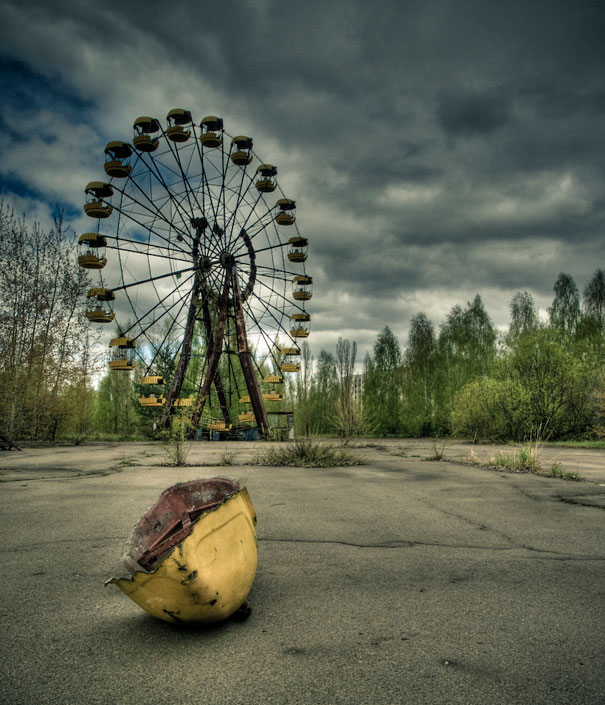
Chernobyl-Today-A-Creepy-Story-told-in-Pictures-funfair

Pripyat Funfair, © Ben Fairless

One of the more bizarre side-effects of the climate change debate is the fact that it’s given new life to the nuclear power lobby. Indeed it sometimes seems that every time I turn on the ABC or open a newspaper there’s some talking head doing his utmost to convince us that not only is nuclear power now safe, it’s also the only technology capable of offering emission-free alternative to fossil fuels. Never mind that we still have no way of dealing with the waste (at least until Generation IV technology becomes a reality), never mind that the emissions generated by extracting and processing uranium far outstrip the emissions generated by coal-fired stations, never mind the possibility of accidents or sabotage, nuclear power is the way to go. (I suppose the one point in their favour is that nuclear technology actually exists, unlike the ludicrous fantasy of “clean” coal).

Of course nuclear power is precisely the sort of boysy technology that appeals to a particular kind of smart man, not least because it allows them to do their “I’m the sort of man who’s prepared to take hard decisions without being fazed by silly, sentimental anxieties about the environment,” routine, but you’d think even they’d be able to hear themselves when they declare that the technology is now foolproof (like that unsinkable ship, the Titanic, I suppose).

Anyway – I thought in the context of that debate it might be worth linking to this remarkable series of photographs of Chernobyl. Gathering together work by a number of photographers, some born in the area, others not, they speak not just to the destructive force of the accident, and the scars it left on the place and its inhabitants, but in their haunting reminder of the way the forest is reclaiming the Exclusion Zone, to the hubris of presuming human society and its creations are anything more than a hiccough in the larger cycle of life and time.

(via io9).

Break text

addthisTweet this

My face, my valuable (and immobile) face!

botoxYou know those moments you don’t think celebrity culture can get any more absurd?

“Dannii Minogue has revealed how she became addicted to Botox injections while her sister Kylie was battling breast cancer.” (from news.com.au)

I’d complain, except the subject of plastic surgery allows me to bring up two of my favourite subjects. First, the always entertaining AwfulPlasticSurgery.com (go on, you know you want to take a look). And second, that most misunderstood and delightfully, shamelessly trashy of shows, Nip/Tuck, a confection which, aside from giving Dannii’s ex-husband, Julian McMahon, the role he was born to play (don’t laugh, he’s scarily good) manages to somehow combine the most lurid and fantastical melodrama with an uneasy and often quite unsettling meditation on the illusions of beauty and the decay of the body. No doubt its unevenness of tone and quality has something to do with the fact it’s never quite found the audience it deserves, but when it’s good, it’s great.

(And yes, ten points to anyone who picked up the obscure Simpsons/Sideshow Luke Perry gag in the title).

Break text

addthisTweet this

The foulest thing I’ve seen this week

Click to enjoy in more detail

Click to enjoy in more detail

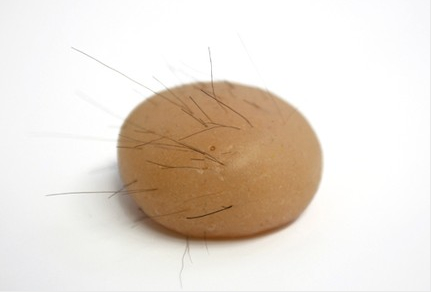
Via my friend Adam comes this photo of a parasite known as Cymothoa exigua, which lives by invading the mouths of fish and attaching itself to their tongues. According to Wikipedia:

“It then proceeds to extract blood through the claws on its front three pairs of legs. As the parasite grows, less and less blood reaches the tongue, and eventually the organ atrophies from lack of blood. The parasite then replaces the fish’s tongue by attaching its own body to the muscles of the tongue stub. The fish is able to use the parasite just like a normal tongue.”

Choice.

Break text

And here's a side view for added viewing pleasure

And here's a side view for added viewing pleasure

Break text

addthisTweet this

The perils of ubiquity

FT004BpreviewThe 10 August issue of The New Yorker has a piece by Alex Ross about the growing number of online retailers offering high-definition music downloads. It’s worth checking out, not least because he mentions David Lang’s hauntingly beautiful Little Match Girl Passion, and Stile Antico’s equally magnificent recording of Palestrina, Gombert, Lassus and others, Song of Songs (I have to confess the harpsichord pieces by Jan Pieterszoon Sweelinck he mentions all sound a bit hard to me, but I’m very interested to hear Ann Southam’s “immense, glacial, hypnotic piano work”, Simple Lines Of Enquiry).

Although much of the piece is occupied with the manner in which recording technology is altering what we hear when we listen to music, Ross is also worrying away at another, deeper question, about how we as a culture and as individuals accommodate a situation where the availability of music radically outstrips our capacity to absorb and understand it. As he puts it:

“For a century or so, the life of a home listener was simple: you had your disks, whether in the form of cylinders, 78s, LPs, or CDs, and, no matter how many of them piled up, there was a clear demarcation between the music that you had and the music that you didn’t. The Internet has removed that distinction. Near-infinity awaits on the other side of the magic rectangle. Video and audio stream in from around the world. The other day, I watched Karol Szymanowski’s King Roger, in an interestingly horrible new production from the Paris Opéra (courtesy of the European arts channel Arte); took in Mahler’s Ninth at the Proms (courtesy of BBC 3); and then bought a virtual seat in the Berlin Philharmonic’s Digital Concert Hall, which had an HD video of Simon Rattle conducting Robert Schumann and Bernd Alois Zimmermann, the agility of the camerawork outdoing the robotic Great Performances standard. (Berlin’s harp-cam is especially cool.)

“But these meandering journeys across the Internet soundscape can be taxing. The medium too easily generates anxiety in place of fulfillment, an addictive cycle of craving and malaise. No sooner has one experience begun than the thought of what else is out there intrudes.”

It’s an interesting question (and one I’ve asked myself before). What does the sheer ubiquity of music and content do to our capacity to engage meaningfully with individual works? Nor is it a concern confined to music: only a few weeks ago Jeff Sparrow was asking, not entirely facetiously, whether the internet was destroying his capacity to read books.

As I remarked when I posted on this subject last time, I’m painfully aware these words are inescapably the articulation of a very particular sort of cultural anxiety, and that it’s difficult to ask these sorts of questions without sounding as if you’re engaged in a lament for what we’re losing. But I do think it’s a serious question. Isn’t the intensity of our reaction to a piece of music or writing a function of a deep and powerful engagement with that piece of music or writing? I know the pieces of music that have mattered to me over the years (Glass’ Metamorphoses, Bach’s Mass in B Minor and St John and St Matthew Passions, Brahms’ German Requiem, Strauss’ Last Songs for instance) are all pieces I’ve listened to repeatedly and often obsessively, sometimes over the space of months or years, and that my relationship to them is inextricably wound up in that process of listening and relistening.

But I also know exactly the feeling of restlessness and dissatisfaction Ross describes. usually it’s worst in the car, where I’ll find myself flicking songs over and over again, often before the last one has finished, looking for the next song I want, the song that will be just right. Like being jacked up on caffeine or speed, it’s a state of nervous dissatisfaction which by it very nature denies you the ability to engage with what’s you’re listening to.

Ross suggests, not implausibly, that the resurgence in interest in vinyl over the last decade might be a reaction against the sheer ubiquity of music in the modern world, a way of controlling its impossible profusion and universal availability. I suspect we all have techniques of our own as well, personal systems and listening habits designed to control our burgeoning digital music collections. Nor is it difficult to see something of the same impulse in the creation of systems like iTunes’ Genius function, or music communities such as Mog, both of which are, in very different ways, technologies designed to filter and control what we listen to by offering recommendations. But these systems are also, inescapably, expressions of a need to preserve our ability to engage with music in a meaningful way, and of the cultural equivalent of the oldest rule of economics, that scarcity and value are inextricably connected.

Break text

addthisTweet this

Bread and Sirkuses

peter_carey

Peter Carey

I’m currently reading Peter Carey’s rather fabulous new novel, Parrot and Olivier in America. Since I’m reviewing it I can’t say much more than that, but I thought I might use it as an excuse to upload an essay I wrote for Meanjin about Carey way back in 1997. Entitled ‘Bread and Sirkuses: Empire and Culture in Peter Carey’s The Unusual Life of Tristan Smith and Jack Maggs, it uses those two books as the starting point for a broader survey of Carey’s work. In places it’s a bit dated, but it’s not a bad piece, so it seemed worth giving it another run.

If you’d like more Careyana, Carey maintains a classy-looking website, with excerpts from his novels, selected reviews and links to a range of interviews and appearances, as well as reproducing this one, which originally appeared in The Paris Review. And if you’d like to read some other pieces I’ve written about Carey’s fiction you might want to check out my reviews of My Life as a Fake and Theft.

Break text

addthisTweet this

James Wood on literary awards

the_man_booker_prizeTo mark the 40th year of the Booker Prize (now the Man Booker Prize) The Guardian has tracked down one judge from each of the 40 judging committees and asked them about their recollections about the process. It’s worth reading the whole article, but James Wood’s comments about the absurdity of the process and the increasingly invasive and distorting role prizes play in the literary economy deserve to be quoted in full:

“After serving on the 1994 Booker prize committee, I made a pledge never to judge a big fiction prize again, and I have so far honoured it. We were a congenial group, and our chairman was not a former politician or bureaucrat but a distinguished literary critic (John Bayley); our meetings were friendly, and surely no less or more argumentative than those of other years. But the absurdity of the process was soon apparent: it is almost impossible to persuade someone else of the quality or poverty of a selected novel (a useful lesson in the limits of literary criticism). In practice, judge A blathers on about his favourite novel for five minutes, and then judge B blathers on about her favourite novel for five minutes, and nothing changes: no one switches sides. That is when the horse-trading begins. I remember that one of the judges phoned me and said, in effect: ‘I know that you especially like novel X, and you know that I especially like novel Y. It would be good if both those books got on to the shortlist, yes? So if you vote for my novel, I’ll vote for yours, OK?’

“That is how our shortlist was patched together, and it is how our winner was chosen. It is how every shortlist is chosen, whether the premises are as explicit or not. I liked the winning book a great deal (James Kelman’s How Late It Was, How Late) – it was one of my choices – and would have been happy with either that book or Alan Hollinghurst’s The Folding Star. But I intensely disliked the way we reached that verdict, and felt that the arbitrary, utterly political process discredited the whole project.

“Since then, prizes have become a form of reviewing: it is prize-lists that select what people read, prize-lists that make literary careers. Bookshops order novels based on the prizes they have won or been shortlisted for. Nowadays, a whole month before the shortlist is announced, scores of novelists are effectively told that their books have not been the “big books” of the year, because they are not to be found on the longlist. Soon, no doubt, we will have the long-longlist, and the long-long longlist. Some wonderful books win the Booker, of course, just as the flypaper occasionally catches some really large flies. But it means – or should mean – nothing in literary terms.”

Read more at The Guardian.

Break text

addthisTweet this

Ever worried you’re trapped inside a simulation of reality?

Maybe you are.

Break text

Break text

addthisTweet this

Dickheads anonymous

Steve FieldingI know it’s wrong to make fun of the intellectually challenged, but this story about the Senate’s Dickhead Numero Uno, Steve Fielding is just too good to pass up:

“Family First Senator Steve Fielding is having trouble describing and spelling the arm of government policy which influences the economy.

“When asked about a proposed Upper House inquiry into Labor’s economic stimulus spending, Senator Fielding said it was crucial to get “physical” policy working.

“‘We need to get the physical and monetary policy working,’ he said.

“Asked if he meant to say fiscal policy he said yes, before attempting to correct himself by spelling the word out.

“‘I will make it quite clear…F..I..S..K..A..L.'” (via AAP and The Australian)

And this is the man who controls the balance of power in the Australian Parliament.

Break text

addthisTweet this

That old black magic

macbr130

The swearing-in of the NSW Government

So I’m reading the front page of this morning’s Sydney Morning Herald, trying to make sense of the increasingly bizarre circumstances surrounding the gangland-style execution of Sydney property developer, Michael McGurk, a scandal which already boasts an alleged tape of senior members of the NSW Government accepting bribes, blackmail and links to everyone from Socceroo Captain, Lucas Neill to former ALP powerbroker, Graham Richardson, and there, alongside the revelation that Michael McGurk was not actually Michael McGurk, but a New Zealander Scot named Michael Rushford, who boasted several identities, is this marvellous titbit:

“Private detective Warren Mallard said yesterday that McGurk had hired him to go to a property near Bathurst to ensure the owners had vacated. McGurk had acquired the property when the owners fell behind in their repayments.

“Mr Mallard said he was aghast to find that the owners had been devil worshippers who had a pit filled with blood and surrounded by bones.”

Say what?

Break text

addthisTweet this

Nobody reviews paperbacks . . .

It’s like they stole my life and put it in a video . . .

Break text

Break text

addthisTweet this

Australian Literary Review out today

ALRJust a reminder that The Australian Literary Review is free in today’s Australian. As usual some of the highlights are online, not least Delia Falconer’s review of J.M. Coetzee’s Summertime and Michael Wood’s look at Thomas Pynchon’s Inherent Vice, but as usual the bulk of it is only available in the print edition (though over at Australian Literature Diary Kerryn Goldsworthy attempts to straddle that divide with some thoughts about her print-only review of Cate Kennedy’s new novel, The World Beneath).

So what are you waiting for? Go out and grab The Oz and do yourself a favour.

Break text

Break text

addthisTweet this

Birds and Sharks and Peter Craven

PEN AnthologyI’ve got pieces in the September issues of The Monthly and Australian Book Review, both of which are out today (and neither of which, sadly, are online). At first glance there’s not a lot to connect them – the Monthly piece is about the trip I took in late June to go diving with whale sharks at Ningaloo, while the Australian Book Review piece is a review of Jeremy Mynott’s delightfully omnivorous book about birds and birdwatching, Birdscapes – but in a way they’re not as disparate as they sound, since both are interested in the question of what we see when we look at animals, and the social context of that observation.

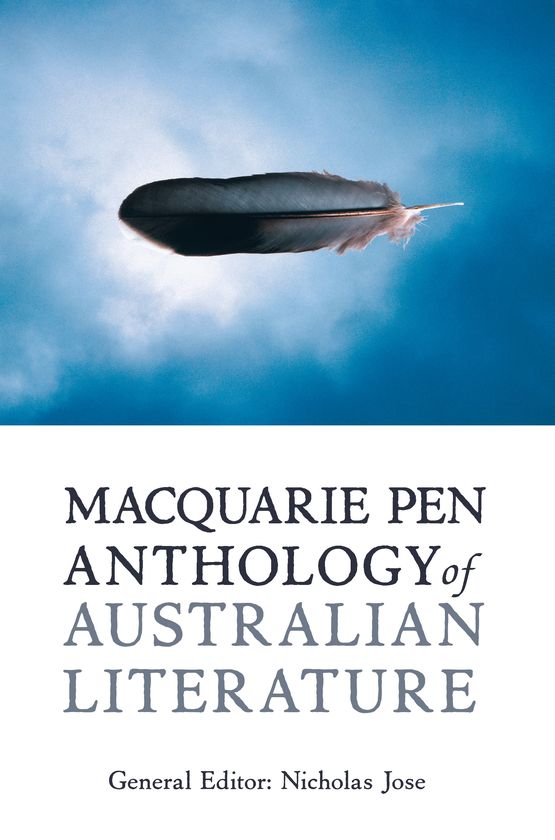
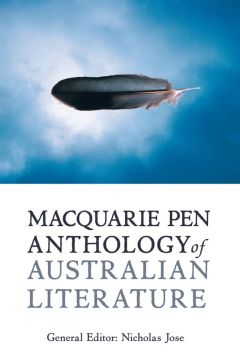
The September issue of Australian Book Review also boasts Peter Craven’s review of the Macquarie PEN Anthology of Australian Literature. To call it a bracing critique is an understatement; it reads more like the critical equivalent of a hand grenade, pointing out omissions, rubbishing the selection and questioning the logic of the anthology’s interaction with what Craven regards as the Australian canon.

I think it’s probably worth pointing out that Craven has long been a champion of the Australian modernist canon, and at least part of his irritation with the collection seems to be a function of his view that this significant part of Australian literary history is not dealt with in a manner which reflects its richness or its diversity. But it’s his criticisms of the anthology’s treatment of Aboriginal writers and writing which are likely to attract the most attention:

“This leaves the final glaring failure of the PEN anthology. It overflows with Aboriginal writing, much of which has no literary value whatever. This is inexplicable, given the availability of the Macquarie PEN Anthology of Aboriginal Writing, of which this collection is a ‘different configuration”. It is hard to see what can have possessed the editors . . . to publish reams and reams of everything from Bennelong’s letter to speeches by Marcia Langton – and every kind of doggerel and naive bit of memoir besides . . . The sheer quantity of Aboriginal writing included in the volume – much of it devoid of literary quality or even literary ambition – is an egregious mistake. It diminishes the importance of Aboriginal culture and obscures the work of serious black writers, such as Alexis Wright, who now constitute a tiny fraction of the whole.”

Not having read the collection in any great detail myself, I don’t feel in a position to comment, but I would say two things. The first is that I feel for the editors, who have, beyond a doubt, taken on a thankless task. As someone who’s edited anthologies before, and is in the early stages of another one at the moment, I know how incredibly difficult it is to satisfy everyone, and there’s no doubt that problem is all the more acute when the collection in question is supposed to be representative of something as vexed as a national literature. The second is to register the fact that Craven’s criticisms, while made from a quite different ideological perspective, echo those made by Ivor Indyk in the Australian Literary Review, who also questioned the collection’s decision to include political speeches and similar works at the expense of writers such as Ruth Park and Dal Stivens, before going on to argue:

“I am happy to embrace the possibility that any kind of writing could have literary qualities but there is a danger here: if, out of a sense of crisis, you include in an anthology of Australian literature all that you think is necessary for its appreciation, then the entity itself might easily go from a state of threatened non-existence to a state in which it included so much that it ceased to be an entity at all.”

Kerryn Goldsworthy, who edited the post-1950 fiction for the collection, has responded to the criticisms Indyk made in the same piece about the under-representation of migrant writers over at Still Life with Cat, but it seems to me that both Indyk and Craven are, in slightly different ways, touching upon a real question about how we define literature in this context. Is Robert Menzies’ ‘Forgotten People’ speech (which is in the collection) literature? No? The what about Ned Kelly and Dan Byrne’s Jerilderie Letter? That seems less problematic at first blush, though Indyk at least finds it a “murderous and . . . maniacal rant”, and compares it to Mein Kampf. And including a petitioner letter of this sort also seems to immediately open the door to the body of similar works by Aboriginal writers, which Craven at least regards as possessing dubious literary merit.

Part of the problem is adopting a position where the notion of “literature” is something that needs defending from the non-literary, since doing so immediately creates a sense of crisis and embattlement.  Yet once that distinction is given away, the emphasis in the title of such a collection quickly falls upon the “Australian”, and the question Indyk poses above becomes particularly acute. My sense (on a pretty cursory read, it must be said) is that the editors have attempted to straddle this divide, presenting a range of writing which seeks to offer a glimpse of the textures and variousness of the Australian experience, and its processing into collective and individual consciousness.

Whether they’ve been successful at this or not is an open question. Indyk and Craven think not, others are more positive. But it seems to me they’ve made the right decision in principle by giving away strict definitions of the “literary”. Because while managing the diversity and competing demands for attention such a decision throws up creates a whole range of new problems, it also opens our minds to just how many ways there are of being Australian, and of the complexities of experience that simple term too often obscures or denies. Does that create an implicit demand that Australian literature be concerned with Australia, or Australians or Australian experience? Probably. Is that appropriate? Perhaps, perhaps not, though as The Man Who Loved Children demonstrates that’s hardly a new problem. But what does matter is that the collection offer something complex and multi-dimensional enough to accommodate the often competing voices with which we speak, and – perhaps just as importantly – to offer a sense of the context out of which these voices speak.

Break text

addthisTweet this