Skip to content

A little music for the weekend …

Three songs from my teenage years, a reminder of just how beautiful Jimmy Barnes was and a link to a post I wrote about Don Watson Walker and his memoir, Shots, back in the days of yore. Try watching the clip for ‘Cheap Wine’ and not knowing that light and palette as Australian.

The Rules of Genre

Apologies for the late notice, but if you’re a NSW Writers’ Centre member, you’re in Sydney and you’re at a loose end tonight, you could do a lot worse than heading out to the NSW Writer’s Centre for tonight’s Writing Genre: is it all about the rules? which features Margo Lanagan, P.M. Newton and myself kicking the genre can around. The event is members only (though I’m not going to claim to know how rigorously that rule is enforced) and bookings can be made by emailing the Centre.

“We have pierced the veneer of outside things”: Four books about Antarctica

Frank Hurley, Aurora alongside the ice off Western Base, 1911-1914

I’ve just finished a long review of Alasdair McGregor’s excellent new anthology, Antarctica: that sweep of savage splendour. The review will appear in the September Australian Book Review, but in the meantime I thought I’d post a link to a review I wrote back in 2005 of four books about Antarctica (including McGregor’s very impressive biography of Frank Hurley, A Photographer’s Life) which may be of interest, as well as pointing to my review of Jon Ronson’s rather fab The Psychopath Test, which appeared in last week’s Weekend Australian.

New Richmond Fontaine!

The new Richmond Fontaine album, The High Country (which interestingly seems to be a single narrative, thus further closing the gap between Willy Vlautin’s songs and his fiction) is due out in September, but in the meantime, live versions of two of the tracks have popped up, together with the news Willy’s first novel, The Motel Life, has just been turned into a motion picture directed by the Polsky Brothers and starring Stephen Dorff, Dakota Fanning and Kris Kristofferson.

Thanks to Jane Palfreyman for the heads-up.


2011 Man Booker Prize Longlist Announced

Alan Hollinghurst

The big news overnight is the announcement of the longlist for this year’s Man Booker Prize. As usual it’s a mixed bag, with books by heavy-hitters such as Alan Hollinghurst rubbing shoulders with books by relative unknowns such as Esi Edugyan, but this year it’s also heavy on Canadians (Alison Pick, Patrick deWitt, Esi Edugyan) and debut novels (Stephen Kelman, A.D. Miller, Yvette Edwards and Patrick McGuiness). There are no Australians on the list.

I’ve only read a handful of the books on the list, so I’m not going to offer any organised views about it beyond saying that while it looks like an interesting and reasonably diverse selection of books, the proof, as always, will be in what kind of shortlist it shakes out into.

Of the books I have read, I’m pleased to see Sebastian Barry’s On Canaan’s Side has made the cut: I’m reviewing it for The Australian so I won’t go into too much detail, but I will say that while I’m not sure it’s quite as good as his extraordinary 2005 novel, A Long Long Way (if you haven’t read it do so, now) it’s a very fine novel. Likewise I’ve read part but not all of the Hollinghurst and while again I’m not convinced it has the urgency and unity of The Line of Beauty, it’s also very, very good. That said I reviewed Carol Birch’s Jamrach’s Menagerie, which is based on the wreck of the Whaleship Essex and was also longlisted for the Orange Prize, and while I like it, I’m a little surprised to see it turning up here, though that’s less because I don’t rate it as a book than because its brand of highly coloured, almost ecstatic historical fiction (think Golding rather than Mantel) seems a little at odds with the tone of the list as a whole.

Of the things I haven’t read I’ve heard uniformly terrific things about Julian Barnes’ The Sense of an Ending, and I’m interested to see Jane Rogers, a writer who has been more than a little neglected in recent years make the list with what sounds like a piece of dystopian science fiction.

As always the other question is what’s not been included. The books the media have noticed are missing are Graham Swift’s Wish You Were Here and Anne Enright’s The Forgotten Waltz. Of the two I’m unsurprised by the omission of the Swift, which I’ve reviewed for The Age, and while again I don’t want to preempt the review I will say is really quite bad. I’m more surprised about the Enright: while it’s not as striking or as urgent as either her short fiction or her 2007 Booker-winner, The Gathering, it’s a quite dazzling book at a textual and technical level, demonstrating not just great psychological and social acuity, but the marvellous combination of steeliness and orality that so distinguishes Enright’s prose. I’m also slightly surprised by the omission of Malcolm Knox’s The Life, which I assume was eligible for the prize, and should, all things being equal, have been in contention.

The other big omission is China Miéville’s Embassytown, which had been widely tipped to bring Miéville the mainstream recognition he so plainly deserves. I don’t want to revisit the genre vs literary argument here, but to my mind the failure to even longlist a novel as rich and prismatic as Embassytown says something about the narrowness of our literary culture.

I’m sure others can think of other SF and Fantasy books that perhaps should have been included, but I’d like to mention one in particular, which is Jo Walton’s Among Others. I have no idea whether it was even submitted, but if it wasn’t that seems a pity, since it’s both a wonderful novel and a book I suspect is likely to appeal to literary readers as much as it does to a segment of the SF and Fantasy readership. I’m planning to write something about it soon, so I won’t go on about it too much here, except to say I enjoyed it immensely, and it’s very definitely a book that deserves a wider readership.

Anyway, enough about me. You can read more about the list at The Guardian and The Independent (or anywhere, really), read the official announcement for more information about the prize and the judges, or find links to samples from the longlisted books on Galleycat. The shortlist is announced on Tuesday 6 September and the winner on Tuesday 18 October. The full longlist is below.

Update: Two more books I’m surprised aren’t on the list. The conclusion to Edward St Aubyn’s Melrose Trilogy, At Last, and my agent David Miller’s wonderful short novel about the death of Conrad, Today. I’m sure more will occur to me as the day goes on …

Julian Barnes – The Sense of an Ending
Sebastian Barry – On Canaan’s Side
Carol Birch – Jamrach’s Menagerie
Patrick deWitt – The Sisters Brothers
Esi Edugyan – Half Blood Blues
Yvvette Edwards – A Cupboard Full of Coats
Alan Hollinghurst – The Stranger’s Child
Stephen Kelman – Pigeon English
Patrick McGuinness – The Last Hundred Days
A.D. Miller – Snowdrops
Alison Pick – Far to Go
Jane Rogers – The Testament of Jessie Lamb
D.J. Taylor – Derby Day


The Ship Song Project

I’ll be back online later this week, but in the meantime, this video from the Sydney Opera House is compulsory viewing. Try not to get chills when Kev Carmody comes in.

Water, Southern Skies and Electronica

I’m in the throes of finally finishing my edits (more on that soon), but in the meantime, here are two amazing pieces of time lapse photography. The first comes via NASA’s Astronomy Picture of the Day, and is by amateur astronomer and photographer Alex Cherney, who compiled twelve months of footage of the movement of stars and clouds across the southern coast of Australia into one very beautiful, and very haunting video. I have a personal affection for this video because I’ve actually been using one of Cherney’s images as the background on my computer for the last six months, but in a way what’s most striking is the way the video serves as a reminder of how different southern skies and landscapes are to those in the Northern Hemisphere. Be sure to embiggen for the full effect.

The second comes via io9, and features images of water in slow motion (set to music by electronica act, Team Ghost). It’s a thing of strange, almost alien beauty.

I’ll be back online properly next week. Catch you all then.


Night Rider

I’m still deep in the hole of my edits (though I can finally see the light at the end of the tunnel, which is a relief) so I’m not really able to keep things ticking over here, but in lieu of any actual content I thought I’d point you towards American Songwriter’s rather fabulous Country Way Sampler, which is available for free on Bandcamp. There’s an interesting mixture of artists represented, from Joe Pug to Matraca Berg to Caitlin Rose and Justin Townes Earle, but as usual with these things the real treats are the tracks by artists you don’t know, and to my mind the best of those is the improbably named Jonny Corndawg’s ‘Night Rider’.

Enjoy. And I’ll be back in a couple of weeks once my edits are finished.

Some more Wayne Levin (and Manta Rays!)

After I published my post about Wayne Levin’s new book, Akule, the other day I came across this rather terrific little video featuring Wayne talking about his experience photographing Manta Rays and his work more generally. Having dived with Mantas myself I’m keenly aware of the feelings of awe Wayne describes, and of the other-worldly presence of them in the water.

Anyway, if you’d like to see more of the shots discussed in the video they’re available on his website, otherwise enjoy!

A Murmuration of Fish: Wayne Levin’s Akule

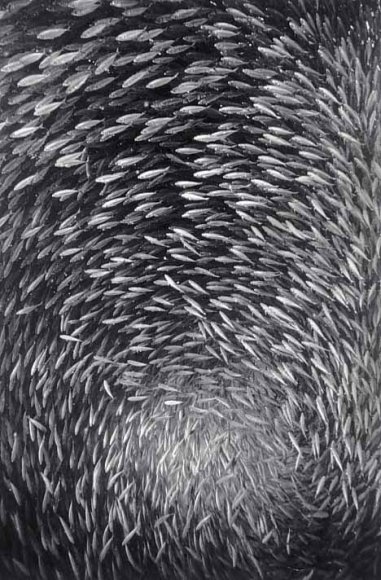
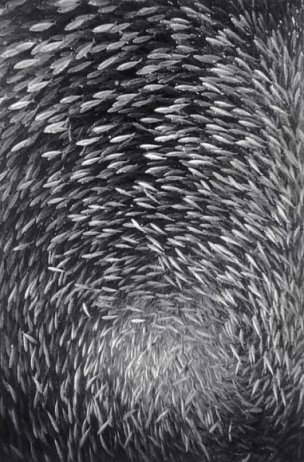
Wayne Levin, ‘Circling Akule’, © Wayne Levin (click to embiggen)

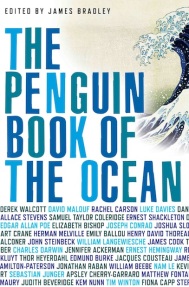
Of the many editorial decisions I made while putting together The Penguin Book of the Ocean, the one I’m proudest of was to include a series of Wayne Levin’s photographs. Anybody who’s seen the book will know how much they add to it, not just because they offer a stunning visual counterpoint to the written selections, but because they so eloquently distill the sense of the ocean’s mystery and beauty I wanted the book to evoke as a whole. I think – I hope – that the book is put together in such a way that every piece adds something essential, but I think there’s little doubt that if there was one selection the removal of which would drastically impoverish the whole, it’s Wayne’s photographs.

I assume some readers will already be familiar with Wayne’s work. Although he’s less well-known in Australia than he is in the United States, his iconic images of swimmers and bodysurfers are both justly celebrated and immediately recognisable (and, I suspect, were at least partly responsible for inspiring Narelle Autio and Trent Parke’s equally iconic celebration of the Australian beach, The Seventh Wave).

For my part, I first encountered Wayne’s work in 2005. I was working on a book about the Pacific (a project which, sadly, I later shelved) and as part of my background research had been reading Thomas Farber’s brilliant essays about water and the ocean, On Water (one of which also appears in The Penguin Book of the Ocean). Keen to read more of Tom’s work I went searching online, and in so doing stumbled on Wayne’s breathtaking 1997 book, Through a Liquid Mirror, which features an introduction by Tom.

Wayne Levin, ‘Body Surfers’

When my copy arrived I sat staring at it for hours. I quickly realised I’d seen some of the images of surfers before, but as I read on I found the real marvels were not those strange, perspectiveless images of humans in flight underwater, but the images of marine creatures: sharks, dolphins, fish, turtles, gliding weightlessly through the deep.

In the weeks after that I bought and read Wayne’s similarly beautiful and deeply haunting collection of photographs of aquariums, Other Oceans, and found my way to his website, which collects many of the images from the books, both of which only added to my admiration for his work.

One of the things I found most striking about Wayne’s images was his decision to work not in colour but in black and white. There’s no doubt one of the great revelations of the last decade or so has been the rapid advances in the documentation of marine environments, in particular the work of the BBC’s Natural History unit, whose efforts have led to the creation of documentaries such as The Blue Planet and Planet Earth. While these works have done much to change the way we see the oceans and their inhabitants, perhaps one of the most profound is the way they’ve taught us to see the marine environment as a place filled with colour, not just the reds and oranges of coral and tropical fish, but the deep, saturated blues and greens of the water, and the dazzling silvers and metallic glints of fish and light.

By contrast, by working in black and white, Wayne’s photos cleave to a more denuded palette, one comprised only of silvery greys and blacks, a decision that serves not just to sever their connection to more documentary forms of photography, but to demand the viewer see the subjects again, not as fish or swimmers or sea spume, but as things in themselves, wrapped in their own mystery and moving outside the bounds of language. Breaking waves become thunder clouds, suggesting how close swimming is to flight, sharks become sculptural objects, whales and dolphins loom out of the dark towards the light.
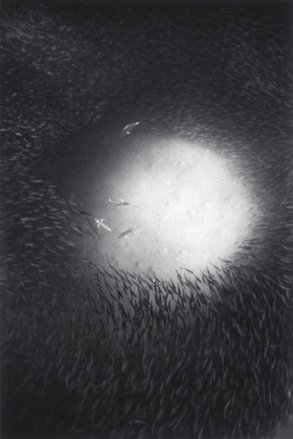
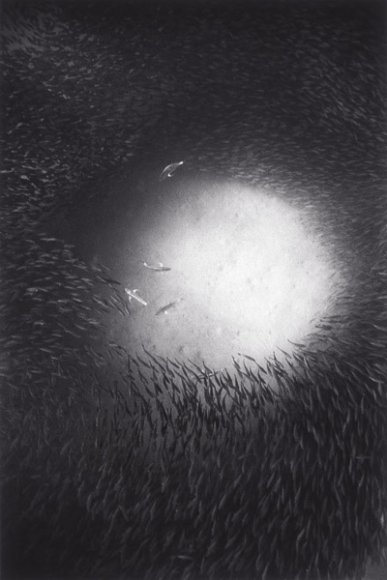
Wayne Levin, ‘Blue Trevally surrounded by Akule’

At its most effective, in images such as  ‘Blue Trevally surrounded by Akule’, this transformation grants the subjects – and by extension the photographs themselves – a sacral quality, imbuing the scenes they depict with a mute power that conveys something essential about both the immensity and indifference of the ocean.

Yet in many ways the best of Wayne’s images are those focussing on schooling Bigeye Scad, or Akule, as they are known in Hawaii. In these images the schools of fish become not just schools but living things in their own right, drifting and swirling like patterns of smoke or the Aurora, many minds in one body.

Most of Wayne’s Akule photographs were taken across a three year period last decade, during which schools of Akule gathered in Kealakekua Bay on Hawaii’s Big Island (and the site of the fatal attack on Captain Cook), and Wayne took to swimming out in pursuit of them, oxygenating his lungs as he went in order to freedive ten, twelve, even eighteen metres down, to the edge of the light to capture the fish moving below.

The best of these images, together with a selection of other images such as ‘Body Surfers, Makapu’u O’ahu 1983’ are collected together in Wayne’s new book, Akule, which was published late last year.

Perhaps interestingly, it’s a smaller book than either Through a Liquid Mirror or Other Oceans, not just slimmer but more closely cropped. Yet somehow this reduction in size gives it an intimacy and simplicity many larger books lack.

But its size also belies the wonder of many of the images it contains. Here, again and again, schools of fish take on the wonder they possess in reality, becoming shifting things of light and silver, darting and turning, many minds in one body.
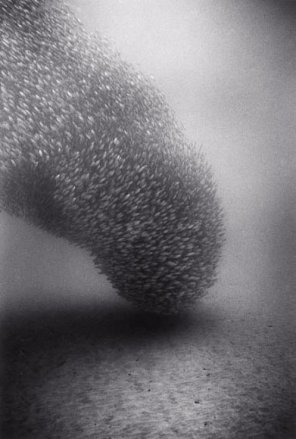
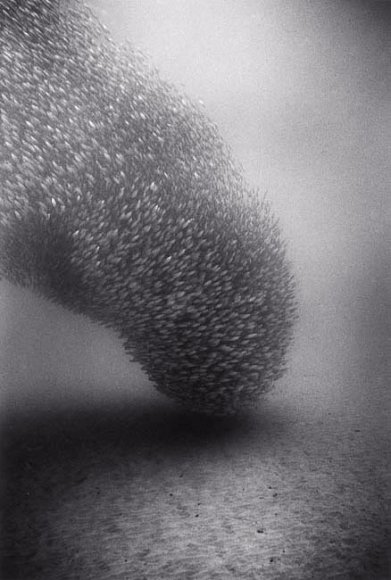
Wayne Levin, ‘Akule Tornado’

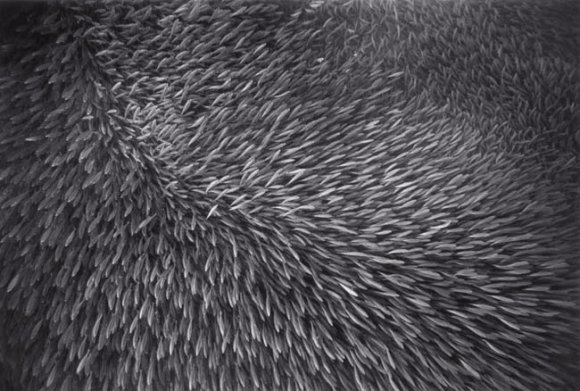
As Frank Stewart points out in his introduction to the book (the book also features a Foreword by Tom Farber), the seemingly purposeful of fish schools are relatively simple, and can, like many complex phenomena, be reproduced by the application of several simple rules, the same rules that create the unity of purpose exhibited by bird flocks (they also, suggestively, bear more than a passing resemblance to the Aboriginal artist, Gloria Petyarre’s Medicine Leaves paintings, which evoke the movement of grass and leaves in the wind).

Stewart is wary of reading too much into the capacity of simple rules to generate complex behaviour, cautioning against the desire of some to see in it something essential we have previously only associated with living things.

I share some of that wariness, though I’m perhaps less inclined than Stewart to dismiss the discoveries of those working in this area as simply the application of “our currently fashionable metaphor to explain the mystery of life”. Yet he’s right to point to the way many of the photographs in Akule ask us to reconsider our ideas about the boundaries of agency. It is impossible to look at photographs like ‘Column of Akule, Kealakekua Bay, Hawai’i 2000’ or ‘Flock of Akule, Keauhou Bay, Hawai’i 2006’ and not be aware of the way these twisting columns of bodies seem to have purpose and meaning of their own, or the manner in which their sense of order and movement seems to imply the presence of some kind of collective organism.

Wayne Levin, ‘Pattern of Akule’

This desire to expand the definition of life to include biological systems is central to much contemporary biological and environmental thinking. Yet it also demands we rethink our own relationship to the environment we inhabit, and the interconnected web of life that sustains it. Given the urgency of the environmental challenges we face, there is something both salutary and humbling in being confronted by work which, like Wayne’s photographs, demands we do precisely this. Because in the end that is what the photographs in Akule do. They ask us to look at the twisting, shifting, leaping columns of fish and see them as what they are: things pulsing with life, mysterious and Other, but living all the same. And, perhaps just as importantly, they demand we re-examine many of our assumptions about the creatures that surround us, by reminding us of how irrelevant we are to them, caught as they are in the business of their lives, and of how our knowledge of them will always be partial, fragmentary, constrained by the limitations of our imaginations and senses.

Akule, Through a Liquid Mirror and Other Oceans are all available from Amazon. If you’d like to see more of Wayne’s work you can visit his website or download a preview of Akule. The Penguin Book of the Ocean is available in Australian bookstores or you can check prices at Booko. At some point I may talk more about my unfinished book about the Pacific but that’s very definitely a story for another day.

Manhattan in motion

Because I’m deep in the land of edits it’s likely to be another slow week around here, but in the meantime you might want to take a minute or two to watch this amazing time-lapse video created by New York photographer Josh Owens: it really is a thing of beauty.

If you like what you see you can check out more of Josh’s videos on Vimeo, follow him on Twitter or visit his website. Thanks to The New Yorker for the original link. You might also want to take a moment to watch Tor Even Mathisen’s similarly breathtaking timelapse video of the Aurora Borealis.


Disco 2000

Thank God it’s Friday . . .

Embassytown

Just a quick link to my review of China Miéville’s Embassytown in this morning’s Weekend Australian. As the review hopefully makes clear, I think it’s Miéville’s best book by some distance: brilliantly conceived, powerfully imagined, thrillingly fertile, and while I do think there’s a slight slackening in the second half, when the narrative frame opens out to take in the large-scale breakdown of the society it depicts, the first half is so good it hardly matters. All of which is a roundabout way of saying just read it, it’s fabulous.

If you’d like to know more about the book you might want to check out Justine Jordan’s profile of Miéville in last week’s Guardian, or my reviews of his last two novels, Kraken and The City and the City. And I know I’ve linked to it before, but if you’re interested you can also read an excerpt from the first chapter on the Tor website.

Prime Minister’s Literary Awards Shortlists Announced

Heartfelt congratulations to my friend, Delia Falconer, whose very personal tribute to her home town, Sydney, has been shortlisted for the Non-Fiction Category of the Prime Minister’s Literary Awards, along with Paul Kelly’s How to Make Gravy and Richard McGregor’s excellent study of the Chinese Communist leadership, The Party and books by Rod Moss and Patrick Wilcken.

I meant to write something about Delia’s book when it came out, and while that got away from me, I think it’s a terrific book: startlingly intelligent, idiosyncratic and written with a very striking blend of steel and fluidity. If you haven’t read it I very much recommend you do.

Congratulations also to the other shortlisted writers. I’ve only had a few moments to look at them, but at first glance I’d say two things. The first is that the Fiction shortlist is overtly and unashamedly literary. And the second is that these shortlists are likely to add fuel to the arguments about the under-representation of women writers that were triggered by last month’s announcement of the second all-male Miles Franklin shortlist in a row. I don’t want to suggest Young Adult Fiction isn’t serious writing, but I think it’s difficult not to be struck by the fact that the two shortlists that would usually be regarded as the more overtly intellectual and literary – Fiction and Non-Fiction – each contain four books by men and one by a woman, while the less overtly literary category of Young Adult Fiction contains five books by women and none by men (the Children’s category is rather more evenly split).

But all that said, my congratulations to all the shortlisted authors, and especially to Delia. I wish you could all win, but I guess it doesn’t work that way.

Non-Fiction
Delia Falconer, Sydney
Paul Kelly, How to Make Gravy
Richard McGregor, The Party
Rod Moss, The Hard Light of Day
Patrick Wilcken, Claude Levi-Strauss: The Poet in the Laboratory

Fiction shortlist
Stephen Daisley, Traitor
Roberta Lowing, Notorious
Roger McDonald, When Colts Ran
David Musgrave, Glissando
Kim Scott, That Deadman Dance

Young Adult Fiction Shortlist
Laura Buzo, Good Oil
Cath Crowley, Graffiti Moon
Cassandra Gold, The Three Loves of Persimmon
Joanne Horniman, About a Girl
Melina Marchetta, The Piper’s Son 

Children’s Fiction
Bronwyn Bancroft, Why I Love Australia
Lucy Christopher, Flyaway
Morris Gleitzman, Now
Bob Graham, April Underhill, Tooth Fairy
Boori Monty Prior and Jan Ormerod, Shake a Leg

Metamorphoses

How do you do that? she asks, seated on the stairs to his loft, How do you know which notes to play without sheets?

Memory, he says, I do it by memory.

It is Boxing Day, and Anna has woken to the sound of the piano. Downstairs Seth seated before it, his fingers moving slowly across the keys.

What is it? I’ve never heard anything like it.

Seth smiles, his fingers continuing to pick out the notes in ones and twos, each separated by a gap, the space between them seeming as important as the notes themselves, the way they fade into it, leaving the memory of their resonance hanging. She shivers.

It doesn’t have a name, he says, An artificial intelligence composed it.

In front of her she can see the muscles in his back shift beneath his skin, the articulated cage of his ribs beneath them.

I have a recording of it, but I prefer to play it myself. There’s an alien quality to it, a sense of another way of being I can get closer to.

It sounds . . . sad. No, she corrects herself, listening to the strange, ghostly sound of the piano, the dying notes, not sad, something else I can’t quite describe, Like the sound of wind in grass or moving water, that quietness, that colourless feeling. She hesitates. Maybe I can’t find the words because there are no words.

It’s like trying to describe the sound of geometry, isn’t it? Can you imagine what it must be like to be conscious, aware, but without matter, without form? Without place. A ghost in a machine.

Anna shakes her head. But listening to the slow patterns of this music she can hear the loneliness of this thing of bits and light, this artificial mind shifting like the aurora through the circuits of some optical computer, like the siren call of a whale in the oceanic night, the long, clicking song that goes unanswered.

 From The Deep Field.