Skip to content

Posts from the ‘Writing’ Category

Bread and Sirkuses

peter_carey

Peter Carey

I’m currently reading Peter Carey’s rather fabulous new novel, Parrot and Olivier in America. Since I’m reviewing it I can’t say much more than that, but I thought I might use it as an excuse to upload an essay I wrote for Meanjin about Carey way back in 1997. Entitled ‘Bread and Sirkuses: Empire and Culture in Peter Carey’s The Unusual Life of Tristan Smith and Jack Maggs, it uses those two books as the starting point for a broader survey of Carey’s work. In places it’s a bit dated, but it’s not a bad piece, so it seemed worth giving it another run.

If you’d like more Careyana, Carey maintains a classy-looking website, with excerpts from his novels, selected reviews and links to a range of interviews and appearances, as well as reproducing this one, which originally appeared in The Paris Review. And if you’d like to read some other pieces I’ve written about Carey’s fiction you might want to check out my reviews of My Life as a Fake and Theft.

Break text

addthisTweet this

Birds and Sharks and Peter Craven

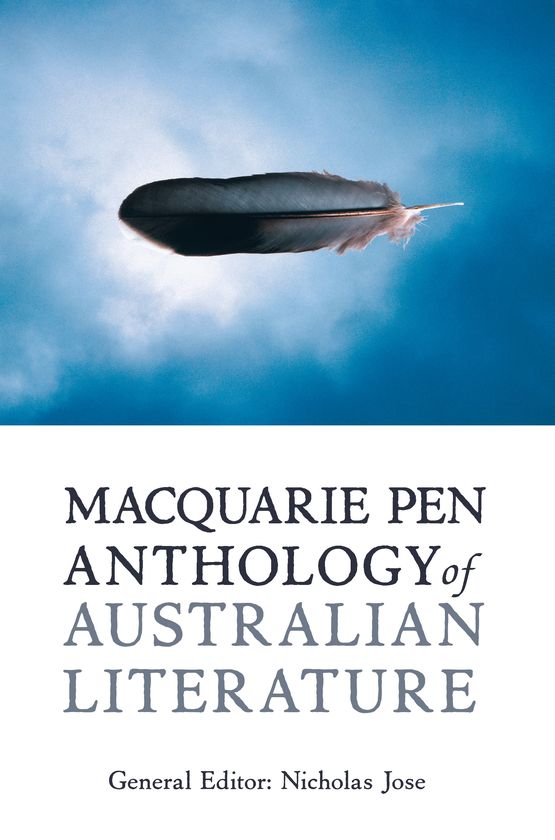
PEN AnthologyI’ve got pieces in the September issues of The Monthly and Australian Book Review, both of which are out today (and neither of which, sadly, are online). At first glance there’s not a lot to connect them – the Monthly piece is about the trip I took in late June to go diving with whale sharks at Ningaloo, while the Australian Book Review piece is a review of Jeremy Mynott’s delightfully omnivorous book about birds and birdwatching, Birdscapes – but in a way they’re not as disparate as they sound, since both are interested in the question of what we see when we look at animals, and the social context of that observation.

The September issue of Australian Book Review also boasts Peter Craven’s review of the Macquarie PEN Anthology of Australian Literature. To call it a bracing critique is an understatement; it reads more like the critical equivalent of a hand grenade, pointing out omissions, rubbishing the selection and questioning the logic of the anthology’s interaction with what Craven regards as the Australian canon.

I think it’s probably worth pointing out that Craven has long been a champion of the Australian modernist canon, and at least part of his irritation with the collection seems to be a function of his view that this significant part of Australian literary history is not dealt with in a manner which reflects its richness or its diversity. But it’s his criticisms of the anthology’s treatment of Aboriginal writers and writing which are likely to attract the most attention:

“This leaves the final glaring failure of the PEN anthology. It overflows with Aboriginal writing, much of which has no literary value whatever. This is inexplicable, given the availability of the Macquarie PEN Anthology of Aboriginal Writing, of which this collection is a ‘different configuration”. It is hard to see what can have possessed the editors . . . to publish reams and reams of everything from Bennelong’s letter to speeches by Marcia Langton – and every kind of doggerel and naive bit of memoir besides . . . The sheer quantity of Aboriginal writing included in the volume – much of it devoid of literary quality or even literary ambition – is an egregious mistake. It diminishes the importance of Aboriginal culture and obscures the work of serious black writers, such as Alexis Wright, who now constitute a tiny fraction of the whole.”

Not having read the collection in any great detail myself, I don’t feel in a position to comment, but I would say two things. The first is that I feel for the editors, who have, beyond a doubt, taken on a thankless task. As someone who’s edited anthologies before, and is in the early stages of another one at the moment, I know how incredibly difficult it is to satisfy everyone, and there’s no doubt that problem is all the more acute when the collection in question is supposed to be representative of something as vexed as a national literature. The second is to register the fact that Craven’s criticisms, while made from a quite different ideological perspective, echo those made by Ivor Indyk in the Australian Literary Review, who also questioned the collection’s decision to include political speeches and similar works at the expense of writers such as Ruth Park and Dal Stivens, before going on to argue:

“I am happy to embrace the possibility that any kind of writing could have literary qualities but there is a danger here: if, out of a sense of crisis, you include in an anthology of Australian literature all that you think is necessary for its appreciation, then the entity itself might easily go from a state of threatened non-existence to a state in which it included so much that it ceased to be an entity at all.”

Kerryn Goldsworthy, who edited the post-1950 fiction for the collection, has responded to the criticisms Indyk made in the same piece about the under-representation of migrant writers over at Still Life with Cat, but it seems to me that both Indyk and Craven are, in slightly different ways, touching upon a real question about how we define literature in this context. Is Robert Menzies’ ‘Forgotten People’ speech (which is in the collection) literature? No? The what about Ned Kelly and Dan Byrne’s Jerilderie Letter? That seems less problematic at first blush, though Indyk at least finds it a “murderous and . . . maniacal rant”, and compares it to Mein Kampf. And including a petitioner letter of this sort also seems to immediately open the door to the body of similar works by Aboriginal writers, which Craven at least regards as possessing dubious literary merit.

Part of the problem is adopting a position where the notion of “literature” is something that needs defending from the non-literary, since doing so immediately creates a sense of crisis and embattlement.  Yet once that distinction is given away, the emphasis in the title of such a collection quickly falls upon the “Australian”, and the question Indyk poses above becomes particularly acute. My sense (on a pretty cursory read, it must be said) is that the editors have attempted to straddle this divide, presenting a range of writing which seeks to offer a glimpse of the textures and variousness of the Australian experience, and its processing into collective and individual consciousness.

Whether they’ve been successful at this or not is an open question. Indyk and Craven think not, others are more positive. But it seems to me they’ve made the right decision in principle by giving away strict definitions of the “literary”. Because while managing the diversity and competing demands for attention such a decision throws up creates a whole range of new problems, it also opens our minds to just how many ways there are of being Australian, and of the complexities of experience that simple term too often obscures or denies. Does that create an implicit demand that Australian literature be concerned with Australia, or Australians or Australian experience? Probably. Is that appropriate? Perhaps, perhaps not, though as The Man Who Loved Children demonstrates that’s hardly a new problem. But what does matter is that the collection offer something complex and multi-dimensional enough to accommodate the often competing voices with which we speak, and – perhaps just as importantly – to offer a sense of the context out of which these voices speak.

Break text

addthisTweet this

Arctic Dreams

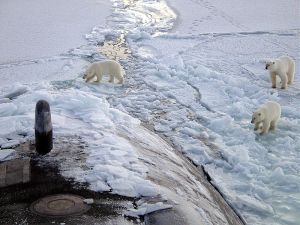
800px-Polar_bears_near_north_poleA while back I did one of those pieces for a newspaper about the books that changed me. Articles of that sort are always slightly weird exercises, as much about selling a version of yourself via your choices as really addressing the question, and I have to confess I don’t remember exactly what books I chose on the day in question (though it’s a fair bet Michael Ondaatje’s In the Skin of a Lion would have been on my list, since the experience of reading it was the thing that set me on the path to becoming a novelist). But I do know that if there’s one book that genuinely has a claim on having changed me, it’s Barry Lopez’s Arctic Dreams, a book which completely altered the way I thought about a whole series of questions about the environment and the way we understand it and our place in it.

Anyway – I wrote the following piece in 2001 for The Australian’s Review of Books, the forerunner to today’s Australian Literary Review, and I recently stumbled on a copy of it on my hard drive while I was working on a review I’ve got in the next issue of Australian Book Review. But what’s frightening about it is that the concerns it expresses were urgent then, eight years ago, yet we don’t seem to have moved any further towards addressing them.

Barry Lopez’s Arctic Dreams begins and ends with the same curious act of respect. A kind of bow, performed before the world he has encountered in the travels through the Arctic. “I took to bowing on these evening walks,” he writes. “I would bow slightly with my hands in my pockets, towards the birds and the evidence of life in their nests – because of their fecundity, unexpected in this remote region, and because of the serene arctic light that came down over the land like breath, like breathing.”

Much later this gesture is repeated, this time on the tip of St Lawrence Island, but in its later incarnation the gesture has moved closer to a kind of stillness, a loss of the self into the land and its rhythms:

“Glaucous gulls fly over. In the shore lead are phalaropes, with their twiglike legs. In the distance I see flocks of oldsquaw against the sky, and a few cormorants. A patch of shadow that could be several thousand crested auklets – too far away to know. Out there are whales – I have seen six or eight grey whales as I have walked this evening. And the ice, pale as the dove-coloured sky.”

The lyric beauty of Lopez’s writing helps transform this simple gesture into a literary artefact of great power and resonance. In his words we glimpse a world that trembles with life, and apprehend, within its detail an otherness we might not otherwise see, a kind of presence which the land embodies, ancient, complete unto itself.

Lopez is first and foremost a visual writer, possessed of a poet’s eye, and his account of the Arctic is anchored in his observation of its terrain, its light, and the animals that inhabit it. Yet it is observation rendered so as to make each moment transcend its detail. Whether it is golden plovers abandoning “their nests in hysterical ploys, artfully feigning a broken wing to distract . . . from the woven grass cups that couched their pale, darkly speckled eggs,” eggs which “glowed with a soft, pure light, like the window light in a Vermeer”, or “herds of belukha whale glid[ing] in silent shoals beneath transparent sheets of young ice”, his writing seeks out the moments when the land reveals itself, where the whole can be glimpsed in the part.

To see in such a way is to contain politics within aesthetics, to transform epiphany into manifesto. It is to suggest a way of seeing that is simultaneously a way of being, as if by seeing clearly we might find connection, and for a moment at least, glimpse the land as something which exists independently of us, possessed of its own meaning. It is, as Lopez puts it, “to be alert for its openings, for that moment when something sacred reveals itself within the mundane, and you know the land knows you are there.”

“You know the land knows you are there.” A notion both simple and strange. Yet this sense of knowing and being known, of seeing and being seen is a way of allowing the imagination to begin conceiving of our relationship with nature as a dialogue, and of nature itself, whether embodied in an owl or the movement of light across the tundra, alive in its own right, “an animal that contains all other animals”, and not something given to us to do with as we desire. This is not science, but in its desire to understand nature, complementary to science, a poetics perhaps, able to contain both the scientific and the moral. Witness Lopez’s description of the intricacy of the polar bear’s physiology and behaviour:

“The interplay here among rest, exertion and nutrition that carries them comfortably through life is something that cannot be broken down into pieces. Like the skater’s long, graceful arc, it is a statement about life, the full exercise of which is beautiful.”

This transformation of aesthetics into politics is central to the tradition of nature writing Lopez is a part of. Ever since Thoreau walked his mile and a half to Walden Pond, writing about nature has been a political act, the expression and the embodiment of a homespun radicalism of peculiarly mystical bent. To see differently, to extend the reach of our imagination through contemplation into other ways of being is to be able to transcend our self, and by moving outside ourselves be granted a new perspective upon our place in the scheme of things. It is to sense the smallness of human history against the story of the planet, and to be made aware of our own impermanence.

There might seem something almost trivial in this appeal to imaginative contemplation given the scale of the environmental catastrophe that surrounds us. The biologist Edward O. Wilson argues that the “maximally optimistic conclusion” is that some 27,000 species become extinct each year, or 74 each day, 3 each hour. Similar estimates put the loss of biodiversity in the next century at somewhere between 25 and 50 per cent, that is to say, one quarter to one half of all species gone forever through human agency within the next 100 years. Given that we have catalogued only the tiniest proportion of this diversity, the vast bulk of these species will vanish unrecorded and unlamented, lost forever.

But it is precisely through the exercise of the imagination that we become able to see the world in such a way as to make sense of this loss, and to understand the cost to ourselves of the failure of imagination that has allowed it to happen. By attending to detail, by learning to see things as they are, we learn to dissolve our selves into the landscape, to become inhabitants of a shared world which exists in its own right, apart from our use of it, one to which we owe a silent respect, and an allegiance.

First published in The Australian’s Review of Books, © James Bradley

Break text

addthisTweet this

The shame of snip and share

Offscreen Film Festival 2008 @ Brussels. Photo: Jeffrey De Keyser.

Offscreen Film Festival 2008 @ Brussels. Photo: Jeffrey De Keyser.

When I started this blog I was worried it would distract me from what I rather stuffily thought of as my “real” writing. I don’t feel that way anymore. Indeed this odd little online creation isn’t just very definitely part of my real writing, it’s also often the bit I enjoy the most.

The thing I didn’t understand back then was that the real problem with blogging isn’t that it’s time-consuming, it’s that it’s completely tyrannical. Don’t post for a day and you feel bad about it, don’t post for a week and you start to feel like you’re letting everybody (including yourself) down. Half the time I feel like I’ve woken up to find myself playing the part of Seymour in an online version of Little Shop of Horrors.

Which is, of course, a roundabout way of apologizing for the fact the site’s been a bit neglected lately. It’s not intentional, just that between work and the fairly appalling schedule I’m on with my novel I’ve been struggling to find the time to post. I think – I hope – things have turned the corner a bit, and I’ll be getting some stuff up this week, but I’m not going to go making any big promises.

To which end I’m going to do something I generally avoid, which is offer a few links in place of content. I’ve got nothing against linking per se, but it always seems a bit like cheating, the sort of thing you do when you’re too busy to write something original. Which I am, of course, but if I keep typing fast enough perhaps I can distract you from that*.

So, without further ado. The most recent issue of The New Yorker has a fascinating interview with Ursula Le Guin, focussed in large part on her 1969 classic, The Left Hand of Darkness, and her feelings about its then-radical take on gender politics, and the manner in which they simultaneously reflect the more conventional attitudes of its times. They’re interesting questions, not least because they recur in the context of Le Guin’s revisionist re-entry into the world of Earthsea in Tehanu (and to a lesser extent, The Other Wind), a book which attempted to unpick the patriarchal underpinnings of one of fantasy’s most remarkable – and enduring – creations.

Meanwhile, over at Sight and Sound, you can read the single best piece of writing about television I’ve read this year, as Kent Jones probes the allure of The Wire. As I’ve said here before, despite my admiration for its many very real achievements, The Wire is a show I often find frustrating. Given the critical consensus that it is one of, if not “the greatest television show ever made”, that often leaves me feeling like a naysayer, but Jones very elegantly teases out many of what I’d see as the show’s weaknesses, while simultaneously illuminating the things which make it so remarkable.

In a completely different vein, at The Chronicle of Higher Education, Michael Ruse uses an exploration of the scientific and philosophical antecedents to James Lovelock’s Gaia hypothesis to examine what has always seemed to me to be one of the more oddly neglected aspects of the climate change debate, which is the manner in which it encapsulates a more fundamental argument about the nature of science itself. And, at The Guardian, Lovelock himself gives one of his trademark doomsayer interviews to celebrate his 90th birthday.

And finally, ever wondered about the link between heroic drinking and great writing? Well at Intelligent Life Tom Shone has some answers (and they may not be the ones you want to hear).

* The eagle-eyed amongst you may have noticed I’ve been using Delicious to post links in the right-hand column for a while now. Sadly they’re not that obvious (and I’m less diligent than I might be in keeping them up to date) but when I finally get my redesign off the ground I’ll be expanding that functionality.

Break text

addthisTweet this

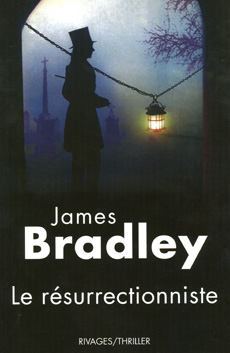
Le Résurrectionniste

Le Resurrectionniste

I’ve always taken a pretty hands-off attitude to translation and translation rights. That’s probably partly because I’m so embarrassingly monolingual, but it’s also about an awareness that you have so little control over the process that it’s better not to let yourself worry too much about it.

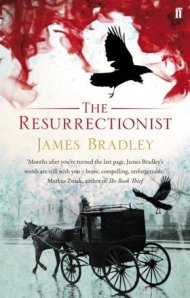
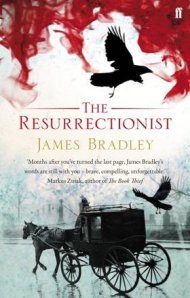
That’s not to say I don’t know any of my translators. I’ve recently been in correspondence with the Brazilian translator of The Resurrectionist and I had quite a bit to do with the German translator of my first two novels. In both cases the things they needed clarifying were small, culturally-specific details (most recently about the bonding of convicts in early New South Wales) or points of fact they were unsure about (or I’d not been as clear about as I might have been).

But the one foreign publisher I do have a relationship with is Payot & Rivages, who have just published The Resurrectionist in France.

It’s a relationship that came about largely by chance. Despite my execrable French, I was fortunate enough to spend the second half of 2007 at the Australia Council’s Keesing Studio in Paris, and since I’d sold the French rights shortly before I arrived I thought it couldn’t hurt to give my publishers a call.

Being as exquisitely courteous as most French people, they not only arranged to meet me, but made a great fuss of me, taking me to lunch and inviting me to their home for dinner.

That in itself was a wonderful gesture, and one made the more special by the somewhat hilarious moment when my translators (unusually they’re brothers who work together) asked me what music I listened to while I was writing the book. It seemed a bit of an odd question, but as I’ve mentioned before that I listened to a lot of Philip Glass while I was writing the book, partly because I found its almost hypnotic qualities helped me get into the right headspace, partly because there was something in the structure and texture of the music I wanted to emulate in the way the book’s parts moved against each other, and so I told them that, at which they laughed in triumph, and said ‘We knew it! We’ve been doing the translation listening to Philip Glass and we knew you’d been doing the same’.

Anyway – the other outtake from the night’s festivities came just before I ate, when I was spirited away to a back room and interviewed on camera. They didn’t tell me I was doing the interview until I’d drunk several glasses of wine, which may or may not be apparent in the excerpts that are now available on their website, but what is apparent is how much more clever and concise I am once somebody has translated me into French. Who knew my rambling, half-drunken words could be turned into such chiselled French prose? Or that I could be so suavely epigrammatic? I suppose the lesson is that I should speak in subtitles more often . . .


Artistic tendencies linked to ‘schizophrenia gene’

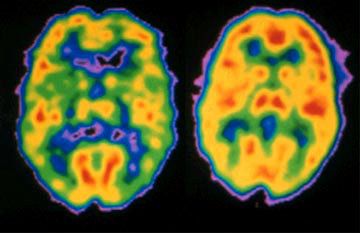
PET scans of a schizophrenia sufferer's brain (left) and normal brain (right).

PET scans of a schizophrenia sufferer's brain (left) and normal brain (right).

New Scientist is reporting a fascinating study suggesting a statistical correlation between a gene linked to schizophrenia and creativity. The study, conducted by Szabolcs Kéri, a researcher at Semmelweis University in Budapest, Hungary:

“examined a gene involved in brain development called neuregulin 1, which previous studies have linked to a slightly increased risk of schizophrenia. Moreover, a single DNA letter mutation that affects how much of the neuregulin 1 protein is made in the brain has been linked to psychosis, poor memory and sensitivity to criticism . . .

“To determine how these variations affect creativity, Kéri genotyped 200 adults who responded to adverts seeking creative and accomplished volunteers. He also gave the volunteers two tests of creative thinking, and devised an objective score of their creative achievements, such as filing a patent or writing a book.

“People with two copies of the neuregulin 1 mutation – about 12 per cent of the study participants – tended to score notably higher on these measures of creativity, compared with other volunteers with one or no copy of the mutation. Those with one copy were also judged to be more creative, on average, than volunteers without the mutation. All told, the mutation explained between 3 and 8 per cent of the differences in creativity”.

I’m always a little sceptical of such studies, not least because of the reductive assumptions inherent in their methodology. But this research fits neatly with a number of other studies suggesting a link between mood disorders and creativity (some of which I’ve mentioned before).

You can read more at New Scientist. And while you’re there, take a minute or two to read this story about researchers turning brain scans into sound, a process which not only reveals patterns and rhythms not always visible to the eye, but also allows the “unsteady rhythms and cadences” (a lovely expression) of dysfunctions such as schizophrenia to emerge. Stranger still is the fact the music of the (hemi)spheres sounds just like early Philip Glass.
Break text

addthisTweet this

Literary Bloodsport Part 3: The Writers Strike Back

Star-Wars-The-Empire-Strikes-BackI’ve been meaning to do a follow-up on my post about literary hatchet jobs for a while now, but the story in yesterday’s Gawker about Alice Hoffmann’s colossal dummy-spit (or is that dummy-twit?) is so hilarious I can’t hold back any longer. As the story explains, Hoffman took great exception to what sounds like a classic “mixed” review, and proceeded to slag off the reviewer on Twitter, even going so far as to twit the reviewer’s phone number and suggest people ring her up and set her straight. Hoffman is now backtracking, but it’s a little difficult to come back from “Now any idiot can be a critic”.
What’s particularly striking is that it’s only one of several cases of writers losing their cool about reviews in recent weeks. Last week MediaBistro reported that Alain de Botton (who I once heard a middle-aged lesbian describe as the thinking woman’s crumpet) took violent exception to Caleb Crain’s review of his new book, The Pleasures and Sorrows of Work, taking time out from his clearly hectic schedule to blast Crain in the comments section of Crain’s blog, Steamboats are Ruining Everything (Botton’s killer barb? “I will hate you till the day I die and wish you nothing but ill will in every career move you make”). And in a rather more succinct comment upon a review of her new book, author Ayelet Waldman twitted, “May Jill Lepore rot in hell. That is all”.

Of course there’s a long and (ig)noble tradition of authors slagging off critics. But I suspect there’s a good chance these rather undignified displays say as much about people’s unfamiliarity with the technology as anything. With any new form of communication it takes a while to learn what’s smart and what’s not (ask yourself how long it too you to learn not to email when angry, or to reply all carelessly). And if there was ever a technology for which the old adage, flame in haste, repent at leisure was appropriate, it’s Twitter (at least with Facebook status updates you have some control over who’s listening, and you can quietly delete them if you think you’ve gone too far). Certainly the rapidity with which the story of Hoffman and de Botton’s dummy-spits has spread is a reminder of the capacity of the online world to regulate itself, and of the democratizing nature of the net more generally. Indeed I suspect Hoffman and de Botton’s real crime isn’t being intemperate, but assuming their status as authors gave them the right to be uncivil (that and the fact they look ridiculous).

Of course I would say that. I’ve always cleaved to Disraeli’s famous dictum, “Never explain, never complain”, and while I’ve had plenty of reviews I could have done without, my general view is that it’s not just undignified to get into a stoush with a reviewer, it’s a fight you’re almost guaranteed to lose. At best you’ll give a bad review oxygen, at worst you’ll look petulant and egomaniacal.

Of course de Botton and others might argue that in the new media environment the relationship between writers and critics is altering, and there’s now a place for more direct discussion and engagement. And they’d probably be right, at least with respect to non-fiction, though as I’ve observed above, authors who assume their status as authors grants them any particular cultural authority are likely to be pretty quickly disabused of that notion. Indeed at a very crude level the shift from physical books and newspapers to electronic books and websites is eroding the distinction between the cultural authority of different media, and promoting a situation where what matters is the quality of your commentary, not the publishing house behind you, or your visibility on bookshop shelves.

But I think the situation is very different with fiction. I’ve spent years avoiding explaining my books in interviews (contextualize, expand upon, talk about process, but never, if you can help it, explain them) partly out of a deep, and essentially uncritical unease with doing so, and partly out of a view that to do so reduces them somehow. However often my views about other aspects of writing change, I’ve always believed novels and stories are living things: mysterious, ineffable, prismatic, and that while writers may be required to promote them, ultimately the book will take on its own life separate from them. It’s possible our culture is increasingly inimical to that sort of indeterminacy, but take it away and a work of fiction is inevitably, and fatally, reduced.

For those wanting to read more about the Hoffman/de Botton imbroglio, Salon’s Mary Elizabeth Williams has a few choice words to say on the subject, and later, on Ayelet Waldman’s intemperate remarks. The Literary Saloon also has views on the matter, as do The Afterword and Edward Champion (thanks to GalleyCat for the links). Likewise Motoko Rich has some interesting reactions in The New York Times. And if you want to see Alain de Botton repenting at leisure, you can read the excerpts from his twitterfeed at The New York Observer.

Break text

addthisTweet this

A couple of updates

Just a quick note to say I’ve added links to two pieces of mine published last year in The Australian Literary Review to the site. The first, ‘Stealing Memory’s Thunder’, is a review of James Frey’s novel, Bright Shiny Morning and a discussion of the growing phenomenon of fake memoir, the second, ‘Perfect Worlds in Miniature’, is a review of recent short story collections by Annie Proulx, Michael Chabon, Robert Drewe and the frighteningly talented Anne Enright.

Break text

addthisTweet this

Literary Bloodsport Part 2: The Lure of the Hatchet Job

hatchetEarlier today I linked to Louis Nowra’s devastating and very funny review of Bob Ellis’ And So It Went: Night Thoughts In A Year Of Change. As my post probably made clear, I’m no fan of Ellis myself, so Nowra was really preaching to the converted, but it got me wondering what other people think about this sort of literary bloodsport. As spectator sports go literary hatchet jobs are up there with cage-fighting, but are they actually a good thing?

For what it’s worth, I think the brutal review is usually a young person’s vice. In my early days as a reviewer I wrote more than one review I still wake in the night feeling sick about (Victor Kelleher and Justin D’Ath, wherever you are, I’m sorry). And I’m not alone in this view. Martin Amis, who in his early years as a writer carved out a career as one of the most terrifying literary hitmen of all time, has observed, “[e]njoying being insulting is a youthful corruption of power. You lose your taste for it when you realize how hard people try, how much they mind, and how long they remember”.

I’m aware, as I write this, that this question blurs into a related one, about what constitutes good reviewing, and what exactly constitutes the right balance between emphasizing the positive and pointing out the faults in a given book, but I don’t think that’s quite what I’m talking about here. There’s a difference between stringent criticism and even a really bad review, and the deliberate attempt to destroy a book or a reputation people such as Dale Peck have made into an art form. And I think there’s also a difference between the deliberately mean-spirited criticism of someone like Lionel Shriver and the energy and excitement that makes a really good hatchet job sing.

My own feelings on the matter are complicated. If nothing else the world is a livelier and more exciting place for a bit of biff. And like any writer I’ve got a few contemporaries I think are frauds or shits (not many, I hasten to say, but definitely a few) and seeing them get a dose always gives me a nasty little thrill. And a really considered hatchet job, like Nowra’s of Ellis, Brian Dillon’s of Michael Ondaatje’s Divisadero, or John Banville’s of Ian McEwan’s Saturday (or indeed almost anything by Dale Peck) is a thing of beauty in its own right. But as a writer I’m also aware of just how awful it is to be on the receiving end of bad reviews (or indeed really nasty blog comments), and not just because I know how hard it is to write any book, good or bad, but because I know how incredibly exposed and vulnerable you make yourself by putting yourself and your work out in the world, and how hard it is for those who don’t do it to relate to that vulnerability.

Perhaps in this context it’s worth returning to Amis. His line about how hard people try and how long they remember is justly famous, but what’s less well-known is what comes after it. “Admittedly there are some critics who enjoy being insulting well into middle age,” he says, before going on to ask why this spectacle seems so undignified, and answering his own question with the observation that it’s because it’s mutton dressed as lamb. But it’s what he says next that’s really important, when he says that looking back, “I am also struck by how hard I sometimes was on writers who (I erroneously felt) were trying to influence me: Mailer, Roth, Ballard”.

What Amis is really talking about is the essentially Oedipal anxiety of influence every writer feels. But he is also drawing our attention to the need for the new to make space for itself. And as he rightly discerns, much of his brilliant, incendiary early criticism (and indeed that of Julian Barnes) was about killing the old lions so they could take over the pride.

I think it’s fair to say that slightly uneasy need to make space for oneself is what drives a lot of really brutal reviewing, especially by younger critics. Certainly one detects more than a touch of the disillusioned disciple in James Wood’s attacks upon the late John Updike. But unlike really brutal reviews of younger writers, which can destroy careers (or even, I suspect, lives) these sorts of reviews serve an important function. There’s a real tendency for established writers to become unassailable, their books lauded no matter what their flaws. One example might be the rise and rise of Peter Carey’s international reputation since the publication of True History of the Kelly Gang, a rise which seems to have been in inverse proportion to the rapidly declining quality of the books themselves. But it’s even more pronounced in the case of writers such as Delillo, who occupy the literary stratosphere. In their case it can be difficult to find ways of saying their new work is not up to scratch, and not just because of the weight of their reputation. Instead a sort of feedback loop begins to exist, a circular argument which declares that the new Delillo (for instance) must be good because Delillo has become one of our models of great writing, and his writing is, therefore, necessarily, great writing.

In this context the hatchet job is important because it helps break that loop, and demand we step back, look again, and ask ourselves what we’re really seeing. And that process isn’t always destructive, not just because the body of work behind such writers is usually robust enough to withstand that sort of assessment, but because a more nuanced eye is likely to reveal things our earlier assumptions were obscuring.

But enough about me. What do others out there think?

Break text

addthisTweet this

Depression, creativity and some more linkage

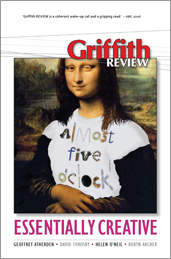
coming-soonI’ve not seen it yet, but the print edition of Saturday’s Age has an extract from my Griffith Review piece on depression and creativity. If it ever turns up online I’ll link to it, but in the meantime, just a reminder I’ve posted the complete, unedited version on this site, or you can download it as a pdf from the Griffith Review site. And please remember you can subscribe to Griffith Review by visiting their website, or purchase individual copies of Essentially Creative from Gleebooks, Readings or bricks and mortar bookshops everywhere.

Meanwhile, following on from Friday’s post about The Second Pass, I thought I’d link to another site I hadn’t seen until very recently, The Millions. A group blog with a very impressive list of regular and guest contributors, it offers intelligent – and substantial – commentary about books, arts and culture, and has recently offered a series of excellent articles about the future of book coverage.

That short piece about The Second Pass (and more particularly Genevieve, of Reeling and Writhing’s characteristically generous comment on it) reminded me that when I set this site up, one of my aims was to share links to articles and sites I thought were worth reading. That ambition rather fell by the wayside, largely because I found the tone of the site as it developed didn’t really suit a lot of linking and aggregation. I’m currently working on a major redesign which will allow me to aggregate links more effectively (a redesign which may also involve a name change, since I’ve rather taken against the name), but in the meantime, I though I’d offer a link to another site, and in particular a piece, I think everybody with an interest in the future of media should read, which is Clay Shirky’s ‘Thinking the Unthinkable’. It’s a month or so old now, but if you haven’t read it you should – it’s probably the most significant piece of writing the blogosphere has seen in the last twelve months.

And finally, my apologies if the content on the site has been a bit rackety recently. I’ve had a bit of a messy few weeks health and work-wise, so I’ve not really been on top of things (the WordPress system’s decision to eat my long post about the death of J.G. Ballard didn’t help either). But I’ve got good things planned for coming weeks, so stay tuned.

Break text

addthisTweet this

On depression and creativity

Griffith ReviewI’ve just realized the full text of my essay about depression and creativity, ‘Never real and always true’ is available for download on the Griffith Review site. Unfortunately it’s only in pdf format, so I’ve taken the liberty of cutting and pasting the text onto this site. And remember you can subscribe to Griffith Review by visiting their website, or purchase individual copies of Essentially Creative online from Gleebooks, Readings or bricks and mortar bookshops everywhere.

‘Never real and always true: on depression and creativity’

Break text

Break text

Break text

addthis

Ngã Uruora (or The Groves of Life)

Geoff Park

Geoff Park

I was deeply saddened last week to learn of the death of the New Zealand ecologist and writer, Geoff Park.

I didn’t know Park, who died on 17 March as a result of a brain tumour, but I did know his work, most particularly his marvellous 1995 book, Ngã Uruora (The Groves of Life): Ecology and History in a New Zealand Landscape, a book I first read after it was pressed on me by Ross Gibson, whose own quietly urgent words about the necessity of coming to understand the landscape we inhabit Park quotes in the book’s introduction.

It’s often difficult to escape the moment, to take the sort of long view which allows one to tell which books and ideas will shape the way we think in years to come, but I think there’s little doubt that Ngã Uruora is one of those books. For while its exploration of the environmental history of New Zealand is ostensibly a small, even parochial subject, it is a book which, in its capaciousness and breadth of vision opens up a new way of understanding the environment, and the deeply complex nature of our relationship to it.

Sadly there doesn’t seem to be any sort of formal obituary to Geoff Park online, but I thought it might be fitting to reproduce a few words which seem to me to capture exactly the quality of attention and generosity which make Ngã Uruora such an important book:

“When you become involved with the landscape . . . it becomes much more than a view. Even to draw a carp, Chinese masters warn, it is not enough to know what the animal looks like, and to understand its anatomy and physiology. It is also necessary to consider the reed which the carp brushes up against each morning, the oblong stone behind which it conceals itself, and the rippling of the water when it comes to the surface. These elements should in no way be constituted as the carp’s environment. They belong to the carp itself. In other words the brush should sketch a life, since a life – like the landscape – is constituted by the traces left behind and imprints silently borne.”

Vale, Geoff Park, go well: you’ll be missed.

Break text

addthis

Contemporary Writers Festival

resurrectionist-cover-ukJust a quick note to let you know that if you’re at a loose end on Sunday, I’ll be speaking alongside Malcolm Knox, Mireille Juchau and Ivor Indyk on a panel called ‘Desperate Characters: Character writing in extremis‘ at the Contemporary Writers Festival in Sydney.
The panel is at 11:30, and full details of the program are available on the NSW Writers Centre website if you’d like to make a day of it.

The Contemporary Writers Festival is a joint initiative of the NSW Writers Centre and the UTS Centre for New Writing.

Break text

addthis

Bodysurfing

abr_april-09-coverI’ve got a poem, ‘Bodysurfing’, in the April issue of Australian Book Review, which is out this week. It’s only eight lines but I promise they’re all gold, every one of them.
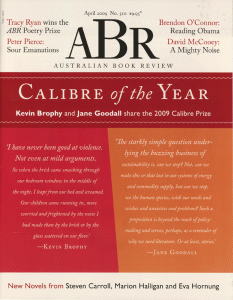
Of course, in the unlikely event the promise of eight hand-tooled lines by yours truly doesn’t seem enough to justify your $9.95 (which makes it a mere $1.25 a line, or 40c a word), the issue also contains the winning entries in this year’s Calibre Award, which has been awarded jointly to Kevin Brophy and Jane Goodall. Both pieces are worth reading, but I definitely wouldn’t miss Kevin Brophy’s truly horrifying account of life with the neighbours from hell, and the secret violence of suburbia.

Australian Book Review is available in bookstores, online, or you can lash out and subscribe.

Break text

addthis

Photography in Australian Fiction

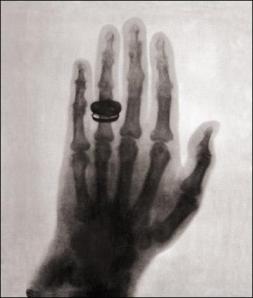
X-Ray image of hand, Wilhelm Konrad Roentgen

Wilhelm Konrad Roentgen, X-Ray image of hand

Last year I met an Italian student called Giorgia Tolfo from Bologna University, who was in Australia to research her thesis, The Photographic Act in Contemporary Australian Fiction. As part of her research she interviewed me and a number of other Australian writers (Delia Falconer and Gail Jones amongst others) who have used photographic motifs in their work.

She’s not the first person to write on this subject. Paul Genoni published a paper in Antipodes in 2002 exploring the use of photography in novels such as my second novel, The Deep Field, Gerald Murnane’s The Plains, Liam Davison’s Soundings, and Thea Astley’s Reaching Tin River (you can access the paper via the Curtin University Library site, though you’ll need to click the pdf symbol in the top right corner to actually read it). But it was interesting to find an Italian student struck by the same resonances between the various works she was writing about (she’s also incredibly bright and very charming, which never hurts either).

Anyway – I just received an email from Giorgia, telling me not only has she passed, but she’s received the highest mark, which is fantastic news. And, since I suspect her thesis isn’t likely to find its way into print in English in a hurry, I thought I might reproduce some extracts from the written interview I did for her after we spoke.

1. What is it that interests you about photography and what was it about photography you set out to investigate in your novel? Was there a particular influence or reference that urged you to write about photography?

I initially became interested in using photography as an element in the novel after looking at a book of photos of museum exhibits by Rosamund Purcell. The images were largely of objects from 18th century cabinets of curiosity, but there were images of fossilized ammonites amongst them, something about those images of ancient stone shells struck a chord with me..

Over time this idea of photographing fossils merged with the ideas I was also interested in exploring, about endings, and continuance, and deep time, and the idea that our own presence in the world might be part of a larger cycle, and a larger order. I remember reading Sontag, and Barthes, and being struck by their insistence that photography must be a representation of death. That seemed right to me, but also wrong – photos are also, necessarily, a form of connection to the past, a kind of persistence through time, in the same way a fossil is, and they connect us to the past, even as they remind us it is gone, and in so doing suggest something about the way loss is always with us, but part of us, and the capacity of things to go on, and endure.

2. In your novel, The Deep Field, Anna begins taking pictures of ammonites and fossils, but only after a scene in which the shells are explored by the blind character with his hands. Was this an attempt to link the idea of tactile memory to the idea of fossils as tactile memories of now vanished organic organisms? What do you see as the best form of memory – visual, tactile, emotional?

I was interested in different ways of being in the world, and particularly by the idea that the blind inhabit a non-spatial world made up of tactile and auditory experience connected in time, rather than spatially. Like virtual reality and cyberspace, that seemed ot me to suggest a very different way of being in the world, and one it might be useful to understand better as technology continues to alter the contours of our identity and the world we inhabit. But I also wanted to connect this idea of the new, and the futuristic to the very ancient, hence the shell on Mars, and the high tech photos of fossils. By doing that, and by playing on the way the blind inhabit their temporal and experiential world I thought it might be possible to suggest something of the way we exist within memory, and experience, rather than the other way around.

3. What do you think about the relationship between fiction and photography? Do you think that the former can help people to better understand the social, emotional and private value of the latter? Do you agree on the fact that fiction is more powerful than theory in exploring the possibilities of photography, being able to create new and not necessarily real situation?

Fiction and photography are necessarily very different. Fiction is narrative-based, and is therefore connected to change. Photography is something sliced free of time we must project a narrative, or meaning into. One explains us to ourselves, the other denies explanation (a process you can see at work in Sebald). But at the same time, both work by opening up imaginative possibility.

That said, I’m always a little wary of the use of photography in fiction. Photography is necessarily documentary and ambiguous, and there seems something dishonest, or sentimental about the impulse to invent stories which displace that ambiguity and fill it in with invented meaning.

As for the question of whether theory or fiction is more useful for exploring the possibilities of photography, I’m not sure either is particularly useful in that context – it’s photography that will explore its own possibilities most usefully. Theory may help us understand it better, criticism may help us understand particular works and practitioners, but I’m really not sure fiction has much of a role to play at all – its interest in photography is almost always for its own, imaginary ends.

4. Do you think there is a peculiarly Australian way of thinking about photography evident in Australian fiction, or do you think the use of photography in fiction is more universal?

I do wonder whether there is a a peculiarly Australian way of thinking about photography you see coming through in writers as diverse as Gail Jones, Delia Falconer, Liam Davison and myself. All of us are interested in exploring a photography as a way of making sense of loss, and transience, rather than as a simplistic memento mori. If this differs from its use in fiction from overseas (and I’m a bit short on ideas for examples to be sure it does) I wonder whether it has something to do with the fact that if you’re in Europe, particularly, or connected by the Jewish diaspora to that European experience, photography might well offer rather starker reminders of the past. Australians are, at some level, interested in finding a way to make sense of their past, and to find reconciliation with it in the present; it’s possible that for Europeans and others the past is something that needs to be put behind them.

Break text

addthis