Skip to content

The Book of Strange New Things
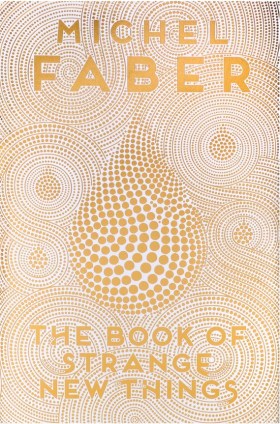
Book of Strange New ThingsAt first blush, science fiction and religion might seem curious bedfellows, the one priding itself on its hard-headedness and rationality, the other giving primacy to faith and the acceptance of mystery.

But dig a little deeper and the differences are less obvious, and not just because of the tradition of books such as James Blish’s A Case of Conscience and Mary Doria Russell’s The Sparrow that explore questions about religion, but because Christianity’s eschatological underpinning is given literal form in many of science fiction’s most famous images of transcendence. After all, what are the final moments of Kubrick’s 2001, or the uploaded consciousnesses and singularities of the cyberpunks and their inheritors but updated versions of the Rapture?

Yet there’s little doubt there have been few science fiction novels as explicitly concerned with the meaning of faith as Michel Faber’s The Book of Strange New Things, a book that features a missionary despatched to an alien world to preach the Gospel to the natives while what looks suspiciously like the end of days consumes our own.

For the missionary, the aptly named Peter Leigh, the position is an extraordinary opportunity, even if it means being separated from his wife, Bea. Although surprisingly little is understood about the planet – Oasis – or its inhabitants, the aliens have specifically requested a missionary be sent, in order that they might learn more about the teachings of the Bible – or as they know it, The Book of Strange New Things – and more particularly its promises of eternal life.

Yet the task quickly proves more difficult than Peter anticipated. For although many of the Oasans are receptive to what he has to say, he finds himself overwhelmed not just by the strangeness of the planet, its oppressive humidity, altered colours and 72 hour days and nights, but by the problems of communicating his message in a way that treats the Oasans as equals.

The situation is not helped by the fact every other human on the planet is an employee of the company in charge of the colonisation, a faceless transnational called USIC (at one point Peter admits he doesn’t know what the letters stand for and is told it doesn’t really matter, “all the meaningful names have been taken”), and seem to have been selected precisely because they have no desire for meaningful contact with the people around them.

But the real problem is back on Earth, where a string of disasters and economic crises lead a newly pregnant Bea to begin to question first Peter, then their relationship, and finally her faith.

These sections – and indeed Faber’s incredibly tender depiction of Peter and Bea’s relationship more generally – are deeply affecting in their own right. But they’re made even more affecting by the fact the novel was written in the shadow of Faber’s wife Eva Youren’s struggle with cancer (Youren died earlier this year, and Faber has said in interviews The Book of Strange New Things will be his last novel). Indeed in one sense The Book of Strange New Things is perhaps best understood as a study of that most undramatic of things, a happy marriage.

At another level though the novel is engaged with a series of questions about religion and its fantasies of salvation and ending. These fantasies are embodied in the book itself, which in a sort of eschatological grace note takes the title of each of its chapters from the last line of that chapter, reinforcing the suggestion that all actions are, in the end, driving toward a particular conclusion. But this structural device is subverted by the resolutely homely nature of Peter and Bea’s faith, and their determination to do good in this life, not merely as a path to rewards in the next, but because by helping others we make both ourselves and the world a better place.

Simultaneously though there’s more than a whiff of Conrad about Peter’s journey and the colonial ambitions of USIC (despite a lovely bit of misdirection in the afterword it’s difficult to believe Peter’s predecessor, who disappeared after going native, is called Kurtzenberg by accident). Yet despite the allusions to Heart of Darkness (and indeed Robert Silverberg’s Downward to the Earth) the novel’s method is never to derange or unsettle in any direct way. Indeed even the Oasans themselves, whose faces resemble “two foetuses curled up” never seem particularly alien or Other in any meaningful way.

It’s tempting to regard this as a failing, of a piece with the book’s oddly cursory attention to the mechanics of its science fictional bells and whistles. How one wants to ask, was Oasis discovered? Why does there only seem to be one group of Oasans? Aren’t there other communities, other cultures elsewhere on the planet? Why does Earth’s economy and environment collapse so suddenly and completely?

Yet I suspect asking these sorts of questions is to miss the point. Because despite its title The Book of Strange New Things isn’t interested in communicating or capturing strangeness at all, quite the reverse. Instead it seeks to demonstrate how inimical the modern world is to the miraculous, how inured it is against true beauty.

This interest in the deadening effects of contemporary culture is not new in Faber’s writing – indeed it’s front and centre in both his first novel, Under The Skin (to which The Book of Strange New Things seems to nod in its opening chapter’s depiction of Peter and Bea’s journey toward the airport along a series of anonymous motorways and layovers), and his third, The Fire Gospel, which was published as part of Canongate’s Myth Series in 2008. But in The Book of Strange New Things it is woven into the fabric of the book, captured not just in the careful affectlessness of the prose but in the USIC employees’ lack of desire to engage not just with questions of faith, but with questions of any kind. Against this backdrop Peter’s faith, like the simple happiness he shares with Bea, seems quixotic at best, an act of folly. Yet it is the triumph of this deeply strange yet strangely affecting novel that it also seems a kind of grace.

This is an extended version of a review that appeared in The Sydney Morning Herald and The Age on 13 December 2014.


A Hard Day’s Night

A Hard Day's Night 2I’ve just watched A Hard Day’s Night, which I haven’t seen in more than 30 years. It’s a film I have always had a soft spot for, mostly because I totally adored it when I saw it as a teenager (an experience that’s mirrored in the opening chapter of Dana Spiotta’s wonderful novel, Stone Arabia), so I was really interested to see how it held up.
The answer is surprisingly well: although the section on the train at the beginning is a bit long and slow (and the pacing in general is a bit slow by contemporary standard) it’s still funny and sneakily surreal and full of life. And though they’re all surprisingly good on camera, both John and Ringo are particularly good.

But what’s really interesting is that it’s not quite the film I remember. If nothing else they’re all much rougher and much more northern than I remember (and their accents are really thick) and despite the mugging and hijinks the film doesn’t attempt to disguise that. But it’s also very clearly a film about emancipation and possibility, with a surprisingly subversive satirical undercurrent (presumably because they chose the Liverpudlian playwright and screenwriter, Alun Owen, to write it, and there’s a lot of gleeful mockery of establishment figures, decorum and the pretensions of the middle classes (the sequence in the ad agency is particularly sharp). But at the same time there’s a lot of that slightly surreal mode of British comedy that delights in wordplay and absurdity that was perfected by Peter Cook and Dudley Moore and others, in particular in scenes like the long “you look just like him” routine with John in the stairwell. I suppose this shouldn’t be a surprise: John and Paul were huge fans of the Goons, and that pleasure in punning and absurdity is visible in both The Beatles’ lyrics and their public personas.

Some other stray observations. Part of what makes the film so delightful is the lightness of director Richard Lester’s touch, and the playful way it shifts modes, jumping from slapstick comedy to playful parodies of the French New Wave and sequences that play with the conventions of James Bond films. It’s also startling to see how completely magnetic John is, although it’s a magnetism that’s made distinctly edgy by the sense he’s always on the verge of doing something unpredictable and dangerous (something the script plays up but is quite clearly there anyway). It’s also clear that part of what made John such a successful songwriter is the contrast between his tough guy image and the songs of male vulnerability he specialised in, in particular songs like ‘If I Fell’. Similarly, while I never really understood why George was such a sex symbol it’s surprisingly obvious when you see him on screen. And although the film doesn’t attempt to disguise the poverty and wreckage of post-war Britain everybody in it, and in particular all the girls, are incredibly beautiful, which whether deliberate or not, helps suggest a sense of renewal and possibility. But basically it’s a delight.

The Coode Street Year in Review

the-coode-street-podcastI’m planning on getting a Best Books post up in the next week or so, but if you’ve got an hour to kill in the meantime you can catch the Coode Street Podcast’s Year in Review special, which features Jonathan Strahan, Gary K. Wolfe and me chatting about some of our favourite science fiction and fantasy books of the year. Books discussed include Lev Grossman’s The Magician’s Land, Ann Leckie’s Ancillary Sword, Adam Roberts’ Bête, David Mitchell’s The Bone Clocks, Nnedi Okorafor’s Lagoon, Garth Nix’s Clariel, William Gibson’s The Peripheral and Monica Byrne’s The Girl in the Road.
You can listen to the show via Podbean or iTunes. And congratulations to Jonathan and Gary on the new partnership between Coode Street and Tor.com: it’s very exciting news for all concerned.


Favourite Music 2014: Part Three

Here’s the third and final part of my list of my favourite albums of 2014. You can also check out Part One and Part Two.

Angel Olsen, Burn Your Fire For No Witness
I haven’t heard Olsen’s debut album, Half Way Home, but if it’s half as good as Burn Your Fire For No Witness it must be pretty fantastic. Olsen has one of those very sixties voices that quaver with vulnerability, and there’s more than a little of the 1960s and 1970s in the songs on Burn Your Fire For No Witness, but there’s nothing derivative about their intensity and intelligence, the deft way she marries elements from the music of the 1940s to garage rock and even glam, or even the wit of her lyrics, which gesture, with delicious irony, toward the self-aware gloom of Leonard Cohen. The net effect is pretty damn special.

Spoon, They Want My Soul
They Want My Soul is classic Spoon: lean and muscular, spaciously produced and totally addictive. If you like Spoon you’ve probably already got it, if you don’t, do yourself a favour and grab a copy. I love all of it but the electric harp (at least I think it’s an electric harp) on ‘Inside Out’ gives me chills every time I hear it.

St Paul & the Broken Bones, Half the City
As the KEXP mini-concert below suggests, St Paul and the Broken Bones are probably one of those bands you really need to see live for the full experience, but all the same, their debut, Half the City is pretty bloody electrifying. Produced by Ben Tanner, of the Alabama Shakes (and just by the way, what is the story with the Shakes’ apparently-recorded-but-still-not-released follow-up album?), it shows off the band’s ferocious brass section and lead singer Paul Janeway’s blistering vocals to brilliant effect. It’s so good.

St Vincent, St Vincent
There’s a reason Annie Clark’s fourth album as St Vincent is at the top of most lists of the best music of 2014, and that’s because it’s seriously good. Smart, rhythmic, intellectual pop that’s both steely and tender, it’s filled with songs like ‘Digital Witness’ and the beautiful final track, ‘Severed Crossed Fingers’ that snake your way into your brain and then sinuously unravel themselves. And she’s dead cool, which never hurts.

The War on Drugs, Lost in the Dream
I already owe The War on Drugs a favour  for propelling Kurt Vile into the solo career that produced one of my favourite albums of 2013, Wakin’ on a Sunny Daze, but now I love them twice over for creating the shimmering, propulsive Lost in the Dream, an album that manages the unusual trick of being both highly textured and soaringly emotional. It’s a fantastic record.

Lucinda Williams, Where the Spirit Meets the Bone
At 61 Lucinda Williams seems to just gets better and better with each album, and Where the Spirit Meets the Bone continues the trend. Featuring 19 tracks over two discs, and almost twice as long as her last album, 2011’s achingly beautiful Blessed, it’s yet another testament to Williams’ capacity to write wonderfully tender songs about damage and loss and love, and although I occasionally get a little frustrated with her strangled phrasing, it’s a wonderful showcase for her distinctive voice and the talents of her band. There are any number of highlights, but if you have a listen make sure you stick around for the final track, an almost ten minute cover of J.J. Cale’s ‘Magnolia’. You might also want to check out The Believer’s 2012 interview with Williams, in which she speaks candidly about her process and career.

Honourable Mentions
Damon Albarn’s post-Blur career has been interestingly schizophrenic, bouncing from projects like Gorillaz and the under-appreciated The Good, The Bad & The Queen to less commercial projects like his opera about Elizabethan alchemist Dr John Dee, but with Everyday Robots he seems to have decided to make a conventional solo album. Except, of course, being Albarn, it’s not particularly conventional: instead it’s a series of introspective songs about alienation and technology. It’s deliberately downbeat, but surprisingly absorbing and heartfelt, and it’s enlivened by a couple of fabulous tracks, most notably the delightful ‘Mr Tembo’.

With its layered vocals and interwoven rhythms and textures Alt-J’s follow-up to their Mercury Award-winning An Awesome Wave, This Is All Yours, shifts between delicately sinister tracks like ‘Hunger of the Pine’ and ‘Warm Foothills’, and the stomping electro-blues of ‘Left Hand Free’, but that variety is part of what makes this beautiful, various and complex album so rewarding. It’s great stuff.

Jeff Tweedy’s decision to record an album with his son, Spencer, could easily have been an act of ageing rock star indulgence, and while it suffers a bit from their decision to spread the results over two discs, there are enough gems on Sukeriae to justify Tweedy’s faith in the project. It’s not quite Wilco (who have also just released a very interesting looking box-set of nerd-bait rarities, Alpha Mike Foxtrot) but it’s still pretty terrific. And the film clip for ‘Low Key’ will have a horrible familiarity for an awful lot of writers and musicians.

Also a few I only came across very recently, but which I already adore. The first two are artists I discovered on Amanda Rose’s always incredibly interesting list of her favourites of 2014 over on Flop-Eared Mule (if you haven’t been, go immediately, it’s a veritable treasure trove of fabulous stuff). First up is Light in the Attic’s reissue of a 1969 album of gospel recordings of Dylan songs. The group behind it, the Brothers & Sisters, were put together by Lou Adler (the guy behind Sam Cooke (he co-wrote ‘What a Wonderful World’, The Mamas and the Papas and Carole King (inasmuch as anybody other than King was behind her success), and featured singers such as Gloria Jones and Merry Clayton (who turns up in 20 Feet From Stardom).

The second is French folk singer Alma Forrer, whose self-titled EP contains four stunning songs that showcase her liquidly beautiful voice.

I can also recommend Reigning Sound’s Shattered, a gem of an album which may wear its influences on its sleeve, but is direct and warm and filled with brilliant songs.

And finally a brilliant little punk pop record from UK act Martha. I’m a sucker for this particularly British brand of guitar pop, and Courting Strong is one of the best versions of it I’ve heard in ages.

And although it’s pushing it, a couple of things that date from 2013 and 2010 respectively, but which I only discovered this year.

The first is Memphis-based singer-songwriter Valerie June’s fantastic Pushin’ Against A Stone, an album that June has described as “organic moonshine roots music”, but which sounds both rooted in tradition and completely contemporary in its eclecticism and political instincts.

And the second is Zoe Muth and the Lost High Roller’s Starlight Hotel and her follow-up, World of Strangers. I didn’t know Muth before I heard Starlight Hotel and her follow-up, World of Strangers, but I was a paid-up fan by the time the first song had played.

Favourite Music 2014: Part Two

As promised on Monday in Part One, here’s the second instalment in my list of my favourite music of the past twelve months. Part Three will go up Friday.

Justin Townes Earle, Single Mothers
Earle has made it clear on several occasions that this album had a troubled birth, having been cut back from two discs to one (there’s now a companion album, Absent Fathers, due for release early next year). It’s difficult not to feel that troubled genesis is reflected on the album itself though, at least to some extent: certainly it’s the least immediately approachable of Earle’s past four albums, partly because the opening two tracks, ‘Worried About The Weather’ and ‘Single Mothers’ are so downbeat. But give it a few listens and the album unpacks itself, revealing gorgeous tracks such as ‘Time Shows Fools’ and ‘Today and a Lonely Night’. I’m not sure it’s Earle’s best – I think that crown still belongs to the brilliant Harlem River Blues – but Single Mothers is still a terrific album that shows Earle continuing to grow as a songwriter and lyricist.

Sharon Van Etten, Are We There
Sharon Van Etten’s last two albums, Tramp and Epic, demonstrated her capacity to write frighteningly intimate and jagged songs about fractured identity and resilience, but Are We There (the annoyingly absent question mark is her doing, not mine) sees Van Etten’s songwriting grow in both complexity and range. The undercurrent of emotional and physical violence that makes Epic so raw is still very present on Are We There, but there’s a new expansiveness to the production and arrangements, an expansiveness that’s anchored by the intensity and total commitment of the performance. It’s a raw, powerful and exhilarating combination.

Hurray for the Riff-Raff, Small Town Heroes
Small Town Heroes isn’t Hurray for the Riff-Raff’s debut but it’s the first of their albums to find real success. Based in New Orleans and led by singer and bassist Alynda Lee Segarra, the band combine traditional elements with contemporary subjects, as evidenced by songs like ‘The Body Electric’, which reworks the murder ballad to expose the violence against women that lies beneath it, but it’s Segarra’s songwriting, voice and charismatic performance that makes them really exciting. You can check out ‘I Know It’s Wrong (But That’s Alright)’ and ‘The Body Electric’ below, together with a scorching performance of one of my all-time favourite songs, The Velvet Underground’s ‘Rock and Roll’.

https://www.youtube.com/watch?v=16k-M_8E1Sc&w=490

The Last Internationale, We Will Reign
I know the thumping blues-rock albums I was supposed to love this year were Royal Blood’s self-titled debut and Jack White’s Lazaretto, but I have to confess I was reasonably unmoved by both of them. Instead I found myself listening to New York act The Last Internationale’s passionate and polemical We Will Reign, an album that nails its political colours to the mast from the first song, the stomping ‘Life, Liberty and Indian Blood’.

Given the subject matter of the songs it’s an album that could be dour or humourless, but it’s not, even on songs like ‘Devil’s Dust’, which is a lament for miners poisoned by their work, something that’s got more than little to do with lead singer Delila Paz’s thrillingly unbridled yet gorgeous voice, something that’s showcased on the live acoustic version of ‘Wanted Man’ below.

Jenny Lewis, The Voyager
I’ve been a huge fan of Jenny Lewis for a long time, so despite being a little underwhelmed by her 2009 collaboration with Johnathan Rice, Jenny and Johnny, I was very excited to finally have a new solo album. And what an album it is: combining the 1970s soft rock of Fleetwood Mac with Lewis’ flair for unpacking her capacity for self-destruction, it manages to be funny, tender and sad all at once, a quality that’s even even more heft in the light of this excellent New Yorker profile of Lewis. It’s a wonderful, wonderful album, and although I can’t find a decent copy of my favourite track, ‘Late Bloomer’, online that doesn’t really matter, because there’s not a bad song on it.

Lydia Loveless, Somewhere Else
One part country, one part punk, Lydia Loveless’ sexually frank and emotionally intelligent songs of romantic disaster are wonderfully raw and funny (let’s face it, a song that begins “Well I was just thinking about you and how you got married last June/I wondered how that worked out for you, so I just thought I would call” is never going to work out well for anybody), and they’re played with fabulously dishevelled energy and directness by Loveless and her band. I love this album.

Favourite Music 2014: Part One

I’m planning to post something about my favourite books of 2014 next week, but in the meantime I thought I might pull together a list of some of my favourite albums of the past year.

I’m not going to pretend what follows is comprehensive or make any claim to objectivity. Instead it’s a very personal list of things I’ve loved over the past twelve months. That being the case I haven’t tried to rank them or pick out absolute favourites; instead I’ve listed them alphabetically, although because the full list is a bit unwieldy I’ve decided to spread it across three posts. This first one covers A to D, the second, which will be published on Wednesday, covers E to L, and the third, which will go up Friday, covers M to Z (together with a few honourable mentions).

Alvvays, Alvvays
Think Best Coast or a dreamy mash-up of Teenage Fanclub and The Pains of Being Pure at Heart. Gorgeous hooks, fuzzy guitars, shimmering production and gorgeous echoes of the 1950s and the glassy cool of Blondie and New Wave. It could be from 1982 or 1990 or last week, but that nostalgic timelessness is part of what makes it so magical. And ‘Archie, Marry Me’ is worth the price of admission all on its own.

Rodrigo Amarante, Cavalo
I bought this one on a whim but I’m so glad I did. Although he’s recorded several albums with Brazilian band Los Hermanos, Amarante is probably best known in the Anglophone world for his work with Strokes drummer Fabrizio Moretti as part of the underrated Little Joy. Cavalo is his first album and it’s wonderful, featuring songs in French, Portuguese and English, and wending its way through delicately retro numbers like the opener, ‘Nada Em Vão’ and ‘Irene’ to sneaky dance tracks like ‘Hourglass’ and gorgeous, almost unclassifiable creations like ‘Mon Nom’.

Benjamin Booker, Benjamin Booker
I love, love, love this album. Right from the nod to Chuck Berry in the opening bars of the first track, ‘Violent Shiver’, it’s just electric, using Booker’s raspy vocals and the deliberately rough and ready production to anchor a series of tightly written yet loosely played songs that combine elements of blues, punk and the garage rock of Pavement and The Strokes. There’s not a bad song on it, but the one I come back to over and over again is the glorious, gospel-influenced ‘Slow Coming’, a song that seems to nod implicitly to Sam Cooke’s classic ‘A Change is Gonna Come’.

Leonard Cohen, Popular Problems
I have to confess I was a bit of a latecomer to Leonard Cohen, but over the past few years I’ve become more and more fascinated by him and his work. All the qualities that make Cohen so singular are on display on Popular Problems, which easily measures up to Cohen’s work in the late-1960s and early-1970s (and leaves his work in the early years of this century for dead), and shifts with startlingly ease from the sardonic wit of ‘Almost Like The Blues’ (“There’s torture and there’s killing/And there’s all my bad reviews/The war, the children missing/Lord, it’s almost like the blues”) to beautiful love songs like ‘Did I Ever Love You’ and the delicate restraint of ‘You Got Me Singing’. And the physical version of the album also includes a wonderfully designed fold-out booklet featuring a series of images of a half-dressed Cohen cleaning his shoes, offering a wonderfully restrained tribute to both Cohen’s fascination with Buddhism and the shadow of mortality that helps lend this slyly vital album its particular beauty.

(While you’re listening to the songs I suggest you take a few minutes to check out the photos of Cohen on Hydra in the 1960s that have surfaced in recent years, many of which also feature George Johnston and Charmian Clift, and this excellent piece about them by Paul Genoni and Tanya Dalziell).

The Delines, Colfax
I’m a huge fan of Willy Vlautin’s work, both as a member of Richmond Fontaine and as the author of novels such as Lean on Pete and The Free, so I was very excited when I heard he’d quietly assembled The Delines, a new group featuring Richmond Fontaine drummer Sean Oldham, Decemberists keyboardist Jenny Conlee and Damnations singer Amy Boone, and that excitement was absolutely borne out by their debut album, Colfax. I’ve written about Vlautin’s songwriting before, but the songs on Colfax show all the emotional intelligence and gift for compressed narrative that make his work with Richmond Fontaine so special, as songs like ‘The Oil Rigs At Night’ make eloquently clear.

Bob Dylan, The Complete Basement Tapes
I’ve never sought out any of the endless bootlegs of Dylan and the Band’s sessions at Big Pink in 1968, which means my exposure to the great white whale of modern music was restricted to the overproduced 1975 collection, but I’m not sure I’ll ever be able to go back to that now I’ve heard the real thing. I ponied up for the absurdly overpriced six CD complete version (which justifies its exorbitant price tag with two beautiful hardback books of photos, but lacks the extensive liner notes that helped make last year’s Another Self-Portrait so fascinating), and although the slightly less-obsessive fan might well do just as well with the two CD selection, it’s still a thrilling experience, filled with a sense of play and delight in the possibility of the music. I’ll leave it to others to unpick the importance and pleasures of this collection, all I have to say is whether you think you’re a Dylan fan or not, try and lay your hands on a copy: it’s wonderful.

Make You Better

Cannot. Wait.

The larger realities of Ursula Le Guin

“We live in capitalism. Its power seems inescapable. So did the divine right of kings.”

Some thoughts about Interstellar

Interstellar 1

I know I’m a little behind the curve on this one, but I finally caught a session of Interstellar last week, and before it gets away from me I thought I might jot down a few (slightly spoilery) thoughts about it.

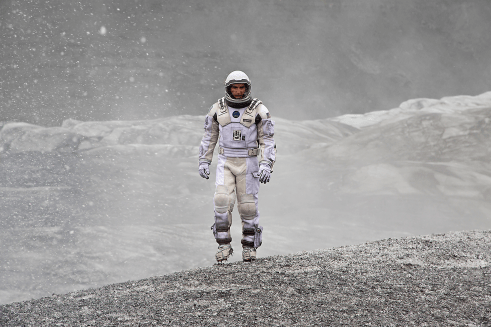
For those who haven’t seen it, it’s Dark Knight and Inception director Christopher Nolan’s new magnum opus, a science fiction epic that marries contemporary anxieties about societal and environmental decline to a nostalgia for the vision of the future’s possibility that drove the space race (and, not coincidentally, also underpins Kubrick’s 2001, a film to which it owes a great deal). Set a generation or two from now, it centres upon Cooper (Matthew McConaughey), a former test pilot and trainee astronaut. Now widowed, Cooper is eking out a living as a farmer with his two children when a gravitational anomaly in his home leads him and his daughter, Murphy (Mackenzie Foy), to what turns out to be a secret NASA installation.

Reunited with his former boss, Professor Brand (Michael Caine), Cooper discovers two things. The first is that the Earth is dying, and will soon be uninhabitable. But knowing that, Brand and his daughter, Dr Brand (Anne Hathaway) have been  studying a wormhole that has appeared in orbit around Saturn, and which connects our solar system to another galaxy. Having sent several scientists through twelve years earlier, Brand is now planning one last mission aimed at establishing whether any of those scientists found planets capable of sustaining life, and, by extension, of saving the human race.

Persuaded to act as the mission’s pilot, Cooper travels through the wormhole on NASA’s last spaceship, the Endurance, with Brand and two other scientists. At least at first his focus is on completing the mission as quickly as possible so he can return to his family, but before long their hopes of returning to Earth begin to fade, as relativistic time dilation severs them from their families and various misadventures, including a run in with a dangerously unhinged survivor of the first mission, Wolf (Matt Damon), cripple the mission, until, in the film’s final reel, Cooper is offered a glimpse of the temporal paradox he inhabits.

Nolan is often described as a cerebral director, but the truth is he’s not, unless the handwaving of Inception is your idea of philosophy. What he does have is a brooding visual style (especially when teamed with cinematographer Wally Pfisterer), and a line in the sort of speechifying that sounds deep but doesn’t bear too much close examination (“the human race was born on Earth, it wasn’t meant to die here,” etc etc). Given all that (and the reviews) I went in expecting Interstellar to be titanically stupid, but in fact despite one truly risible speech by Brand (apparently love is a force, like gravity, that transcends time and space, which we’d all know if it weren’t for the fact scientists haven’t discovered it yet) there’s surprisingly little of the overtly stupid philosophising that mars films like Prometheus.

interstellar_a

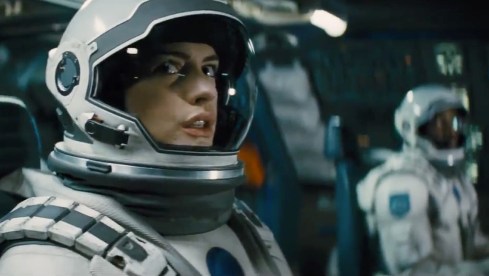
Dr Brand (Anne Hathaway)

None of which is to say Interstellar is a smart film, or even a particularly slick one, but if you try not to think about it too hard it does have its own daft poetry. Some of that poetry is in the effects: the initial ride through the wormhole (and indeed the wormhole itself) is gorgeous, as are the waves on the first planet the crew visit, and there are any number of extraordinary vistas and images. But it’s also in its peculiar rhythms and weird, slightly dopey high-mindedness, even if it is marred by its absurdly intrusive soundtrack (which sounds like they commissioned the Abominable Dr Phibes to compose a series of variations on Philip Glass and then play them really, really loudly).

Of course you have to try pretty hard not to think about it too much, because as soon as you do the questions start multiplying like a game of whac-a-mole. Why does it take Endurance months to get to Mars yet once the ship is through the wormhole it suddenly becomes possible to fly between planets in no time at all? How come they need a multiple stage heavy lift rocket to get off Earth yet they’re then able to take off and land on other planets unassisted? And where is the sun in the system they visit? Surely it’s not the one that’s being consumed by the black hole? And (and I’m afraid this one’s a biggie) in what way is colonising a solar system with an enormous black hole in it a long term survival strategy? And that’s all before you begin wondering about things like how they could possibly not notice Wolf’s story about a surface with breathable air and organics is bunk (given they’ve seen the planet from orbit) or or how it is the spaceship technology hasn’t changed in a century despite the development of technology allowing us to construct vast space colonies. Or indeed why despite the dire warnings at the film’s beginning the threat of suffocation doesn’t seem to have transpired by the time Murphy figures out the riddle of gravity.

What’s interesting is that despite the film’s constant exhortations to go outwards and beyond, to remember a time when we invented things and embraced possibility, it’s not really about those things at all. Instead at some level its real preoccupation is loss and, more deeply, time.

In a way this isn’t surprising. Despite the glitter of the technology that surrounds us we live in a cultural moment in which we are beset by loss. A large part of that is environmental, something the film acknowledges in the opening sequences and the dust storms and blight that are slowly poisoning the Earth. But it’s also about a loss of faith in the future, a sense that we no longer know how to think about what comes next.

The factors behind this are complex. In part it’s a function of the failure of so many of the narratives of progress that have driven our cultures for so long. But it’s also at least partly a function of the triumph of capitalism and its capacity to crowd out the idea there might be alternative ways of structuring society. In this regard it was interesting to hear Ursula le Guin reversing the polarity of Frederic Jameson’s remark about it being easier to imagine the end of the world than the end of capitalism when she said “we live in capitalism. Its power seems inescapable. So did the divine right of kings” at the National Book Award ceremony last week.

INTERSTELLAR

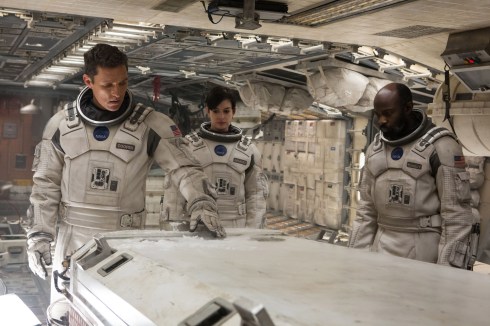
Cooper (Matthew McConaughey), Dr Brand (Anne Hathaway) and Romilly (David Gyasi)

But whatever its origins, this sense of grief pervades contemporary culture. You can see it in films like Interstellar, in TV shows like The Walking Dead, and in many, many novels.

What’s interesting to me is less the grief, which seems the only sane response to the conflagration surrounding us, but the fact trying to talk about it seems, almost inevitably, to lead us to a consideration of time. This is obviously the case in Interstellar, which plays overtly with the idea of time, relativity and the deep future, but it’s also also visible in a novel like David Mitchell’s The Bone Clocks (a book I think has been roundly misunderstood by most critics), which despite its cast of murderous immortals and journeys toward the land of the dead, is really attempting to find a way to talk about deep time and survival.

It’s possible I’m a bit obsessed on this last point – loss and time and how we think about them are written deep into the fabric of my new novel, Clade, which is out early next year – but I don’t think I am. Because finding the emotional and intellectual tools we need to think our way out of our current predicament clearly requires us to find new ways of thinking about the future and own relationship to it.

What’s surprising about Interstellar is that despite its desire to map out a space for this kind of thinking, its solutions are unreflectively technological and technocratic. This unreflectiveness is visible in NASA’s back-up plan in case the Endurance’s mission fails, plan that will see tens of thousands of human embryos hatched and then auto-raised by computers, allowing a new society to be built from nothing. As Abigail Nussbaum has noted in a slightly different context, it’s a plan that’s nothing short of grotesque, but it’s also of a piece with the film’s suggestion that the solution to Earth’s environmental problems will be to leave Earth and live in orbital colonies.

As Nussbaum points out, neither of these are plans that hold up to any real scrutiny. They’re also contradicted by the film’s unintentional subtext, which is that even allowing for the intervention of extra-dimensional beings with the power to control space and time, space doesn’t want us, meaning we really have no alternative but to find ways of living here on Earth that won’t ruin the planet.

In the end though, these science fictional elements are only really window dressing, because at its heart Interstellar’s real nostalgia is as much for another era of filmmaking as another era of human possibility. Its debt to 2001 is large and explicit, and many of its best bits (the ride through the wormhole, the long sequence in the infinite library, the talking computers) are borrowed from Kubrick’s masterpiece. Yet where 2001 deliberately denies the viewer the tools to interpret what they are seeing, forcing them to find their own meaning (in a very real sense the film of 2001 is the monolith, and it is our own reflection we see in it) Interstellar is a  more gimcrack creation, one part homage, one part digital masterpiece, one part awkward, almost naive high-mindedness, a combination that lends it moments of surprising beauty and even power, and which almost allows it to transcend its own absurdities.

That Glimpse Of Truth: 100 Of The Finest Short Stories Ever Written

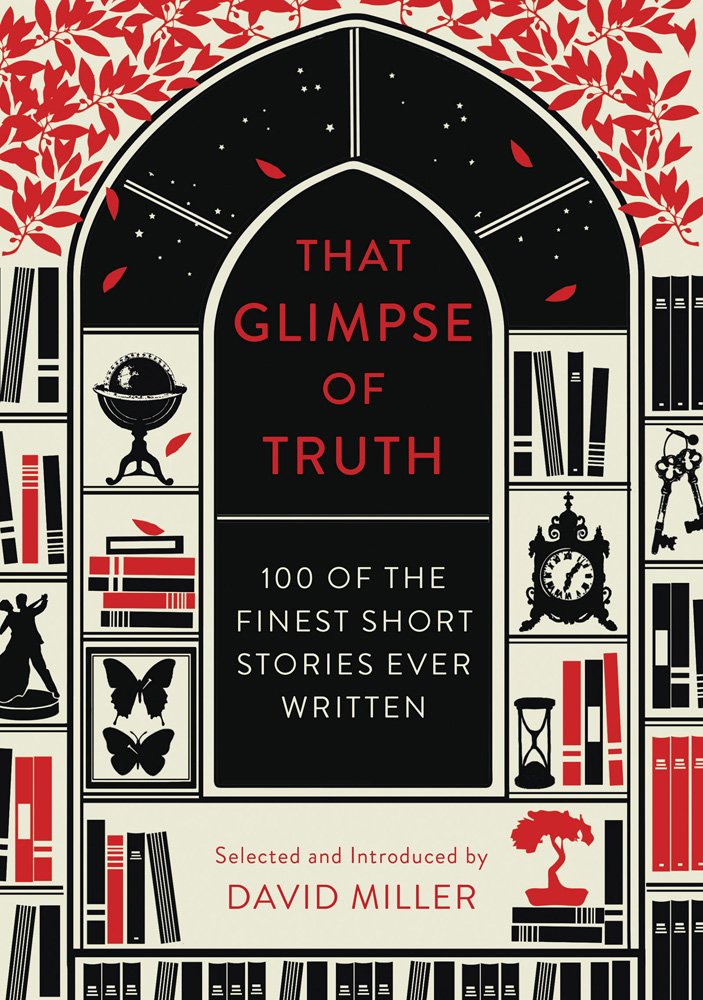
Glimpse of TruthI’m very excited to say my story, ‘Beauty’s Sister’, has been included in David Miller’s new anthology, That Glimpse of Truth: 100 Of The Finest Short Stories Ever Written, which was released last week. If you’ve seen the book you’ll know it’s just insanely gorgeous object (and with the Christmas season rapidly approaching would make a perfect gift, hint hint), but it’s also amazingly good, and features stories by Kate Atkinson, Julian Barnes, Angela Carter, Anton Chekhov, Charles Dickens, Roald Dahl, Penelope Fitzgerald, Gustave Flaubert, Rudyard Kipling, Somerset Maugham, Ian McEwan, Alice Munro, V.S. Pritchett, Thomas Pynchon, Muriel Spark and Colm Tóibín as well as me (and in case you’re wondering then yes, it is a little daunting to be in such company).

Obviously you can still buy ‘Beauty’s Sister’ as a Penguin Special in either electronic or print form, but I very much recommend taking the plunge and checking out That Glimpse of Truth. It’s available in bookstores in the UK and Australia, but if you can’t get to a bookstore you can compare prices on Booko (Australia, New Zealand, UK, US, Canada) or buy the ebook through all the usual channels.

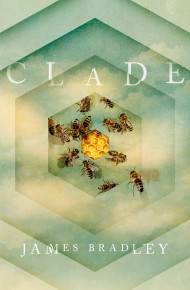
Clade cover and preorders!

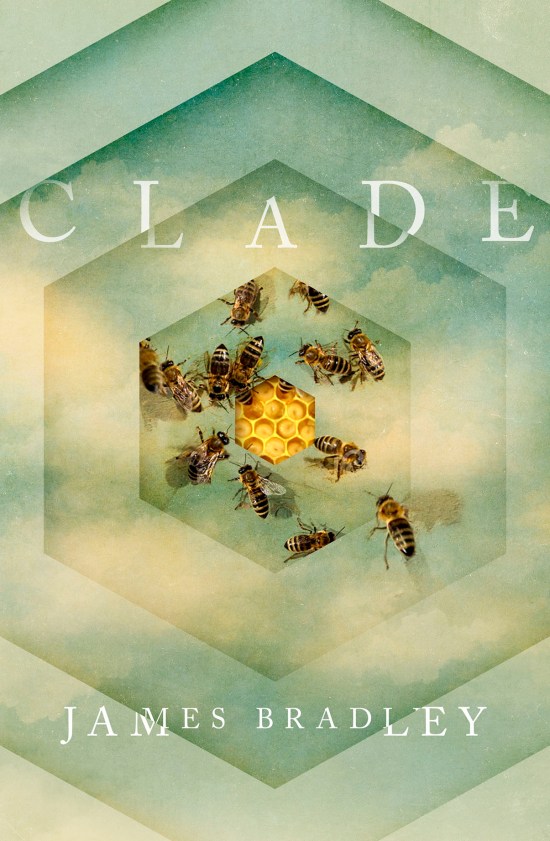
So it’s official. My new novel, Clade, will be released by Penguin in Australia on 28 January. As the blurb says, “A provocative, urgent novel about time, family and how a changing planet might change our lives, from the acclaimed author of The Resurrectionist and editor of The Penguin Book of the Ocean.”

You can feast your eyes on the very sexy cover below, and if you’d like to preorder a copy you can do so through Booktopia and Bookworld. I’ll pop up more links as it becomes more widely available, and post some more details soon. [Update: you can also preorder through Boomerang Books]

Very exciting!

Clade

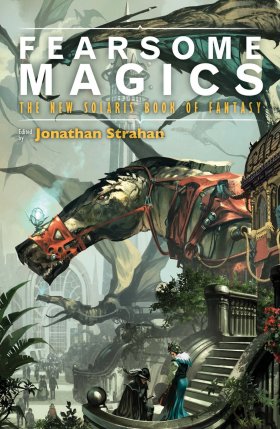
Fearsome Magics

Fearsome MagicsJust a quick note to say I’ve got a story in editor extraordinaire Jonathan Strahan’s new anthology, Fearsome Magics, which is due out today. The follow-up to Jonathan’s World Fantasy Award-nominated Fearsome Journeys, it’s also the second in his New Solaris Book of Fantasy series.
I haven’t read all of it yet, but the bits I have are terrific. You can check out the full table of contents over at Coode Street, but there are new stories by Garth Nix, Karin Tidbeck, Kaaron Warren, Frances Hardinge, Christopher Rowe, Isobelle Carmody and a bunch of other fabulous people. I think – I hope – my story, ‘The Changeling’, is interesting: to my mind it’s less fantasy than a sort of anti-fantasy, although I’m not going to say more than that.

Australian readers who’d like to pick up a copy can check prices on Booko; otherwise you can check out your favourite independent bookseller, head to Amazon or Amazon UK, or pick up the ebook for iBooks, Google Books and Kobo. In the words of the immortal Molly Meldrum, ‘Do yourself a favour …”.

Immense Heaven

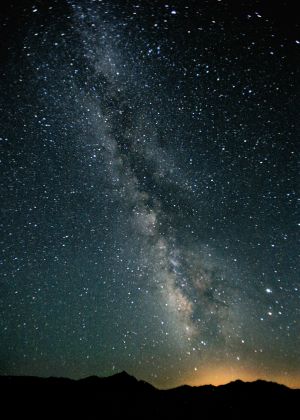
1024px-Milky_Way_Night_Sky_Black_Rock_Desert_NevadaOur sun is one of the approximately 300 billion stars that make up the Milky Way. The Milky Way is part of what is known as the Local Group, a formation of at least 54 galaxies galaxies spanning 10 million light years. The Local Group lies on the fringe of a much larger supercluster of galactic groups and clusters which contains more than 100,000 galaxies and spans some 520 million light years.
I’m not sure how many of us can really make sense of these sorts of numbers, or the idea that the universe is composed of a web of galactic clusters that shift and flow like water. Yet there’s something deeply fitting in the news earlier this week that the team responsible for identifying this vast supercluster have named it Laniakea, a Hawaiian word that means “immense” or “immeasurable heaven”, and was chosen to honour the Polynesian sailors who once navigated the great space of the Pacific by reading the stars.

It’s a name whose poetry extends beyond the obvious resonances with the ocean. It often seems there is something irresistible about our tendency to see the ocean infinite, immeasurable, trackless. There’s little doubt it’s an association that runs very deep, but it’s also at least partly a cultural construction, a legacy of Romanticism and the ways technology has progressively alienated us from the environment.

In fact the ocean is anything but trackless. As the achievements of the Pacific Islanders (and other pre-modern sailors) demonstrate, it is quite possible to read the sea, to learn to make sense not just of the stars but of patterns of wind and wave, the movement of birds and fish and driftwood (as several of the pieces in The Penguin Book of the Ocean attest).

The systems of knowledge, of fine-grained observation and remembered experience that underpinned this process were developed over hundreds and in some cases thousands of years. Yet because the cultures that encoded them were largely oral, they were also vulnerable, and as the Pacific was colonised, and its cultures disrupted and suppressed, they largely disappeared. Indeed the fact that persist at all is largely due to the efforts of people such as the late Will Kyselka and David Lewis, who worked to preserve and recover as much of them as possible.

That systems of knowledge acquired over thousands of years should have been lost like this is strangely ironic: after all, the colonial project was spearheaded by the scientific voyages undertaken by explorers such as Banks and Cook during the late eighteenth and nineteenth century, voyages that were themselves part of the extraordinary project of discovery and description that underpins modern science, and which has led, more than 200 years later, to us being able to map the flow of galaxies through billions of light years of space with such sophistication that it is possible for structures such as Laniakea to be identified and understood.

Lanikea isn’t the first astronomical object to be given a Polynesian name: astronomers have already chosen to name two of the dwarf planets discovered in recent years in the outer solar system MakeMake (for the creator of humanity and god of fertility worshipped by the Easter Islanders) and Haumea (the matron goddess of the island of Hawaii), yet it’s certainly the most significant. Nor should we be so naive as to think giving Polynesian names to heavenly bodies will bring back what has been lost: as Victoria Nelson has observed, “the death of a culture, like the death of a star, lasts longer than anyone can possibly imagine. The sadness, the echoes and ambiguities, persist for hundreds of years”. But reading about the naming of Laniakea I found myself wondering whether it’s possible that by incorporating the language and poetry of the Polynesians into the scientific endeavour we begin to acknowledge the repositories of knowledge embedded in their cultures (and by extension other non-Western and indigenous cultures), and just perhaps, go some small way toward recognising the injustices that have been inflicted upon them.

Laniakea. Immense Heaven.


A new novel, a new story and a new anthology …

It’s been a while since I posted, and given how much I’ve got to get through over the next few months it may be a while before I get back to posting more regularly, but I wanted to announce a couple of things.

The first – and most important – is that Penguin will be publishing my new novel, Clade, in Australia in February next year, with other territories to follow. I’ve posted a few bits and pieces about it here and there, but it’s a book I’ve been thinking about and working on for a while now, and I think it’s pretty special. At some point I’ll pop up a proper description, but for now it’s probably enough to say it’s about time, and family and climate change, it moves from the very near future to the end of the 21st century, and that it’s got birds, floods, bees and aliens. I rather love it and I hope other people will as well.

Although I’m currently deep in the process of editing Clade, I’ve also spent the first half of the year working on a couple of other projects. The first is another new stand-alone novel, which is slowly taking shape; the second is a trilogy of new novels. I can’t talk much about either just yet, except to say that the first novel of the trilogy is written and the next two are underway, and I’m hoping I’ll have drafts of both the standalone novel and all three books in the trilogy by the end of next year.

In the meantime I’ve got a couple of other bibs and bobs around the place. One is a new story, ‘Skinsuit’, which you’ll find in Island Magazine 137. The full text of the magazine isn’t online but you can pick up the print version at good bookstores here in Australia or order print and digital versions from Island directly (while you’re there you might want to think about supporting the magazine and its investment in Australian writing and culture by subscribing). The issue also features fiction by Tegan Bennett Daylight, Angela Meyer and Sunil Badami, as well as non-fiction by Alison Croggon and Damon Young, so you’re guaranteed value for money.

The other is a piece in if:book Australia’s The N00BZ: New Adventures in Literature. Edited by Simon Groth, the collection is the culmination of a project that saw fifteen writers including attempt to stretch or challenge their writing practice in different ways. Sometimes the challenges were personal – Sean Williams participated in a sleep deprivation study, and charted the effects on his writing – sometimes, as with Benjamin Law’s decision to learn shorthand, they were technical, and sometimes, as with Jeff Sparrow’s exploration of the experience of not writing, they involved an examination of the author’s writing practice more generally. For me the challenge revolved around trying to develop and write the script for a comic, a project that was both about exploring my lifelong fascination with comics and beginning the process of learning to work in a new form.

It was a great project, and one I enjoyed being involved in immensely, and having read the contributions of the other writers I’m confident they enjoyed being involved in the process as much as I did. If you’d like a taster you can read my contribution online, but I really do recommend you check out the entire collection, which is currently available in digital form with the print version to follow in August.

Best Books 2013

The KillsBecause it’s Christmas Eve and I’m sure everybody’s mind is focussed on matters literary I thought I’d take a moment to pull together a list of some of the books I’ve most enjoyed over the past twelve months. As usual I’ve already made a start in my contributions to the annual roundups in The Australian and The Sydney Morning Herald and The Age, which also have contributions from Delia Falconer, David Malouf, Geordie Williamson, Felicity Plunkett and a lot of other people: if you have a chance I really do recommend checking them out.
As I said in my list for The Australian, I don’t think there’s any doubt in my mind that the best new book I read this year was Richard House’s 1000 page metafictional thriller, The Kills, a book I’ve been proselytising about ever since I read it back in August. In a time when it’s occasionally difficult to make a case for the novel House’s book (or books, I suppose, since it’s really four short novels) is a reminder of exactly why fiction matters: smart, savage, politically ferocious, it’s also technically and formally audacious, pushing the boundaries of what novels are by incorporating video and sound into its structure.

I was also hugely impressed by Rachel Kushner’s dazzling study of art and politics, The Flamethrowers, a book that’s distinguished both by its intelligence and by the electric energy of its prose, Margaret Atwood’s occasionally frustrating but ferociously funny Maddaddam, Karen Joy Fowler’s characteristically smart, self-aware chimpanzee experiment novel, We Are All Completely Beside Ourselves, Philipp Meyer’s sprawling Texan saga, The Son and Patrick Flanery’s brilliant, angry and thrillingly unstable exploration of contemporary America, Fallen Land.

Another book I liked very much but which seemed to receive less attention that I would have expected was Julian Barnes’ Levels of Life. Although I’m a big admirer of Barnes I was a bit underwhelmed by The Sense of an Ending. But Levels of Life is a remarkable book, exhibiting both extraordinary control and a palpable sense of the raw, unprocessed (and largely unprocessable) nature of grief.

RevengeMeg Wolitzer’s The Interestings is another book that seems to have found a while to attract the attention it deserves, so it’s pleasing to see it turning up on a number of best of the year lists. Warm, capacious and very smart about the nature of friendship and the way age and success alters the dynamics of relationships, it’s also one of the most consistently enjoyable things I’ve read this year. And while I suspect it slipped under a lot of people’s radar, I loved Yoko Ogawa’s splendidly sinister matryoshka doll of a collection, Revenge.
There are also a couple of books I came to late, but which blew me away. The first is A Death in the Family, the first part of Karl Ove Knausgaard’s epic six-volume autobiographical fiction, My Struggle. I’ve yet to read the second, A Man in Love, which was released in an English translation earlier this year, but I was mesmerised by A Death in the Family. The Sydney Review of Books has just published a brilliant review of the two of them by editor James Ley; if you only read one piece about Knausgaard it’s the one to read, not least because it’s very articulate about the reflexiveness of Knausgaard’s project, and about the Proustian edge to the books, which seems to me to have been mostly misunderstood. I suspect a lot of the impact of A Death in the Family is due to the power of the final third, and its unflinching depiction of the narrator’s father’s death of alcoholism and its aftermath, but the book is also fascinating for the way it explores the tension between mimesis and banality.

The other book I came to late was the late Ian MacDonald’s thrilling study of The Beatles, Revolution in the Head, which I read alongside Pete Doggett’s whip-smart account of the lead up to and aftermath of their breakup, You Never Give Me Your Money and Tune In, the first volume of Mark Lewisohn’s huge but often fascinating biography of the band and its members, All These Years. While the others are all good, MacDonald’s book is hands-down the best book of pop music criticism I’ve ever read, although it’s given a run for its money by one of the other standout books I read this year, Bob Stanley (late of pop group, Saint Etienne)’s endlessly absorbing, occasionally problematic and constantly delightful history of pop, Yeah Yeah Yeah. I want to write something longer about Yeah Yeah Yeah at some point: for now I’ll just say that while Stanley lacks MacDonald’s deep critical intelligence he’s never less than engaging and his command of his extraordinarily diverse material is remarkable, and like many such works my arguments with it only added to the pleasure of reading it.

Caspar HendersonI have to confess I didn’t read as much Australian fiction as I should have this year, but of the things I did read a couple of books really stood out. One was Tim Winton’s Eyrie, a book that in its portrait of the contradictions underlying the West Australian boom was more explicitly engaged with contemporary Australia than a lot of Winton’s fiction, but the real standout was Richard Flanagan’s The Narrow Road to the Deep North. Flanagan seems to have spent most of his career looking for a way to marry his family history to the national narrative; in The Narrow Road to the Deep North he’s done just that, with remarkable results.
On the genre side of things I very much enjoyed Neil Gaiman’s The Ocean at the End of the Lane, Graham Joyce’s slyly unpredictable follow-up to the wonderful Some Kind of Fairy Tale, The Year of the Ladybird, and Ann Leckie’s terrific debut, Ancillary Justice, as well as Paul McAuley’s final Quiet War novel, Evening’s Empires and Madeline Ashby’s queasily acute exploration of the line between human and Other, iD, but I think the thing I enjoyed most was Guy Gavriel Kay’s gorgeous, allusive sequel to Under Heaven, River of Stars. All Kay’s books are terrific but I suspect River of Stars is the best thing he’s written to date.

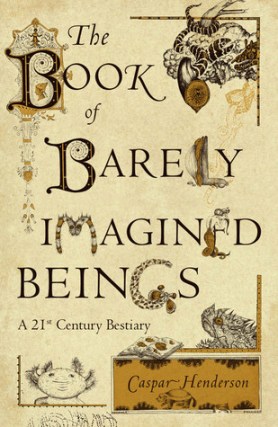
Of the non-fiction I read this year the best thing was Caspar Henderson’s prismatic exploration of our ways of thinking about animals, Nature and ourselves, The Book of Barely Imagined Beings, but I was also dazzled by Mark Cocker and David Tipling’s astonishingly beautiful compendium of bird lore, Birds and People. I admired Cocker’s last book, Crow Country, very much, but Birds and People is a much more singular creation, and, interestingly, one that has more than a few resonances with The Book of Barely Imagined Beings. Other non-fiction books I enjoyed include Tim Dee’s deeply disquieting study of four spaces, Four Fields, Philip Hoare’s peripatetic exploration of the ocean and its meanings, The Sea Inside, psychiatrist Stephen Grosz’s wonderfully humane and psychologically sophisticated The Examined Life and John Ogden’s magnificent study of Sydney’s southern beaches, Saltwater People of the Fatal Shore (if you’ve got a moment the interview with Ogden on the ABC’s Late Night Live is well worth a listen).

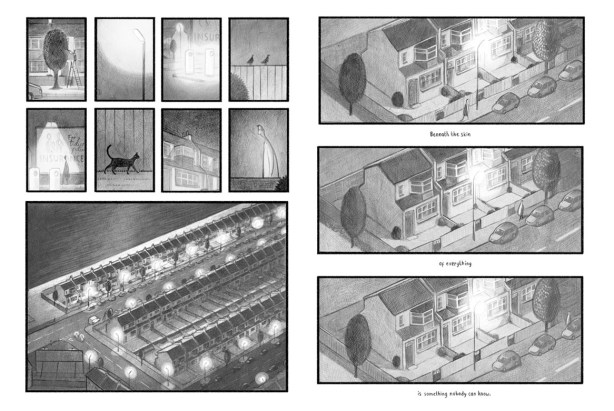
And last, but not least, a book I came to late but loved quite immoderately, Stephen Collins’ delightfully weird contemporary fable, The Gigantic Beard That Was Evil. As I said in my piece for The Australian on the weekend, even if you don’t normally read comics please take the time to track one down; you won’t be sorry.

And finally my best wishes to all of you for the holiday season: I hope you’ve had a great year and the twelve months ahead are full of life, love and all good things.

Stephen Collins, The Gigantic Beard That Was Evil

Stephen Collins, The Gigantic Beard That Was Evil