Skip to content

Some thoughts about Avatar Part 1: 3D and reality

Neytiri (Zoe Saldana) and Sully (Sam Worthington)

Given the sheer volume of discussion of Avatar online, and the fact that it’s now a month since the film was released, I’ve been a little reluctant to chip in with my two cents worth. But while the time for anything like a straight review is long past, I feel like there are some things worth saying about it that don’t seem to have been said to date.

Because what I want to say is reasonably extended, I’ve decided to break it up into two (or just possibly three) posts. The first – this one – is about the 3D technology of the film; later in the week I want to say a few things about the film’s broader message, and perhaps about what it is that seems to work (and not work) in it.

To begin with, I think it’s worth observing just how overwhelming the response to the film has been. I can’t think of another film in recent years which has generated anything like as much commentary as Avatar, or (perhaps more interestingly) which has managed to chew up so much bandwidth across so many channels. You’d expect a genre film, especially a genre film as expensive and technically striking as Avatar to be generating a lot of commentary on sites which cater to fanboys, but it’s a lot less usual for a genre film (or indeed any film) to be generating continuing commentary on the opinion pages of the major international broadsheets.

At least part of this can be attributed to the film’s politics, which have enraged right-wing commentators around the world (or at least inspired the sorts of absurd posturing that passes for outrage in right-wing circles). I’m not going to rehash their arguments here, which mostly turn on the mawkishness of the film’s ecological and political subtexts, but I would observe that there’s something telling about the sheer ferocity of the Right’s hostility to messages which are, at one level, so unexceptional (after all, as Elvis Costello almost asked, what’s so threatening about peace, love and understanding?).

But I’m not sure the somewhat confected political debate about the film’s politics really explains its transformation into a full-blown cultural phenomenon. Certainly it’s difficult to imagine the armies of people who’ve trooped off to see the film having a Road to Damascus moment as they head home to their houses filled with the sort of consumer technologies that made the film possible and deciding to give it all away for a simpler life (nor, I suspect, would the many corporations with a stake in its success be impressed if they thought its anti-consumerist message was actually hitting home).

Instead the film’s impact seems to be a result of the technologies that make it so striking, in particular Cameron’s extremely sophisticated fusion of 3D and digital special effects.

In itself this is hardly a remarkable observation, but stay with me for a moment. 3D isn’t new, but after the success of Avatar I think we can assume it’s here to stay. There have already been announcements that films ranging from the new Bond film to 2012’s Star Trek 2 and the now-Sam Raimi-less Spiderman 4 will be shot in 3D, and while the technology will presumably take a while to trickle down into smaller, less spectacle-driven productions, I think there’s little doubt it will.

To my mind the interesting question isn’t whether 3D will gradually displace older, 2D technologies, but what that will mean for the way we see and experience film (or indeed whether it is fair to continue to describe the future of visual storytelling as “film”). As anyone who’s seen it knows, what’s really exciting about Avatar isn’t the story (though to tell the truth, I found it completely absorbing, all my caveats about the woodenness of its storytelling notwithstanding) or even the effects (which are, quite simply, extraordinary) but the sense of immersion. As many before me have observed, the film largely declines to employ the sort of cheesy things-shooting-out-of-the-screen-at-you gimmicks 3D films have usually confined themselves to, and instead concentrates on creating a world you enter as if it were real.

Interestingly, I think the sheer novelty of the experience rather overwhelms the fact that as a simulation of real space the film is actually rather crude. There’s depth, but objects and figures often seem more like planes moving in space than actual three-dimensional things (rather like a $300 million Captain Pugwash cartoon, I suppose). That’s not to say it isn’t amazing, and – as the film’s publicity reminds us – unlike anything we’ve seen before, but it is to be reminded that for all its wonder to an audience in 2010, within a decade Avatar is likely to look as crude as the original Star Wars does now. Likewise I suspect it’s fair to assume that 3D film and television are probably only transitional technologies, and that the future lies in holographic projection or some similar technology.

But crude or not, I think there’s little doubt Avatar is the embodiment of Cameron’s recognition that cultural forms are, in a very deep sense, artefacts of the technology that create them. Novels take the form they do because of the codex book, movies the cinema (and increasingly, television) screen, video games the computer screen. So moving from 2D to 3D isn’t just about adding depth to films, it’s about creating something new, something unlike anything we’ve had before.

In a minor way this is visible in the textures of the film itself. Despite the immersiveness of the 3D Avatar often seems curiously flat texturally. Given the riot of colour that is Pandorum, it would be impossible to describe it as washed-out, but more than once I found myself nostalgic for the vivid density of colour digital images and digital film have made us familiar with. There are a few moments that have it – most memorably the early scenes in space, which draw upon NASA’s photographs of the ISS and shuttle missions – but for the most part Pandorum (and by extension the film itself) doesn’t look dense or vivid enough to be “real”.

Arrival at Pandorum

But this density of colour is itself new, a consequence of the shift to digital imaging, and the increasingly blurry line between reality and representations of reality, a line films like Avatar are making even blurrier. What looked “real” to an audience familiar with Technicolor looks strange to us, just as the more liquid surfaces of analog photography seem increasingly other-worldly to a culture more accustomed to digital reproduction.

This is doubly true of Avatar’s use of 3D, which breaks the fourth wall in a truly revolutionary manner. Instead of watching the film, the audience are in the film. I’ve not read everything that’s been written about the film, but it seems odd to me that people haven’t made more of the fact that Cameron quite deliberately situates a second, imaginary immersive technology at the centre of the film, as if to suggest the film is, in some small way, a very crude version of what Sully and the others experience “dreamwalking” in the avatars themselves.
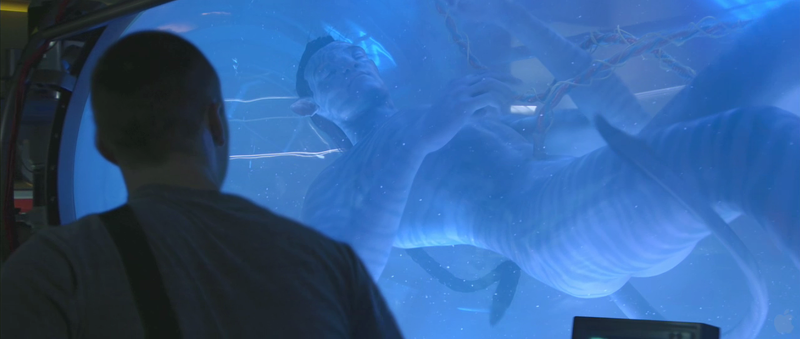
Sully (Sam Worthington) and his avatar

But the avatar technology also – and importantly to my mind – invokes the computer game. I don’t mean by this that the film is intended to celebrate gaming or leverage a computer game (though it’s certainly not too cynical to suggest there’s nothing accidental about the very obvious continuity between the textures of the film and the textures of Avatar: The Game). Instead I think Cameron invokes gaming because he understands – whether consciously or not – the synergies between the immersiveness of 3D moviemaking and the computer game.

In a very crude sense, computer games and film have been converging for some time. In the gaming world it’s long since ceased to be surprising for a game to be “cinematic”, and, conversely, I think it’s fair to say the largely digital textures of a lot of action and science fiction films often seem to resemble those of the more sophisticated games.

Critics of games and gaming usually point to the crudeness of the interactions, or the lack of interiority in games as a sign of their inferiority to older forms such as fiction and film. But that seems to me to miss the point. Games aren’t about interiority, they’re about agency, and often, the creativity of the player. They are an experience, a means of entering another world.

Of course this is precisely what Sully does in the film when he steps into his avatar’s body (and again when he leaves the control of the mission and becomes one of the Na’vi), and what, in a cruder sense, the film allows the viewer to do. And while the agency enjoyed by a player is absent, the sense of immersion moves the experience beyond that of passive consumption, suggesting something more like possibility, or even escape. Indeed the film very deliberately suggests this longing for freedom, and for escape through its early concentration on Sully and his ruined body, and the sense he only becomes fully alive, and fully real in the moment he steps into the avatar.

Which brings us back, I think, to the question of what 3D will do to film, and perhaps more profoundly, film’s storytelling. All forms of fictional narrative – novels, films, television series, even fairy tales and folk stories – create worlds. But the shift to 3D makes this process central, emphasising the viewer’s immersion in the world of the film, just as computer games emphasise the player’s immersion in the world of the game. It also, in the longer term, suggests new forms of interactivity, and, I suspect, narrative possibilities (at the very least POV pornography is unlikely to ever be quite the same). And, more deeply, it hastens our transition into a world where the virtual and the real are essentially indistinguishable, and where our sense of what is real is hopelessly enmeshed in the technologies we use to reproduce it. As filmmakers like Cocteau understood long ago, 2D film has always, at some deep level, been about a kind of dreaming, a way of projecting our fantasies onto the screen (it’s not accidental we watch movies in the dark, or that film is essentially insubstantial, a play of light upon a screen); with 3D those dreams cease to be insubstantial, and begin to populate the world around us.

Break text

Lean on Pete

Is Richmond Fontaine frontman Willy Vlautin the greatest writer you’ve never heard of? Judging by what I’ve read of his forthcoming novel, Lean on Pete, the answer may well be yes. I’m planning a longer post about Willy and his books and music sometime soon, but in the meantime you might want to check out this lovely little video of him reading from Lean on Pete, with backing music by Richmond Fontaine. And if you like what you hear, I thoroughly recommend checking out his first two novels, The Motel Life and Northline at Amazon, Readings or Book Depository, or dropping past Richmond Fontaine’s Myspace page. Or you could just go the whole hog and and download a copy of Richmond Fontaine’s fantastic 2009 album, We Used To Think The Freeway Sounded Like a River via their Bandcamp page. I promise you won’t be disappointed.

Break text

Break text

How does this uncritical anti-science nonsense end up on the front page?

Am I the only one who’s completely horrified by the Australian media’s embrace of the ongoing publicity campaign by the Catholic Church over the canonisation of Mary MacKillop? Not content with wall-to-wall coverage of the announcement just before Christmas, we’re now being treated to nonsense like this and this (and this!) on the front pages of the newspapers.

Rather than fulminate at length, I’m going to confine myself to a few questions. How is it even remotely okay for major newspapers to be publishing uncritical articles about “miracles” on their front pages in 2010? Have we really lost the fight against the anti-science mob that comprehensively? If such claims were made by another, less established religion or belief-system (let’s say Scientology, or perhaps the Exclusive Brethren) would they be allowed to go through to the keeper so easily? And what does that tell us about the power and influence of the big churches, and the Catholic Church in particular? And finally, and perhaps most pertinently, why are editors who are so resistant to the scientific evidence surrounding climate change so uncritical when it comes to this sort of religious claptrap?

Break text


This one’s for you, John, or “I built a sex robot in your memory”

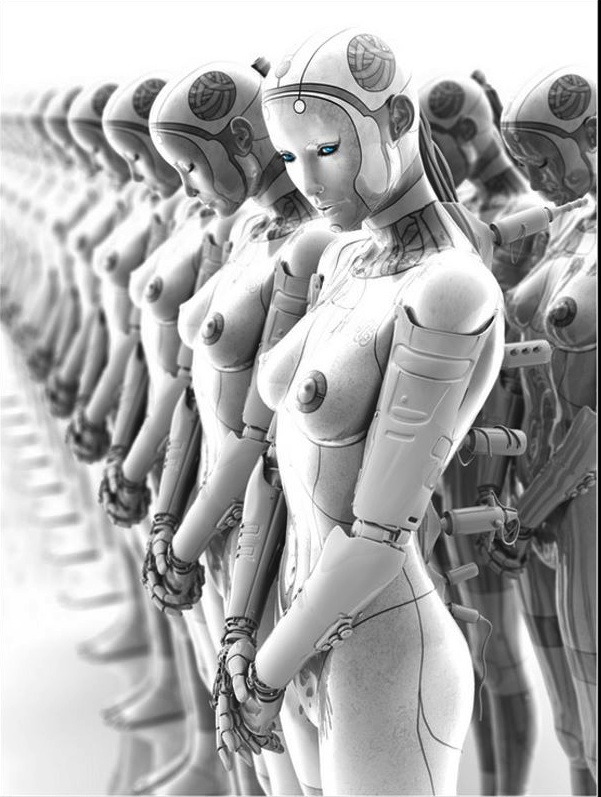
I’m sure more than a few of you will have seen the story out of this week’s Adult Entertainment Expo about the launch of TrueCompanion’s “anatomically consistent” artificial intelligence-driven sex robot, Roxxxy.

I’m reasonably unmoved by the story itself: sex robots aren’t new, and I think it’s safe to assume they’ll grow more sophisticated and lifelike in years to come (if you’d like to know more you might want to check out Shouting to hear the echoes as an introduction to the wild and wonderful world of Synthetiks).

But there’s a detail buried in The Sydney Morning Herald’s coverage of the launch which had me choking on my muesli. Apparently:

“Inspiration for the sex robot sprang from the September 11, 2001 attacks. ‘I had a friend who passed away in 9/11,’ [Roxxxy’s creator, Douglas Hines] said. ‘I promised myself I would create a program to store his personality, and that became the foundation for Roxxxy True Companion’.”

Now, quite aside from the fact this is pretty much the plot of Caprica (which I’ll be reviewing in the next couple of weeks), am I wrong in thinking there’s something splendidly weird about the idea of creating a sex robot to commemorate a friend’s passing? And, if we wanted to get all psychological for a moment, that there’s something about the way the idea mixes up subject and object (literally and metaphorically) which goes to the heart of pornography and the sex industries more generally? Or is it just that Marx was right all along, and all history, no matter how dreadful, is eventually and inevitably reborn as farce?

Break text

A sneak peek of Matt Smith as the Doctor

I’m just interrupting my desperate race to the end of a first draft imposed silence to let you know a trailer featuring Matt Smith as the Doctor has found its way onto the internet. I think David Tennant is going to be a hard act to follow (though after the truly ridiculous first part of ‘The End of Time’ I’m not sure the end of Russell T. Davies’ reign is necessarily such a bad thing) but any episode which features the Doctor hitting a Dalek with a sledgehammer has to be worth a look.

Break text

Break text

The Morning That I Get To Hell

In my post the other day about The Low Anthem’s Oh My God Charlie Darwin, I rattled off a few of the albums that have given me the most pleasure over the last twelve months or so. I’ve talked about some of them before, but one I haven’t mentioned, and should have, is the fabulous Nothing Gold Can Stay, by Felice Brothers frontman Simone Felice’s side-act, The Duke and The King. If you haven’t heard it, I strongly recommend dropping by their Myspace page and listening to a couple of tracks, because it’s gem of an album: more laid-back and gentle than the Felice Brothers proper, but suffused with amazing warmth and feeling, and layering soul and gospel over the usual Felice blend of backwoods folk and blues. I’ve pulled a couple of tracks from the album below, the debut single, ‘If You Ever Get Famous’, and a gorgeous live version of one of my favourite tracks, ‘The Morning That I Get To Hell’, but if you can track down the album proper down, do. You won’t be sorry.

Break text

Break text

Break text

Free music!

Day feel colourless and drab? Then just hop over to Vanguard Records and for a limited time you can download a free Christmas sampler featuring tracks by Josh Ritter, the Watson Twins and a bunch of other acts well worth making the acquaintance of.

You see? Good things do come to those who wait.

Break text

Break text

Fair suck of the sav (or the revenge of the poo dinosaur)

"Grr, baby."

On Twitter the other day, Angela from Literary Minded pinged me for wrongly attributing her quip about this year’s male-dominated Miles Franklin shortlist being a sausagefest to Kerryn Goldsworthy.

Angela was joking, but I know where she’s coming from. Every writer’s got stories about having ideas pinched or misattributed. And though it happens less often than a lot of people think, it does happen. I keenly remember pitching a story to a TV show and being told it wasn’t for them, only to see the same story turn up a few eps later in the season, virtually unchanged.

For the most part though, I try not to get too hung up about these things. But a few years ago I had the very disconcerting experience of sitting down to read a new book of essays by a highly celebrated Australian writer, only to come across two pages that had been transcribed pretty much verbatim from a conversation I’d had with them at Adelaide Writers’ Week a year or 18 months previously.

It’s difficult to know what to do in this sort of situation, since squealing just makes you look over-sensitive, so I just copped it. But it meant that when my friend Delia Falconer called me a couple of weeks later to ask whether I wanted to be acknowledged as the source for a section in her novel, The Lost Thoughts of Soldiers, I told her I did. Definitely. No questions asked.

The catch was that the section in question was based on a story from my brother’s time working as a bouncer in an Adelaide pub. One night, at closing time, he went to check the toilets, and there on the cistern was a sleekly glistening brown dinosaur crafted from human shit. Disgusting, yes, but what was worse was the care its creator had lavished upon it, inserting little sticks for arms and match-heads for eyes. That and the fact that the tap in the toilet was broken, so whoever had made it had gone back out into the pub without washing their hands.

Of course in Delia’s hands the story gained a literary patina the original lacked, but all the same I was pleased when my copy of the novel arrived to see my name in black and white in the acknowledgements page. This time at least I’d kept control over my material.

Or so I thought. A couple of weeks later I went to the launch of the book, and quickly became aware people were looking at me strangely. At first I thought I was being paranoid, but then, during the speeches I realised what was going on. Having read the story and the acknowledgements people had put two and two together and decided it was me personally who’d made the dinosaur. Appalled at the notion I might have become known as some sort of demented coprophiliac, crafting little animals out of poo in between writing books, I told people they were wrong, it was a story my brother had told me, to which they smiled patronisingly, and said, ‘Oh right, whatever you say’.

But worse was to come. A few months later, when the book came out in the US, Delia did an interview about it which mentioned the story, and namechecked me as the source. which meant that for a long time afterwards if you googled my name and “poo dinosaur” you pulled up multiple hits (all gone now, I note with relief).

Oh yes, me and Auguste Rodin, artists of the living clay.

Break text

Oh My God, Charlie Darwin

I’ve been thinking vaguely of knocking together a list of my favourite albums of the year, but that project’s rather fallen by the wayside (off the top of my head, M. Ward’s joyous Hold Time, Metric’s Fantasies, The Duke and the King’s Nothing Gold Can Stay, the Felice Brothers’ footstomping Yonder is the Clock, Richmond Fontaine’s We Used To Think The Freeway Sounded Like A River (perhaps not quite as strong track by track as Thirteen Cities, but pretty damn good all the same), the honey-voiced Justin Towne Earle’s grower, Midnight at the Movies, the Yeah Yeah Yeahs’ It’s Blitz, Girls’ Album and, on the classical side of the fence, David Lang’s Little Match Girl Passion and the insanely cheap box set of lesser-known Bach Masses and Cantatas featuring Phillipe Herreweghe, the Collegium Vocale and assorted soloists I picked up on Amazon a while back, and now, sadly, discontinued).

But one CD that would almost definitely be on the list would be The Low Anthem’s Oh My God Charlie Darwin. I’ll spare you me raving about its brilliance, and just give you this, the almost too cute animated video of the title track.

Break text

Break text

Why are all the best bloggers women?

Why are all the best bloggers women? What is it about the online space that allows women's voices to predominate?

Read more

Sunday ephemera

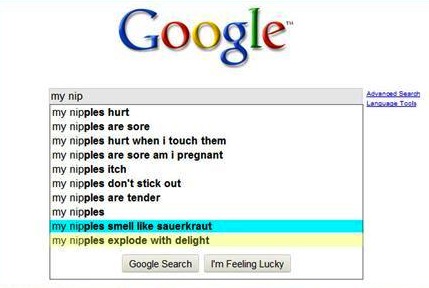
"my nipples smell like sauerkraut"

After a very rewarding morning washing a tub of Vaseline out of my three year-old’s hair (in case you’re interested shampoo is useless but talcum powder and then shampoo seems to have helped) I thought I’d chuck up a few links to liven up your Sunday.

The first is a delicious new site called Autocomplete Me, which I found via Spike (who found it via The Millions), which uses the Google’s autocomplete function as a device to peer into the murky depths of the collective subconscious. Having confessed before to the voyeuristic pleasures of eavesdropping on other people’s search terms it’s the sort of site I can’t help but enjoy, but I challenge anybody not to be both fascinated and bemused by the fragmentary glimpses of people’s private worlds the site throws up. Some are cute (“What do you feed a Yeti anyway?”), a lot are weird (“Cheese is the devil’s plaything”) and  some are just plain worrying (“I’ve just had a conversation with my cat in the shower about pancakes. We both like them a lot”).

I also thought in the light of my post a few weeks back about the death of the letter it might be worth pointing to Stacy Schiff’s wonderful review of Thomas Mallon’s equally wonderful-sounding Yours Ever: People and their Letters, a book written in the shadow of the disappearance of the form to which it is devoted. Schiff reads Mallon’s book as an elegy for a dying art, suggesting in closing:

“It is next to impossible to read these pages without mourning the whole apparatus of distance, without experiencing a deep and plangent longing for the airmail envelope, the sweetest shade of blue this side of a Tiffany box. Is it possible to sound crusty or confessional electronically? It is as if text and e-mail messages are of this world, a letter an attempt, however illusory, to transcend it. All of which adds tension and resonance to Mallon’s pages, already crackling with hesitations and vulnerabilities, obsessions and aspirations, with reminders of the lost art of literary telepathy, of the aching, attenuated rhythm of a written correspondence.”

To which, my suggestion that blogs and Twitter might, in a very small way, be replacing the letter notwithstanding, I can only say, ‘Amen’.

And finally, a little Sunday song. I know this video’s done the rounds a lot of times already, I know it’s just marketing, but it’s a wonderful thing all the same. Enjoy.

Break text

Break text

Audiofile’s Best Voices of 2009

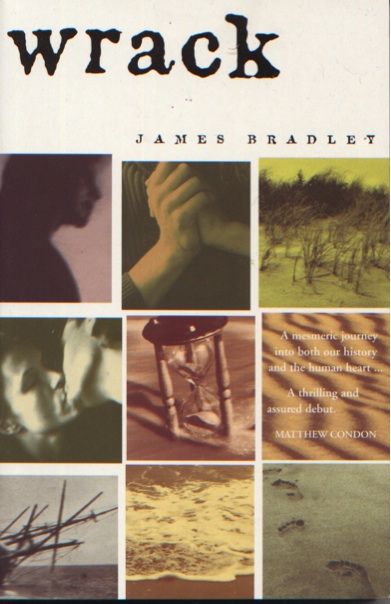
Just a quick note to say congratulations to Humphrey Bower for being chosen as one of US Audiofile Magazine’s Best Voices of 2009 for his work on the Audio Book of my first novel, Wrack, produced by Australia’s Bolinda Publishing. Perth-based Humphrey, who’s built quite a reputation in recent years for his work voicing novels by Sonya Hartnett, Gregory Roberts and Tim Winton, also works as an actor and director on stage and screen (anyone who was watching John Safran’s Race Relations over recent weeks may have caught him in episode 3 as Rabbi Packouz) and voiced the Audio Book of my third novel, The Resurrectionist, back in 2007 (if you’d like to know more about Humphrey there’s a bio at Audiofile).

I suspect the world of Audio Books isn’t one that intrudes into many people’s lives, but it’s an incredibly important industry. My grandmother began to lose her sight in her 70s, and was basically blind for most of the last decade of her life. I’m not sure she was a great reader before she lost her sight, but once it was gone she found great solace in Audio Books, even though, as the years went on, her hearing became worse and worse.

Looking back, I wish one of my books had been recorded in time for her to listen to it. I’m not sure she would have enjoyed it particularly, but I think it would have meant a lot to her, and it would certainly have meant a lot to me. So while I’m congratulating Humphrey, and Bolinda, I’d like to extend a larger thank you to the Audio Book industry in general for all their efforts. I don’t know much about the economics of it but I’m pretty certain publishing Audio Books in Australia faces all the same challenges the Australian publishing industry in general faces, only more so, which makes their work all the more praiseworthy.

If you’re interested you can listen to a sample of Humphrey’s recording of Wrack here, and of The Resurrectionist here (for what it’s worth I particularly like his work on Wrack).

Break text

Books of the Year

What were your favourite books of the year? I ask because a few weeks ago I spent half an hour pulling together a list of my books of the year for the December issue of Australian Book Review, which hit the shops this week. Writing these sorts of lists is always a slightly odd process, not least because it’s often difficult by November or December to remember what you read in January (though I’ve been using Facebook’s Virtual Bookshelf app to track my reading lately, which has helped a bit with that part of the process). But it also throws up other problems. Does a book count if it was published last year but you didn’t read it until this year? What happens if you had a dud year, and nothing much lit your fire? And, much as I hate to admit it, there’s always the need to look like I’m a slightly more serious person than I actually am.

Unfortunately ABR’s lists aren’t online, but if you all promise to run out and buy a copy I don’t think they’ll mind if I reveal my picks, which were (in no particular order) Hilary Mantel’s Wolf Hall, A.S. Byatt’s The Children’s Book, J.M. Coetzee’s Summertime and Marilynne Robinson’s Home.

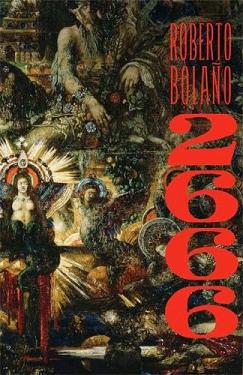
Looking at the list I’m painfully aware of how conservative it looks. But I’m also reminded that about two minutes after I sent it off, I realised I’d left off the two books which should, by rights, have headed the list, Roberto Bolano’s 2666 and Jonathan Littell’s opus, The Kindly Ones.

What interests me about both is that they’re both immense, and immensely flawed, yet simultaneously both are works that test the limits of what the novel can do. The Littell – ostensibly the more conventional of the two, and not dissimilar in its way from William Vollman’s similarly immense and semi-factional Europe Central – is, in a formal sense, a failure, unable to resolve the tension between the stories of the Oresteia which are invoked by its title, and the historical material in which it is grounded. Yet despite that it is a powerful and deeply disturbing work, not just because of its many graphic and oddly numbed scenes of violence and degradation, but because the textures of its narrator, Aue’s, consciousness are so repulsive, and, more importantly, because it demands, both by virtue of its extraordinary synthesis of historical and documentary sources, and its curiously uninflected observation of the monstrosities it depicts, that the reader look at the Holocaust anew.

At a formal level, 2666 is even more problematic than The Kindly Ones. Unfinished at the time of Bolano’s death in 1999, it has been translated with great fluidity and care by Natasha Wimmer. As Musil’s Man Without Qualities demonstrates, a novel does not need to be complete to be great, but 2666 is incomplete in a deeply indeterminate way. Pieced together from several manuscripts after Bolano’s death, its current incarnation was supposed, at least at the time of publication, to be a good approximation of Bolano’s intentions. But in the year or so since it was published more sections have appeared, suggesting that judgement might be premature.

Exactly where these new sections fit isn’t clear. Certainly the book as it stands seems complete, and it’s difficult to imagine how new sections could be incorporated into the whole. Yet like Bolano’s similarly dazzling The Savage Detectives, the novel celebrates a particular form of uncertainty and fascination with the outer limits of meaning by incorporating them into its fabric, qualities that suggest its form is mutable in a way the form of most novels most definitely is not.

What’s remarkable about both is that they question the very idea of the novel, in the case of The Kindly Ones by eliding the boundary between the novel and history, in the case of 2666 by creating a book which through its textual game-playing and multiplicity deliberately (or presumably deliberately) denies the reader the satisfactions of resolution and closure we normally associate with fiction.

I’m not sure how I managed to forget two books which so infuriated and delighted me when I was doing my list for ABR, but I think the fact I did should be a reminder of how provisional any list of the best books is. Because when I think about it, there are easily half a dozen more I could have included. Richard Holmes’ joyous The Age of Wonder, for instance, or Esther Woolfson’s wonderful Corvus. Or Robert Charles Wilson’s Spin. Or David Malouf’s Ransom. Or James Lasdun’s It’s Beginning to Hurt. The list goes on and one.

Which brings me back to the question I asked at the outset. What are the best things you’ve read this year? Are there books I should have read I haven’t? Any remarkable and unexpected discoveries? Can you confine yourself to just three, or five, or do you need to list more? Either way, I’d love to know.

Break text

The day after

Honey I Blew Up The Party?

I’m sure I’m not the only one who’s finding this morning a bit of a letdown after the madness of the last few days. Lunchtime already and no challenges for the Liberal leadership? No open treachery or attacks upon colleagues? Even the ABC’s no longer broadcasting live from Canberra. It’s a bit like the day after Christmas.

Anyway, if you’re after something to brighten up the emptiness of your post #spill day, you might want to hustle down to the shop and pick up the December issue of the Australian Literary Review, which is available free in today’s Australian. As usual some of the highlights are available online, not least Inga Clendinnen’s on Noel Pearson’s manifesto to rebuild indigenous communities, Peter Pierce on Thomas Keneally and Rowan Callick on criminal justice in China, as well as a long piece by yours truly about the Australian lit mag scene (obviously the real highlight of the issue) but a lot isn’t, so if you can lay your hands on a copy of the print edition, do.

Break text

More Conservative Craziness

Thought Tony Abbott as Opposition Leader was the nuttiest piece of right-wing nonsense you’d see this week? Think again . . .

Break text

Break text