Via Overland comes Karen Andrew’s sly update of Clive James’ poem, ‘The Book of my Enemy has been Remaindered’.
And here was me telling some students only a couple of days ago that one of the joys of blogging was that the status anxiety and envy that so shrivels novelists and poets’ hearts just evaporates in cyberspace. Oh foolish, utopian me.
Over at Hackpacker the irrepressible George Dunford has posted the text of a piece about the Australian litblogging scene. Originally published in The Big Issue a couple of weeks ago, it’s filled with sage and worldly pronouncements from such luminaries as Jessa Crispin and Yours Truly, but if that’s not enough to convince you to exercise your mousefinger, George’s description of Perry Middlemiss as the white-bearded Wizard of Oz litblogs definitely should.
The current issue of The New York Review of Books includes an excellent piece by Michael Massing about the future of news. In contrast to the angst and aggro that often surrounds the subject, Massing’s piece is laudably clear and uncoloured by either Wired-style techno-utopianism or stupidly reactive declaratons about the enduring importance of newspapers and the frivolousness and pointlessness of new media forms such as blogging.
To his credit Massing seeks to tease out the increasingly symbiotic relationship between bloggers and conventional journalists, and to emphasize the increasing role bloggers are playing in breaking news, both as part of the daily news cycle and in a more sophisticated, investigative mode. And, interestingly, he suggests the real danger in the shift to decentralized modes of news gathering and dissemination is less about the loss of the resources of the major media companies, and more about the sort of echo-chamber effect that too often predominates on the net, in which people balkanize into self-reinforcing conclaves of shared opinion.
In a way, of course, Massing’s article is a counterpiece to Clay Shirky’s now-famous article, ‘Newspapers and thinking the unthinkable’, which argued that the current convulsions in our media landscape are analogous to the convulsions which reshaped European society in the years following the invention of the printing press. Indeed Massing pushes Shirky’s argument one step further, suggesting a further analogy between the printing press’ role in loosening the grip of the Catholic Church on medieval society and the manner in which blogging and new media are undermining corporate and government control of the flow of ideas in contemporary society.
I don’t think either Massing or Shirky would argue they know what the future of media looks like. But as both make clear, we’re beginning to see some of its outlines. Fewer large media companies and fewer newspapers. More rapid dissemination of opinion and ideas. A shift away from professionalized news-gathering and opinion towards news-gathering and dissemination by amateur or non-traditional sources. The increasing predominance of news services defined by their ideological positions.
All of these make many of those familiar with old media such as newspapers deeply uncomfortable, just as the rise of television news has traditionally unsettled those who give primacy to the sorts of values that are supposed to prevail in print journalism. Yet for my part I’m broadly optimistic about the future. Partly this is about my feeling that newspapers have never been the paragons of liberty their defenders claim them to be. But it’s also about recognizing that what’s happening is, in some sense, inevitable and evolutionary. As the technological underpinnings of our society change, so will our society, and there’s a level at which it’s better to see that as a positive, rather than fighting a rearguard action you’re destined to lose. What’s happening is painful, but it’s also exciting, and creates new possibilities on every side.
None of which is to say I don’t have concerns about how we manage the process, not the least of which is the question of how we manage to finance new media organizations capable of breaking news and carrying out investigative journalism in smaller countries such as Australia. Massing goes to some lengths to point out that rather than being parasitic, as they are often accused of being, increasing numbers of American political bloggers are now generating sufficient revenue to take on larger and more complex stories, involving considerable research and travel.
This revenue seems to be being drawn from a range of sources, but the bulk of it still seems to be coming from donations. That’s not a problem in and of itself, but I do wonder whether it’s a model we’re capable of replicating in Australia, a country with a significantly smaller population than the USA, and a far less established philanthropic tradition.
This isn’t to say there aren’t already groups in Australia seeking to develop models to enable such projects. I mentioned Swinburne University’s new fund to support public interest journalism a while back, and there are certainly other such projects in development.
But I think there’s little question the difficulties associated with setting up and financing new media outfits in Australia are exponentially greater than in the US. While it’s partly a legacy of its history, it seems telling that the one really successful Australian non-traditional news organization, Crikey!, runs on a subscription model, rather than by allowing free access to all its content and financing that through advertising or other sources.
Some have suggested the solution is some form of state funding, whether via direct subsidy of the sort the French Government has offered the French newspapers, grant-based funding of the sort employed in the cultural sector, or some sort of public trust model. For myself, I’d be very surprised if any of these models were either politically palatable or even particularly workable, though I’d be lying if I said I knew what the alternatives were. But it does seem to me the question of how we finance new media news services in a small country such as Australia is a real issue, and one the American or even the British experience is unlikely to offer answers to.
New Scientist is reporting that German engineering firm, Festo, has unveiled a flock of bionic penguins at the Hanover Messe Trade Exhibition. Designed around a system of flexible glass fibre rods, which allow them to twist their heads like real penguins, and equipped with sonar and a limited form of autonomy, they can swim as gracefully as their biological counterparts. And there’s even a helium-filled flying version which “swims” through the air.
Go on – tell me the sight of bionic penguins coursing through the water doesn’t make you grin like an idiot as well.
Today’s LA Times has a story which purports to explain the truth (or should that be “Truth”?) behind that Holy Grail of conspiracy theories, Area 51, and it’s almost as improbable as the crazy talk of flying saucers and alien technology. That crashed UFO? A disk shaped, Lockheed-designed stealth aircraft called OXCART. Those reports of secret engineering? True, but they were reverse-engineering Soviet technology. And there’s even sodium pentathol-fuelled interrogations and men in black dumping drug-addled test pilots on their wives’ doorsteps. And why are we hearing this now? Because the US Government wants to set the record straight. Hmm.
Online bookseller, The Book Depository, have introduced a voyeuristic new page which plots who’s buying what onto a map of the world in real time. It’s not the World Cup, by any means, but it’s weirdly mesmerizing to watch a window pop up and tell you someone in Ireland has bought The Road, and someone in Norway has bought Experiencing Father’s Embrace, and someone in Portugal has bought Quilting in No Time. Oh, and someone in South Korea has bought a self-help book called Happiness . . .
Ever wondered whether you’d survive a nuclear strike? Well Sydney’s Carlos Labs has the answer. Simply enter an address, take your pick from a selection of Fat Boys, Uncle Joes and rogue non-planetary bodies and Google Maps will spit out a diagram detailing the effects on your nearest and dearest. It’s the closest thing to playing Dr Strangelove (or Dick Cheney) in the privacy of your own home you’ll ever find.
I promise I’m going to post or write about some of these questions in more detail soon, but anything I’d want to say about the ongoing crisis in the mainstream media would be prefaced by the observation that we need to examine our preconceptions before we begin. Whatever people such as myself like to think, newspapers are not a given if they can’t turn a profit, and since journalism in its current form is a product of the economic structures that support it, changes in those structures are likely to alter the nature of journalism, and we need to bear that in mind when we lament the fading of forms such as investigative journalism. In that context this piece by Margaret Simons asking whether newspapers really are the public good we think they are is well worth a read.
I was listening to Bruce Springsteen belt out ‘Radio Nowhere’, the opening track to his 2007 album, Magic, the other day, and as I did I was struck by how archaic it felt. Not in terms of its energy – as anyone who heard him perform ‘The Rising’ at the concert to celebrate Obama’s inauguration a few weeks ago knows, Bruce can still crank out the tunes like nobody’s business – but in terms of its invocation of the radio as a vehicle of connection.
When I was a teenager growing up in Adelaide in the 1980s, the radio – and music more generally – was a lifeline, a connection to a larger, more vivid world. Listening to it was a way of believing, however briefly, that there were other people, out there in the dark, just like you. And whether rightly or not, we invested the music we listened to, the music we loved, with all that longing and desire and need to escape.
No doubt that’s why the radio is such a powerful trope in the music of the period. I can think of a half a dozen songs without even trying – Elvis Costello’s ‘Radio, Radio’, Meatloaf’s ‘Paradise by the Dashboard Light’, The Sports’ ‘Who Listens to the Radio’, to take three examples, which bounce off the idea of the radio as a vehicle for connection (albeit a corrupted one, in the case of Elvis Costello’s ‘Radio, Radio’). All of them depend upon an idea of music as something almost talismanic, something which defines and liberates, and the radio as a medium for communion with that power.
But listening to Bruce Springsteen the other day, I found myself wondering whether that’s still the case. There’s no doubt the importance of radio to teenagers must have diminished. They can access music from anywhere, any time they want, and they’re constantly connected to friends, both real and virtual, by social networking. But more deeply, I found myself wondering, isn’t it possible the sheer ubiquity of contemporary media, the immediate accessibility of any song, anywhere, pretty much at the flick of a switch, is eroding the intensity of people’s connection to the music they love?
I know I’m articulating a very particular sort of cultural anxiety, but that doesn’t mean my question is an entirely frivolous one. Certainly at least part of the reason music mattered to us in the 1980s was because it was scarce. Albums were expensive, tapes were unreliable, the radio played things as and when it felt like it. But that’s no longer the case. And there’s little doubt that the endless feed of information from the net has changed the way people read, driving modes of interaction wth text which are about skimming, and sampling, and only very occasionally about reading carefully, or deeply. So mightn’t the contemporary world’s immediate access to music be doing something similar to our relationship with music, and more particularly the relationship of teenagers to music?
Update: I’ve just discovered this piece by Mark Mordue, which speaks much more eloquently than I have about the power of music for those growing up away from the bright lights of the big city.
I meant to post this link a couple of weeks ago when it was first published, but this piece by the wonderful John Lanchester about video games is well worth a look. Lanchester is essentially trying to think his way around the question of what the aesthetics of a form which is built around interaction and creativity might look like. They’re not new questions, and anyone with a passing interest in science fiction would be able to invoke a half a dozen examples of imaginary worlds in which video games and their descendants are genuine art forms, but Lanchester is canny enough to grasp that there’s a gap between imagining such a thing and actually creating it, and that the question of how that gap is bridged, and in what context, depends in large part on the ways in which the conflicting desires of the visionaries who are driving the form’s development and the studio heads who are financing their vision are resolved.
Lost returns to Australian television tonight, several weeks after it resumed in the US and in the rather unfriendly timeslot of 10:30pm.
Presumably the tardy return and crappy timeslot are a reflection of the show’s waning ratings, at least here in Australia. While the loss of viewers to downloads has forced Australian networks to release popular shows in a more timely manner than they have traditionally deigned to (SciFi on Foxtel are to be commended for their decision to screen the final season of Battlestar Galactica only hours after it goes to air in the US) old habits die hard, and as soon as a show begins to fail in the ratings it’s a fair bet the commercial networks will be treating viewers with the dizzying disrespect they always have by screening them long after primetime, delaying episodes and altering their schedules without warning (a disaster for anyone trying to record programs).
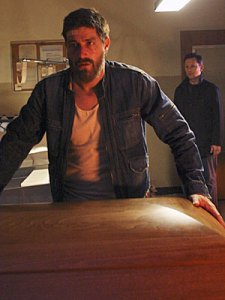
Jack (Matthew Fox) and Ben (Michael Emerson) find Locke's body
It’s a pity, in many ways, because as anyone who has stuck around through the longueurs of the second and third seasons knows, Lost went from strength to strength across its increasingly wild fourth season, and reviews from overseas suggest the fifth is even better. As Season Three ended, several of the survivors (Jack, Kate, Sayid, Hurley, Sun and Claire’s son, Aaron) are off the island, a turn of events a series of flash-forwards (mirroring the device of the flashbacks in the first few seasons) have revealed to have caused any number of problems of its own. Jack is a drunken wreck, his relationship with Kate has come unravelled, Hurley is in an asylum and talking to dead people, Sayid is an assassin employed by the perfidious Charles Widmore, Sun has taken over her father’s criminal and business empire and Locke, last seen trying to save the island, is in a coffin on the mainland. The fate of many of those back on the island, in particular Jin, is unclear, but the island itself seems to have teleported away not just through space but through time. And Ben has arrived to tell Jack and the other members of the Oceanic Six that if they want to save themselves and the other survivors they have to go back to the island.
It’s exactly as mad as it sounds, of course, and almost as incomprehensible. Like many shows which rely upon the unravelling of intricate plots, it’s almost impossible to keep track of precisely what’s going on, and indeed in many ways, keeping track of what’s going on is almost beside the point. What matters is the almost visceral thrill of the show’s twists and turns, and the sense that some new craziness lies just around the corner.
Last week I published a piece in The Australian Literary Review about the rise of what I called the new television. In it I argued that shows such as The Sopranos represent a mode of television drama unlike any we have seen before, filmic in their exploration of the medium’s visual and aural possibilities and novelistic in their preparedness to reject the generic conventions of series television and embrace the complexity and ambiguity of our inner lives.
One of the more striking aspects of this new television is the way it has been made possible by changes in television’s economic model, and by the rise of cable networks less reliant upon advertising and the growing popularity of alternative distribution models such as DVD and downloads, legal or otherwise. This shift away from reliance upon advertisers has allowed the cable networks to make more courageous choices about content and style, and to rely upon greater loyalty from their audiences over time, allowing longer and more complex storylines to be developed and explored.
Image via Wikipedia
Lost and The Sopranos are quite different phenomena of course. If The Sopranos can be understood as the early 21st century’s answer to Dostoyevsky, or Tolstoy, Lost’s antecedents are to be found in the Saturday morning serials of the 1930s, and more particularly, the Silver Age comics of Jack Kirby, Stan Lee, Steve Ditko and others. Certainly Lost, like other, more obviously derivative shows such as Heroes, owes more than just its subject matter to the pulpy, four-colour world of the comic strip. Its structure, with the movement back and forwards in time from an essentially static present is reminiscent of the comic, as is its dependence upon the show’s complex and intertwined mythology. But in many ways it is its dependence upon the piecing together of the puzzles it presents, rather than the transformation of character through action and circumstance to generate narrative excitement and interest that ties it most closely to the comic. For all the intensity and vividness with which characters like Jack are drawn, it’s not their personal and existential travails we’re interested in, merely the part they play in a much larger picture, just as with Spiderman it’s the thrill of recognition we feel in discovering the Green Goblin is Harry Osborn’s father that keeps us reading.
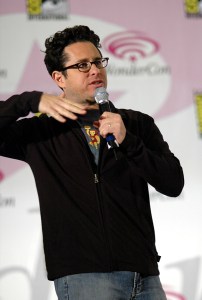
J.J. Abrams
It’s a mode of storytelling Lost’s creator, J.J. Abrams has spent much of the last decade perfecting. First in Alias (a show I never warmed to), and more recently in the drearily derivative Fringe, as well as in films like Mission Impossible III, Cloverfield and the upcoming Star Trek reboot, Abrams has demonstrated an remarkable capacity to marry a purely pop, MTV aesthetic to narrative elements which rarely find their way into mainstream television. Sean Williams, for one sees Lost, with its teleportation and time travel plots, as a trojan horse designed to smuggle science fictional tropes into the mainstream, and in many ways the same could be said of all of Abrams’ work to date.
Part of the Abrams mystique is the illusion that everything in shows such as Lost and Fringe is part of some intricate plan worked out in advance. Like many other television shows, Lost assumes many of its viewers will watch (and indeed rewatch) episodes on Tivo and DVD, allowing them to pause and rewind, and as a result every second frame has some secret unlikely to reveal itself on a casual viewing hidden in it. If a television is on during a flashback in Lost you can assume whatever’s on will pertain to the plot, if a document is glimpsed on a table it will matter, if a logo appears on a coffee cup it will be part of the larger picture.
Obviously this increasingly complex web of associations in Lost and other shows like it depends upon exactly the same transformation in delivery technologies that underpins the rise of the new television more generally. Yet they are supplemented, in Lost’s case, by the very intelligent and deliberate use of the internet. Google Lost, and you will find endless discussions and spoilers, attempts to unravel the show’s mysteries and general speculation about what every detail might mean. And it’s not idle chatter either: I suspect for many viewers this second life (if you’ll pardon the pun) is as much a part of their enjoyment of the show as its more immediate pleasures.
Evangeline Lilly as Kate
The illusion it’s all planned is, of course, just that. One only has to look at the description of the original pilot (which was meant to star Michael Keaton as Jack, and have him die at the end of the first episode) to be reminded of the organic manner in which any television show, even one as intricate as Lost, evolves. Perhaps to his credit Abrams seems happy to give away the sort of fascistic control over every aspect of his shows’ creation that David Chase clearly exerted over The Sopranos or Matthew Weiner now exerts over Mad Men (there’s a fascinating if appalling depiction of Weiner at work in this excellent New York Times feature about life on the Mad Men set)
It’s also interesting to contrast Abrams’ manipulation of the illusion of control with the cheerful and slightly dismaying preparedness of Ronald D. Moore, co-creator of Battlestar Galactica, another show whose success depends at least in part on the complexity of its overarching narrative, to admit how many of the crucial decisions about Battlestar Galactica are made in the most casual fashion (“Who shall we make the last of the Final Five? Adama? The President? Ellen?????”).
Jack and Sayid (Naveen Andrews) on the island
Given this careful calibrated interplay between the collaborative technologies of the internet (an interplay shows like Battlestar Galactica also build on through the release of mini webisodes between seasons) it would be tempting to see Lost and shows like it as the first wave of a new, viewer-driven mode of television, a wikivision if you like, but they’re not, or not really. The shows are still driven from the top down, even if they aren’t mapped out by their creators in quite the detail they pretend they are. And it is worth asking whether viewer-driven television would be attractive anyway. In the days of yore, when Xena was one of the hottest shows on tv, its writers checked out the newsgroups, and discovered, somewhat to their dismay, that its fans were enraged by many aspects of the current season. Pleased to have an insight into what viewers did and didn’t like, they began to change storylines and finesse characters to meet the wishes of their fans. The strategy worked. Within a few episodes the chat on the newsgroups grew far more positive. But simultaneously, ratings began to slide. Pleasing the diehard fans, it turned out, was not the same as pleasing viewers more generally.
Yet there’s little doubt Lost and its relatives are part of a broader transformation of television drama, a transformation driven by related, forces to those which have allowed shows like The Sopranos and The Wire and Big Love to flourish. And, like those shows, they represent a flowering of televison drama which speaks to its vitality as a form. Whether this renaissance can survive the next wave of changes to the media landscape is an interesting question, but for now, I’m just happy to have Lost back.
For anyone who’s interested, William Gibson has started posting excerpts from his new novel on his blog at www.williamgibsonbooks.com. The first was posted on New Year’s Day, and there have been several more substantial pieces over the past couple of weeks.
The excerpts suggest the new book picks up somewhere after Gibson’s last novel, Spook Country leaves off, and that it will draw the brilliant Pattern Recognition and Spook Country together into a trilogy, mirroring the pattern of the Sprawl and Bridge sequences.
Gibson experimented with the same practice during the writing of Spook Country, and though a lot of his fans were excited by it, I felt it was better to stay away and wait for the real thing. Perhaps I’m just too busy, perhaps it’s a more deepseated, novelist’s prejudice against the idea of wiki-ing a book (though I’d be interested to know how many of the responses the excerpts receive Gibson will take on board).
break text
For those wanting more Gibson paraphernalia, here is the very stylish video Gibson’s publishers released to coincide with the publication of Spook Country in 2007.
break text
break text
And here is a short review of Pattern Recognition I wrote for The Sydney Morning Herald in 2003. It’s still available online, but for some reason the quotes in the version on the SMH website have dropped out, rather changing the sense of the piece. That being the case I’ve taken the liberty of reproducing my original review below with the missing quotes reinstated (I hope the SMH won’t mind).
Somewhere in the middle of Pattern Recognition, William Gibson’s seventh novel, the central character, Cayce Pollard, describes her memories of that day in New York, of the impact of the second plane. The experience, related in a fragmented, dream-like language, seems to collapse time, collapse meaning. It is “like watching one of her own dreams on television. Some vast and deeply personal insult to any ordinary notion of interiority. An experience outside of culture.”
What Gibson’s language strains to reveal in that event, or more properly, in our experience of it, is the sense of vertigo it induced, of the collapsing of boundaries: political, geographical, personal, ethical, its singularity lying not in its death toll, or in its nature but in our experience of it, the way it unmade the certainties that not just our present but our future were grounded in.
Whether it was begun before or after September 11, this sense of our experience of reality exceeding itself is wound deeply into Pattern Recognition. Not only is it the first of Gibson’s novels to take place in the immediate present, it also seems to represent the closure of some kind of circle in his writing, not least in the allusive play between the names of its protagonist, Cayce and the anti-hero of his groundbreaking first novel, Neuromancer, Case.
Of course to call Gibson a writer of science fiction has always been to misunderstand him. Gibson’s antecedents lie more in Burroughs and Pynchon than Arthur C. Clarke, their strange, essentially poetic assemblages of image and echo designed to explore the inner textures of a culture which exists increasingly outside of time and space. The effect is probably nearest to that of an intellectually rigorous brand of video-art: suggestive, unsettling, and unresolved, its meanings arising out of the interplay between the elements rather than residing within them.
And so, despite its contemporary setting Pattern Recognition is classic Gibson. Moving between London, Tokyo and Moscow, it turns upon a series of film fragments which have been appearing anonymously upon the internet. These fragments, in an echo of the Joseph Cornell-like assemblages of Count Zero’s artificial intelligence, are possessed of a mute, almost inexplicable power, a power attested to by the global underground following they have attracted. Carefully denuded of any identifiable signs of context or origin, the fragments may or may not be part of some larger work, yet regardless their power stems from their sense of compression, the way they seem to signify the possibility of a meaning which they simultaneously deny.
Cayce, a follower of the footage herself, is commissioned by her sometime boss, the wonderfully-named Belgian market-guru, Hubertus Bigend (who “seems to have no sense at all that his name might be ridiculous to anyone, ever”) to establish the identity of the footage’s creator. Bigend’s motives for doing so are ambiguous to say the least, but Cayce accepts nonetheless, a decision which drops her deep into a world of obsessed footage-heads, industrial espionage, Russian mafia and cryptography, only to fetch up, finally, in the painful truth of the footage’s origins.
Woven through this are a collection of images which play off each other with ever-increasing subtlety and power. The pictures of the missing pinned to windows and walls and doors in New York. An amateur archaeological dig near Stalingrad, where guns and badges, uniforms and eventually an entire Stuka, its pilot still in its cockpit are being drawn from the suffocating, erasing mud by Russian skinheads. Diagrams of the arming mechanism of antiquated American explosives are uncovered coded deep inside the footage. Mechanical calculators designed in Buchenwald are traded to collectors from car boots, resembling nothing so much as grenades. And everywhere, out of the fragments of the past, the present and the future, meaning suggests itself, elusive, partial yet possessed of a strange and ultimately deeply moving poetry.
Like Gibson’s futuristic novels, which refract the present hauntingly through the lens of their possible futures, there is something at once utterly immediate and strangely timeless about Pattern Recognition. It captures the fluidity of meaning and the sense of shifting certainties which infect our historical moment, strung between the unrecoverable past and the nascent future. ‘“The future is there . . . looking back at us,” as Cayce herself says. “Trying to make sense of the fiction we have become. And from where they are, the past behind us will look nothing at all like the past we imagine behind us now.”
One of the secret, slightly sneaky pleasures of blogging is reading the list of google searches that lead people to your site. Usually they’re sort of predictable, sometimes they’re a little odd, and sometimes they’re just gloriously weird. To which category I’m pleased to add one of yesterday’s, “how long are sharks’ tongues?”.
What I can’t decide is whether it was someone looking for the answer to a piece of biological trivia (since I don’t think sharks have tongues it might be more correct to describe it as biological fantasy) or someone planning a Roman banquet who doesn’t have a strong grasp on the distinction between birds and fish.
Either way, it’s wonderful, and I thank its author for brightening up a rather gloomy morning.
’The Changeling'
Appears in Jonathan Strahan's Fearsome Magics. Compare prices for the UK print edition and US print edition; also available for Kindle (US and UK) and most other ebook formats.




 Over at Hackpacker the irrepressible George Dunford has posted the text of a piece about the
 The current issue of The New York Review of Books includes an
 New Scientist is
 Today’s LA Times has a story which purports to explain the truth (or should that be “Truth”?) behind that Holy Grail of conspiracy theories, Area 51, and it’s almost as improbable as the crazy talk of flying saucers and alien technology. That crashed UFO? A disk shaped, Lockheed-designed stealth aircraft called OXCART. Those reports of secret engineering? True, but they were reverse-engineering Soviet technology. And there’s even sodium pentathol-fuelled interrogations and men in black dumping drug-addled test pilots on their wives’ doorsteps. And why are we hearing this now? Because the US Government wants to set the record straight. Hmm.

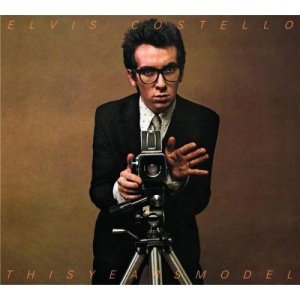 I was listening to Bruce Springsteen belt out ‘Radio Nowhere’, the opening track to his 2007 album, Magic, the other day, and as I did I was struck by how archaic it felt. Not in terms of its energy – as anyone who heard him perform ‘The Rising’ at the concert to celebrate Obama’s inauguration a few weeks ago knows, Bruce can still crank out the tunes like nobody’s business – but in terms of its invocation of the radio as a vehicle of connection.
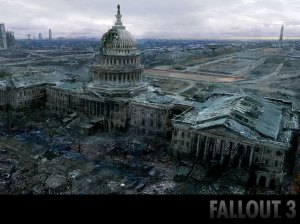 I meant to post this link a couple of weeks ago when it was first published, but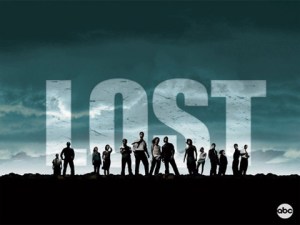




 leaves off, and that it will draw the brilliant
  and
and 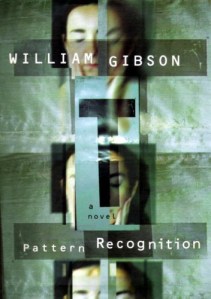 Pattern Recognition
 One of the secret, slightly sneaky pleasures of blogging is reading the list of google searches that lead people to your site. Usually they’re sort of predictable, sometimes they’re a little odd, and sometimes they’re just gloriously weird. To which category I’m pleased to add one of yesterday’s, “how long are sharks’ tongues?”.





 city of tongues