Oliver Sacks on blindness and the mind

Cover via Amazon
Oliver Sacks has used his own experiences to inform his thinking and writing about the mind before, most notably in a A Leg to Stand On
Break text


Feb 17
Cover via Amazon
Oliver Sacks has used his own experiences to inform his thinking and writing about the mind before, most notably in a A Leg to Stand On
Break text
Feb 15
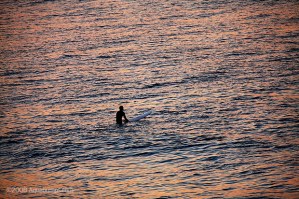
Bondi Waiting, © aquabumps.com, 2008
While digging through my hard drive yesterday I came across the piece below. It’s a few years old now, and I think a rather different version of the same piece ran in Good Reading in 2004, but it seemed worth giving it an airing, not least because I so rarely find time to surf anymore, and I miss it so much.
Two or three times a week, twelve months of the year, I make my way to the beach with my brother and a small group of friends. Although the purpose of the trip is what we call “ocean time”, which is code for surfing, it is also about a sort of escape, not just from our work and from our day to day lives, but from the more controlled aspects of the selves we need to be to live those lives.
The result is a little like playing hooky: slightly overcharged and somehow suspended out of normality. It’s also almost exclusively male, and curiously, for something that is about escape, is itself highly ritualised. From the time-coded pick-ups to the arguments about which beaches we will check out to the perving on chicks these excursions conform to a script which varies only in its detail.
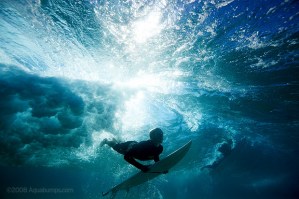
Explosion duckdive, Bondi, © aquabumps.com, 2008
How much the sense of escape is connected to the actual surfing I’m not sure. It may be that the surfing is merely a pretext for this behaviour, as shopping or golf or fishing clearly are for other people, at least in part. But although we all spend time together for other purposes, much of it also involving physical activity – running, gym, occasionally snorkelling or diving – none of these other expeditions have the same sense of excitement and freedom, either for me or the others.
I suspect most people conceive of writing – and people who write, with a few notable exceptions – as confined to a sphere which not just excludes the physical, but which actually exists in some sort of opposition to it. In fact the processes of writing, and of entering a space where it is possible to write, seem to me to be about a way of being which is almost seamlessly continuous with the life of the body.
Writing, at least the sort I’m interested in, is about communicating the nature of being. Despite its medium, it is a conversation between minds about aspects of existence – psychological, spiritual, emotional – which exist independent of language, and which are for the most part irreducible to mere words. It’s about making the apprehended but inexpressible communicable, about taking the pre-verbal and ineffable experience of emotion and passing that experience on to another. That mere words have this ability to transcend their own meanings, to offer us a glimpse of the mirrors that lie in the inner worlds of others is something we have all felt in that moment of recognition that comes when something we read or hear strikes us as somehow right or true, that sense a chord has been struck somewhere within us, its meanings neither simple nor easily explained.
Like music, any piece of writing has a shape and cadence of its own. It is about rhythms, in language, in character, in story. It is these rhythms that you seek when you write, for they are the contours you try and bring forth. What guides you is not the intellect, or at least not the conscious part of it, but something more intuitive. It is the sense that you are following a shape which somehow already exists, something not so much invented as implicit in the thing itself. Just as sculptors claim to see a shape within the uncarved stone, so the story seems to be already there, like a name half-forgotten which lingers on the tip of the tongue.
Understood like this the process of writing is more a kind of listening than anything, a quiet attendance to the thing. Like the shaping of objects with the hands, the turn of a pot upon a wheel or a lathe upon wood, it is a process in which the intrusion of the conscious mind is often a hindrance, for the important thing in trying to find these rhythms is not to try too hard, not to force it. To hear the rhythms in a thing, to let it happen, you must learn to let go of your intentions, to forget the self and just be.
Learning to do this is one of the hardest things about writing. When a book is near its end it usually has a kind of momentum, an effortlessness, as if some apex has been passed and now the run is downhill, but before that point it can be difficult to find the rhythms you are seeking. Forgetting the self and entering that state of flow is not something that can be just picked up and put down: it requires large spaces of time, room to think and tinker, or just to be.
But it’s not just a question of time. What is needed is a way of escaping the life you are immersed within, of connecting with those things which ground you and your work. Different people find this in different ways, but increasingly I have found it through the stolen time of surfing.
Surfers often talk about their sport in almost religious terms, and although I don’t have a lot of sympathy for much of the culture that surrounds surfing, this sense of the act as a kind of spiritual journey is one I understand very well. To leave the shore and swim out, through the break and over the back, is to feel yourself slip free of your moorings and give yourself to the elements. Although your conscious mind still matters, you enter a world where it is your physical existence that matters first and foremost, the movement of your body in the water, with the water.
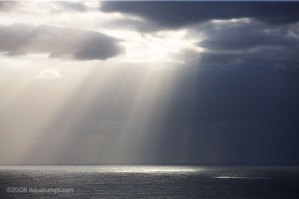
Rays of Light, Bondi, © aquabumps.com, 2008
Sometimes the rewards for this are no more than the joy of playing in the ocean, a simple pleasure in the act itself. But there are other times, most often in the last hour or so of dusk, when the beach is quiet and the sky has begun to fade, when it is far more. Then, as the ocean moves beneath you and the long feed of the clouds passes overhead it possible to sense the presence of a meaning which lingers just out of reach. It is to do with time, and its depth, with the rhythm of the sky and the waves, the cry of the birds as they pass overhead. Apprehended not consciously but somewhere deeper, this meaning beats like the pulse of a heart, something always there but of which we are only occasionally aware; deep and ceaseless, it fills the fabric of the world until it trembles with its weight.
This sense of the world’s presence in its pieces, of its divinity is one which runs deep in my writing. But the knowledge of its existence grounds me in a more mundane way, binding me to the act of surfing, to the escape it offers. For in the loss of self that surfing demands, the submission of the conscious mind to the rhythms of the ocean, I find a sort of peace, a capacity to move and think freely, and ultimately, to attain the sort of equilibrium I need to write.
(The images on this page are provided courtesy of Eugene Tan at www.aquabumps.com, whose daily email chronicle of the changing moods of Sydney’s beaches has been a bright point in my day for more years than I care to remember).
© James Bradley, 2009
Break text
 One of the secret, slightly sneaky pleasures of blogging is reading the list of google searches that lead people to your site. Usually they’re sort of predictable, sometimes they’re a little odd, and sometimes they’re just gloriously weird. To which category I’m pleased to add one of yesterday’s, “how long are sharks’ tongues?”.
What I can’t decide is whether it was someone looking for the answer to a piece of biological trivia (since I don’t think sharks have tongues it might be more correct to describe it as biological fantasy) or someone planning a Roman banquet who doesn’t have a strong grasp on the distinction between birds and fish.
Either way, it’s wonderful, and I thank its author for brightening up a rather gloomy morning.
Break text

Mike Frakes, 'Great Egret' (click to enlarge)
Since I’m on a bit of a nature roll, let me recommend checking out the winners of the International Wildbird Photographer Awards. The winning image, by 17 year-old Mark Smit of the Netherlands, is a stunner, but I think my personal favourite is this one, by Australian Mike Frakes. Taken on the Swan River, in Perth, it’s a wonderful image, full of a sense of the strange, secret life that emerges under cover of dark, and of the way the wild is always present close at hand, even in the most urban environment.
And if you’ve got a bit more time to spend, I highly recommend a visit to the Wildlife Photographer of the Year online gallery.
brek text
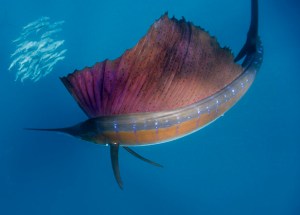
Photo by Paul Nicklen
This is an amazing and beautiful thing. Photos and video of sailfish cooperating to herd schools of sardine.
“The hunt seems almost mammalian. Sailfish—which often travel in loose groups—clearly join forces. Males and females alike circle the prey, pushing the school into tighter formation, and taking a few bites in turn. Each forward rush is punctuated by a startling flare of the dorsal fin, which more than doubles the hunter’s profile . . . The sardines, too, work in concert. Detecting each other’s proximity and movement, they shift in synchrony, each fish both leader and follower. The fish mass slides like a drop of mercury, mesmerizing, with a shimmer that may help to confuse predators . . .”
Read more at National Geographic.
Break text
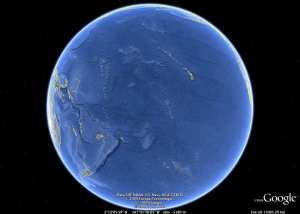 There’s something to be written here about the gap between our ability to image the natural world and our understanding of it, particularly in the context of the oceans. Certainly there’s an irony at work in the fact that we know so little about what lies beneath the waves, the speed with which we are destroying it and the fact anyone with a computer terminal can now gaze at an exquisitely detailed sonar model of the ocean floor. But all that aside, this is an amazing thing, so perhaps rather than maundering on I’ll just give in to the marvel of the technology for a moment.
Google goes deep with ocean simulations
And if anyone is interested in the things that live in the ocean, check out the Census of Marine Life.
Update: New Scientist helpfully informs me that the new version of Google Earth also lets you visit the empty oceans and towering peaks of Mars. Check out the Google Earth blog for instructions on how to use the new feature.
break text
Feb 3
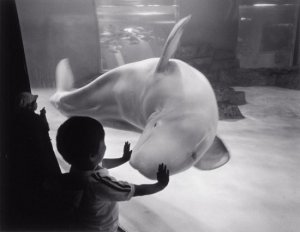
'Baluga Whale, Hakejima Sea Paradise' from Other Oceans
Flicking through some books the other night, I came across my copy of Wayne Levin’s Other Oceans
Levin’s photography probably isn’t familiar to many outside of the United States, and the broader community of those who are fascinated by the ocean, but he’s a Hawaii-based photographer who, working largely in black and white, has spent the best part of the last three decades documenting a very personal portrait of the ocean and its inhabitants. Although he has explored seas further afield, most of his photographs have been taken in the waters around his home, capturing surfers and divers and, most remarkably, what he describes as the resident spirits of the seas – the whales, dolphins, turtles and fish that move beneath the surface, largely unseen.
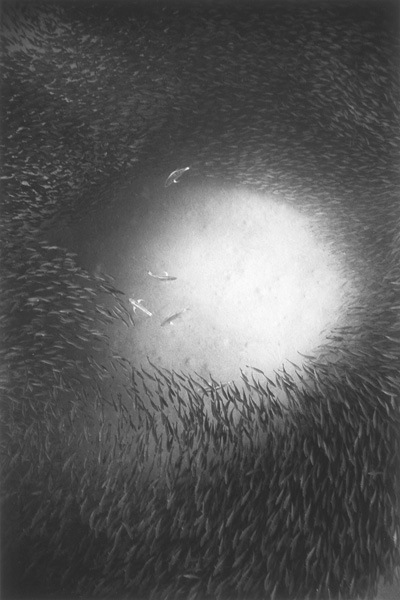 The best of his photographs capture something of the immensity and mysteriousness of the ocean, its elusive and constantly-changing beauty. Some are collected together in Other Oceans and Through a Liquid Mirror


Break text
Break text
All images © Wayne Levin.

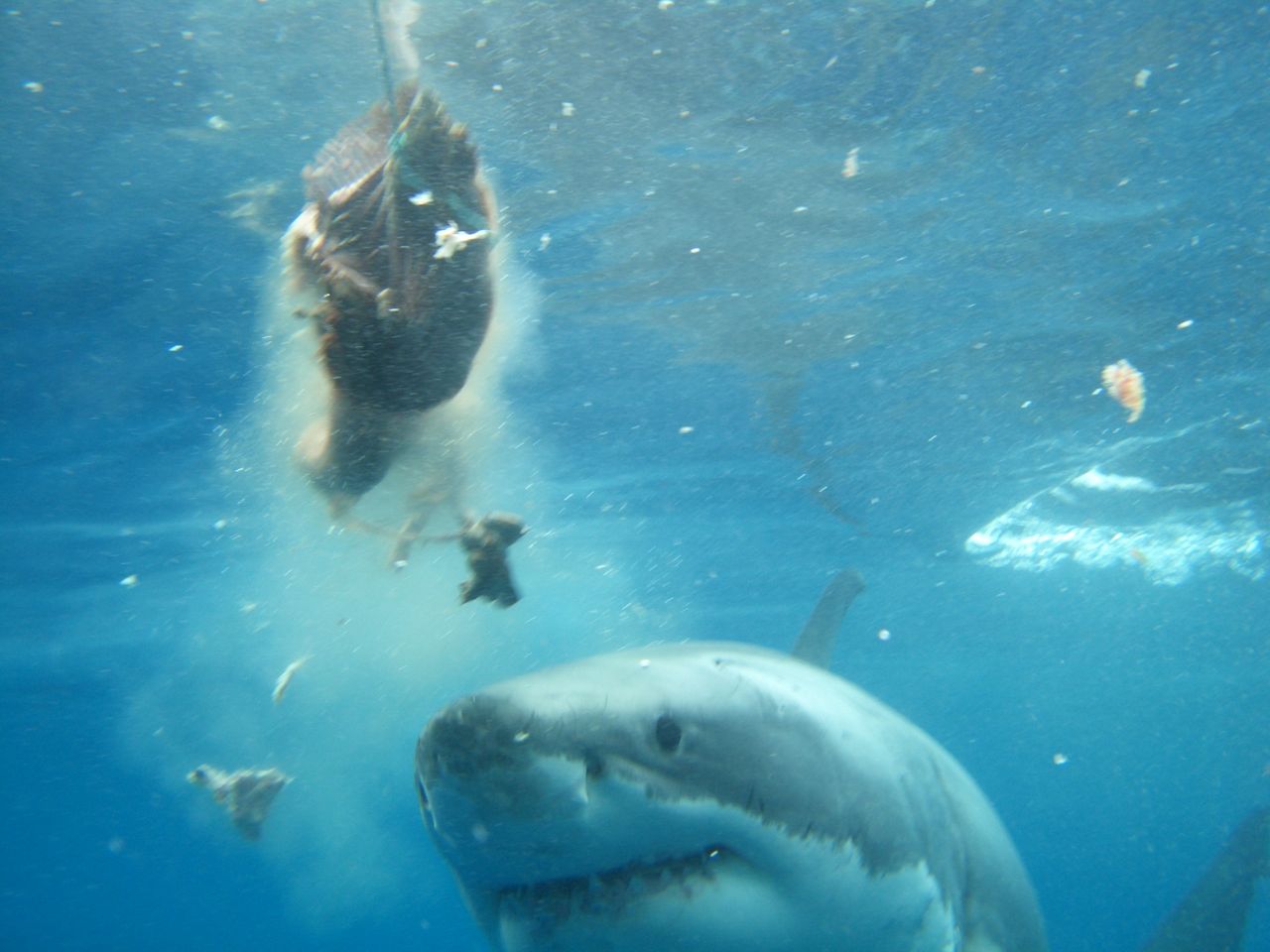
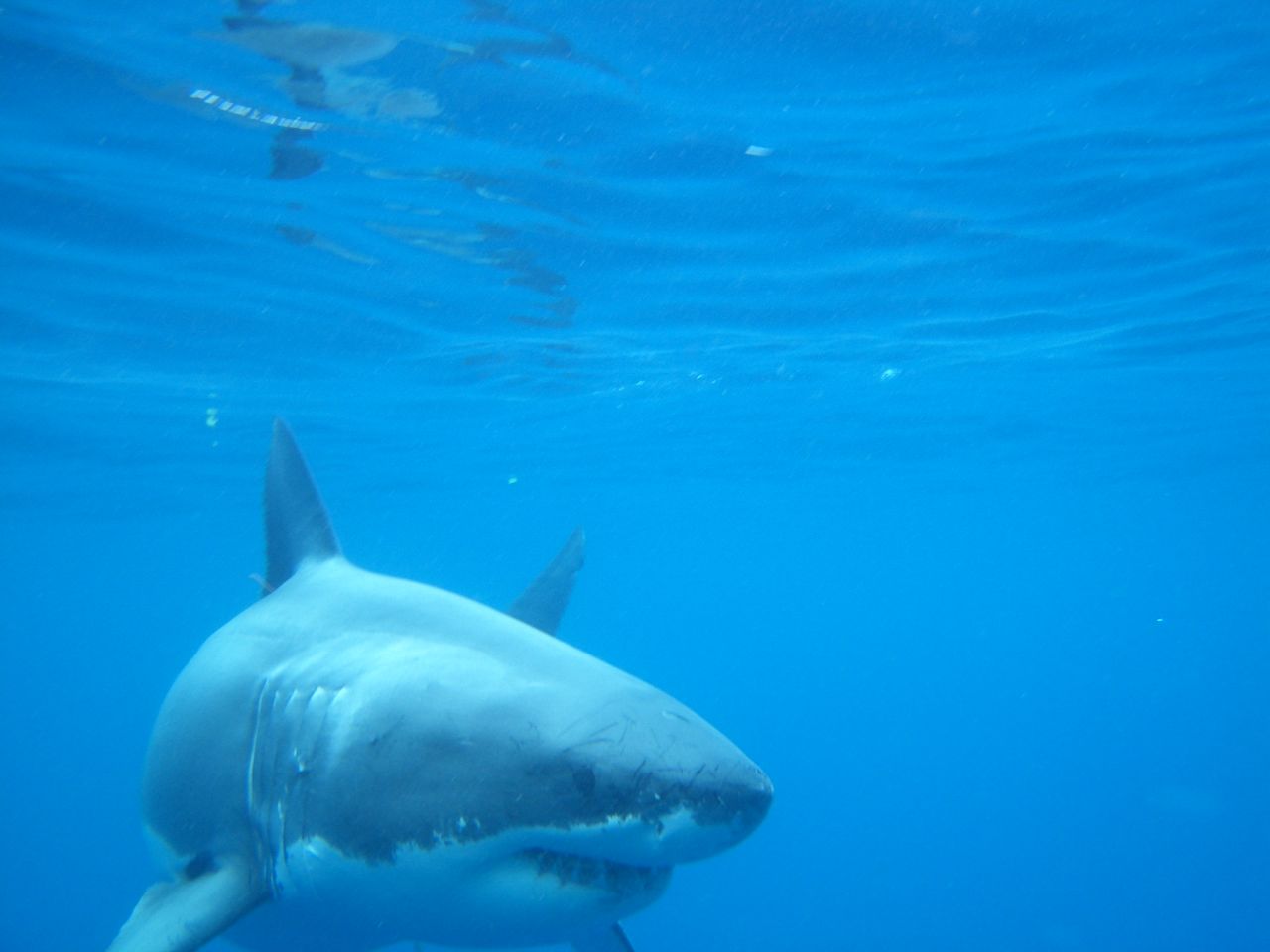
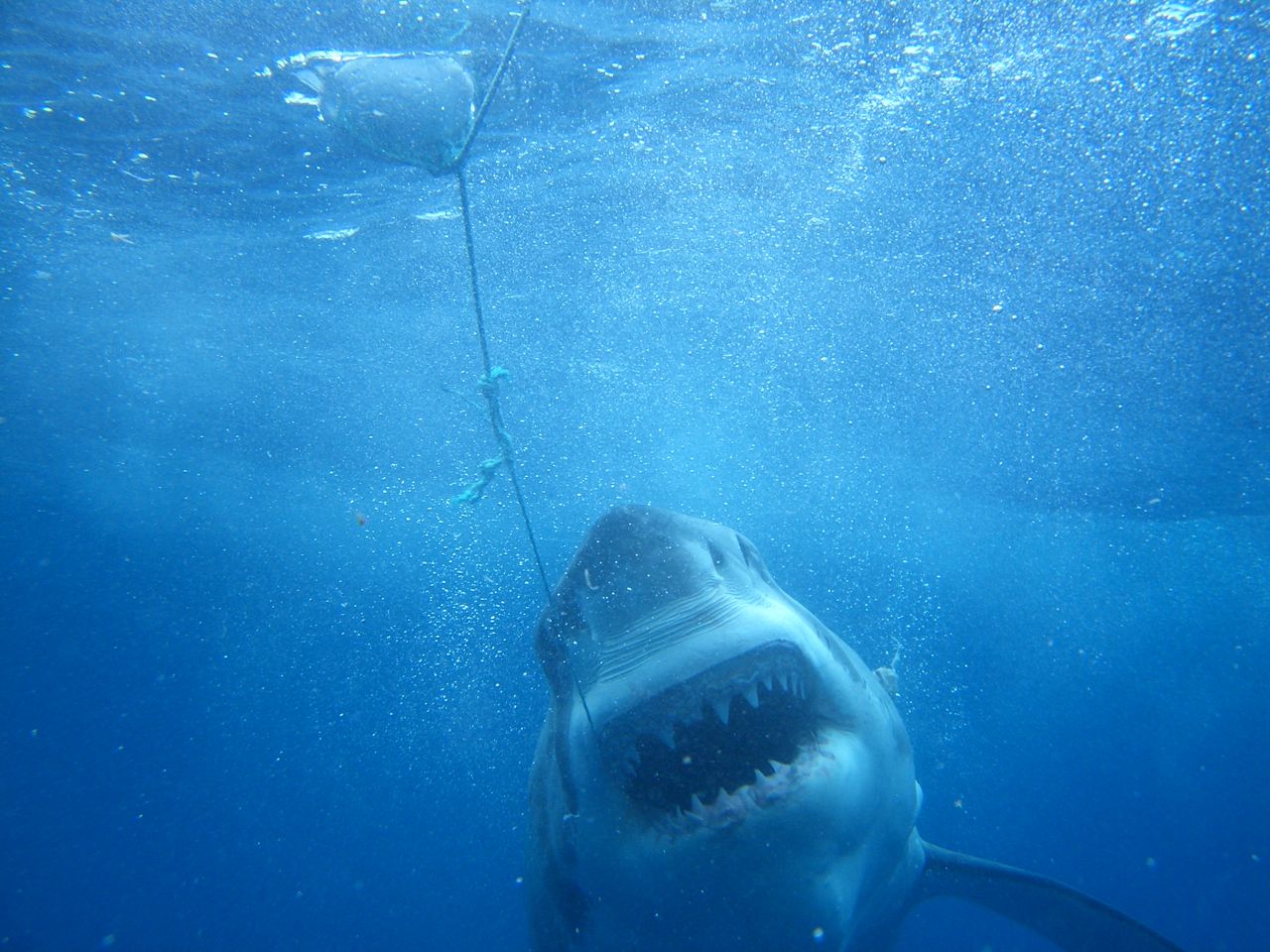
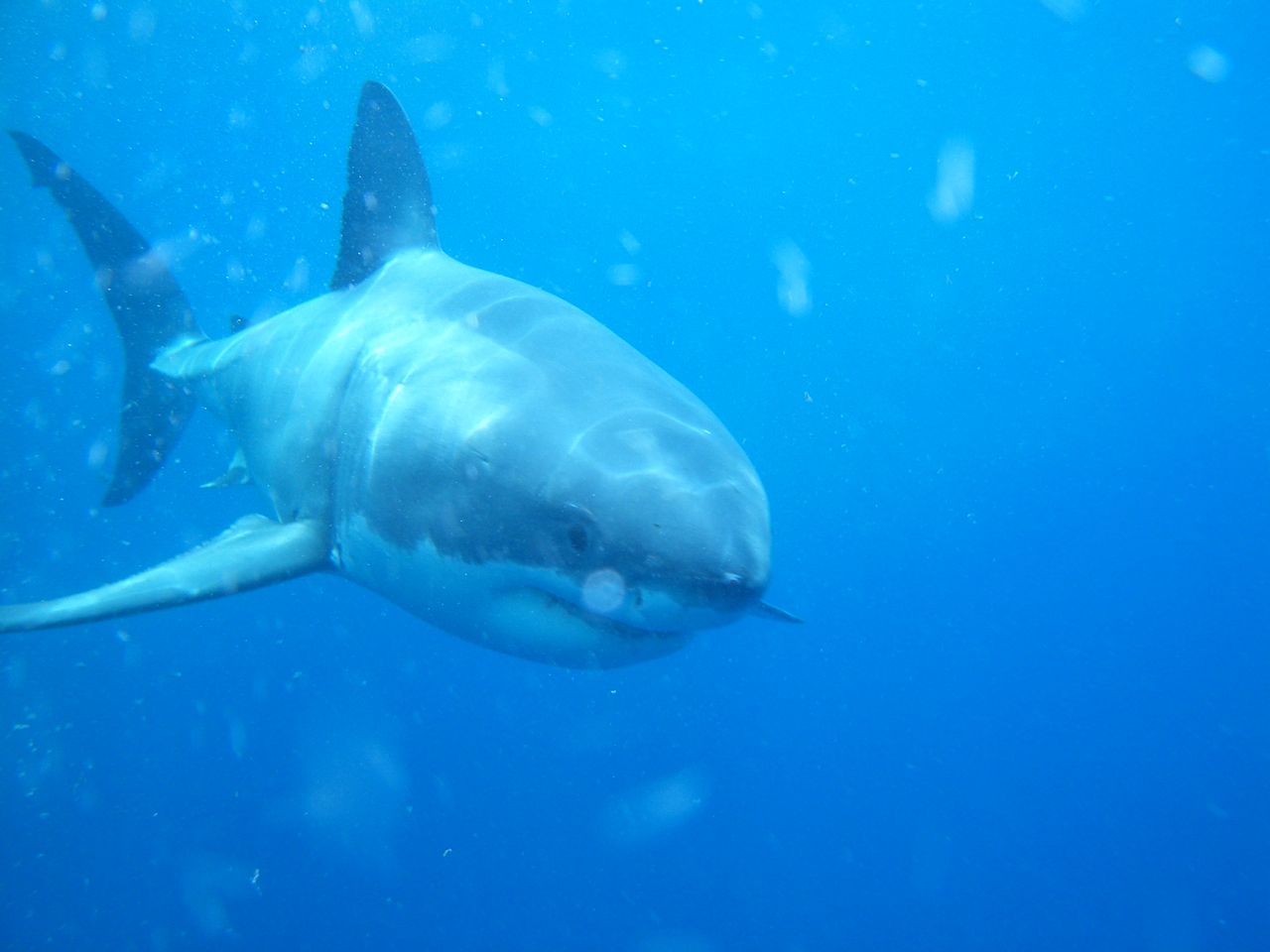
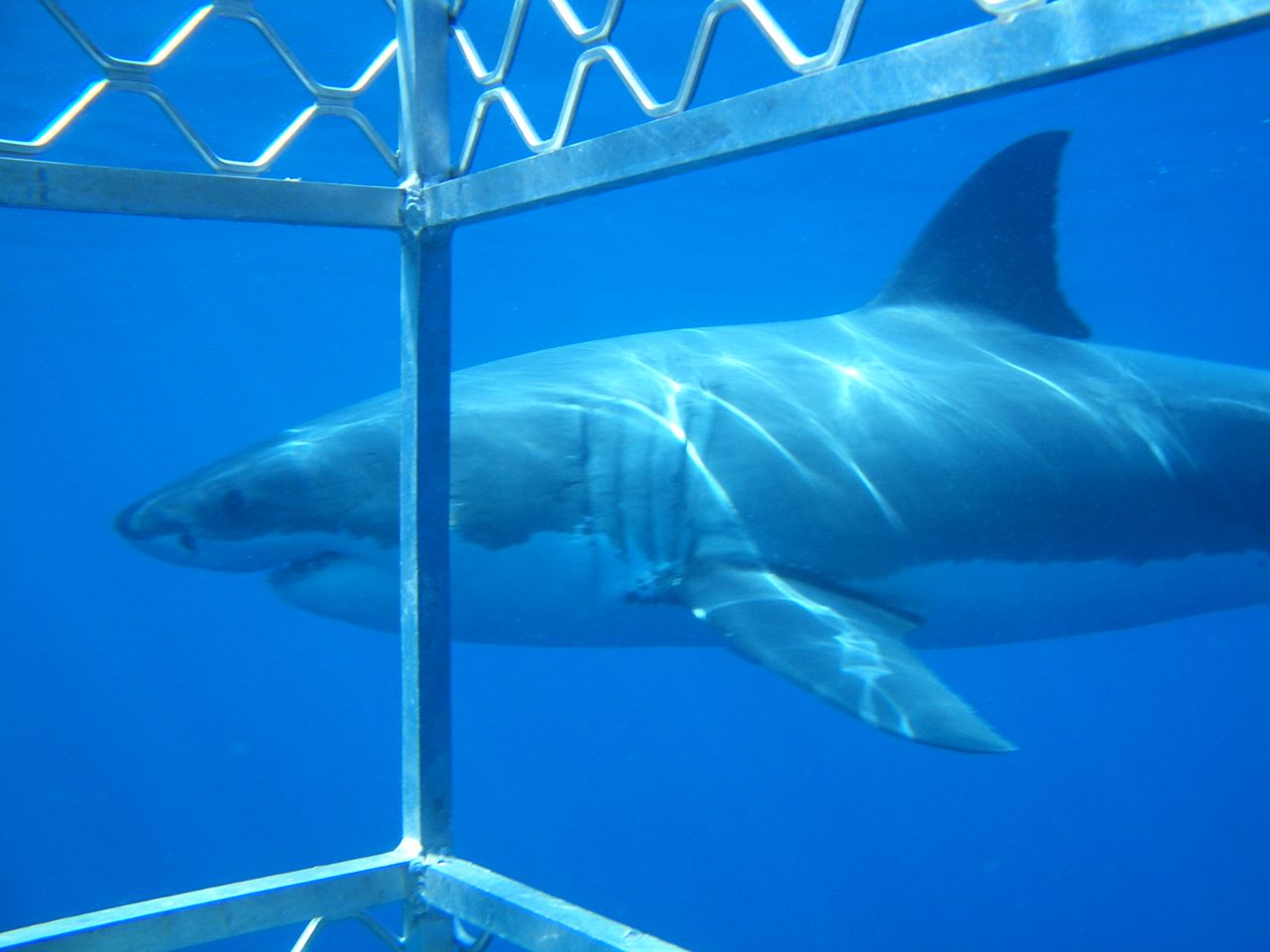
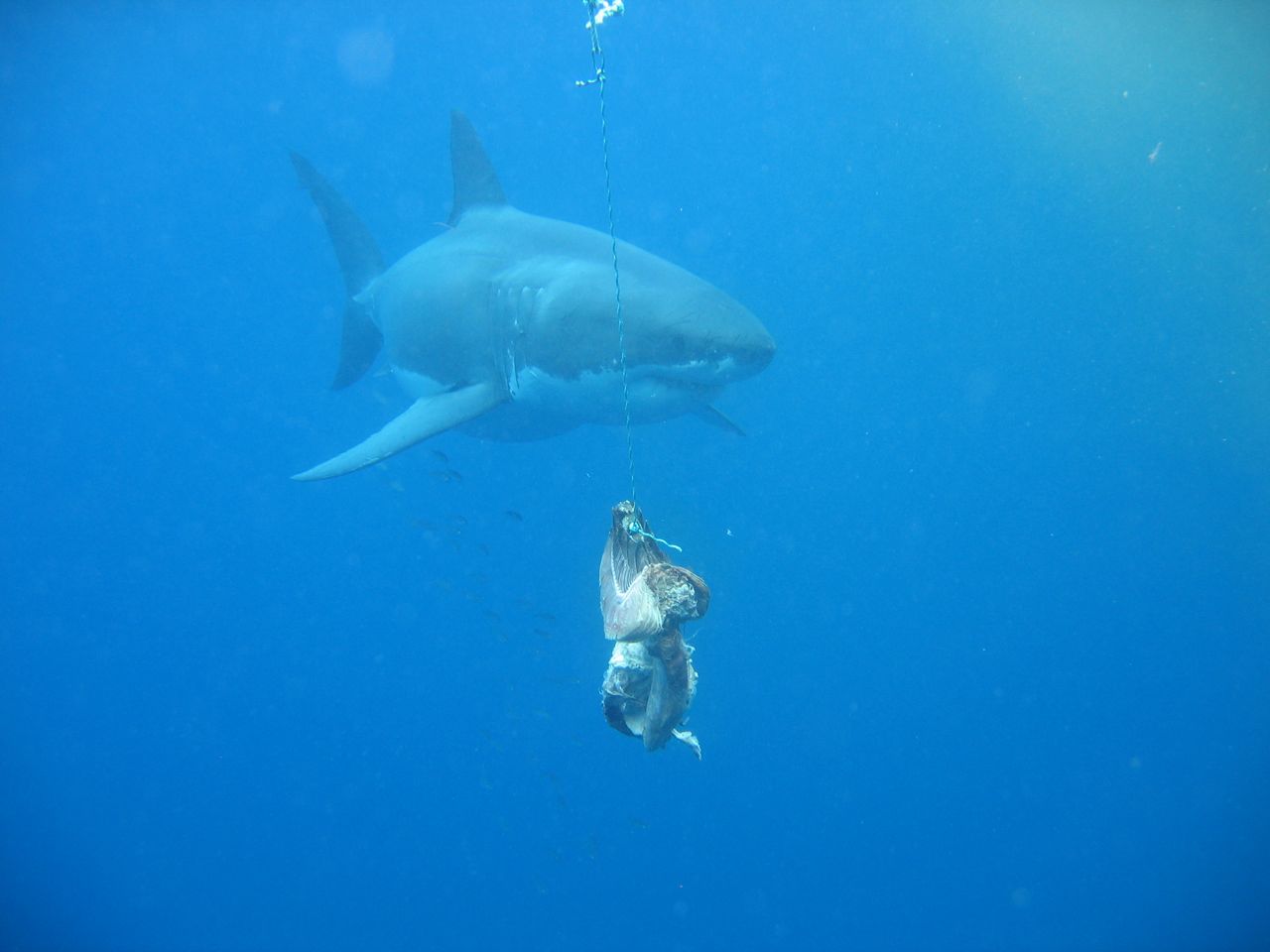
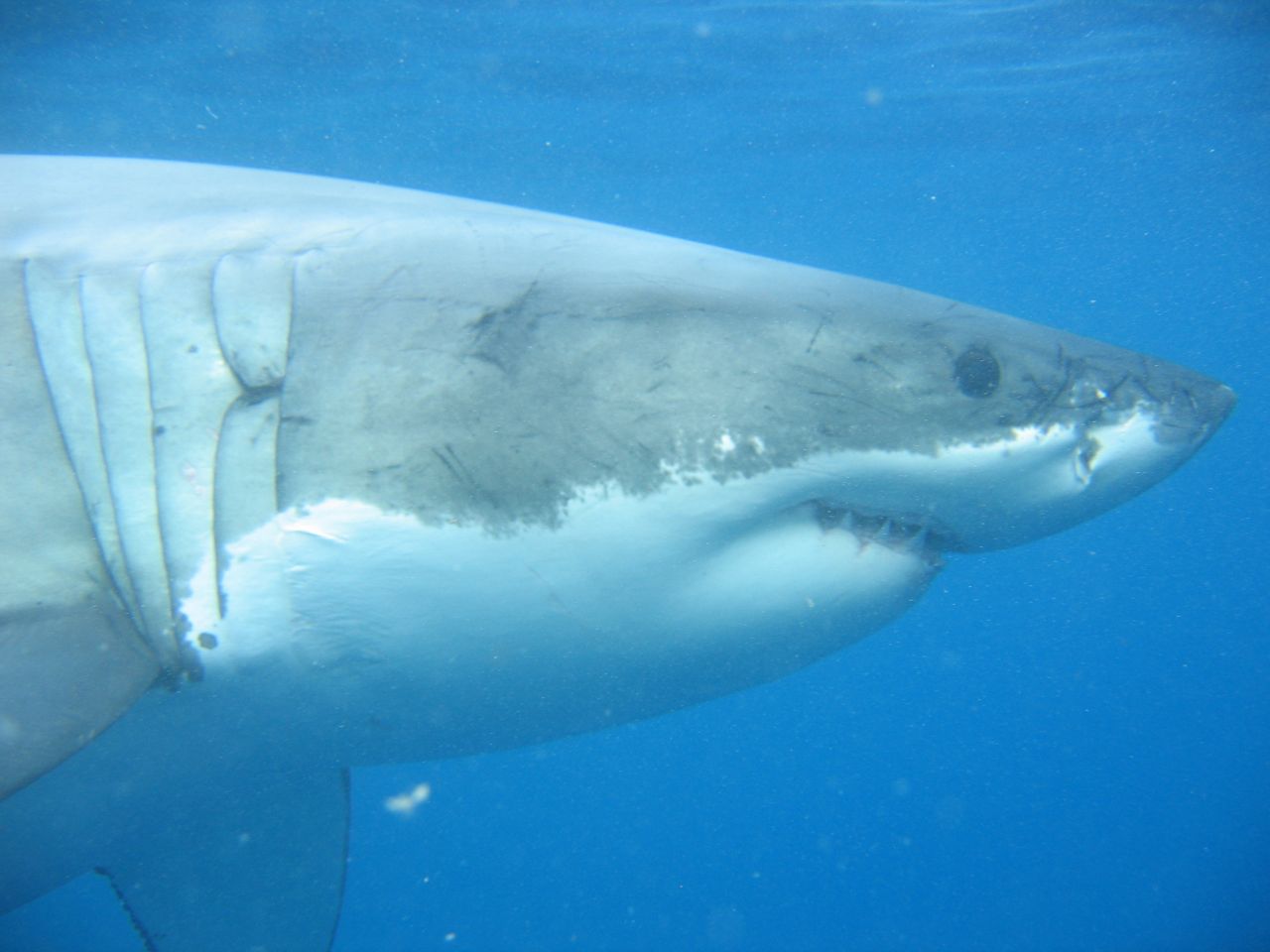
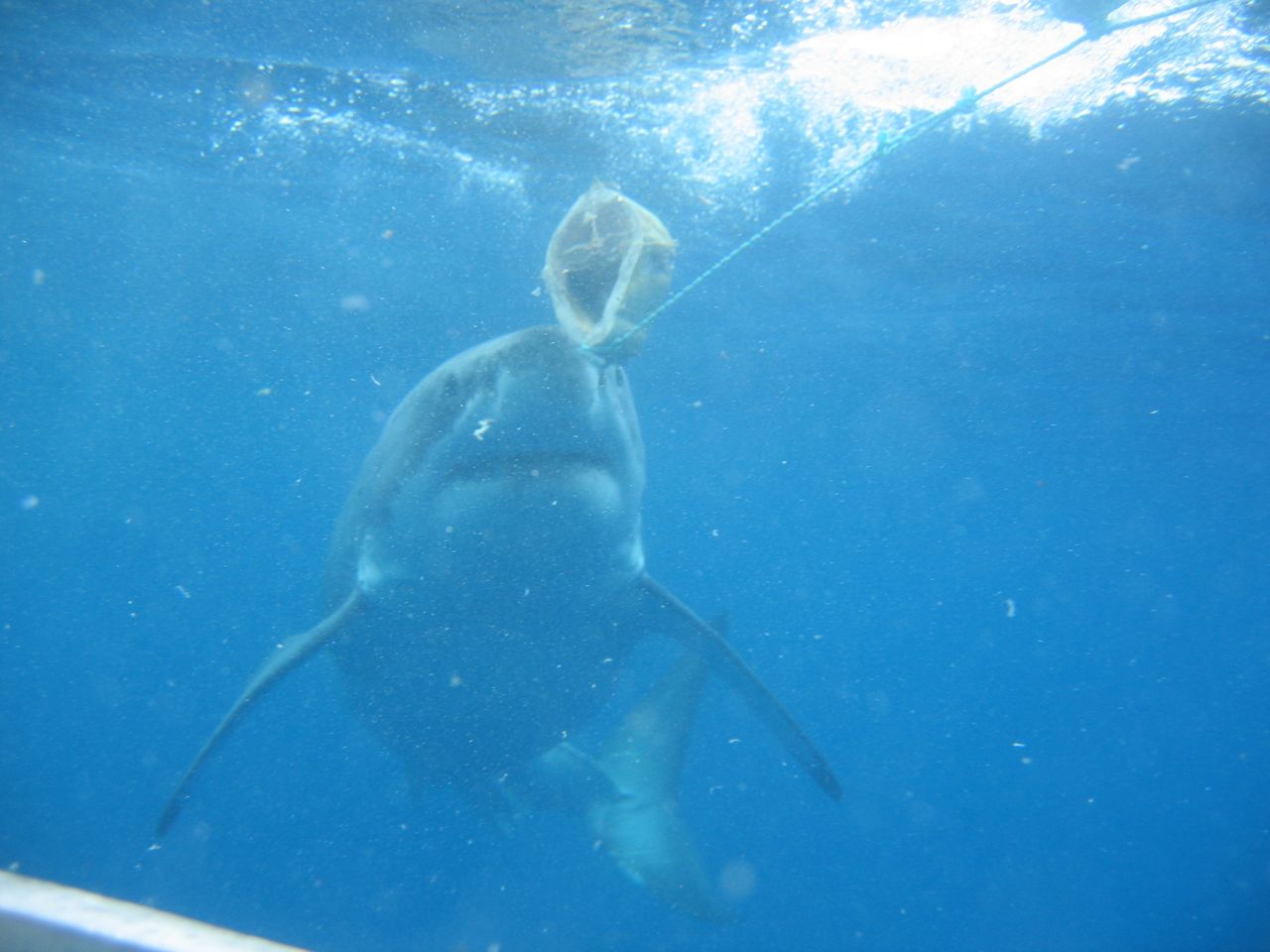
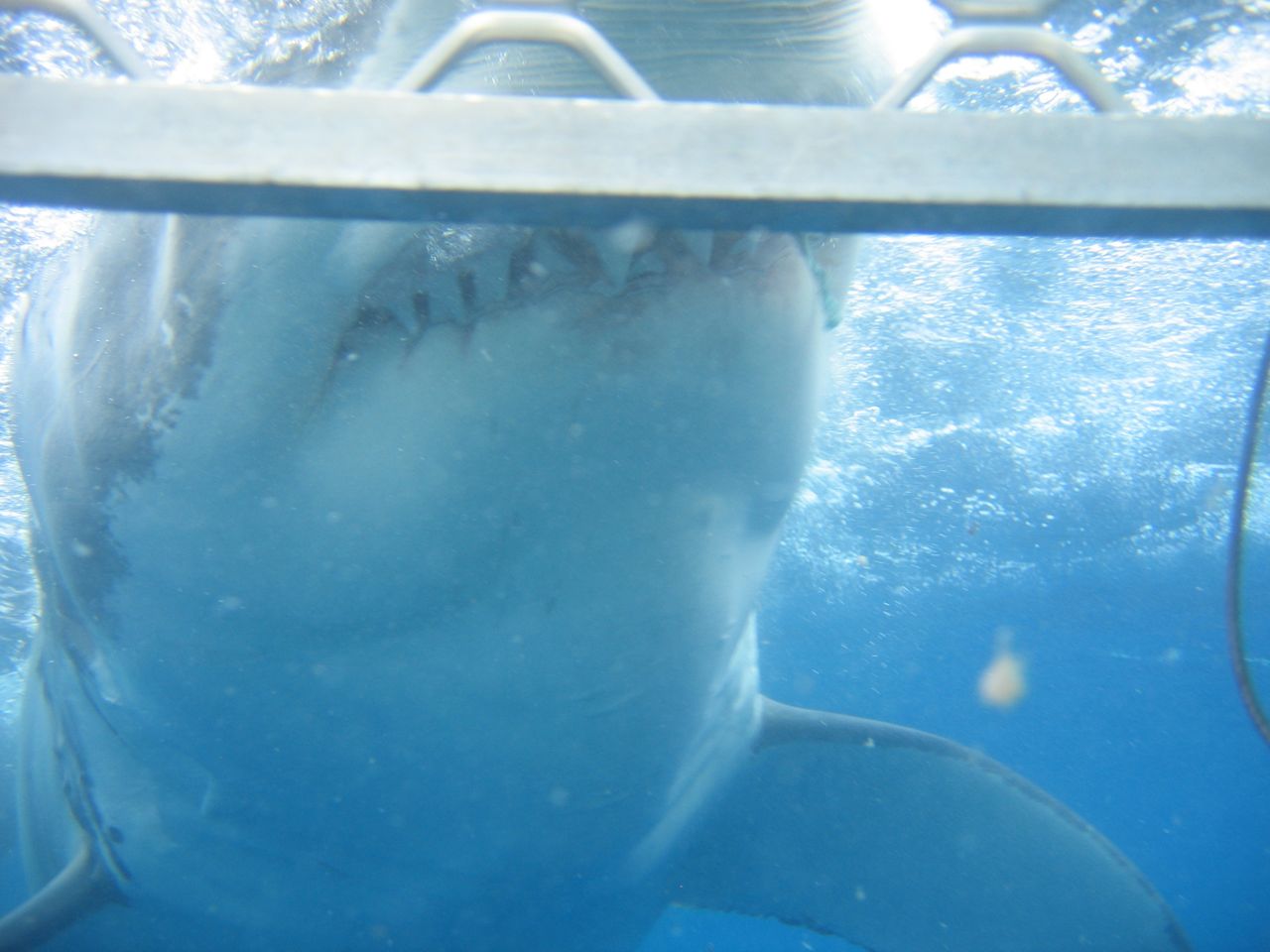
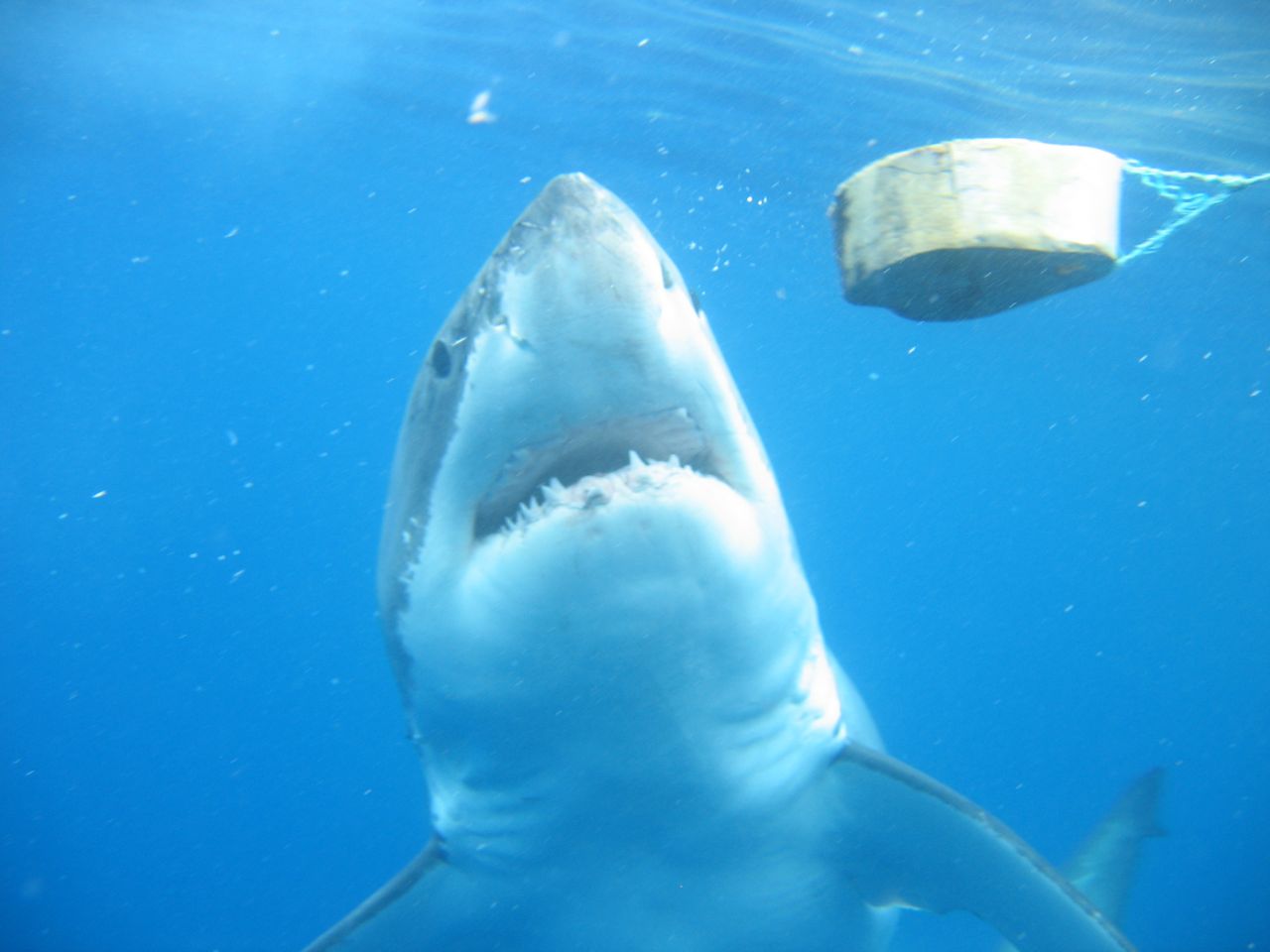
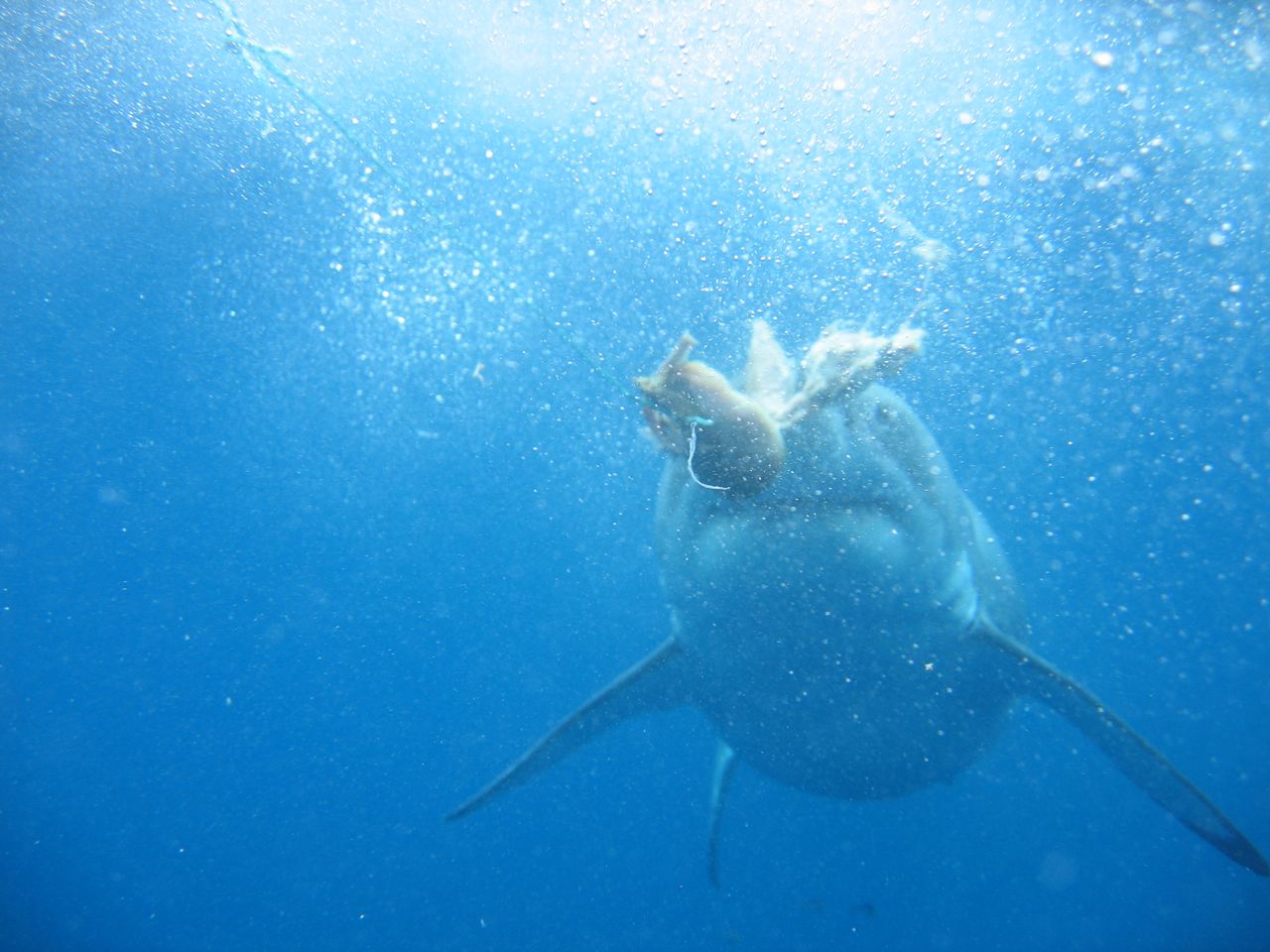
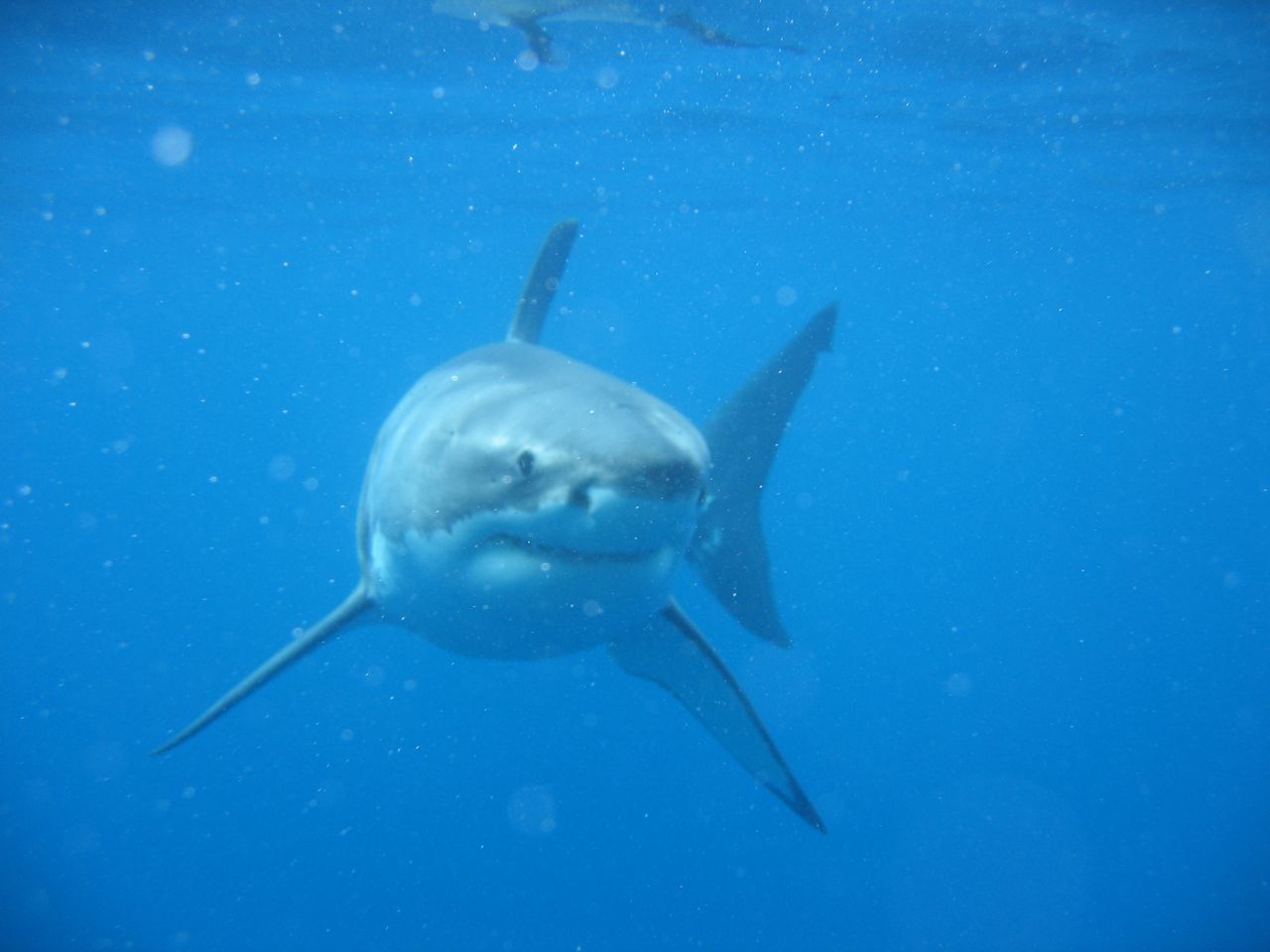
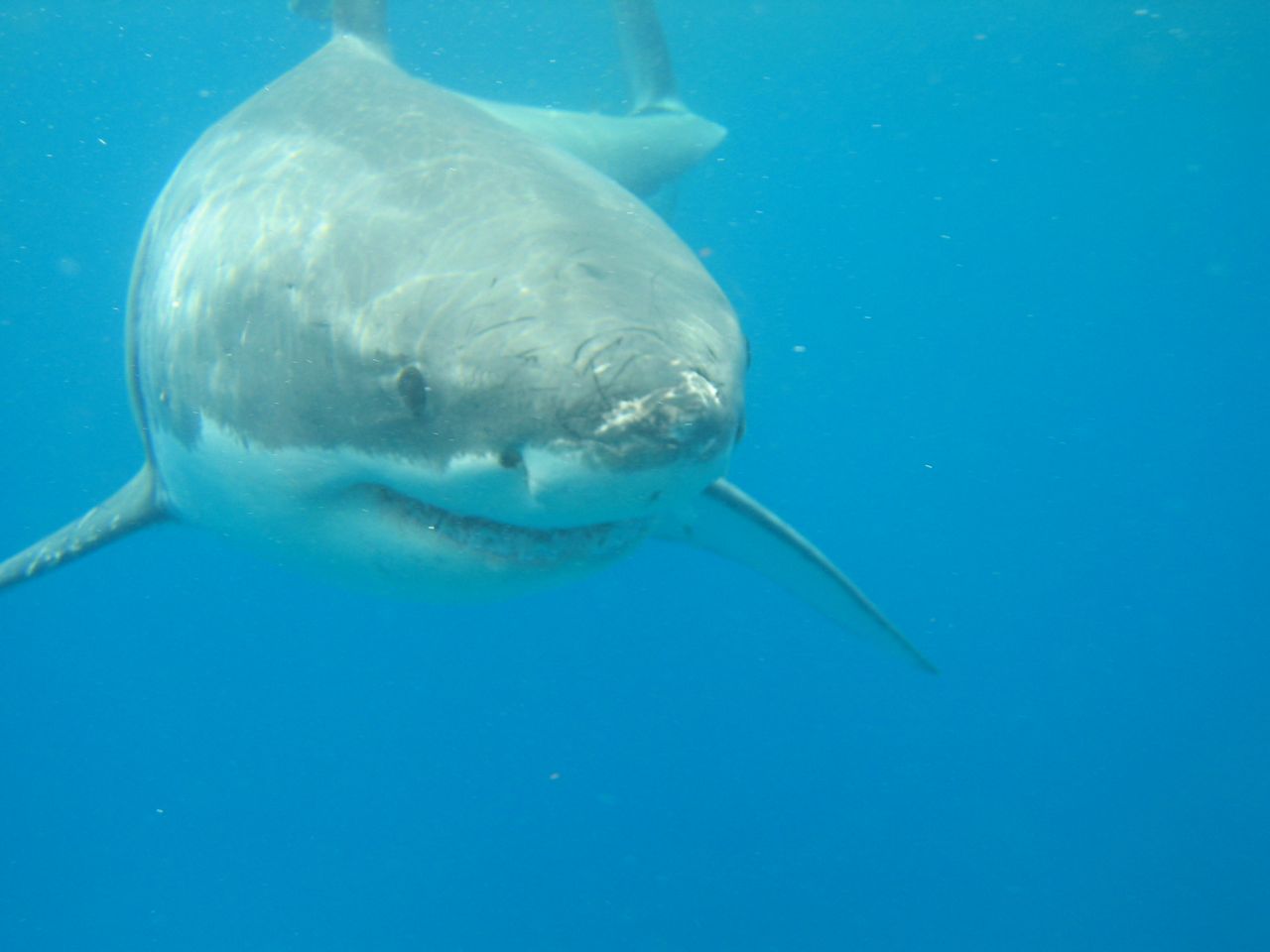
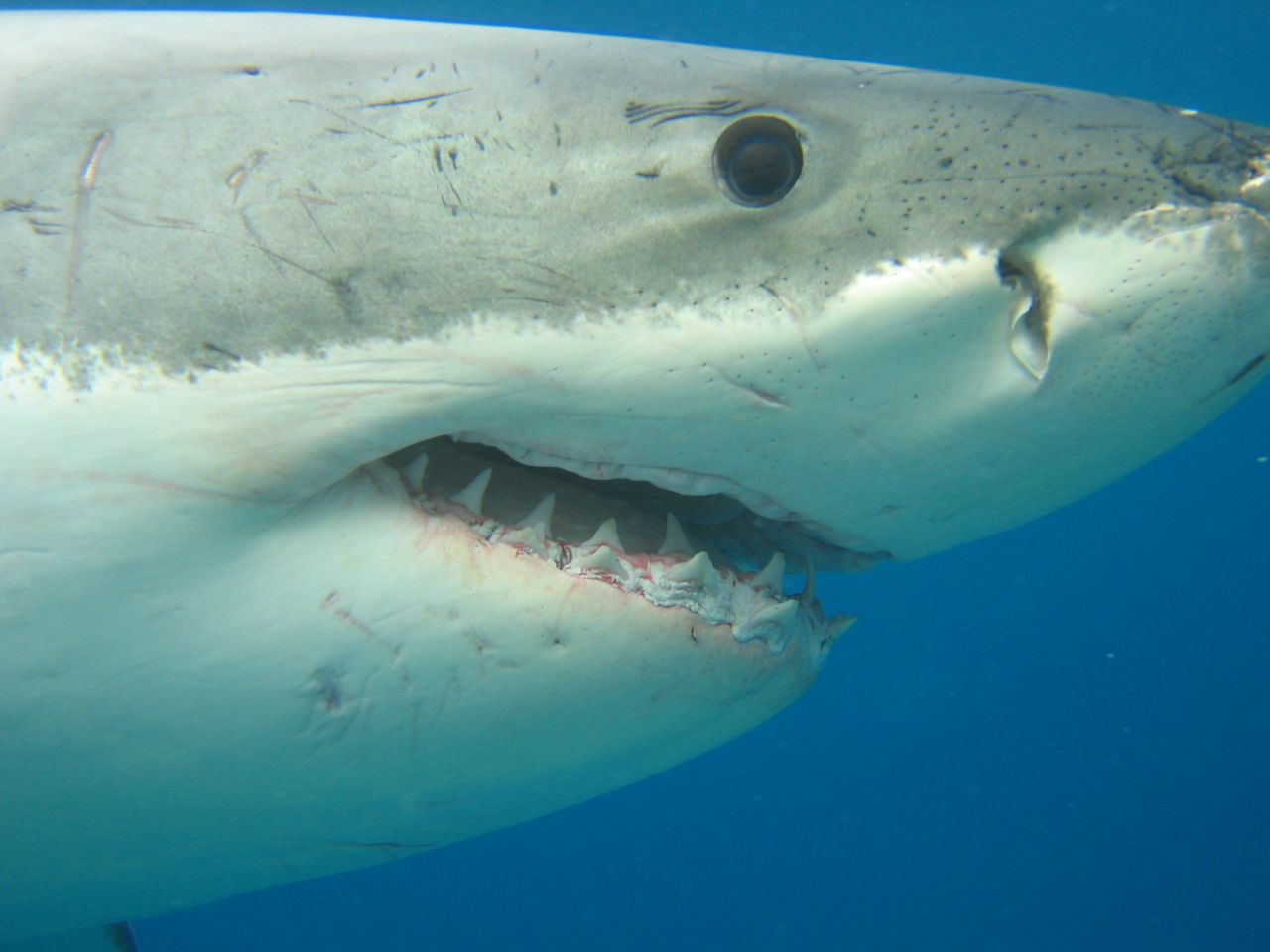
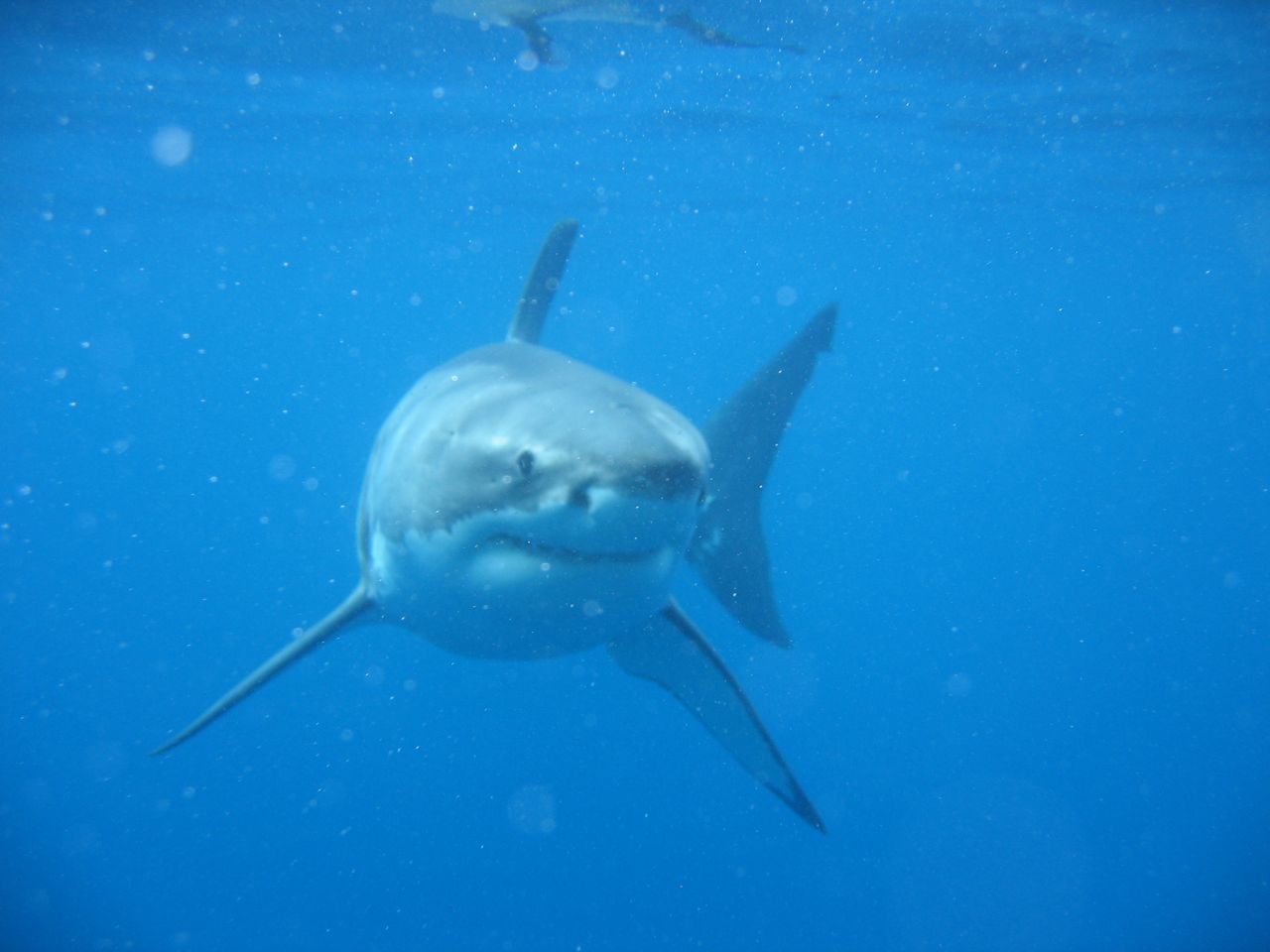
In 2005, along with my brother, Patrick, I spent several days cage-diving trip with Great White Sharks off the south coast of South Australia. It was one of the more remarkable experiences I’ve ever had, and I subsequently wrote about it for the now-defunct Bulletin. Since the piece is no longer available online, and sharks are all over the media at the moment, it seems a nice moment to resurrect the piece, together with some photos from the trip.
“Aside from those more obvious considerations touching Moby Dick, which could not but occasionally awaken in any man’s soul some alarm, there was another thought, or rather vague, nameless horror concerning him, which at times by its intensity completely overpowered all the rest; and yet so mystical and well nigh ineffable was it, that I almost despair of putting it in a comprehensible form. It was the whiteness of the whale that above all things appalled me.”
Herman Melville, Moby Dick
As we leave Port Lincoln a shearwater moves beside us, appearing and then disappearing behind the swell’s smooth motion as it skates across the waves. Behind us dolphins shoot through the water, slipping out and around the bow, their pale bellies flashing as they veer and turn. The weather is high, and still; the early morning water like silk.
Only as we round the cape does the wind hit, the swell thunking heavily into the hull so we pitch and roll, spray rising. To the west the low outline of the coast moves slowly past, the treeless hills and barren beaches strangely, powerfully familiar like so much I have seen in the last 24 hours. Although I’ve not lived in South Australia for the better part of 15 years it’s still there, inside of me: I realise thisas I stand watching it pass, those hills and the open sea evoking the same sense of loneliness and loss one can hear in the names the early explorers gave them: Dangerous Reef, Memory Cove, Cape Catastrophe. Coffin Bay.
Our destination is to the south-east, a lonely series of rocky islets called Neptune Islands that sits scattered across the mouth of the Spencer Gulf. Save for the seals and the seabirdscongregating on their low shores they would harbour little of interest — a ruined lighthouse, the condemned remains of a scientific station — were it not for the fact that they are also one of the few places in the world where Great White Sharks are known to congregate. Having spent the last few weeks reading and thinking about these shadowy creatures I am now travelling to this place I last visited as a child, to see them for myself.
Four hours later we arrive. Choosing a mooring in the lee of South Neptune baits are set and berley cast out into the water. Tommy ruffs rise to peck at the red cloud of messy fishmeat, glittering and quick, darting and turning while others nibble at the hunks of tuna carcass that trail behind the boat on baitropes. We stand watching as the crew lower a battered cage from the back of the boat into the water, the passengers laughing excitedly at the dents in the metal — evidence of previous encounters with the creatures we are here to see. ‘How long do you think we will have to wait?’ someone asks, but as they say this one of the baitropes goes taut with a crack and all 17 metres of the boat jerks sideways. With the others I run to the side, but the bait — the back third of a tuna that would have been a metre and a half long when it was alive — is already gone, the rope floating free.
I struggle into my wetsuit, digesting instructions on how to enter and exit the cage without being tipped over the side by the swell or overbalanced by my weightbelt. And then I’m off the back, and into the water.
Beneath the surface I grasp for my regulator. Although broken cloud moves overhead and the cage rises and falls in a metre or more of wave, the visibility is good, the water an impossible blue, deep and smoky. Immediately in front of the cage a tuna’s ruined neck and gills float, a billow of filmy guts beneath it. The water is cool, enclosing.
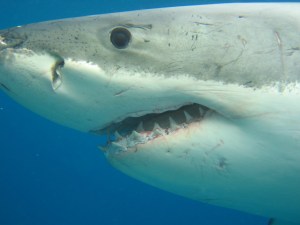
For a long time nothing happens. And then, just when it seems that the creature must have gone, slipped away into the ocean, a shape appears out of the blue, swimming steadily towards us. In the perspectiveless colour of the water it is hard at first to tell how large it is; it moves casually, almost effortlessly, its body weightless, its eyes trained on us. Only as it gets closer does the size of it become apparent, the power. I had thought it would be more beautiful, I realise, sinuous, and sleek, like a tiger. But despite the sinister ease with which it slides through the water there is nothing beautiful about it. Rather it is brutish, possessed of the overdeveloped look of the tomcat — that massiveness, though applied to a frame more than five metres in length.
As it approaches we move closer to the bars of our cage, eager to see more. Its mouth — surprisingly small in its head — hangs open, the uneven teeth protruding raggedly, the nostrils visible above them as blunt depressions. Behind its pectoral fins swim a school of silvery baitfish, following its motion with quick, shimmery turns like a clutch of young. The effect is oddly tender.
In a moment it will turn, striking at the cage with sudden ferocity, the force of the blow sending all three of us staggering to the floor and leaving teeth embedded in the metal of the tanks. But for now it simply turns, passing so close beside us that we could touch it. One gill is torn, scars crisscrossing the nose and face, the black eyes cold and depthless as it gazes through the cage at us.
What will be most surprising to me, as I look back, is that I am not afraid, even as it circles and strikes. Perhaps it is simply the reassuring fact of the cage, but faced with their lazy power of their motion, their careless brutality, I am filled instead with a sense of wonder that such things might still exist. It is as if the fact of their movement through these waters, the ghostly way they have appeared and will later disappear into the ocean’s immensity, like some half-remembered dream suggesting not terror, but something buried deeper, something primal, and deeper than words. Yet this is a creature with which I have shared an uneasy proximity all of my life. Always, everywhere: when we are in the water the idea of the shark is there with us, a shadowy presence lurking just out of sight, like the monsters that once lurked just beyond our campfires, unseen, unstoppable, implacable. And of all the sharks it is this one – the Great White, Carcharodon carcharias – that we fear the most.
Seeing sharks up close, such fears seem natural enough. Sharks are sometimes caricatured as primitive, their basic design dating back some 400 million years, but in reality they are highly adapted and sophisticated creatures, their longevity testament to their perfection. Watching as they glide past or strike at the baits it is obvious that in some deep sense this is what they are for, that in their speed and savagery they are entirely and utterly themselves.
Over the hours and days that follow, as I watch them gather around the boat, I find myself wondering at this quality in them. It’s easy to romanticise wild creatures, particularly ones as singular as sharks. Indeed in the case of a creature so feared, so maligned, romanticisation might almost be seen as a response to the horror they provoke in many. Watching them as they circle the cage, looking into their strangely empty eyes I find my own desire to see something ancient and unknowable reflected back at me, rendered somehow ridiculous by their obdurate alienness.
And yet are the fears we project onto them any less ridiculous? As we drove through Port Lincoln, we had passed the Sorrento Motor Inn. Seeing it my brother reminded me that we stayed there once as children, 25 years ago, on a holiday with our parents. Looking out the window I realised he was right; I remembered not just the hotel but our parents’ warnings about the beach that runs behind it, curving away towards what is now the marina. People got eaten here, they told us over and over again, disappearing after diving off the back of fishing boats or dragged under while snorkelling off the rocks. My parents were not nervous people, but the threat posed by the sharks seemed real enough to them then, and real enough I suppose to us.
*
On my second dive I take off my glove, peeling the nylon from my pale and wrinkled skin. Though they live alone in the ocean, gathering only to feed or breed, there are four or five sharks now attracted by the smell of the bait and moving in long arcs around the boat, sometimes vanishing into the failing light for minutes at a time. Seen together they are surprisingly individual, their bodies and markings, even their faces, easy to tell apart. Some look tired, their mouths hanging open with apparent exhaustion; others are sinisterly clownish, their wide, bland faces cartoonish; others are sleek and savage, their bodies still slender.
One by one they pass, watching the drifting baits. And for creatures with such a fearsome reputation they are surprisingly cautious, refusing to take a bait more often than not. Biologists have argued this caution reflects the risk that their prey — adult Great Whites prey almost exclusively on large mammalian creatures such as seals — pose to them, rather than the other way round. Their characteristic mode of attack is designed not to maximise their chances of a successful kill but to minimise the chances of damage to their eyes from the teeth and claws of struggling seals, and so their lips peel back to push their jaws forward, and their eyes roll back into their head.
Outside the cage I can see three of them circling, some way off. Flexing my hand I wait, watching them, and then, almost on cue, one — a five-metre male recognisable by the claspers behind his pelvic fins — turns inwards, heading towards me like a steadily moving torpedo. Despite the effortlessness of his motion he moves improbably quickly, his speed a reminder of the power of his body. Out on the perimeter of my vision I can still see the others, waiting, no doubt watching.
As he draws closer he does not turn aside, and for an instant or two I have a very clear sense of being watched, considered. At first I think he means to ram the cage, maybe try and force his snout through the gap designed to allow easy filming. But then, at the last moment he turns aside, his body pressing against the metal so it creaks and grinds. Reaching out I grasp his pectoral fin, feeling for a moment the power in him before he pushes on. The mottled line where his darker back meets his paler belly passes close, and reaching out again I press my hand against it, not sure what to expect. Great Whites, like makos and some large turtles, have warm blood: a heat exchange system in their bodies heats it to 24-27º, making their physiology closer in many ways to that of mammals and birds than that of other fish. That they can exchange energy more efficiently means their muscles can contract faster and more powerfully.
As he moves by his skin slides under my hand, surprisingly smooth — the skin of sharks is made up of thousands of tiny dermal denticles, or skin teeth; rubbed against the grain these are abrasive, like sandpaper, but traced with it they can seem almost frictionless — and pressing harder I seek the warmth I know should be there. But whether or not it is my own skin gone numb in the cool water or the layers of insulating flesh between us, I feel nothing, only the skin itself, its resistance beneath my hand. And then he is gone, peeling away from the cage and away.
I watch him go, swimming away as if my clumsy attempt to touch him has driven him to retreat: it’s strange how little is really known about these creatures, particularly given the space they occupy in our cultural imagination. Studying marine animals of any sort poses considerable practical difficulties, and in the case of large, dangerous and migratory predators these problems are only exacerbated. It’s not even clear how many of them there are: some South Australians believe their numbers have increased since they were protected in 1997, but most other data points to an ongoing decline in their numbers, the recent spate of attacks along Australia’s coasts notwithstanding.
There’s something peculiarly tragic in this. Of course the extinction of any species is a tragedy, but it’s difficult not to feel that we ourselves will be somehow diminished on the day the last Bengal tiger falls to a poacher’s bullet or the last polar bear is reduced to scavenging in rubbish dumps as the polar ice melts.
In a similar vein the biologist David Quammen has recently argued for a reappraisal of the way we understand those few species which have regularly preyed upon human beings, seeking to tease out a more complex way of seeing them and, by extension, our place in the world. Drawing together narrative threads as diverse as Gligamesh, Beowulf and Alien, he suggests that our deep-seated fears of creatures such as the shark are not just predictable but actually necessary, even desired, serving to remind us of our limitations, our mortality.
What’s interesting about Quammen’s argument is that it points out that those communities who live closest to these creatures — be they lions or bears or crocodiles — do not fear these creatures so much as respect them, even venerate them. Predator and prey are, if not quite two sides of the same coin, at least bound together by the nature of their relationship, the one made somehow more real by the other.
By contrast societies such as ours, mercifully free of predators, feel the need to invent them, projecting our subliminal terrors and cultural anxieties onto cinema screens, and, presumably, beneath the waves. Like Alexander with the armies of the world vanquished, we find ourselves not ennobled by our success but diminished, and so we create monsters to make ourselves feel alive, as if knowing life depended on understanding how easily it might be snatched away.
*
Near dusk on our third day, great clouds of shearwaters wheel overhead, dark against the paling sky as they gather for the night. At the back of the boat my brother and one of our fellow passengers are fishing, when one of them hooks something big. There is much laughter, speculation that the shark from earlier — a massive five-metre male with a nose scored clean and pale by some unknown collision — might be on the end. Earlier today he’d struck at one of the baits, rolling up between the boat and the cage, sending the berley bucket tumbling into the water and smashing the occupants of the cage back in a great kicking surge before biting clean through the massive rope which secures the cage to the boat. And though we all of us know it is not that shark’s weight against the rod — that the line would have snapped — we gather, curious to see what has been caught.
Almost on cue, as they strain to bring whatever it is that has been caught on board, he appears, gliding beneath the boat, the white spot on his snout clearly visible in the dark water. We all shout, excited, and as we do a huge grouper, almost a metre and a half in length, comes looming into view, fighting on the line.
A few metres from the boat the shark turns, swinging back as we haul the grouper higher, trying to save it. As it thrashes on the line the captain leans over, only inches from the water, trying to draw the hook from its mouth. The shark passes underneath again, and as it does the grouper floats free, flapping half-submerged, its swim bladder swollen from the too-quick ascent to the surface. It flounders away from the boat, struggling to dive, and we laugh and shout, urging it to swim while in one long, almost lazy roll the shark surfaces, its huge head rising from the water to engulf the fish in its maw. It rolls once and then again, its body flashing dark and dazzling white as it turns. Though this afternoon I stood so close to it I could touch it without fear the effect now is terrifying, the sheer size of the shark, its power suddenly brought home to me — to all of us — as much by the casual economy of its attack as by anything. For a few seconds the shark turns near the surface, flicking its tail and slicing around, still caught up in the attack. On the boat all of us are whooping and shouting, horrified by the spectacle and excited by it, demanding of each other, did we see it? And then a few seconds later the shark erupts from the water again, caught in a craypot’s ropes, struggling in the buoys, turning and fighting, before pulling the buoys down with it and vanishing.
For a long time we stand staring after it, wanting it to return. I’m sure I should feel sorry for the grouper but I don’t or not very. Indeed I almost wish one of the seals I can hear crying on the rocks a few hundred metres away might swim close so I could see it get taken too. I know — all of us know — that we have seen something here modern humans rarely get the chance to see, some vision of the primal, horrible and magnificent. And in its wake I feel enlivened somehow, as if my awe has reminded me of some part of me I had forgotten, the feeling lasting until long after the shark has gone, so long that later that night, in the silence of our cabin my brother and I find ourselves laughing at it, elated, still buoyed by the violence of the shark’s attack, the memory wild in us.
First published in The Bulletin
© James Bradley, 2005
break text 1
break text 2
Jan 27
I want to post something about animal intelligence and birds in the next few days. In the meantime I have two words for you.
Burrowing. Owls.
Clever Critters: 8 Best Non-Human Tool Users | Wired Science from Wired.com.





 city of tongues