Richard T Kelly’s blog
 British author Richard T Kelly’s first novel, Crusaders

Break text


Feb 17
British author Richard T Kelly’s first novel, Crusaders
Break text
While I’m on a little surfing jag I thought it might be worth linking to my review of Tim Winton’s Breath, which was published in The Age last year.

Sean O'Brien (image via Wikipedia)
This week’s TLS has a terrific piece about the thriller and crime fiction by Sean O’Brien, author of last year’s T.S. Eliot and Forward Prize-winning The Drowned Book
Break text
Feb 11
Lost returns to Australian television tonight, several weeks after it resumed in the US and in the rather unfriendly timeslot of 10:30pm.
Presumably the tardy return and crappy timeslot are a reflection of the show’s waning ratings, at least here in Australia. While the loss of viewers to downloads has forced Australian networks to release popular shows in a more timely manner than they have traditionally deigned to (SciFi on Foxtel are to be commended for their decision to screen the final season of Battlestar Galactica only hours after it goes to air in the US) old habits die hard, and as soon as a show begins to fail in the ratings it’s a fair bet the commercial networks will be treating viewers with the dizzying disrespect they always have by screening them long after primetime, delaying episodes and altering their schedules without warning (a disaster for anyone trying to record programs).
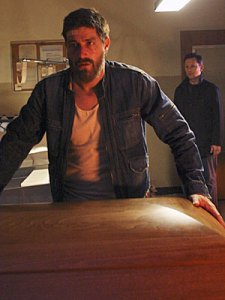
Jack (Matthew Fox) and Ben (Michael Emerson) find Locke's body
It’s a pity, in many ways, because as anyone who has stuck around through the longueurs of the second and third seasons knows, Lost went from strength to strength across its increasingly wild fourth season, and reviews from overseas suggest the fifth is even better. As Season Three ended, several of the survivors (Jack, Kate, Sayid, Hurley, Sun and Claire’s son, Aaron) are off the island, a turn of events a series of flash-forwards (mirroring the device of the flashbacks in the first few seasons) have revealed to have caused any number of problems of its own. Jack is a drunken wreck, his relationship with Kate has come unravelled, Hurley is in an asylum and talking to dead people, Sayid is an assassin employed by the perfidious Charles Widmore, Sun has taken over her father’s criminal and business empire and Locke, last seen trying to save the island, is in a coffin on the mainland. The fate of many of those back on the island, in particular Jin, is unclear, but the island itself seems to have teleported away not just through space but through time. And Ben has arrived to tell Jack and the other members of the Oceanic Six that if they want to save themselves and the other survivors they have to go back to the island.
It’s exactly as mad as it sounds, of course, and almost as incomprehensible. Like many shows which rely upon the unravelling of intricate plots, it’s almost impossible to keep track of precisely what’s going on, and indeed in many ways, keeping track of what’s going on is almost beside the point. What matters is the almost visceral thrill of the show’s twists and turns, and the sense that some new craziness lies just around the corner.
Last week I published a piece in The Australian Literary Review about the rise of what I called the new television. In it I argued that shows such as The Sopranos represent a mode of television drama unlike any we have seen before, filmic in their exploration of the medium’s visual and aural possibilities and novelistic in their preparedness to reject the generic conventions of series television and embrace the complexity and ambiguity of our inner lives.
One of the more striking aspects of this new television is the way it has been made possible by changes in television’s economic model, and by the rise of cable networks less reliant upon advertising and the growing popularity of alternative distribution models such as DVD and downloads, legal or otherwise. This shift away from reliance upon advertisers has allowed the cable networks to make more courageous choices about content and style, and to rely upon greater loyalty from their audiences over time, allowing longer and more complex storylines to be developed and explored.

Image via Wikipedia
Lost and The Sopranos are quite different phenomena of course. If The Sopranos can be understood as the early 21st century’s answer to Dostoyevsky, or Tolstoy, Lost’s antecedents are to be found in the Saturday morning serials of the 1930s, and more particularly, the Silver Age comics of Jack Kirby, Stan Lee, Steve Ditko and others. Certainly Lost, like other, more obviously derivative shows such as Heroes, owes more than just its subject matter to the pulpy, four-colour world of the comic strip. Its structure, with the movement back and forwards in time from an essentially static present is reminiscent of the comic, as is its dependence upon the show’s complex and intertwined mythology. But in many ways it is its dependence upon the piecing together of the puzzles it presents, rather than the transformation of character through action and circumstance to generate narrative excitement and interest that ties it most closely to the comic. For all the intensity and vividness with which characters like Jack are drawn, it’s not their personal and existential travails we’re interested in, merely the part they play in a much larger picture, just as with Spiderman it’s the thrill of recognition we feel in discovering the Green Goblin is Harry Osborn’s father that keeps us reading.
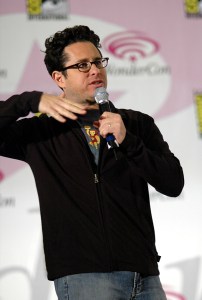
J.J. Abrams
It’s a mode of storytelling Lost’s creator, J.J. Abrams has spent much of the last decade perfecting. First in Alias (a show I never warmed to), and more recently in the drearily derivative Fringe, as well as in films like Mission Impossible III, Cloverfield and the upcoming Star Trek reboot, Abrams has demonstrated an remarkable capacity to marry a purely pop, MTV aesthetic to narrative elements which rarely find their way into mainstream television. Sean Williams, for one sees Lost, with its teleportation and time travel plots, as a trojan horse designed to smuggle science fictional tropes into the mainstream, and in many ways the same could be said of all of Abrams’ work to date.
Part of the Abrams mystique is the illusion that everything in shows such as Lost and Fringe is part of some intricate plan worked out in advance. Like many other television shows, Lost assumes many of its viewers will watch (and indeed rewatch) episodes on Tivo and DVD, allowing them to pause and rewind, and as a result every second frame has some secret unlikely to reveal itself on a casual viewing hidden in it. If a television is on during a flashback in Lost you can assume whatever’s on will pertain to the plot, if a document is glimpsed on a table it will matter, if a logo appears on a coffee cup it will be part of the larger picture.
Obviously this increasingly complex web of associations in Lost and other shows like it depends upon exactly the same transformation in delivery technologies that underpins the rise of the new television more generally. Yet they are supplemented, in Lost’s case, by the very intelligent and deliberate use of the internet. Google Lost, and you will find endless discussions and spoilers, attempts to unravel the show’s mysteries and general speculation about what every detail might mean. And it’s not idle chatter either: I suspect for many viewers this second life (if you’ll pardon the pun) is as much a part of their enjoyment of the show as its more immediate pleasures.
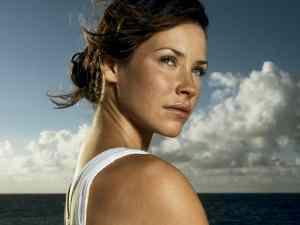
Evangeline Lilly as Kate
The illusion it’s all planned is, of course, just that. One only has to look at the description of the original pilot (which was meant to star Michael Keaton as Jack, and have him die at the end of the first episode) to be reminded of the organic manner in which any television show, even one as intricate as Lost, evolves. Perhaps to his credit Abrams seems happy to give away the sort of fascistic control over every aspect of his shows’ creation that David Chase clearly exerted over The Sopranos or Matthew Weiner now exerts over Mad Men (there’s a fascinating if appalling depiction of Weiner at work in this excellent New York Times feature about life on the Mad Men set)
It’s also interesting to contrast Abrams’ manipulation of the illusion of control with the cheerful and slightly dismaying preparedness of Ronald D. Moore, co-creator of Battlestar Galactica, another show whose success depends at least in part on the complexity of its overarching narrative, to admit how many of the crucial decisions about Battlestar Galactica are made in the most casual fashion (“Who shall we make the last of the Final Five? Adama? The President? Ellen?????”).
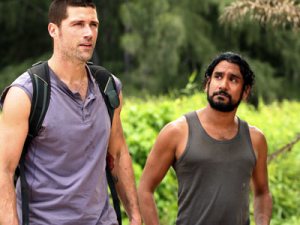
Jack and Sayid (Naveen Andrews) on the island
Given this careful calibrated interplay between the collaborative technologies of the internet (an interplay shows like Battlestar Galactica also build on through the release of mini webisodes between seasons) it would be tempting to see Lost and shows like it as the first wave of a new, viewer-driven mode of television, a wikivision if you like, but they’re not, or not really. The shows are still driven from the top down, even if they aren’t mapped out by their creators in quite the detail they pretend they are. And it is worth asking whether viewer-driven television would be attractive anyway. In the days of yore, when Xena was one of the hottest shows on tv, its writers checked out the newsgroups, and discovered, somewhat to their dismay, that its fans were enraged by many aspects of the current season. Pleased to have an insight into what viewers did and didn’t like, they began to change storylines and finesse characters to meet the wishes of their fans. The strategy worked. Within a few episodes the chat on the newsgroups grew far more positive. But simultaneously, ratings began to slide. Pleasing the diehard fans, it turned out, was not the same as pleasing viewers more generally.
Yet there’s little doubt Lost and its relatives are part of a broader transformation of television drama, a transformation driven by related, forces to those which have allowed shows like The Sopranos and The Wire and Big Love to flourish. And, like those shows, they represent a flowering of televison drama which speaks to its vitality as a form. Whether this renaissance can survive the next wave of changes to the media landscape is an interesting question, but for now, I’m just happy to have Lost back.
Break text
A Lost Mastermind offers a crash course
A Lost Recap: On Lost, the Island Skips, Skips, Skips in Time
Break text
Break text
Feb 11

For anyone who’s interested, William Gibson has started posting excerpts from his new novel on his blog at www.williamgibsonbooks.com. The first was posted on New Year’s Day, and there have been several more substantial pieces over the past couple of weeks.
The excerpts suggest the new book picks up somewhere after Gibson’s last novel, Spook Country

Gibson experimented with the same practice during the writing of Spook Country, and though a lot of his fans were excited by it, I felt it was better to stay away and wait for the real thing. Perhaps I’m just too busy, perhaps it’s a more deepseated, novelist’s prejudice against the idea of wiki-ing a book (though I’d be interested to know how many of the responses the excerpts receive Gibson will take on board).
break text
For those wanting more Gibson paraphernalia, here is the very stylish video Gibson’s publishers released to coincide with the publication of Spook Country in 2007.
break text
break text
And here is a short review of Pattern Recognition I wrote for The Sydney Morning Herald in 2003. It’s still available online, but for some reason the quotes in the version on the SMH website have dropped out, rather changing the sense of the piece. That being the case I’ve taken the liberty of reproducing my original review below with the missing quotes reinstated (I hope the SMH won’t mind).
Break text
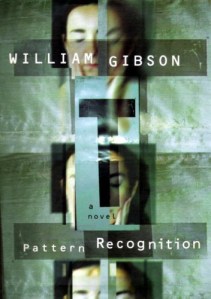 Pattern Recognition
By William Gibson
Somewhere in the middle of Pattern Recognition, William Gibson’s seventh novel, the central character, Cayce Pollard, describes her memories of that day in New York, of the impact of the second plane. The experience, related in a fragmented, dream-like language, seems to collapse time, collapse meaning. It is “like watching one of her own dreams on television. Some vast and deeply personal insult to any ordinary notion of interiority. An experience outside of culture.”
What Gibson’s language strains to reveal in that event, or more properly, in our experience of it, is the sense of vertigo it induced, of the collapsing of boundaries: political, geographical, personal, ethical, its singularity lying not in its death toll, or in its nature but in our experience of it, the way it unmade the certainties that not just our present but our future were grounded in.
Whether it was begun before or after September 11, this sense of our experience of reality exceeding itself is wound deeply into Pattern Recognition. Not only is it the first of Gibson’s novels to take place in the immediate present, it also seems to represent the closure of some kind of circle in his writing, not least in the allusive play between the names of its protagonist, Cayce and the anti-hero of his groundbreaking first novel, Neuromancer, Case.
Of course to call Gibson a writer of science fiction has always been to misunderstand him. Gibson’s antecedents lie more in Burroughs and Pynchon than Arthur C. Clarke, their strange, essentially poetic assemblages of image and echo designed to explore the inner textures of a culture which exists increasingly outside of time and space. The effect is probably nearest to that of an intellectually rigorous brand of video-art: suggestive, unsettling, and unresolved, its meanings arising out of the interplay between the elements rather than residing within them.
And so, despite its contemporary setting Pattern Recognition is classic Gibson. Moving between London, Tokyo and Moscow, it turns upon a series of film fragments which have been appearing anonymously upon the internet. These fragments, in an echo of the Joseph Cornell-like assemblages of Count Zero’s artificial intelligence, are possessed of a mute, almost inexplicable power, a power attested to by the global underground following they have attracted. Carefully denuded of any identifiable signs of context or origin, the fragments may or may not be part of some larger work, yet regardless their power stems from their sense of compression, the way they seem to signify the possibility of a meaning which they simultaneously deny.
Cayce, a follower of the footage herself, is commissioned by her sometime boss, the wonderfully-named Belgian market-guru, Hubertus Bigend (who “seems to have no sense at all that his name might be ridiculous to anyone, ever”) to establish the identity of the footage’s creator. Bigend’s motives for doing so are ambiguous to say the least, but Cayce accepts nonetheless, a decision which drops her deep into a world of obsessed footage-heads, industrial espionage, Russian mafia and cryptography, only to fetch up, finally, in the painful truth of the footage’s origins.
Woven through this are a collection of images which play off each other with ever-increasing subtlety and power. The pictures of the missing pinned to windows and walls and doors in New York. An amateur archaeological dig near Stalingrad, where guns and badges, uniforms and eventually an entire Stuka, its pilot still in its cockpit are being drawn from the suffocating, erasing mud by Russian skinheads. Diagrams of the arming mechanism of antiquated American explosives are uncovered coded deep inside the footage. Mechanical calculators designed in Buchenwald are traded to collectors from car boots, resembling nothing so much as grenades. And everywhere, out of the fragments of the past, the present and the future, meaning suggests itself, elusive, partial yet possessed of a strange and ultimately deeply moving poetry.
Like Gibson’s futuristic novels, which refract the present hauntingly through the lens of their possible futures, there is something at once utterly immediate and strangely timeless about Pattern Recognition. It captures the fluidity of meaning and the sense of shifting certainties which infect our historical moment, strung between the unrecoverable past and the nascent future. ‘“The future is there . . . looking back at us,” as Cayce herself says. “Trying to make sense of the fiction we have become. And from where they are, the past behind us will look nothing at all like the past we imagine behind us now.”
First published in The Sydney Morning Herald, 15 March 2003.
© James Bradley, 2003.
break text
Feb 7

There’s a fascinating conversation going on over at Matilda about the ethics of reviewing, and in particular the question of whether accepting free books from publishers compromises bloggers. My feeling is that the latter question is a bit of a furphy, since reviewers for the mainstream press accept free books all the time, and it doesn’t compromise our integrity (or what we laughingly call our integrity). But I also think the discussion at Matilda is circling around another larger and more interesting question about the future of the book review itself.
The book review, in its current incarnation, is largely a creature of the print media, and in particular the newspaper. But over recent years the commitment of newspapers to their book review sections has been wavering. In his excellent Overland lecture Malcolm Knox disputes the economics of this failing commitment, but whether it’s sound business thinking or not, the review sections of newspapers are in trouble. In recent weeks The Washington Post has folded its august Book World section back into the main paper (although it will continue to live on, ghost-like, online) and it seems likely other papers around the world will follow suit in the next few years. Given the convulsions (death throes?) afflicting the print media more generally as the GFC collides with their already shaky business models it might be interesting to see whether newspapers themselves outlive their book review sections, but whatever happens it looks less and less likely the traditional mainstream media print review will be around in anything other than a niche capacity ten years from now.
That of course raises the question of what happens then. Assuming there will continue to be interest in books (and while I think interest in books will continue to contract I’m confident both that there will continue to be a community of readers eager to discuss and debate books, and that the net will drive deeper and broader collaborations between such individuals) there will continue to be a demand for reviews of new publications, and I think we can safely assume the publishing business (whatever it looks like in a decade’s time) will continue to seek out forums prepared to give space to its product.
But what will those forums, and those reviews look like? The book review as it is traditionally understood is an awkward beast in cyberspace. The very qualities that give it shape in the print media – its authoritative air, the craft involved in shaping a piece to fit the space allotted, its ongoing process of attempting to balance the subjective response of the reviewer with a more objective view make it seem overly formal and hopelessly enclosed in the more collaborative environment of the blogosphere. Blogposts, and blogging, as they have evolved to date, are a much more personal, subjective form of writing, and offer quite different pleasures to the traditional review.
Yet the traditional review looks the way it does for a reason. Unlike bloggers, reviewers operate within a complex web of competing responsibilities to author, reader, book and editor (Kerryn Goldsworthy has written about this elsewhere but I can’t find the link, dammit) as well as restrictions relating to length and similar questions.
So will the end of the print media’s commitment to book reviewing mean the end of book reviewing, or at least of book reviews as we know them? Or will the ways bloggers write about books begin to become more formalized and codified as they become more enmeshed in the cycle of book promotion and discussion? Something of this sort is already happening with Amazon’s system of ranking for its reviewers, which despite being driven from the bottom-up, still push the reader reviews towards the more formal and balanced mode expected in the print media. Will new forums spring up to replace the broadsheet review sections, either aggregating reviews on blogs or actually commissioning them? And if it’s the latter how will it work economically? And perhaps most importantly, how will the blogging community, which has traditionally been opposed to absorption into the corporate machine, handle the process of being professionalized by inevitably closer relations with publishers and publicists? What will it mean for their independence and freedom of expression?
I don’t pretend I know the answers to these questions, but they’re real, and I suspect they’re dilemmas the blogging community is going to have to face up to, possibly sooner rather than later.
Break text
Feb 5
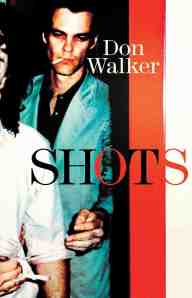 On Wednesday 11 March I’m hosting a conversation with Don Walker at Gleebooks in Sydney. Don’s name may be unfamiliar to anyone from outside Australia, but to almost any Australian under the age of 50 his name will be immediately recognizable as one of the creative forces behind Cold Chisel.
The event is to promote Don’s first book, a memoir called Shots. In recent years there’s been a spate of memoirs by members of the iconic Australian bands of the 1980s – Rob Hirst of Midnight Oil published Willie’s Bar and Grill a few years ago, Mark Seymour’s take on his career with Hunters and Collectors, Thirteen Tonne Theory, was published last year, and Paul Kelly has a book coming out with Penguin later this year. Yet all of them are essentially accounts of the lives and times of the bands with which their authors are associated.
Shots is a quite different and much more ambitious proposition. Written in a free-flowing, impressionistic stream of consciousness, it deliberately downplays Don’s time with Cold Chisel. They – the band – are never mentioned by name, and even Jimmy Barnes is only ever identified as Jimmy.
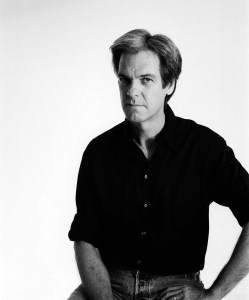
Don Walker
This decision allows not only allows Shots to break free of the expectations usually associated with memoirs by musicians, but has the effect of emphasizing the fact that Don’s time with Cold Chisel, and in particular the period of their greatest success, was relatively brief. Reading the book I was struck by the realization that despite dominating the Australian music scene in a way no other band ever has, in fact there is only about three years between the release of their first really big album, East, in 1980, and the band’s breakup in 1983.
In place of lengthy reminiscences about life with the band, Don tries to give a portrait of the textures of a life as it is lived, spanning from his childhood in North Queensland and Grafton to his reunion with his daughter several years ago (indeed in many ways the book reads as a sort of gift of his life to his daughter, a process of documenting and recording the steps which brought him to his life with her, and his love for her), and taking in his failed career as a physicist, his many years as a struggling musician, and the sprawling disaster of Cold Chisel’s fame and the years that followed.
It’s a fascinating document, and not least because it’s so beautifully written. Don has managed to graft the spareness and vernacular rhythms of his songwriting to the larger narrative frame of the book with startling success, and there’s a swing and a tensile strength to the seemingly plainspoken prose it’s difficult not to admire. But it’s also fascinating as a kind of psychogeography, a mapping of places, and people.This is immediately apparent in the early sections, about growing up in Ayr and Grafton. But it’s in the chapters set in Adelaide, and later Sydney, where it really comes to life. Again and again the book very clearly captures the textures of life in Kings Cross in the 1970s, and of the spaces and secret worlds that moved within the Sydney of that time.
In a way this shouldn’t be surprising. Although I suspect their intelligence and precision has been somewhat obscured by years of FM radio play, the songs Don wrote for Cold Chisel are best seen as little word-pictures, depictions of people and places. Many – ‘Breakfast at Sweetheart’s’, or ‘Cheap Wine’, to name just two – are rooted in the demi-monde Don depicts so well in Shots, others, such as ‘Flame Trees’ are about the landscape of regional Australia. But at their best, all are remarkably successful, not just as songs, but as evocations of particular moments and lived realities which owe more than a little to Carver or Tobias Wolff. They’re not narrative in form, more impressionistic, prose poems of a sort, but they’re very effective nonetheless. Indeed for all that it is usually Paul Kelly who comes to mind when Australians talk about storytelling songwriters, Don does it just as well, if not better, precisely because he eschews the narrative devices that people celebrate in Kelly’s songs.
The interesting thing is that this sort of writing is not, as a rule, something Australians do well. With the not inconsiderable exception of Tim Winton’s recent work, our fiction, and in particular our short fiction, is not particualrly good at the sort of pared-back, realist writing which draws its integrity from its observation of regional lives that is seldom far away in American writing. This is partly because the economics of our industry militate against the short story as a form, and partly, presumably, because our population is essentially urban, but it is also at least in part a function of our sense that stories of ordinary Australian life are somehow lacking in ambition. Not for nothing have the most celebrated Australian writers of the last few decades been those who produce foundational narratives about the imaginary origins of Australia, whether in the highly-coloured vein of Peter Carey or in the more conventional vein of Kate Grenville. As the taste for this sort of capital “N” national literarure has dissipated in recent years this has begun to change, and writers as various as Malcolm Knox, Christos Tsiolkas and Steven Carroll have begin to write fiction which more deliberately situates itself in the lives of the city and the suburbs, but I suspect many still have trouble placing their work in a larger critical framework, precisely because it isn’t national literature in any meaningful sense.
But I digress. I’m embarassingly excited to be involved in this event, not least because Don’s songs have been such an important part of my life. I’m old enough to have seen Cold Chisel play live as a teenager. I picked a drunken Jimmy Barnes up off the floor at a gig at the Apollo Stadium in Adelaide in 1983 or 1984, which was the height of glamour to me then (I also remember a very different Jimmy roaming the dancefloors of Mardi Gras and Sleaze back in the 1990s, though that’s another story) and I still love many of their songs. But I’m also excited to be able to help Don promote the book, which is a genuinely impressive achievement.
More information about the Gleebooks event is available on the Gleebooks website. For information about events in Melbourne and elsewhere contact Readings or visit the Black Inc website.
Shots can be purchased from Gleebooks, Readings or bricks and mortar bookstores anywhere.
Break text
Feb 3
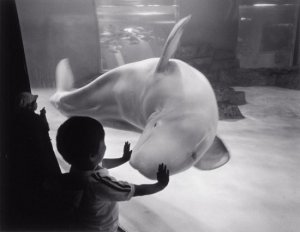
'Baluga Whale, Hakejima Sea Paradise' from Other Oceans
Flicking through some books the other night, I came across my copy of Wayne Levin’s Other Oceans
Levin’s photography probably isn’t familiar to many outside of the United States, and the broader community of those who are fascinated by the ocean, but he’s a Hawaii-based photographer who, working largely in black and white, has spent the best part of the last three decades documenting a very personal portrait of the ocean and its inhabitants. Although he has explored seas further afield, most of his photographs have been taken in the waters around his home, capturing surfers and divers and, most remarkably, what he describes as the resident spirits of the seas – the whales, dolphins, turtles and fish that move beneath the surface, largely unseen.
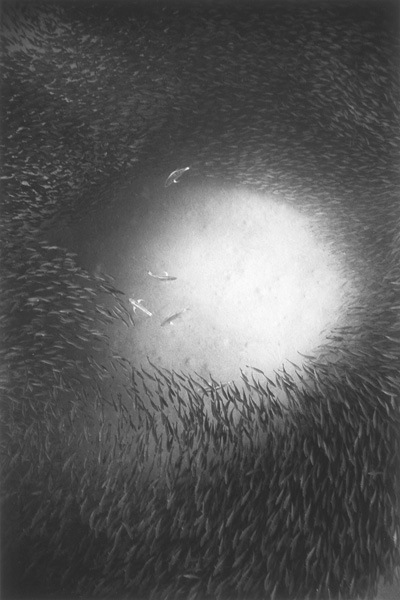 The best of his photographs capture something of the immensity and mysteriousness of the ocean, its elusive and constantly-changing beauty. Some are collected together in Other Oceans and Through a Liquid Mirror


Break text
Break text
All images © Wayne Levin.
 I’m working my way through the immense, amazing and completely exhilarating 2666 (more on that later) at the moment, but it seems Bolano might have been doing a little self-mythologizing of his own . . .
A Chilean Writer’s Fictions Might Include His Own Colorful Past
Jan 29
I mentioned Alex Ross’ wonderful study of 20th century music, The Rest is Noise, in my post the other day about Philip Glass. I’ve now discovered Ross – who is also music critic for The New Yorker – has a website, The Rest is Noise, which incorporates a blog, articles and information about the book. If you’re interested in classical and contemporary classical music it’s well worth checking out.
Jan 28
John Updike, Prize-Winning Writer, Dead at Age 76
Update: Crikey! have saved me the effort of assembling a compendium of links to obits and tributes to Updike by putting together a rather splendid one of their own at Vale John Updike: A Crikey Compendium (nifty title, no?).
And while I was always a slightly ambivalent admirer of Updike, it seems a terrible loss, not least because he was so incredibly productive right up until the end. I’m also slightly thrown by the fact that I was reading James Wolcott’s piece in the London Review of Books about his continued vitality only last night.



 city of tongues