Skip to content

Archive for

Summer and the myths of Australianness

Narelle Autio, 'The Climb', © Narelle Autio 2001

Some of you may have noticed my piece in The Weekend Australian about summer and the myths of Australianness a couple of weeks back. It was an interesting piece to write, not least because the process of putting it together was, in an odd way, very similar to the processes of remembering and reliving the past that seem to me to so essential to the experience of summer. Certainly while writing it I was reminded very powerfully of my childhood and adolescence in Adelaide, and of the silent, empty streets and wakeful nights.

As a writer you have next to no control over the illustrations that appear with your pieces(I think I’ve been asked for a suggestion once and offered them unsolicited twice in all the years I’ve been writing for newspapers). But in the case of this piece I’m not sure I could have chosen something more appropriate, because Review’s Editor, Deborah Jones, chose to use not just an image by Narelle Autio, but her photo ‘The Climb’, which was taken on Brighton Jetty, only a kilometre or so from where I grew up.

I’ve been an admirer of Autio’s photos for a long time, and my partner and I actually own several of them. While the early black and white images of swimmers and surfers bear a passing resemblance to Wayne Levin’s images of bodysurfers, they have an informality and sense of play that’s very much their own, a celebratory aspect that seems to capture something not just of the joy and spontaneity of their subject, but of the odd way that joy and spontaneity seems to exist suspended on the edge of memory.

But the series ‘The Climb’ is a part of has always been my favourite. Partly that’s because the images that comprise it are so vivid and immediate, in particular photos such as ‘Black Marlin’. But it’s also because they capture that oddly informal and shapeless communality that summer holidays often involve, the groups of people and sudden pleasures of caravan parks and camping grounds.

Part of what makes them so beautiful is the sheer saturation of colour, not just the blues of the water but its greenness, the yellow of the sand, even the brooding, impossible purple of late afternoon cloud. I suspect to many it’s a saturation that will seem immediately tropical, but oddly enough I remember standing in front of these pictures in the gallery and being immediately, unshakeably certain that Autio was from South Australia like me. It wasn’t the subjects of the photos – indeed I’m reasonably certain the photo that made me so sure she and I grew up near each other, ‘Orange Car’, is actually of somewhere in New South Wales – rather it was something about the quality of the light and its intensity, the degraded nature of the yellows.

As it turned out I was right: Autio grew up two beaches away from me in Adelaide. But that certainty was a reminder of somethign I’ve long thought about the nature of the Australian experience fo the beach. I keenly remember reading Robert Drewe’s brilliant memoir, The Shark Net, for the first time and being struck by the way it spoke to the summer landscape I knew as a child. Partly that was about it being set amidst the emptiness of sandhills and marram grass of the west coast rather than the cliffs and broken bays one finds on Australia’s east coast, but it was also about the way it made the landscape so palpable, not just the heat and the wind, but the denuded palette of sand and sea and sky, the intense, almost unbearable light.

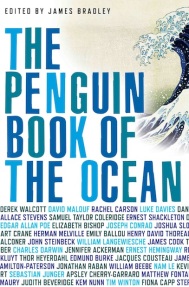
One of my enduring regrets about The Penguin Book of the Ocean is the fact I couldn’t find a way to include something of Rob’s, not just because he was one of the first two or three writers I thought of when I was planning the book, but because he’s a writer I’ve admired enormously for many years, and whose writing played an important part in inspiring me to become a writer in the first place. I’ve been meaning for some time to write something about the process of putting the anthology together, and the way my desire for it to work as a whole, rather than as a collection of pieces made a lot the decisions for me. But in the end I just couldn’t find a piece by him that spoke to the ocean in the way I needed it to (for a writer whose public image is so indelibly associated with the beach Drewe’s books are usually only interested in landscape in a fairly passing sense, and tend to focus much more on the illusions and betrayals of middle class life).

But I do wonder whether that sense of the differences between the bays and beaches of the east coast and the more denuded landscapes of the south and west coast isn’t one of the reasons Penguin decided to use Autio’s photos to illustrate their recent rerelease of Tim Winton’s coastal memoir, Land’s Edge.

Originally published in 1993, with photographs by Trish Ainslie and Roger Garwood, Land’s Edge is at one level an account of Winton’s enduring love of the ocean, and of the part it played in shaping him. But it’s also a sort of manifesto, a mapping out of the emotional and philosophical territory Winton’s fiction has explored over the years.

To my mind it’s an interesting, if slightly unsatisfying book. I’ve read it twice now, and both times I kept wanting Winton to go further, push harder, dig deeper. But that’s not to say it’s without its pleasures. Certainly it’s fascinating to see the way Winton’s experiences have been woven into the larger fabric of the work, and to be made aware of echoes and allusions between the books and the life which would not otherwise be apparent. It’s also interesting to be reminded how much deeper and darker Winton’s work has grown in the last two decades, and of the manner in which his command of language has kept pace with that deepening: word by word, sentence by sentence I’m not sure there’s any writer working in Australia  at the moment (except maybe Delia Falconer) who can match the raw power of Winton’s prose. Even its rough-hewn textures are deceptive, intimations of the steel beneath (in this context you might want to check out my review of Breath from a couple of years back) .

But in a way the real pleasure of this new edition is the book itself, and the use it makes of Autio’s photographs. Penguin have clearly gone to considerable expense to use excellent paper, and it shows, lending both the text and the images a richness and a clarity they might otherwise lack. It’s also convinced Winton to speak publicly, something he doesn’t often do (if you’re interested there’s a long interview with him by Stephen Romei in yesterday’s Australian, complemented by an audio recording of Winton reading from Land’s Edge). If you’d like a taste of the book I’ve reproduced several of the images in it below, and there’s an extract available on Penguin’s website. Likewise if you’d like to see more of Autio’s images you should visit Stills Gallery. Otherwise you can read my piece on summer at The Australian.
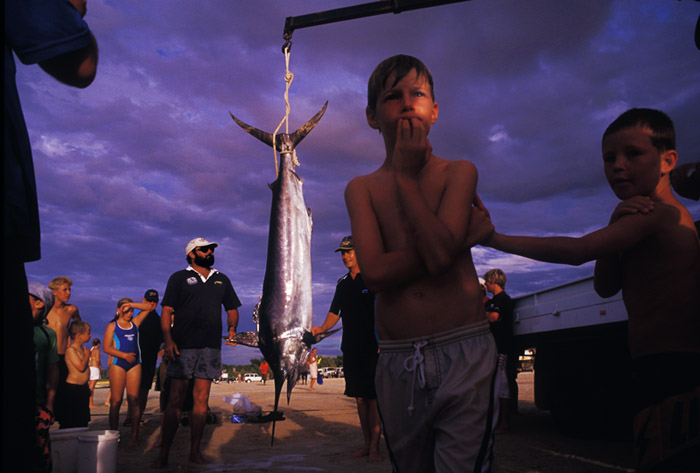
Narelle Autio, 'Black Marlin', © Narelle Autio 2001
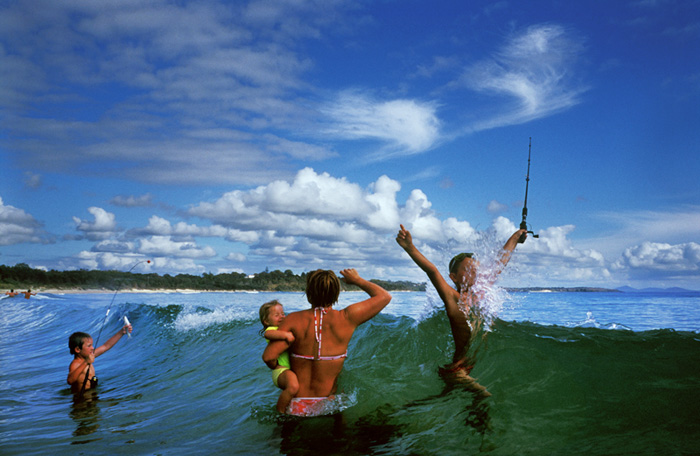
Narelle Autio, 'Before School', © Narelle Autio 2001
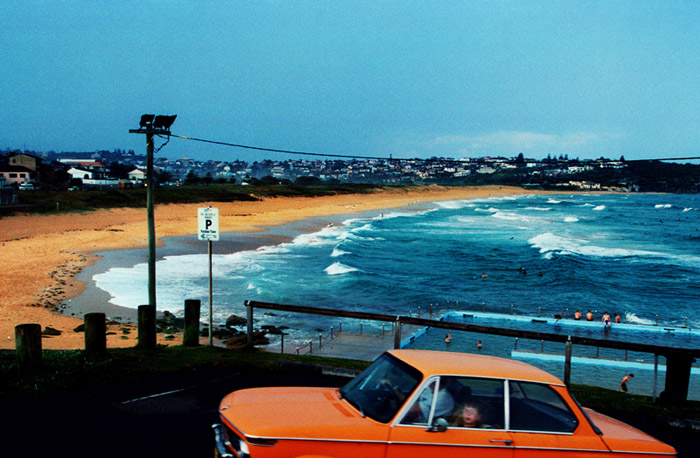
Narelle Autio, 'Orange Car', © Narelle Autio 2001
 

Wikileaks

As most of you will be aware, last night Julian Assange surrendered to police in London on sexual assault charges. Like many others I’m deeply perturbed by this development, especially given the pretty clear evidence the charges are weak at best and that the Swedish Government (which has been significantly embarrassed by the revelations in the latest round of document dumps) has interfered with the process underlying them.

For what it’s worth, my views about Wikileaks are complex. I’m not convinced total transparency is either practical or desirable. But by the same token confidentiality and control over the flow of information is one of the tools governments and other interests employ to control the public and manipulate public discourse and opinion.

All of which is a long-winded way of saying Wikileaks is an imperfect creation, but one of immense importance. It heralds a profound rewriting of the relationship between the individual and the state, the governed and the governing. By fatally undermining the capacity of the powerful to mislead the public it embodies precisely the values a free media – and by extension a free society – should aspire to.

This is not to say it’s perfect. Unlike the evidence of malfeasance and illegal action by governments around the world, I’m unconvinced much of the tattle in the diplomatic cables is valuable or newsworthy. But that’s not an argument against Wikileaks more generally: freedom of expression and a free media necessarily assumes ongoing debate about the limits of public interest, and commensurately, errors in judgement about those limits. A free media is by its nature a ragged and disputational creature.

Part of what makes Wikileaks genuinely revolutionary is its refusal to accept that there is a public interest beyond the right to know. By rejecting this notion they also reject the collusive relationship with power that undermines the effectiveness of so much media. This fundamentally alters many aspects of our public discourse, and will, over time, alter the very nature of society, both for the better and, I suspect, the worse. It is also, to my mind, an unsustainable and utopian ideal: the proper functioning of democratic society is incompatible with total transparency. But by redefining the limits of our right to know it creates a new standard to which free societies should aspire, and simultaneously provides a disruptive corollary to that freedom which will help safeguard it.

That our politicians have been slow to grasp the larger implications of Wikileaks is hardly surprising. I think it’s increasingly obvious we’re in a moment of historical transition, a transition which will be shaped both by forces beyond our control, such as climate change, and by the economic and social effects of new technology and global media. Neither our governments nor our political and social institutions are showing much sign of being up to either set of challenges, and our politicians are manifestly inadequate to both.

Here in Australia the response has been slipshod and cynical, demonstrating the worst aspects of the Labor Party’s increasingly reactionary and paternalistic mindset. Prime Minister Julia Gillard looked ridiculous last week parroting the American line that Assange was a criminal, and compounded the blunder yesterday with her assertion that the release of information was illegal because it relied upon an illegal act.

The exact seriousness of the threat to Assange is unclear, and will in the first instance depend upon whether British courts uphold an extradition order to return him to Sweden. What is clear is that a writer and journalist has been imprisoned on charges which are self-evidently connected to his work as a writer and journalist, and to his part in revealing evidence of illegal and unethical behaviour by the powerful. In such a context the obligation upon the Australian government, and indeed all people who claim to support freedom of expression and the free media is to protest as loudly and as vociferously as possible.

Having been involved  off and on with Sydney PEN Centre over the years, I’m painfully aware of the difficulty of embarrassing governments which abuse freedom of expression. But I’m also aware that protesting does help, and that despite its statements to date, the Australian Government and Prime Minister Gillard may yet see their way to do what is right by Assange.

To this end I was one of the more than 200 people who signed the open letter to Prime Minister Gillard by Jeff Sparrow and Lizzie O’Shea that was published on the ABC’s The Drum yesterday.

Open letters of this sort always seem to me to be oddly quixotic creations, more symbolic of the powerlessness of those who sign than any real influence. But this time I’m not so sure. As of a moment ago there were more than 4000 comments, and the response was overwhelmingly supportive. That’s not to say there aren’t detractors, but it’s difficult not to wonder whether Assange’s newfound celebrity will prove a lightning rod for the changes that are clearly beginning to take place. As the events of the last two and a bit years and from the GFC on in particular have demonstrated, the rules that have defined our world for the best part of half a century are breaking down, and the relationship between the public and those in authority is growing increasingly poisonous.

This isn’t always a good thing – certainly the crazed, reactionary convulsions of the Australian and American political landscapes in 2010 have not made our societies happier or suggested our politicians and media have any real idea about how to deal with what’s happening. But it’s also increasingly difficult to ignore the fact that the ground is shifting beneath our feet.

Having said all that I’d like to ask three things. The first is that you visit The Drum and read Jeff and Lizzie’s letter, which makes a series of unexceptional demands relating to Assange’s rights as an Australian citizen, and the obligations of the Australian Government to safeguard his liberty. As it indicates at the beginning, many of the signatories are not uncritical of the larger Wikileaks project, but the principles set out in the letter transcend those differences.

The second is that you take a few minutes to read some of the better commentary about Wiileaks. I’m going to suggest you begin with Assange’s own essays about authoritarianism, conspiracy and transparency. As anyone who reads them will be able to see, Assange is neither a terrorist nor a Cold War villain out of a James Bond movie, but a serious thinker with profound and revolutionary ideas about the relationship between the state and information. If the essays themselves seem too daunting I’d urge you to at the very least skim the analysis of their content on zunguzungu.

I’d also suggest reading three pieces by Guy Rundle, Bernard Keane and Clay Shirky, all of which offer interesting and provocative perspectives on the question (Rundle and Shirky in particular do useful work placing the events of recent weeks in historical context and trying to think through their larger implications).

You should also be sure you read Assange’s op-ed in this morning’s Australian, which was written in the hours before his arrest. Given The Australian’s behaviour and pronouncements during the Groggate and TwitDef scandals of recent weeks it may come as a surprise to many that it’s clearly placing its not inconsiderable weight behind Assange (though perhaps not as big a surprise as it may have been to many of its subscribers, who are no doubt choking on their cereal as I type). But I’m not sure it’s that surprising, not just because it’s a reminder of the The Australian’s more general mercurialness, but because as Assange himself points out, a belief in the importance of a free and unfettered media is one of News Limited’s fundamental principles (even if it’s not always demonstrated by their actions or drive for market dominance).

Finally, the third thing I’d like you to do is suggest things you’ve seen or read that add substantially to this debate. I’m sure the days and weeks to come will produce a torrent of coverage, and it’s be nice to aggregate – or indeed wiki – it here. So if you have links, bring them; I want to see them.


A blast from the past: me talking about The Resurrectionist

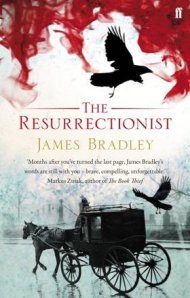
I was chatting about book trailers this morning and it reminded me of the video below, which was produced and directed by Steve Macdonald to coincide with The Resurrectionist’s inclusion as one of Richard and Judy’s Summer Reads in 2008. If you can get past the fact I look even more crumpled and feral than usual, my hair’s about a foot high and my stammer is particularly noticeable, it’s actually not too bad. And of course if you’re so excited after you’ve watched it you want to buy a copy, you can check out Booko for prices on the Australian and UK editions.


So you want to write a novel?

I’m still laughing.


The Tallest Man in the World

I’ve come a little late to The Tallest Man on Earth, but after being pointed to his second album, The Wild Hunt,  by my friend Hannah (literary agent to the (rock) stars), I’m now totally obsessed. As Tim Dunlop points out, Swedish singer/songwriter Kristian Masson’s vocals are Dylanesque, but hey, that’s not always a bad thing, especially when the songs are so beautifully crafted and full of life. Like the new Justin Townes Earle album, Harlem River Blues, this is music that understands its history but isn’t bound by it, and it’s wonderful.


Waves, the ocean and the sublime

Today’s Australian contains the last Australian Literary Review for 2010. A chunk of the issue is given over to a long piece by Michael Costa suggesting some solutions to the problems facing the ALP and a forum of prominent academics such as Glyn Davis, Peter Doherty and Stephen Lincoln exploring the challenges and opportunities facing Australia and the world as we look forward to 2020.

But the issue also features a long piece by me about Susan Casey’s new book, The Wave: In Pursuit of the Ocean’s Greatest Furies. Some of you may know Casey as the author of The Devil’s Teeth, which explored the world of Great White Sharks and the researchers who study them, and while it’s largely shark-free, The Wave often reads like a sequel or counterpart to its predecessor, using the career of big wave surfer Laird Hamilton as the springboard for a much larger study of the science of waves and the gathering storm of climate change.

I won’t rehearse the arguments of the book here, except to say that it’s an intelligent, if sometimes slightly slick piece of work. I’ve subsequently learned there’s been something of a scandal about the fact Casey shared the proceeds from the book with Hamilton, a fact that lends her already over-eroticised and hagiographical descriptions of him a distinctly queasy edge. But as I say in the review, Casey writes brilliantly about the breaks themselves, and the larger picture the book paints of the effects of climate change on ocean turbulence and wave height is likely to be deeply disturbing to anybody who’s not familiar with the facts surrounding the changes taking place beneath the ocean’s surface (if this material is new to you you might want to take a moment to read this story from the ABC, and perhaps this piece by Elizabeth Kolbert as a primer).

Much of what I want to say is in the review itself, but there is one story in Casey’s book I desperately wanted to include but just couldn’t shoehorn in, and that concerns the wave that hit Alaska’s Lituya Bay in 1958. Situated midway between Vancouver and Anchorage, Lituya Bay is one of those rare places where the various factors that generate tsunamis converge, combining a narrow fjord and near vertical cliffs on three sides with a steeply rising bottom, large glaciers and seismic instability. First charted by La Perouse in 1786, it has a long history of sudden and violent wave activity.

But the wave that struck on 9 July 1958 dwarfs all other recorded waves. Triggered by an earthquake, the ocean sent a tsunami which reached 524m in height rolling through the bay and out to sea.

The notion of a wave more than half a kilometre high beggars belief. Yet it is not the most remarkable part of this story. That honour belongs to the fact that at the time of the tsunami several fishing boats were moored in the bay, and one of the captains, Howard Ulrich, survived by steering his boat up the face of the approaching wave.

You can read the review in full here.

Update: I thought these two videos, one of Laird Hamilton in action, the other of an unidentified surfer riding a very big wave might be of interest (thanks to Tim Dunlop for the reminder).