Skip to content

Vale Jay Bennett

jay_bennett_1243334340_crop_360x284Sad news yesterday about the death of the brilliant and multi-talented Jay Bennett. Most famous for co-writing and playing guitar on Wilco’s second, third and fourth albums, Summerteeth, Being Thereand Yankee Hotel Foxtrot, the latter part of Bennett’s career was often overshadowed by the circumstances surrounding the breakdown of his relationship with Wilco frontman, Jeff Tweedy and his subsequent dismissal from the band (a process documented in some detail in the documentary, I Am Trying to Break Your Heart.

Despite the ongoing acrimony between Bennett and Tweedy – most recently Bennett commenced proceedings against Tweedy for breach of contract (an action complemented by the incredibly sad claim that he was taking the action because he needed hip replacement surgery he could not afford) – in the years after leaving Wilco Bennett went on to record five critically acclaimed solo albums, and was apparently working on a sixth at the time of his death. And, their continuing success notwithstanding, it has been difficult not to feel his absence has robbed Wilco of the edginess that lent the pop wizardry of those earlier albums its brilliance.

Details about Bennett’s death are a little sketchy, but according to a statement issued by his friend and collaborator, Edward Burch, “Jay died in his sleep and an autopsy is being performed. The family is in mourning and is unavailable for comment at this time”. Tweedy also issued a statement, saying, “We are all deeply saddened by this tragedy. We will miss Jay as we remember him – as a truly unique and gifted human being and one who made welcome and significant contributions to the band’s songs and evolution. Our thoughts go out to his family and friends in this very difficult time”.

A couple of clips featuring Bennett from I Am Trying to Break Your Heart can be seen below, The New York Times and The Guardian both have obituaries, and in The Chicago Tribune Greg Kot has compiled a (very) brief guide to the best of Bennett’s work. Bennett’s delicate and beautiful fifth solo album, 2008’s Whatever Happened I Apologize, is also available as a free download from www.rockproper.com.

Break text

Break text

Break text

addthisTweet this

Health and Australian Society

I’m grateful to The New York Times’ Book Design Review for digging this wonderful cover from the 1970s out of Seven Hundred Penguins, the sequel to Penguin by Design: A Cover Story 1935-2005. What the Book Design Review misses is that the author of this magnificently liveried tome is actually Basil Hetzel, the discoverer of the link between iodine deficiency, goitre and cretinism, and one of the unsung heroes of human health, but I suppose they can’t be blamed too much for being mesmerized by the cover itself. After all, a hard-earned thirst needs a good cold beer . . .

Break text

health

Break text

addthisTweet this

The Guardian does The Wire

thewireseason4I’ve just discovered Steve Busfield at The Guardian has begun a week-by-week, season-by-season blog covering every episode of The Wire. It’s up to the final of Season One at the moment, but if you want to read them in sequence, or you’re afraid of spoilers, you might want to start at the beginning.

It’s interesting, in a way, to observe the afterlife of The Wire. Despite famously failing to rate during its initial run on television (a claim I always find a little hard to square with the rather obviously inflating budgets of successive seasons) it has gone on to enjoy cult status on DVD and via download, a process which has only added to its rather cliquey, elite appeal (it should come as no surprise that after being bounced around the graveyard shift by the repulsive Channel 9, the ABC has recently announced it will repeat the series from Season One later this year).

For my part I’ve always felt slightly conflicted about the show. For all that I admire its ambition, the sheer richness of the characters and the unflinching nature of its social observation (Season Four, which concentrates on the school system and the children within it is almost physically distressing), I’m troubled by the self-consciousness of that same ambition, the unreconstructed gender politics and the oddly conventional visual style.

But all that said, it’s a show which holds within it moments of brilliance. Who could forget Ziggy finally coming unstuck in Season Two, or Poot and Bodie disposing of Wallace on Stringer and Avon’s orders in Season One? Or the transformation of Prez? Or Bodie and Poot and their girlfriends running into Herc and Carver and their girlfriends outside the cinema? Or McNulty and Bunk’s wonderful “motherf**cker” crime scene reconstruction? Or Omar? Or Bubbles? Or indeed the chillingly hilarious cold open to Season Four, in which Snoop drops into Walmart to buy a nailgun:

break text

Break text

And I suppose while I’m here I can’t pass up the chance to give the motherf**cker scene one more airing:

Break text

Break text

addthisTweet this

Literary Prize gets it right?

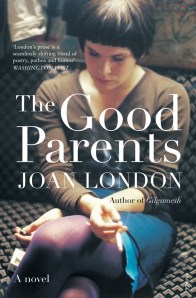
The Good ParentsI was delighted to see Joan London’s The Good Parents, win the Christina Stead Award for Fiction at last night’s NSW Premier’s Awards. I think like many people I’d been assuming the award would go to Tim Winton for Breath, so to see Joan win was an unexpected delight.

Literary awards in Australia don’t tend to do much for sales, but I do hope this one leads at least a few people to The Good Parents because it’s a wonderful novel. Like her last, Gilgamesh, it’s a deceptively subtle work, which is at once intelligent and immensely compassionate, and which, in its way, reminds me of Marilynne Robinson at her best.

If you’d like to know more the Arts NSW website has links to an extract from the novel and an interview with Joan. And in place of the dead link they provide to the Sydney Morning Herald review you might want to check out the review at The New York Times.

Break text

addthisTweet this

Revenge of the Doorstop

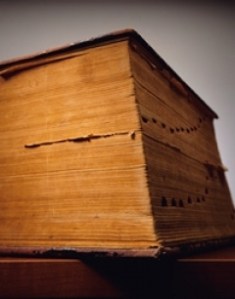
fatbookNow I don’t mean to carp, but what is it with 2009 and unreasonably fat books? It’s only May, and I’ve already had to wade my way through the 900-odd pages of 2666, the 1,000 (incredibly dense) pages of The Kindly Ones and the 600 or so of A.S. Byatt’s The Children’s Book. And this morning Hilary Mantel’s 600 page-plus Wolf Hall lands on my doorstep with an audible thud. Don’t these people have better things to do with their time?

Grrr.

Break text

addthisTweet this

Thunder Road

I’m not quite sure why, but for a month or so before I got sick, I’d been listening almost exclusively to Bruce Springsteen. For the most part it had been mid-period and newer material – The River, Tunnel of Love, and Magic – but then a post by Pavlov’s Cat made me pull out my copies of a pair of albums I loved when I was 19 or 20, Born to Run and The Wild, The Innocent and the E-Street Shuffle.

I know that on later albums Springsteen found a depth and a range he probably only dreamed about in those early years, but I’m not sure he ever found his way back to the sheer joy and exaltation of those first three albums, their delight in the world as they found it,. And listening to them again I’m reminded incredibly powerfully of what it was like to feel all that certainty and purity of feeling, and of the person I was when this music was my life.

Break text

Break text

addthisTweet this

Flu-like symptoms

fluIn my last post, a week and a half ago, I was banging on about how much I had planned for the next few weeks. A site rebuild, I airily promised, more links, high quality posting, and all soon. And then total silence fell.

Those who know me well will probably just shake their heads. But this time there’s a reason, and it wasn’t (sadly) that I’ve been busy crafting the first Ulysses of the digital age, it’s the rather more prosaic fact that I’ve been sick as a dog for the last week.

I’m not going to bore you all with the lurid details of my symptoms, but I did want to say sorry for the silence, and to say I’ll be posting again soon. And to apologize to all the people who’ve commented or sent me messages over the past ten days or so for my non-response, which was simply a function of being in no condition to even think about sitting up at a computer (or indeed sitting up at all a fair bit of the time). But I’m still here, and I hope things will be flowing again soon.

Break text

addthisTweet this

Depression, creativity and some more linkage

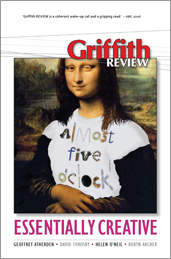
coming-soonI’ve not seen it yet, but the print edition of Saturday’s Age has an extract from my Griffith Review piece on depression and creativity. If it ever turns up online I’ll link to it, but in the meantime, just a reminder I’ve posted the complete, unedited version on this site, or you can download it as a pdf from the Griffith Review site. And please remember you can subscribe to Griffith Review by visiting their website, or purchase individual copies of Essentially Creative from Gleebooks, Readings or bricks and mortar bookshops everywhere.

Meanwhile, following on from Friday’s post about The Second Pass, I thought I’d link to another site I hadn’t seen until very recently, The Millions. A group blog with a very impressive list of regular and guest contributors, it offers intelligent – and substantial – commentary about books, arts and culture, and has recently offered a series of excellent articles about the future of book coverage.

That short piece about The Second Pass (and more particularly Genevieve, of Reeling and Writhing’s characteristically generous comment on it) reminded me that when I set this site up, one of my aims was to share links to articles and sites I thought were worth reading. That ambition rather fell by the wayside, largely because I found the tone of the site as it developed didn’t really suit a lot of linking and aggregation. I’m currently working on a major redesign which will allow me to aggregate links more effectively (a redesign which may also involve a name change, since I’ve rather taken against the name), but in the meantime, I though I’d offer a link to another site, and in particular a piece, I think everybody with an interest in the future of media should read, which is Clay Shirky’s ‘Thinking the Unthinkable’. It’s a month or so old now, but if you haven’t read it you should – it’s probably the most significant piece of writing the blogosphere has seen in the last twelve months.

And finally, my apologies if the content on the site has been a bit rackety recently. I’ve had a bit of a messy few weeks health and work-wise, so I’ve not really been on top of things (the WordPress system’s decision to eat my long post about the death of J.G. Ballard didn’t help either). But I’ve got good things planned for coming weeks, so stay tuned.

Break text

addthisTweet this

The Second Pass

435333026_9ef2d33964

Image by Richard Eriksson

A while back, I was musing about the future of the book review in an online world, and whether as the print forums for reviewing folded, we would see the rise of new, online forums. What I missed then was the launch of The Second Pass, a new and extremely impressive online book review which attempts to merge the best of the old with some of the new. As its editor, John Williams, explains in his Editor’s Note:

“There are many very good literary blogs out there (several of them can be found on our Links page). But most of these feature writing by one person (and perhaps an occasional guest), and, understandably, aren’t always updated daily, blogs being a full-time job for very few people. My occasional byline will be just one of many in the reviews sections: Circulating, which will review newly released titles; and The Backlist, which will focus on older, sometimes unfairly neglected books.

“The Blog will be updated several times every weekday. It will include, among other features, links to noteworthy reviews published elsewhere, great opening sentences, book covers both lovely and horrific, excerpts from books we admire, “anti-blurbs,” and roundups of what’s happening on other blogs.”

Meanwhile, for those of you after yet more writing about books, Critical Mass’ Rigoberto Gonzalez offers a list of eight blogs about books and writing he thinks are indispensable. Some, such as Maud Newton’s, are likely to be familiar, others, such as Ron Silliman’s, may be less so, but they’re all worth a look. And closer to home, Meanjin now has a blog.

Break text

addthistwitter-02

Bionic penguins

penguinsNew Scientist is reporting that German engineering firm, Festo, has unveiled a flock of bionic penguins at the Hanover Messe Trade Exhibition. Designed around a system of flexible glass fibre rods, which allow them to twist their heads like real penguins, and equipped with sonar and a limited form of autonomy, they can swim as gracefully as their biological counterparts. And there’s even a helium-filled flying version which “swims” through the air.

Go on – tell me the sight of bionic penguins coursing through the water doesn’t make you grin like an idiot as well.

Break text


Break text

addthistwitter-02

The future begins now: first Caprica reviews

capricaAlthough I’m still waiting for my copy to arrive, the first reviews of the DVD-release version of the Battlestar Galactica spin-off/prequel, Caprica, have begun to pop up around the traps.

Created by Ronald D. Moore and David Eick, the driving forces behind the revisioned Battlestar Galactica, Caprica looks like being a very different creature from its parent, even as it explores similar – and similarly troubling – territory. Set 60 years before the events of Battlestar Galactica, and starring the man with the charisma bypass, Eric Stoltz and Polly Walker, who lit up the screen as Rome’s scheming Atia, it focuses on the creation of the first Cylons (or the first non-Final Five, Earth that wasn’t Earth Cylons, but we won’t go there) and the lives of two families, the Greystones and the Adamas. Like the troubled Ian McShane vehicle, Kings (which has already been shifted to Saturday nights in the US, usually the prelude to a show being taken round the back and put out of its misery) it depicts a science fictional version of contemporary America, a place of almost unbridled wealth and decadence riven by religious extremism and the perils of technology. These are of course questions explored with great power and suggestiveness in Battlestar Galactica, but as the trailer below suggests, Caprica has ambitions to be more than a simple companion piece to its parent series, even as it draws on its aesthetic and mythology.

I’m sure more reviews will appear in coming days, but thus far the word is broadly positive, if not actually ecstatic. Wired’s Underwire gives it a 8 out of 10, suggesting it’s a little on the slow side but praising its intelligence and preparedness to tackle difficult issues. Wired‘s Geekdad is similarly positive, saying that while “it’s not the kind of action-packed, thrilling, anyone-really-could-die-at-any-moment kind of show Battlestar Galactica fans have been, well, fanatic about these past four seasons,” it is “a very good drama, with good science fiction thrown in”. Slashfilm goes further, saying it asks “some deep questions about the morality of creating artificial life,” adding that while “[i]t’s rare for a sci-fi show to attempt drama with very little action . . . it manages stay compelling without much reliance on ’splosions”. And io9’s resident smart cookie, Annalee Newitz, thinks it “works incredibly well, despite a few hiccups, helped along by some brilliant worldbuilding and terrific acting from stars Esai Morales and Eric Stoltz”.

Perhaps almost as interesting as the release itself is its nature. The version just released is not a pilot, but a special DVD-only movie release, complete with R-rating. And while the series itself is already in production, and is currently scheduled to screen in 2010, the version available now will not be seen on television. Instead the producers will reshape the television pilot (and presumably the series) on the basis of responses to the DVD version. Whether you see its release as a cynical cashing in on the gaping hole left in many fans’ lives by the end of Battlestar Galactica or an interesting use of the different delivery technologies is proably a matter of perspective.

Caprica is available from Amazon.

break text


Break text

addthistwitter-02

On Fairy Tales

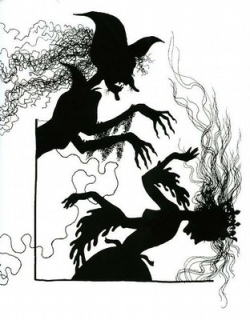
Jan Pienkowski, Sleeping Beauty, from Jan Pienkowski, Fairy Tales

Jan Pienkowski, Sleeping Beauty, from Jan Pienkowski, Fairy Tales

Hiding from Monday’s downpour in the Bondi Junction Westfield, I came across the new Puffin edition of Jan Pienkowski’s Fairy Tales in our local Borders. Originally published in the 1970s, it was a book I loved as a child, as much for its stunning illustrations as for its text. Taken with my discovery I bought it, and brought it home, thinking I could read it to my daughter when she is a bit older.

Clearly I didn’t do much of a job of hiding it, because last night she found it, and bringing it into the kitchen, demanded my partner, Mardi, read it to her. Because she’s not three yet we’ve generally shied away from reading her fairy stories, wary not just of their violence, but of the often complex ideas they involve. At first Mardi refused, telling her it was too long, and too complicated, but Annabelle insisted, and so Mardi sat down and read her ‘Snow White’. I was cooking dinner, so I could see Annabelle listening as the story unfolded, completely enthralled. Once or twice she asked questions, or pointed to a picture, but for the most part she was spellbound, despite the story running to more than 40 pages, and being filled with things she had never heard of, such as dwarves and spells, and kings and queens. And, once it was done, she asked for another, and then another.

Anyway, this morning before childcare I came into her room to find her seated on the floor with her teddy on her lap, and the book open in front of her. Turning the pages carefully she pointed to the pictures, explaining to teddy, ‘that’s a bad lady,’ and ‘that’s a dwarf,’ and ‘that’s a witch casting a spell’. And as she did I was struck anew by the thrilling power of old stories, of the way they seem somehow to be already there, somewhere deep inside of us, waiting only for us to call them back, into the light.

Update: This post reminded me of this piece, which I wrote in 2007 to coincide with the publication of Harry Potter and the Deathly Hallows:

The Lands Within

Break text

addthis

Meditations in an Emergency: Some thoughts about Mad Men

mad-menWith two series already in the can in the US and a third well into production, AMC’s multi-award winning Mad Men finally makes it to Australian free-to-air tonight. And, to celebrate, the hype machine has been running hard for several weeks (I hope regular visitors are taking note of my restraint in not going on about the pathetic and disrespectful attitude of Australian networks towards their viewers, but I feel like a broken record on that score).

The most recent – and substantial – addition to the promotional material filling the newspapers is a long piece by Clive James in The Australian Magazine (and which is, I suspect, a repurposing of a piece he wrote for the TLS a while back). Sadly it isn’t online, but if you can lay your hands on the hard copy it’s well worth a look.

James’ piece is constructed around two points. The first is a desire to deconstruct the sociologial significance of “quality” (or what I’d call the “new”) television in general, and Mad Men in particular. James rightly points to the manner in which these shows have been embraced by audiences traditionally averse to what they perceive as the downmarket pleasures of television (and particularly American television).

It’s a point that’s been made before but it’s a valid one (that said, please, please check out Stuff White People Like’s take on The Wire and Mad Men). As James rightly observes, at least part of the appeal of shows such as Mad Men and The Sopranos is the reassuring sense that they are written and produced with the cognoscenti in mind, a feeling that is only reinforced by the fact that much of their success has been driven by DVD sales, which in Australia and the UK at least, suggest one is seeking one’s pleasures away from the great unwashed.

I think it would be naive to think television networks didn’t factor these sorts of considerations into the structuring of their programming. But James wants to tie this argument to a second argument about Mad Men in particular, which is that there is something essentially dishonest about the show itself. Like a number of other commentators in the UK, perhaps most notably Mark Greif, he believes the show trades in a sort of inverted nostalgia, in which contemporary vanities are flattered by the show’s careful airbrushing of the past:

“The media world we live in now has generated mad men, and it’s a high end product, with a sure sense the smart audience would rather find it than be hit over the head with it. Even when they are hit over the head with it by an adroit international campaign of promotion they are still convinced that they are finding it all by themselves. But what they are finding is another illusion, though a remarkable nuanced and fascinating one. The illusion is of a past where even the smartest people weren’t quite as smart as us. There is much talk in the press about how the secret of the show’s appeal lies in nostalgia – nostalgia for a time when a man was a man, a woman shaped like an hourglass had no ambition but to stay home and cook, and everyone smoked like a train, with not thought of ever hitting the buffers. But the show does better than that. It doesn’t make the mistake of presenting life on the avenue as a fairground. Indeed it’s a prison, and young Peggy will have to fight her way out.

“But nobody will think their way out, and the awkward truth is that a lot of them, in reality, were already thinking. They just hadn’t figured out what to do next, mainly because they were involved in a paradox: it was the wealth they produced that would give them the freedom to question their lives. Stuck with the same paradox, we revel in the opportunity to look back and patronise the clever for not being quite clever enough to be living now.

Mad Men is a marketing campaign: what it sells is a sense of superiority, and it sells it brilliantly.”

While I suspect there’s something to be made of the markedly different responses the show elicits on opposite sides of the Atlantic, what’s interesting in James’ argument – and indeed in Greif’s – is the notion that Mad Men fails because it declines to do justice to the vigour and intelligence of the world it ostensibly inhabits. Both argue that its historical account of one of advertising’s most innovative periods is shortchanged by what James describes as its “lingering emphasis upon character”, a failing both also see as intrinsic to its appeal to elite tastes.

The problem with this analysis is that it fundamentally misunderstands the show. Mad Men is not a show about advertising any more than The Sopranos is a show about gangsters. One only has to watch the almost photo-realistic recreation of the fashion, architecture and even cinematography of the period to be reminded of the show’s fascination with surfaces, their ambiguity and, ultimately, their deceptiveness. Not for nothing, I suspect, does the show’s portrait of the 1960s often more closely resemble a film set of the period than the period itself. The stillness of the show, its refusal to spell out meanings, even its oddly static storylines all speak to its fascination with the mystery its characters’ inner lives offer not just to each other, but to themselves.

The mistake, it seems to me, is thinking that the drinking and smoking and sexual anxieties the show depicts in are its true point, when in fact the true point is the fragility of the world the characters inhabit. They might be the Masters of the Universe, but the universe they rule is one the viewer knows is about to be swept away. Not for nothing does the series move in fits and starts forward in time, jumping from 1960 in the first season to 1962 in the second, and on again in the third (this time to 1965 if reports from the set are to be believed) revealing each time the deepening cracks in the facade of the world it inhabits. Seen from this perspective there’s something of the memento mori in the way the characters live, oblivious of what lies just around the corner.

Indeed if the show is nostalgic at all, it’s nostalgic in a quite different way to the one James and Greif accuse it of being. Clive James may remember the early 1960s, but Mad Men’s creator, Matthew Weiner, who was born in 1965 does not, except in the way any of us who were born in the 1960s remember it, which is through the medium of our parents, and our memories of early childhood, childhoods that were lived against the backdrop of precisely the upheavals the action of Mad Men prefigures.

It’s usual, of course, to see the shadow of John Cheever and Richard Yates hanging over Mad Men, but I wonder whether it doesn’t owe more to novels such as Rick Moody’s The Ice Storm. For in some powerful sense it is less about what we see and more about what we know is coming, and about trying to make sense, from the vantage point of the children who grew up in its aftermath, of the dislocation and confusion the 1960s and 1970s engendered.

The children of the 1960s – X-ers – are often accused of being judgemental, even priggish. But whether we are or not, I don’t think there’s anything priggish about Mad Men, nor even what Mark Grief acidly describes as the “whiff of Doesn’t That Look Good” that lies beneath the “Now We Know Better”. Instead there is a ruefulness, a sense of loss. As we watch the world begin to come apart at the seams, we cannot help but anticipate the damage these characters will do to one another in the years to come.

Admittedly this is less evident in the early episodes, which are rather too insistent in their foregrounding of the sexual politics (it’s actually the racial politics, which are largely unspoken, which are more disturbing, presumably precisely because they are pointed out to us less deliberately), and in the constant drinking and smoking. But it is very obvious by the final episodes of the second season, in which Don vanishes to California, and into a sort of Paul Bowlesian fantasy of freedom, and in the deeply uncertain tone of the season’s wonderful finale, ‘Meditations in an Emergency’, which plays out against the backdrop of the Cuban Missile Crisis.

Mad Men begins Thursday 16 April at 8:30pm on SBS.

Break text

addthis

Grieving for Dummies

I kid you not . . .

Break text

dummiesBreak text

addthis

On depression and creativity

Griffith ReviewI’ve just realized the full text of my essay about depression and creativity, ‘Never real and always true’ is available for download on the Griffith Review site. Unfortunately it’s only in pdf format, so I’ve taken the liberty of cutting and pasting the text onto this site. And remember you can subscribe to Griffith Review by visiting their website, or purchase individual copies of Essentially Creative online from Gleebooks, Readings or bricks and mortar bookshops everywhere.

‘Never real and always true: on depression and creativity’

Break text

Break text

Break text

addthis