Skip to content

Is climate change denialism the new Hansonism?
Like everybody else in Australia I’ve spent the last couple of weeks mesmerised by the spectacle of the Liberal Party coming unravelled over the question of their position on the Rudd Government’s Carbon Pollution Reduction Scheme and climate change more generally. Watching open warfare break out between what the media politely describe as the conservatives (I suspect reactionaries is probably closer to the truth, but perhaps a little inflammatory for the broadsheets to use on a daily basis) and the moderates I’m reminded of an interview I heard with The Sydney Morning Herald’s Political Editor, Peter Hartcher at the time of Turnbull’s elevation to the leadership, in which he was asked whether he thought Turnbull was ready to lead the Liberal Party. To his credit Hartcher just laughed. ‘I think the real question is whether the Liberal Party is ready for Malcolm Turnbull’.

Aside from the fact somebody’s usually done something totally insane by lunchtime (and yes, Tony Abbott, I’m looking at you) one of the really fascinating things about the whole schemozzle is the way it’s highlighted just how entrenched climate change denialism is in the ranks of the Liberal Party.

Now I’d be the last to claim the views of our elected representatives are particularly representative of the views of the community at large. On a range of issues, from religion to abortion and euthanasia, they are, for the most part, markedly more conservative than most Australians. And if the polling is to be believed, they’re similarly out of step on climate change, as polls such as this one in today’s Sydney Morning Herald showing two thirds of Australians support the ETS, demonstrate.

But on the question of climate change I suspect they’re providing a useful reminder that despite the increasing acceptance in the community at large that climate change is happening, and fast, there is a small and entrenched minority who reject the science.

What’s interesting to me is the distribution of these beliefs across the community. A few weeks ago Roy Morgan released some polling data about the question, which Crikey’s Possum has offered some useful commentary on. Several things stand out in the Morgan data. First, belief in climate change and the need for action divides pretty cleanly across party, gender and demographic lines. Labor and Green voters are much more concerned than Liberal voters, women are more concerned than men, and people in the capital cities are more concerned than those in regional and rural areas. Second, and more worryingly, these positions are hardening and polarising: there has been a small increase in the number of people who disapprove of the CPRS in the last few months, and these new initiates into the ranks of the climate change denialists are mostly Liberal-voting men from outside the capital cities (I appreciate disapproval of the CPRS and climate change denialism are not precisely the same thing, but I think we can assume the two are closely connected in this context).

These are, of course, precisely the same people who were the backbone of One Nation a decade ago. Older white men from outside the capital cities.

One of the things I remember most keenly about the rise of Pauline Hanson was the way it blindsided conventional public opinion. For middle-class elites it seemed to come out of nowhere, a furious, incoherent cry of unreason which deliberately rejected the foundations of their world view in favour of views which seemed to inhabit a netherworld somewhere between the laughable and the poisonous.

I suspect the rising tide of climate change denialism is catching middle-class elites off-guard in exactly the same way. That Andrew Bolt’s blog is a haven for denialist maddies is no secret, but I’d suggest anyone who thinks there’s broad-based support for action on climate change spend some time trawling the comment strings on The Daily Telegraph or The Punch, or maybe tune into 2GB for an hour or two.

Of course I’m well aware that an awful lot of what passes for commentary on news sites is the work of formal and semi-formal political operatives. But the sheer ferocity of the comments about Turnbull and Rudd, and the persistent suggestion that the science of climate change is a lunatic conspiracy, and the CPRS some kind of plot to destroy (white) Australia is pretty striking. More broadly, climate change denialism exhibits many of the same characteristics that made Hansonism so potent: the rejection of evidence-based policy, suspicion of expert opinion, dislike of what was seen as the preaching of the self-appointed guardians of public morality. And, judging by the polls on different news sites, it’s catching elite opinion off-guard in exactly the same way Hansonism did: earlier today I compared two polls about the Liberal leadership: The Sydney Morning Herald was registering close to 70% support for Malcolm Turnbull, while support for Turnbull over at The Daily Telegraph was running at about 31%.

All of which suggests there is something fundamental happening out on the fringes of public debate. It may not have a name yet, or a figurehead, but it’s not too much of a stretch to see the beginnings of a larger political movement, grounded in climate change denialism and resonating with older anxieties about immigration, refugees and Aborigines (for what it’s worth I don’t think it’s a coincidence we’ve seen an uptick in anti-immigration sentiment in recent months, or that portions of the Liberal Party are running so hard on refugees again).

There are some important differences between Hansonism and the new movement, not least the fact that whatever else it was, Hansonism was, in a very real sense, a grass roots movement, while climate change denialism has been assiduously fostered by powerful interests with a lot at stake (if you’re interested in tracing the role of big business in stalling action on climate change and discrediting the science I thoroughly recommend you check out the relevant chapter in George Monbiot’s Heat). And unlike Hansonism, the ranks of the climate change denialists are swollen by a solid cohort of wealthy older men. But I suspect that in some deep sense climate change denialism is drawing on the same discontent that Hansonism drew upon, and that despite the now-overwhelming scientific evidence, in the months and years to come it may well begin to gain ground in much the way Hansonism did a decade ago.

Break text

I’m baaaack . . .

My apologies if things have been a bit quiet around here. As I said a couple of weeks ago, I’ve had a few things on (moving house, new baby etc etc) so my posting’s been a bit curtailed by more immediate demands. But since we’re now in the new house and the baby’s born I’m going to tempt fate by declaring the worst of the interruptions are over and I’m ready to resume normal transmission. I’m also prepared to tempt fate by saying I’m planning to post a bit more regularly than I was in the lead-up to the recent hiatus, but time will tell whether that’s an idle boast or not. Either way, it’s nice to be back online, and I’ll have my first posts up soon.

Break text

Paul Nicklen’s Polar Obsessions

A while back I linked to an amazing series of images of sailfish rounding up baitfish by National Geographic photographer Paul Nicklen. To commemorate the publication of Nicklen’s new book, Polar Obsession, National Geographic have now released an amazing video montage of his encounter with a leopard seal, an encounter that begins with the seal taking the camera and Nicklen’s hand in its mouth. It’s an amazing sequence, and the images are just breathtaking. If you’d like to see more of Nicklen’s work you can check out his website, which has a beautiful array of images (though it must be said the fact that they’re all watermarked to within an inch of their life does detract a bit from the viewing experience) or you can check out a selection of images from Polar Obsession on The Huffington Post (and vote for your favourite).
And while we’re on the subject of nature photography, the wonderful Wayne Levin (who I’ve also mentioned before) has just added a lot of new work to his website as part of the lead up to the release of not just one, but two new books next year. Most of the images are black and white underwater shots of the subjects he’s long been fascinated with (bodysurfers, marine animals) but a number were taken on a recent trip to the remote Papahanaumokuakea Marine National Monument as part of a scientific expedition by staff of the US National Oceanic and Atmospheric Administration, and represent a bit of a departure for Levin, not least because some of them aren’t only above water, they’re actually in colour.

Break text

Break text

Running Silent

Mars

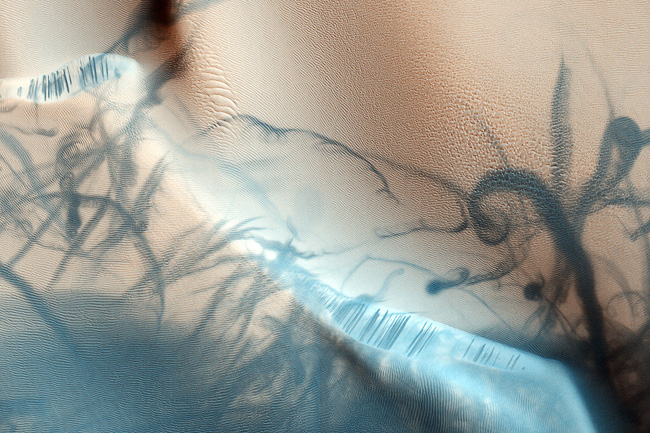
The trails of dust devils on the Martian surface

Just a quick note to say sorry things have been a bit quiet around here, and to apologise in advance for the fact it’s likely to stay that way for another couple of weeks. If it’s any excuse I’m in the midst of something of a perfect storm of work and personal commitments (we moved house last Monday, and my partner is about to give birth to our second child in the next couple of days. And I’m still working at the Uni and have a book to finish, as well as all my normal freelance work, so it really is all a bit silly at present). But with a bit of luck I’ll get a few things up in the next little bit and then get back to posting properly in December.

In the meantime I’ll offer you three little tidbits from the last week. The first is the fact that while I was listening to a lecture about Flannery O’Connor the other day I realized that since she was only 39 when she died in 1964, she’d only be 84 if she were still alive today, which is not that much older than Philip Roth (76), Cormac McCarthy (76), Shirley Hazzard (78) or David Malouf (75) all of whom are not just alive but at the peak of their powers. So if O’Connor hadn’t died young there’s a good chance she’d still be writing, and even if she wasn’t she would have been until very recently. Which is strange, at least to me, since in my mind she’s very much a writer of the mid-20th century, and not the 21st.

The second is this broadcast about intelligent bacteria from the ABC’s All in the Mind program, which is very definitely worth a listen. I’ve long been aware of evidence that colonies of bacteria seem to possess organizational abilities beyond what we’d expect of individual bacteria, but I had never run across the suggestion that they themselves might be intelligent, either collectively or individually, so the talk of nanobrains in the program was exciting stuff. Want a refocussing of your perspective on the place of humans in the universe? I reckon this might be a place to start.

And finally there’s this rather magnificent gallery of images of the Martian surface. You can see black basalt sanddunes, organically curling dust devil tracks and the tracks of the Rovers, and while I’m a bit of a Mars tragic, it’s wonderful, almost painfully beautiful stuff. If you want to see more you might want to check out The University of Arizona at Tucson’s High Resolution Imaging Science Experiment.

Break text

addthisTweet this

A birdless world

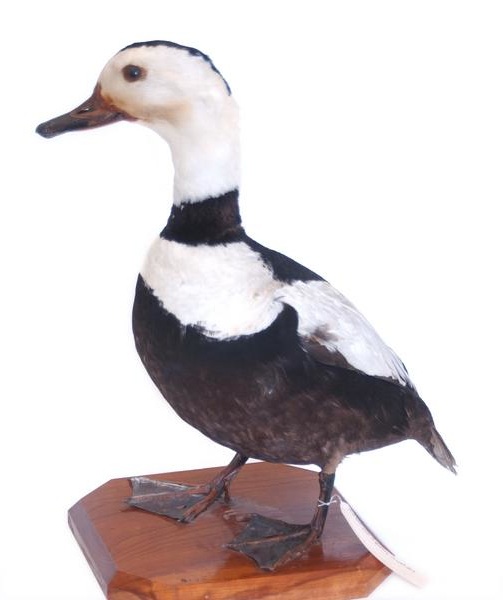
Labrador Duck

Labrador Duck, Museum of Zoology, University of Michigan, © Phil Myers

A couple of weeks ago I reviewed Glen Chilton’s new book about his quest to see every known specimen of the extinct Labrador Duck, The Curse of the Labrador Duck, for The Sydney Morning Herald. It’s an pleasingly oddball little book, and while I don’t think Chilton is interested enough in exploring the larger issues his story raises, there’s something incredibly sad about the spectacle of Chilton making his way from museum to museum to inspect the often misidentified skins and eggs that are all that remain of the species.

But the detail from the book that’s stayed with me is an aside in the middle about the fact that even when kept in perfect conditions in museums stuffed birds last about 500 years. Put them out on display, expose them to daylight and changes in temperature and they perish even more quickly. All of which means that once a species is gone, it’s not just the living bird that’s gone, but, in reasonably short order, all physical trace of them.

Obviously there’s an anthropocentrism at work here, an assumption that somehow our knowledge of a species has larger meaning, but in this context I don’t think it’s wholly misplaced. After all, most of the species that have vanished in the last few centuries, and certainly almost all of the thousands more that are likely to vanish in the near future have been wiped out by humans. But speaking as someone who’s been woken at 4:30am every morning for the last week by the primal whoops and screams of Koels, Black Cockatoos and Channel-Billed Cuckoos, it also seems difficult to reconcile the silence of vanished birds with their raucous, vital presence, or to avoid the feeling a world without them would be a much smaller, and less joyous place.

Break text

addthisTweet this

Parrot and Olivier in America

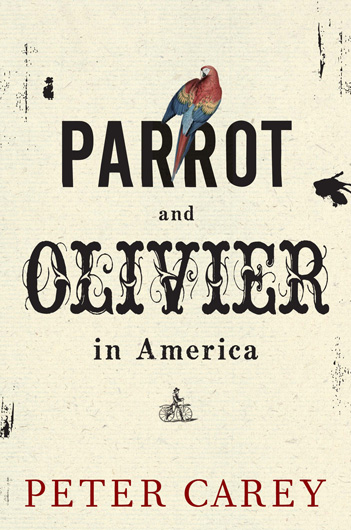
parrot-olivier-ausJust a quick note to say my review of Peter Carey’s new novel, Parrot and Olivier in America, is available on The Australian’s website.

It’s been interesting speaking to people who’ve read the piece, not least because it’s difficult to escape the feeling Carey’s burned through some of his goodwill in recent years. The reasons for that seem to be complex – certainly there’s a view the last few books have been a bit patchy – but I also suspect changing literary fashion has left his brand of big, rough-hewn post-modernity looking a little awkward in the contemporary landscape (I’d say something similar about Doctorow and Rushdie, though I have to say I think Carey’s streets ahead of either of them). Of course that’s always a problem for writers as distinctive as Carey, but I do hope it won’t stop readers seeking out this new one, not least because it’s his best book in years, and definitely up there with early masterpieces like Illywhacker. Nor am I alone in this judgement: in Saturday’s Sydney Morning Herald Andrew Reimer calls it a tour de force (not online), and Jennifer Byrne says something similar in Saturday’s Age.

And if you’re interested in reading more about Carey you might like to check out this piece I wrote for Meanjin a while back. It’s a bit long in the tooth these days but it’s got some good moments.

Break text

addthisTweet this

Work in progress

work-in-progressThe other day I mentioned a couple of events I was speaking at, one at Gertrude and Alice Bookshop in Bondi, the other at the National Library of Australia. At the time it slipped my mind that I’m also reading as part of the UTS Centre for New Writing’s Work in Progress event, next Wednesday 4 November at 6:00pm.

It’s should be a fun evening, not least because it’s deliberately designed as a showcase for unpublished work by established writers, and will feature Frank Moorhouse reading from his new novel, as well as readings by John Dale, Delia Falconer, Anthony Macris, Mandy Sayer, Gabrielle Carey, Martin Harrison, and others. In keeping with the spirit of the event I’m planning to give my new novel, Black Friday (which I was talking about here a week or two ago) its first airing.

Event details:

Date: Wednesday 4 Nov 2009, 6:00 PM – 8:00 PM
Location: The Loft, Broadway Campus, The University of Technology, Sydney
Contact: John.Dale@uts.edu.au
Admission: Free

Break text

addthisTweet this

Hang the DJ goes to America

To celebrate the US release of his delightfully idiosyncratic book of music lists, Hang the DJ, Angus Cargill is pulling together a series of songs and clips featuring some of his favourite American music. Today’s offering is ‘Roll on Arte’, by the incomparable Felice Brothers, and I’m sure tomorrow’s will be of an equal calibre, so if you’d like a tour of some bands and music you may not have heard before (and most definitely should) it might be worth keeping an eye on his site over the next week or two.

And if you haven’t got a copy of the book, track one down. It’s a wonderfully peculiar compilation of rants and raves about music from writers like DBC Pierre, Rick Moody and Ali Smith, and it’s not just a fascinating window into the musical likes and dislikes of a truly eclectic bunch of writers, it’s a lot of fun.

Break text

Break text

addthisTweet this

The death of the letter

Penny Black-1On Friday a journalist friend rang looking for some comments about the death of the letter. The story grew out of reports of a sharp decline in the use of snail mail, and having already spoken to historian Les Carlyon and linguist Sue Butler, both of whom had made the usual noises about the loss of a form which has allowed us to communicate complex thought and emotion for many generations, he wanted a literary perspective on the question.

Before I go any further I should say that I agree, at least generally, with the remarks by Carlyon and Butler which are quoted in the article. The letter is a remarkable form, not just because of its capacity to record the feelings and impressions of the moment for posterity, but because it is a form that has always been as much about a process of self-creation and exploration as communication.

In a way that shouldn’t be surprising. The act of writing isn’t simply about putting thoughts down on paper, it’s about a process of thought. And, as a result, the process of writing a letter allows us to explore thoughts and ideas we might not be able to express or even access in everyday life. Indeed in a very real sense, writing letters is less about communication than the creation of a self through the act of writing. Usually these selves are freer, smarter, sometimes they’re something like our best self, more often they’re versions of our everyday self which only find their true expression on the page. It’s a process you see at work in the correspondence of writers such as Philip Larkin or Flaubert, both of whom were capable of being scatological and filthy with one friend, and considered and thoughtful with another. Or in the epistolary relationship between Robert Lowell and Elizabeth Bishop, a relationship in which both revealed aspects of themselves they concealed from everyone else.

But the thing that struck me while I was talking to my friend on Friday, was that despite the passing of the letter, these are exactly the same processes one sees at work when people blog, or tweet, or even update their Facebook statuses. In all cases they’re projecting versions of themselves outwards, and in so doing engaging in the same processes of self-invention that once went on in correspondence. The only real difference is that they’re doing it in public, or at least semi-public.

Obviously there’s nothing particularly radical about observing that technology is altering our notions of identity. But it does suggest that the usual anxieties provoked by the passing of cultural forms and institutions are at least partly misplaced in this context.

More importantly though, it’s a reminder that the transition from the written letter to email isn’t simply a story about changing technology. It’s part of a much larger story about the way technology is redefining the boundaries between our public and private selves. It’s not a neutral process by any means, and its effects can be seen in the increasing anxiety about the management of confidential information, in the arguments about the use (and abuse) of surveillance technologies, and even in the rise of celebrity culture. But it’s also a story that’s as much about possibility as decline, something which can be obscured when one concentrates on only one aspect of the story.

Break text

addthisTweet this

I could hear the angels whispering . . .

Ever been struck by how closely the textures of the stranger end of folklore resemble the textures of schizophrenia? Because I can’t listen to this track without feeling like I’m hearing a song about someone lost in the netherworld of madness.

Break text

Break text

addthisTweet this

Whale Sharks

I’ve just noticed my piece from September’s Monthly about diving with whale sharks at Ningaloo is now available online. You can read it (and a pretty impressive selection of other pieces from the magazine) here.

Break text

addthisTweet this

Little Lolita’s adventures in the irony-free zone

LolitaI’m sure many of you will have seen this story about Asinine Australia Post’s decision to remove the Popular Penguin editions of Lolita, The Delta of Venus and The History of Sexuality from display. If it wasn’t so pathetic and stupid it’d be funny (not least because, as Godard’s Letterboxes has pointed out on her Twitterfeed, there’s an irony in the notion of repressing a book about sexual repression which seems to have gone straight over the heads of Australia Post’s public affairs people).

Anyone who’s heard me on the subject will know I can bang on endlessly about the lunacy of the contemporary nanny state, so rather than bore you all with more blog-rage, I thought I’d revisit another piece of marketing hilarity concerning Nabokov’s masterpiece. This was last year’s revelation that Woolworths in the UK were selling a range of bedroom furniture aimed at young girls called “Lolita”, and featuring a bed called the “Lolita Midsleeper Combi”.

A special bed? And a Combi at that? Oh Lolita, light of my life, fire of my loins. What exalted heaven is this?

Apparently Woolworths “had no idea” about the connotations of the name.

If you didn’t laugh, you’d cry.

Break text

addthisTweet this

Girls, Girls, Girls . . .

These guys are the business. And their debut, Album, is a gem.

Break text

Break text

(Thanks to Geordie Williamson for the recommendation).

Break text

addthisTweet this

On novels and place

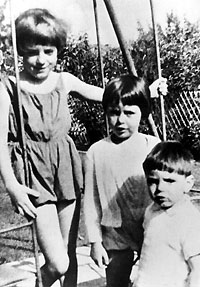
beaumont_kids,0

The Beaumont Children, who disappeared in Glenelg on Australia Day, 1966.

If this blog’s been looking a bit neglected lately, it’s because I’ve been frantically trying to knock over a first draft of my new novel. I had been hoping to have a draft done by the time our second child is born in November, and while I suspect that goal has now slipped away from me, I’m at least halfway there, so I think there’s a good chance I’ll have something by Christmas.

Writing first drafts is always a weird process. A lot of writers are planners, but I’m not, or not particularly. I’ve usually got a rough idea of the shape of the book, and at least a few key scenes, but I usually don’t have a terribly clear sense of how those pieces stick together, or what order they happen in. So mostly what I’m doing when I write first drafts is looking for the rhythm, and the energy. Sometimes that can be exhilarating, but mostly it’s a matter of feeling my way forward, looking for the moments when the thing chimes into life.

I’m still not quite sure what I think of this one (which is currently called Black Friday, though that may change). If you’d asked me a few weeks ago I would have said I wasn’t sure if it would work, but in the last fortnight or so I’ve become a lot more confident it will. Partly that’s because I’ve slid past the halfway mark, but mostly it’s because I can feel the characters beginning to live, and breathe, and the narrative beginning to develop the forward energy it needs.

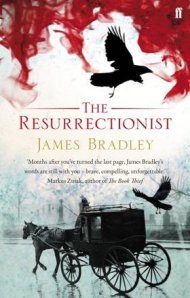
That’s not to say all’s right with it. I’ve got a point of view problem that won’t go away, and the plotting of the section I’ve just finished is a shambles. And it’s precisely the sort of dark, disordered book I promised myself I wouldn’t write after the experience of writing The Resurrectionist. And my central character is pretty spectacularly unpleasant (as is the subject matter), but she also feels scarily real to me, which has to be a good thing.

What’s been strangest though, has been the manner in which the setting of the book has come bubbling out of me. Although it begins in the present day, the bulk of the action tales place in the early 1980s, and focuses on the actions of a small group of political radicals who decide to kill the Prime Minister. These characters come from a variety of backgrounds, but one of them – the central character – grew up in Adelaide, and there’s an extended sequence near the beginning depicting her absorption into the alternative demi-monde of the time in the backlots of Glenelg.

Although the scenes in question take place in 1980, and I didn’t finish school until 1984, the world this section takes place in is absolutely one I remember. The characters go to school at the school I went to (though it’s not named) and though they live a couple of suburbs further north along the coast, most of the action takes place in Glenelg, where I grew up (I’ve actually based the share-house she becomes entangled in on the house an old friend’s mother bought not long after we finished school).

In a way it’s unsurprising that the book has such a definite location. All three of the novels I’ve published so far are powerfully anchored in the places they’re set. Given that two of them – The Resurrectionist and The Deep Field – are set in places which don’t actually exist (the London of the 1820s and the Sydney of the future, respectively) that might seem an odd thing to say, but it’s true. Whenever I write about a place I need to feel I have a connection with it in an emotional sense, and to feel it’s an integral part of the larger symbolic and textural landscape of the novel. And so while the places they describe may not be real, in a literal sense, they need to be real to me, and to resonate with the book as a whole.

The curious thing is that I never had any desire to write about Adelaide. I left the best part of 20 years ago, and though when I visit it still seems almost overwhelmingly familiar, it’s been a long, long time since it felt like home. And although the South Australian landscape I grew up in has found its way into my work from time to time (the sandhills on the southern coast of New South Wales in which much of the action of Wrack takes place are imaginary versions of the Coorong, and the sandhills at West Beach, rather than anywhere you’d find on a map) I’ve not just not written about the place I grew up in, but actively not wanted to write about it.

In a way, of course, all I’m saying here is something I think any writer, and most readers understand, at least intuitively, which is that place, or location in fiction is never physical, or at least not in any simple sense. Place is always really a psychological space, a thing evoked through the layering of detail, and emotion. And like the strange, almost mystical capacity of characters to be conjured into life by a few words of dialogue or description (not for nothing, I think, do Christians understand God’s Word as a living thing; language has a primal and often quite unsettling power to take on life of its own) places are brought to life by the suggestion of great strata of meaning layered beneath the details we use to evoke them.

I’m not sure precisely what led me back to Adelaide, and the world I knew as an adolescent. What I do know is that it’s a process that began when I was struggling to finish The Resurrectionist. One of the inspirations for that book was the Snowtown murders, and having heard me talk about them, and about Adelaide and its history of serial murder more generally, my agent, David Miller, convinced me I should write about them, and about what seemed to me the very particular experience of growing up in Adelaide in the 1980s.

I still think the piece that came out of that conversation, ‘The Element of Need’, is one of the better things I’ve written in recent years. For contractual reasons there was a lag between me writing it and it being published, but a version was published in Heat last year (you can read a brief extract on the Giramondo website) and it’s recently been picked up for inclusion in Best Australian Essays 2009.

But good or not, writing the piece seemed to unlock something inside me. For a time I toyed with expanding it into a full length book, but for various reasons to do with my reluctance to spend too long in the headspace it inhabits that didn’t happen (though it still might). But alongside the book I didn’t write I found myself playing around with stories and novels which used the landscapes of my childhood and adolescence in quite direct ways. And although few, if any, of these are ever likely to find their way into print, the thing I kept running up against was the manner in which the landscapes they inhabit are so vivid and so particular.

I always think it’s dangerous to assume you know why you find yourself writing about particular things (and I’m painfully aware that even when you think you do know you’re often wrong, and the real reasons are hidden from you). But I do wonder whether this process of moving back, into the past, isn’t at least partly to do with growing older. My father is 76, and he routinely says his childhood, which he once barely remembered, is now almost frighteningly vivid. And while he’s got three and a half decades on me, the last few years have been pretty tumultuous. I’ve turned 40, become a father, felt the always unstable cycle of my moods spin frighteningly out of control, felt the only thing I ever wanted to do – writing – leave me, and then, tentatively at first, but then with greater certainty, return, all experiences which have left me painfully aware of the fragility of life, and of our vulnerability to its vicissitudes.

Yet at the same time the spaces I’m exploring are not simply memory. Despite various disruptions I had a pretty happy childhood. But the landscapes of the writing that draws on it are alienated and often downright creepy, populated by people with important parts of themselves missing. This is partly to do with my sense that there is something haunted and even sinister about Adelaide, some sense in which the outward peacefulness and order disguises something cruel and brutal. But I’m also aware that this view is itself coloured by my own fairly uncomfortable relationship with the place, and the person I was when I lived there.

I’m not sure this is terribly surprising. Like a lot of people who have left places I’ve allowed Adelaide to stand in for my past, and going back is always a pretty uncomfortable experience. But it’s also a reminder of the way fiction takes elements of our inner lives and gives them shape. For the Adelaide (and more particularly the Glenelg) I’m writing about in my new book isn’t a real one, in any literal sense, but an expression of whatever it is in me that has drawn me back there. I’m not going to try and unpack that part of me here – that’s what the novel’s for – but it is a reminder of the dangers of assuming fiction is, in ever, in any narrow sense, autobiographical, and simultaneously an illustration of Faulkner’s dictum: “The past is not dead. It is not even past”.

Break text

addthisTweet this

Gertrude, Alice and the Flight of the Mind

balloonsIn case you’re at a loose end over the next couple of weeks, I’m doing two events. The first is a literary breakfast this Friday (16 October) at Gertrude and Alice Bookstore here in Bondi Beach. Tickets are $12, and bookings can be made by emailing info@gertrudeandalice.com.au or by phone on 02 9130 5155. I’m going to be talking about my most recent novel, The Resurrectionist (all that darkness and death seem so appropriate for breakfast in Bondi, after all).

And the weekend after next (24-25 October) I’m one of a very impressive line-up of writers appearing at the National Library of Australia’s Flight of the Mind Conference in Canberra. Held over two days, the Conference is designed to explore a range of questions about creativity and the writing imagination, and speakers include Alex Miller, Peter Goldsworthy and Sophie Cunningham. I’m speaking on Sunday morning at 10:00am, and given what a big part of my life this site’s become over the last year, I’m planning to speak about the way technology is altering both what and how we write. The full Conference program is available here, and bookings can be made by emailing events@nla.gov.au or calling 02 6262 1122.

Break text

addthisTweet this