Skip to content

Posts from the ‘Writing’ Category

James Wood on The Book Show

James Wood

James Wood

Further to my post earlier this week about James Wood, the ABC’s Book Show ran this interview with him this morning. In it Wood talks about How Fiction Works (often sticking pretty closely to the text of the book itself) but that’s not so much a problem as a reason for listening, since in so doing he offers a reminder of exactly the breadth and attentiveness that so distinguish his writing.

Anyone after more information about Wood could do worse than checking out the links on his Wikipedia page.

Break text

addthis

Never real and always true

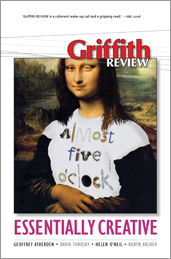
edition_imagephpI’ve got a piece about depression and creativity in the latest Griffith Review, Essentially Creative. The piece explores the links between mood disorders and creativity, and asks what we’re losing when we define behaviours intimately connected with creativity as disorders. It’s also a very personal piece, and one I found quite confronting to write.

As I say in the article:

I am not sure that if, fifteen or twenty years ago when I began writing, I was asked whether it was connected with my troubled moods, I would have seen the connection. Yet, looking back, it seems obvious. I came to writing almost by mistake, stumbling on it in my final year at university. At first I wrote poetry, partly as a way of sublimating desire, partly because it seemed to offer the most immediate vehicle for the feelings and experiences I sought to explore. Later, when I began to write fiction, my motivations were more complex, but the writing remained grounded in these same feelings and experiences.
But these feelings and experiences, and more particularly their intensity and what seemed to me their singularity, were inextricably bound up with the cyclic episodes of sadness and irrationality that have afflicted me since I was twelve.

Unfortunately the piece isn’t available online, but you can buy Essentially Creative from Readings or Gleebooks, as well as in any decent bricks and mortar bookshop. Or you can subscribe to Griffith Review on their website.

Break text

addthis

Beyond the break: On Surfing and Writing


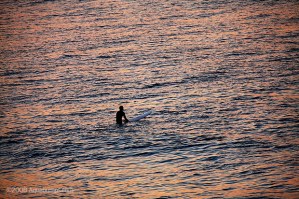
Bondi Waiting, © aquabumps.com, 2008

Bondi Waiting, © aquabumps.com, 2008

While digging through my hard drive yesterday I came across the piece below. It’s a few years old now, and I think a rather different version of the same piece ran in Good Reading in 2004, but it seemed worth giving it an airing, not least because I so rarely find time to surf anymore, and I miss it so much.

Two or three times a week, twelve months of the year, I make my way to the beach with my brother and a small group of friends. Although the purpose of the trip is what we call “ocean time”, which is code for surfing, it is also about a sort of escape, not just from our work and from our day to day lives, but from the more controlled aspects of the selves we need to be to live those lives.

The result is a little like playing hooky: slightly overcharged and somehow suspended out of normality. It’s also almost exclusively male, and curiously, for something that is about escape, is itself highly ritualised. From the time-coded pick-ups to the arguments about which beaches we will check out to the perving on chicks these excursions conform to a script which varies only in its detail.
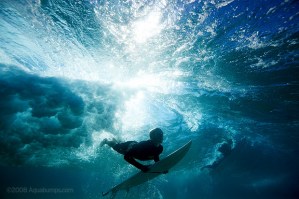
Explosion duckdive, Bondi  (courtesy www.aquabumps.com)

Explosion duckdive, Bondi, © aquabumps.com, 2008

How much the sense of escape is connected to the actual surfing I’m not sure. It may be that the surfing is merely a pretext for this behaviour, as shopping or golf or fishing clearly are for other people, at least in part. But although we all spend time together for other purposes, much of it also involving physical activity – running, gym, occasionally snorkelling or diving – none of these other expeditions have the same sense of excitement and freedom, either for me or the others.

I suspect most people conceive of writing – and people who write, with a few notable exceptions – as confined to a sphere which not just excludes the physical, but which actually exists in some sort of opposition to it. In fact the processes of writing, and of entering a space where it is possible to write, seem to me to be about a way of being which is almost seamlessly continuous with the life of the body.

Writing, at least the sort I’m interested in, is about communicating the nature of being. Despite its medium, it is a conversation between minds about aspects of existence – psychological, spiritual, emotional – which exist independent of language, and which are for the most part irreducible to mere words. It’s about making the apprehended but inexpressible communicable, about taking the pre-verbal and ineffable experience of emotion and passing that experience on to another. That mere words have this ability to transcend their own meanings, to offer us a glimpse of the mirrors that lie in the inner worlds of others is something we have all felt in that moment of recognition that comes when something we read or hear strikes us as somehow right or true, that sense a chord has been struck somewhere within us, its meanings neither simple nor easily explained.

Like music, any piece of writing has a shape and cadence of its own. It is about rhythms, in language, in character, in story. It is these rhythms that you seek when you write, for they are the contours you try and bring forth. What guides you is not the intellect, or at least not the conscious part of it, but something more intuitive. It is the sense that you are following a shape which somehow already exists, something not so much invented as implicit in the thing itself. Just as sculptors claim to see a shape within the uncarved stone, so the story seems to be already there, like a name half-forgotten which lingers on the tip of the tongue.

Understood like this the process of writing is more a kind of listening than anything, a quiet attendance to the thing. Like the shaping of objects with the hands, the turn of a pot upon a wheel or a lathe upon wood, it is a process in which the intrusion of the conscious mind is often a hindrance, for the important thing in trying to find these rhythms is not to try too hard, not to force it. To hear the rhythms in a thing, to let it happen, you must learn to let go of your intentions, to forget the self and just be.

Learning to do this is one of the hardest things about writing. When a book is near its end it usually has a kind of momentum, an effortlessness, as if some apex has been passed and now the run is downhill, but before that point it can be difficult to find the rhythms you are seeking. Forgetting the self and entering that state of flow is not something that can be just picked up and put down: it requires large spaces of time, room to think and tinker, or just to be.

But it’s not just a question of time. What is needed is a way of escaping the life you are immersed within, of connecting with those things which ground you and your work. Different people find this in different ways, but increasingly I have found it through the stolen time of surfing.

Surfers often talk about their sport in almost religious terms, and although I don’t have a lot of sympathy for much of the culture that surrounds surfing, this sense of the act as a kind of spiritual journey is one I understand very well. To leave the shore and swim out, through the break and over the back, is to feel yourself slip free of your moorings and give yourself to the elements. Although your conscious mind still matters, you enter a world where it is your physical existence that matters first and foremost, the movement of your body in the water, with the water.
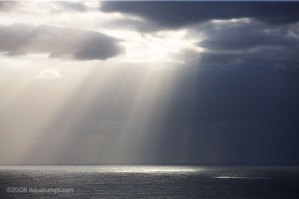
Rays of Light, Bondi, © aquabumps.com, 2008

Rays of Light, Bondi, © aquabumps.com, 2008

Sometimes the rewards for this are no more than the joy of playing in the ocean, a simple pleasure in the act itself. But there are other times, most often in the last hour or so of dusk, when the beach is quiet and the sky has begun to fade, when it is far more. Then, as the ocean moves beneath you and the long feed of the clouds passes overhead it  possible to sense the presence of a meaning which lingers just out of reach. It is to do with time, and its depth, with the rhythm of the sky and the waves, the cry of the birds as they pass overhead. Apprehended not consciously but somewhere deeper, this meaning beats like the pulse of a heart, something always there but of which we are only occasionally aware; deep and ceaseless, it fills the fabric of the world until it trembles with its weight.

This sense of the world’s presence in its pieces, of its divinity is one which runs deep in my writing. But the knowledge of its existence grounds me in a more mundane way, binding me to the act of surfing, to the escape it offers. For in the loss of self that surfing demands, the submission of the conscious mind to the rhythms of the ocean, I find a sort of peace, a capacity to move and think freely, and ultimately, to attain the sort of equilibrium I need to write.

(The images on this page are provided courtesy of Eugene Tan at www.aquabumps.com, whose daily email chronicle of the changing moods of Sydney’s beaches has been a bright point in my day for more years than I care to remember).

© James Bradley, 2009

Break text

addthis

The review is dead. Long live the review?

{{Potd/2006-11-2 (en)}}
Image via Wikipedia

There’s a fascinating conversation going on over at Matilda about the ethics of reviewing, and in particular the question of whether accepting free books from publishers compromises bloggers. My feeling is that the latter question is a bit of a furphy, since reviewers for the mainstream press accept free books all the time, and it doesn’t compromise our integrity (or what we laughingly call our integrity). But I also think the discussion at Matilda is circling around another larger and more interesting question about the future of the book review itself.

The book review, in its current incarnation, is largely a creature of the print media, and in particular the newspaper. But over recent years the commitment of newspapers to their book review sections has been wavering. In his excellent Overland lecture Malcolm Knox disputes the economics of this failing commitment, but whether it’s sound business thinking or not, the review sections of newspapers are in trouble. In recent weeks The Washington Post has folded its august Book World section back into the main paper (although it will continue to live on, ghost-like, online) and it seems likely other papers around the world will follow suit in the next few years. Given the convulsions (death throes?) afflicting the print media more generally as the GFC collides with their already shaky business models it might be interesting to see whether newspapers themselves outlive their book review sections, but whatever happens it looks less and less likely the traditional mainstream media print review will be around in anything other than a niche capacity ten years from now.

That of course raises the question of what happens then. Assuming there will continue to be interest in books (and while I think interest in books will continue to contract I’m confident both that there will continue to be a community of readers eager to discuss and debate books, and that the net will drive deeper and broader collaborations between such individuals) there will continue to be a demand for reviews of new publications, and I think we can safely assume the publishing business (whatever it looks like in a decade’s time) will continue to seek out forums prepared to give space to its product.

But what will those forums, and those reviews look like? The book review as it is traditionally understood is an awkward beast in cyberspace. The very qualities that give it shape in the print media – its authoritative air, the craft involved in shaping a piece to fit the space allotted, its ongoing process of attempting to balance the subjective response of the reviewer with a more objective view make it seem overly formal and hopelessly enclosed in the more collaborative environment of the blogosphere. Blogposts, and blogging, as they have evolved to date, are a much more personal, subjective form of writing, and offer quite different pleasures to the traditional review.

Yet the traditional review looks the way it does for a reason. Unlike bloggers, reviewers operate within a complex web of competing responsibilities to author, reader, book and editor (Kerryn Goldsworthy has written about this elsewhere but I can’t find the link, dammit) as well as restrictions relating to length and similar questions.

So will the end of the print media’s commitment to book reviewing mean the end of book reviewing, or at least of book reviews as we know them? Or will the ways bloggers write about books begin to become more formalized and codified as they become more enmeshed in the cycle of book promotion and discussion? Something of this sort is already happening with Amazon’s system of ranking for its reviewers, which despite being driven from the bottom-up, still push the reader reviews towards the more formal and balanced mode expected in the print media. Will new forums spring up to replace the broadsheet review sections, either aggregating reviews on blogs or actually commissioning them? And if it’s the latter how will it work economically? And perhaps most importantly, how will the blogging community, which has traditionally been opposed to absorption into the corporate machine, handle the process of being professionalized by inevitably closer relations with publishers and publicists? What will it mean for their independence and freedom of expression?

I don’t pretend I know the answers to these questions, but they’re real, and I suspect they’re dilemmas the blogging community is going to have to face up to, possibly sooner rather than later.

Break text

addthis

Wayne Levin

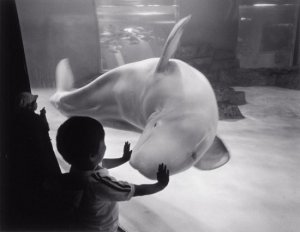
'Baluga Whale, Hakejima Sea Paradise' from Other Oceans

'Baluga Whale, Hakejima Sea Paradise' from Other Oceans

Flicking through some books the other night, I came across my copy of Wayne Levin’s Other Oceans. It’s a remarkable book, showcasing a series of black and white photos taken by Levin in aquariums around the world, and juxtaposing an almost sacred sense of the mysteriousness and wonder of the ocean and its inhabitants with the hushed, oddly utilitarian surfaces of the aquariums themselves. It is a juxtaposition that is haunting because it speaks so directly to our yearning for communion with the otherness we see embodied in the ocean and its inhabitants. But it is also, as Thomas Farber points out in his introduction, unsettling for the way it reminds us that if we do not change the path we are on, and quickly, it will not be long before the only way we will know the ocean’s inhabitants will be as creatures in submarine zoos of the sort featured in Levin’s photographs.
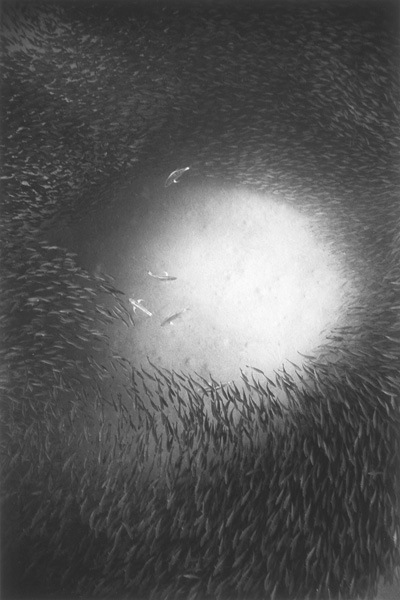
Levin’s photography probably isn’t familiar to many outside of the United States, and the broader community of those who are fascinated by the ocean, but he’s a Hawaii-based photographer who, working largely in black and white, has spent the best part of the last three decades documenting a very personal portrait of the ocean and its inhabitants. Although he has explored seas further afield, most of his photographs have been taken in the waters around his home, capturing surfers and divers and, most remarkably, what he describes as the resident spirits of the seas – the whales, dolphins, turtles and fish that move beneath the surface, largely unseen.

441The best of his photographs capture something of the immensity and mysteriousness of the ocean, its elusive and constantly-changing beauty. Some are collected together in Other Oceans and Through a Liquid Mirror, both of which feature introductions by Thomas Farber, author of the remarkable The Face of the Deep and On Water. But he also operates a beautiful website, Wayne Levin Images, which draws together a terrific selection of his work, and is well worth a visit.

Break text

addthis

Break text

All images © Wayne Levin.

Philip Glass

Composer Philip Glass, Florence 1993.
Image via Wikipedia

Having just watched Scott Hicks’ biographical documentary, Glass: A Portrait of Philip in Twelve Parts, I’m reminded that one of the things I’ve always found intriguing about Glass is the curious way his work blurs the line between the popular and the cerebral. He seems as home writing film scores and occasional music such as the Sesame Street piece below, as he is writing symphonies and operas.

I’d always assumed this was partly to do with his relatively unconventional career trajectory – until well after Einstein on the Beach was a hit he was still working as a taxi driver, for a time before they fell out, he and Steve Reich ran a moving business together, and I’m sure everyone has heard the anecdote about him installing a dishwasher in the apartment of a suitably appalled Robert Hughes during his time working as a plumber (in Hicks’ film they reproduce a comic strip in which Hughes is identified as “art critic John Hughes” which might be a deliberate slight but is probably just a fortuitous mistake). A career which so deliberately eschewed the conventional path for a composer and performer must, I’d always assumed, bring not only its own financial pressures but a preparedness to step outside the traditional parameters of high and low art. But interestingly, in The Rest is Noise, Alex Ross’ history of twentieth century music, he suggests it is as easily understood in historical terms:

“Riley, Reich and Glass came to be called minimalists, although they are better understood as the continuation of a circuitous, difficult-to-name development in American music that dated back tot he early years of the century, and more often than not took root on the West Coast. This alternative canon includes Henry Cowell and Lou Harrison, who drew on non-Western traditions and built up a hypnotic atmosphere through insistent repetition; Morton Feldman, who distributed minimal parcels of sound over long durations; and La Monte Young, who made music from long, buzzing drones. All of them in one way or another set aside a premise that had governed classical composition for centuries – the conception of music as a self-contained linguistic activity that develops relationships among discrete thematic characters over a well-marked period of time. This music was, by contrast, open-ended, potentially limitless.

“It was a purely American art, free of modernist angst and inflected with pop optimism . . . Reich and his colleagues borrowed from popular music, especially from bebop and modern jazz, and they affected pop music in turn”.

It seems curious to me that even now Glass is so routinely derided. How anyone could engage with the beauty and intelligence and rigour of his work and not be affected is difficult to understand, not least because it isn’t really necessary to take on the major works to appreciate him: the sheer profusion of his work means that often the details and the seemingly throwaway moments are – ironically, given that his music is so much about the construction of soundscapes – themselves things of extraordinary beauty.

But – and I think this is what I wanted to say to begin with – it was particularly fascinating to hear Glass speak about his process in Hicks’ film, and the sense that he often doesn’t know what a piece – even, or especially a major piece – is about until quite a long way into the process, a feeling I’m sure any writer knows very well (as indeed they know the worry Glass jokes about, that you may not realize what it’s about until it’s being performed). But I was particularly touched by his remark immediately afterwards, that for all that he is used to working with this uncertainty, sometimes for younger artists it can be terrifying.

Oddly, given all this, Glass has more than intellectual interest for me. When I was writing The Resurrectionist I listened to Glass a lot, not just for the hypnotic effect of the music, but because there was something in the way the pieces worked as larger cycles I wanted to understand, and use. And it must have worked. When I met my French translators (brothers, who work together, and lovely guys, both of them) in 2007, they asked me whether I’d listened to much music when I was writing the book. Yes, I said, Radiohead’s Kid A when I was writing the sections in the centre in which Gabriel loses his mind, but mostly Philip Glass. And at this last they began to laugh. ‘We knew it,’ they said. ‘We’ve been doing the translation listening to Philip Glass and we knew you’d been doing the same’.

Glass must be 71 now, but in 2007, when he turned 70, The Guardian ran this piece which is well worth reading.

Here, in one of the odder cross-pollinations, is a segment from Sesame Street which used Glass’ music.

And for good measure, here’s Branka Parlic playing one of my favourite pieces of Glass’ music, Metamorphosis One.

And here, out of interest, is the trailer for Glass: A Portrait of Philip in Twelve Parts.

addthis

Reblog this post [with Zemanta]