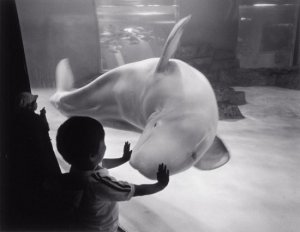
'Baluga Whale, Hakejima Sea Paradise' from Other Oceans
Flicking through some books the other night, I came across my copy of Wayne Levin’s Other Oceans . It’s a remarkable book, showcasing a series of black and white photos taken by Levin in aquariums around the world, and juxtaposing an almost sacred sense of the mysteriousness and wonder of the ocean and its inhabitants with the hushed, oddly utilitarian surfaces of the aquariums themselves. It is a juxtaposition that is haunting because it speaks so directly to our yearning for communion with the otherness we see embodied in the ocean and its inhabitants. But it is also, as Thomas Farber points out in his introduction, unsettling for the way it reminds us that if we do not change the path we are on, and quickly, it will not be long before the only way we will know the ocean’s inhabitants will be as creatures in submarine zoos of the sort featured in Levin’s photographs.
Levin’s photography probably isn’t familiar to many outside of the United States, and the broader community of those who are fascinated by the ocean, but he’s a Hawaii-based photographer who, working largely in black and white, has spent the best part of the last three decades documenting a very personal portrait of the ocean and its inhabitants. Although he has explored seas further afield, most of his photographs have been taken in the waters around his home, capturing surfers and divers and, most remarkably, what he describes as the resident spirits of the seas – the whales, dolphins, turtles and fish that move beneath the surface, largely unseen.
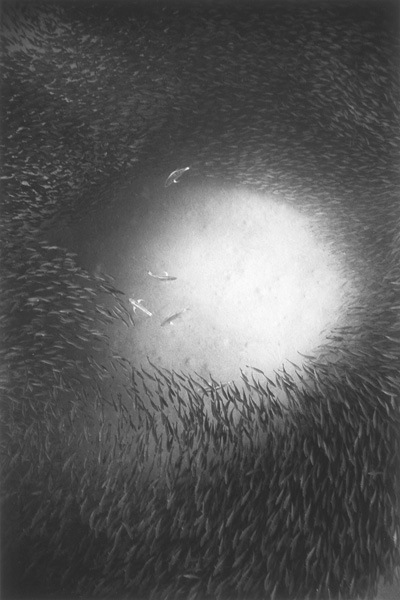
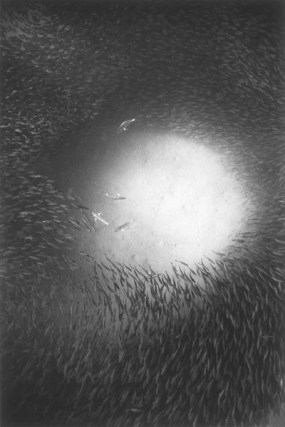 The best of his photographs capture something of the immensity and mysteriousness of the ocean, its elusive and constantly-changing beauty. Some are collected together in Other Oceans and Through a Liquid Mirror
 , both of which feature introductions by Thomas Farber, author of the remarkable The Face of the Deep
 and On Water
 . But he also operates a beautiful website, Wayne Levin Images, which draws together a terrific selection of his work, and is well worth a visit.
Break text

Break text
All images © Wayne Levin.







 city of tongues