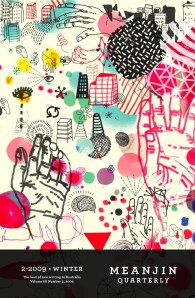
 After the acrimony surrounding the absorption of Meanjin into MUP, and the departure of former editor Ian Britain, one could have been forgiven for thinking Sophie Cunningham had accepted a poisoned chalice when she took over as editor last year. I’m not sure anyone would think that now: despite a mildly controversial redesign the magazine seems to have gone from strength to strength under her editorship, a process which is clearly visible in the Winter issue (2/2008) which was launched at Sydney Writers’ Festival last week and features Ross Gibson’s quietly brilliant piece on William Dawes and Patyegarang, Katherine Wilson on the hoaxing of Keith Windschuttle and an interview with Christos Tsiolkas.
I’m obviously not an unbiased reader – I’ve known Sophie for a long time, and she’s published a couple of pieces by me in the new-look magazine – but what I find exciting about her version of Meanjin is its determination to drag the literary magazine into the 21st century. In doing that she’s obviously drawn inspiration from American magazines like McSweeney’s which have embraced the possibilities of advances in publishing technology to create magazines which reflect the omnivorousness of their interests in their physical form, and which are prepared to explore the possibilities opened up by zines and graphic forms such as comics. But she’s also clearly put a lot of effort into trying to reimagine the sort of writing one might find in a magazine such as Meanjin by including more life writing and memoir and commissioning pieces on television and broader questions about digital copyright and new media.
All of which brings us to the Meanjin blog, Spike, which has been going from strength to strength over recent weeks. Although News Ltd are about to launch some kind of new media venture under the stewardship of former Daily Telegraph Editor, David Penberthy, Australian media has handled the transition to digital strikingly badly. In contrast to newspapers such as The Guardian and The New York Times, which have devoted considerable time and energy to developing digital incarnations that embrace the possibilities of the medium by incorporating high-quality blogging and high levels of interactivity, the online versions of our newspapers are largely content to simply replicate their print versions online, albeit in a stripped back and dumbed down form.
This contrast is particularly acute in the context of the cultural pages of Australian newspapers and magazines, through which you can almost hear the tumbleweed blowing. Rather than using the cost pressures upon the print versions of these sections as an excuse to build more sophisticated online presences, Australian newspapers have been progressively scaling back their cultural content online.
Nor – although it must be said this is largely a matter of economics – have our literary magazines embraced the possibilities of digital publishing. There are some notable exceptions out in the blogosphere, where outfits like Larvatus Prodeo have found niches and occupied them with varying degrees of success. And in a slightly more formal context Inside Story is doing some good work, and The Monthly has set up its subscription-based Slow TV. But in general it’s fair to say that most of what’s out there is being done on the sniff of an oily rag by individual bloggers.
That alone would be reason to make Spike – which is already drawing on a pretty wide pool of contributors and producing the sort of steady stream of good material that makes individual bloggers like myself feel exhausted every time we look at it – stand out from the crowd. But what’s more interesting about it is the fact that rather than devoting their resources to reproducing the content from the print version of the magazine online, Meanjin has decided to create a separate entity which complements and extends the print version of the magazine by providing content specifically created for an online environment.
All of which makes the redesign of the physical magazine, and its preparedness to rethink how the medium might affect the message seem less about simply taking design cues from elsewhere and more about a really serious strategy to find a model which might contain good writing across a variety of media (a project that’s also visible in Sophie and the magazine’s enthusiastic and highly successful embrace of the possibilities of Twitter).
In and of itself the successful implementation of such a strategy would be interesting, but I suspect the current convulsions in the media landscape give it increasing urgency. As the newspapers stumble dinosaur-like towards their inevitable oblivion, the question of where the Australian cultural and literary conversation will occur is sharpening, and I’d have to say that at this point the forums aren’t exactly thick on the ground. I can name a slew of American sites such as The Second Pass, Salon, BookForum or The Millions, all of which offer access to writing about books and ideas of a very high standard, and which, to a greater or lesser degree, embrace the possibilities of the internet as a medium. By contrast, there are almost no Australian sites offering anything of the sort, nor – at least without considerable private or institutional backing – does it seem likely there will be any time soon.
I suspect some people will accuse me of cultural nationalism, but they’d be mistaken. All I’m saying is that it’s vital small countries, and in particular anglophone small countries with a long history as importers of culture, possess forums in which ideas and issues be discussed in context. Because without them we’ll be condemned to listening to other people’s conversations, without ever being able to have our own.
All of which makes the Meanjin experiment as important as it is interesting. Because while Meanjin isn’t going to be The Sydney Morning Herald of the future, I do think in it, and in Spike, it’s possible to see a model which suggests it is possible to mark out space for the Australian cultural conversation online without being either stuffy or parochial. And that’s something that really, really matters.
Break text



 Sad news yesterday about the death of the brilliant and multi-talented Jay Bennett. Most famous for co-writing and playing guitar on
  ,
,  and
and  , the latter part of Bennett’s career was often overshadowed by the circumstances surrounding the breakdown of his relationship with Wilco frontman,
  .
. , the sequel to
  . What the Book Design Review misses is that the author of this magnificently liveried tome is actually
 I’ve just discovered Steve Busfield at The Guardian has begun a week-by-week, season-by-season blog covering every episode of The Wire. It’s up to the
 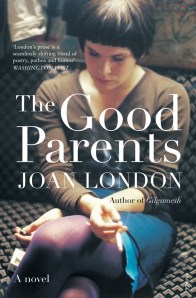 I was delighted to see Joan London’s The Good Parents, win the Christina Stead Award for Fiction at last night’s NSW Premier’s Awards. I think like many people I’d been assuming the award would go to Tim Winton for Breath, so to see Joan win was an unexpected delight.
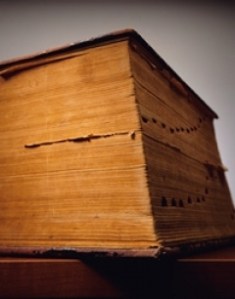 Now I don’t mean to carp, but what is it with 2009 and unreasonably fat books? It’s only May, and I’ve already had to wade my way through the 900-odd pages of 2666, the 1,000 (incredibly dense) pages of The Kindly Ones and the 600 or so of A.S. Byatt’s The Children’s Book. And this morning Hilary Mantel’s 600 page-plus Wolf Hall lands on my doorstep with an audible thud. Don’t these people have better things to do with their time?
 In my
In my 



 city of tongues