Skip to content

Posts from the ‘Science and Nature’ Category

Paul Nicklen’s Polar Obsessions

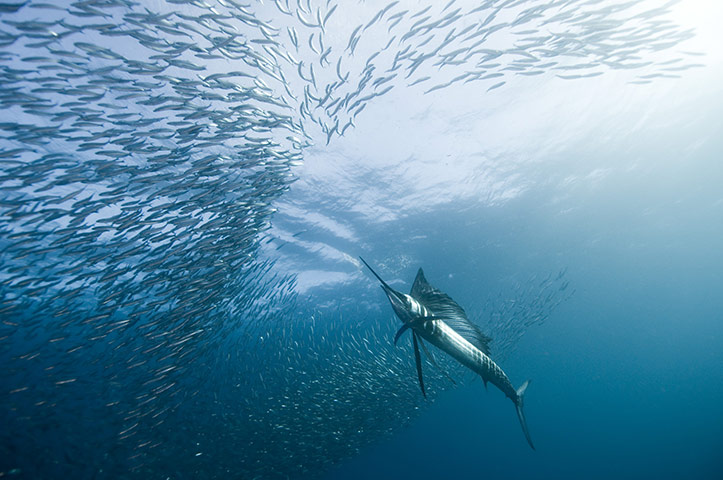
A while back I linked to an amazing series of images of sailfish rounding up baitfish by National Geographic photographer Paul Nicklen. To commemorate the publication of Nicklen’s new book, Polar Obsession, National Geographic have now released an amazing video montage of his encounter with a leopard seal, an encounter that begins with the seal taking the camera and Nicklen’s hand in its mouth. It’s an amazing sequence, and the images are just breathtaking. If you’d like to see more of Nicklen’s work you can check out his website, which has a beautiful array of images (though it must be said the fact that they’re all watermarked to within an inch of their life does detract a bit from the viewing experience) or you can check out a selection of images from Polar Obsession on The Huffington Post (and vote for your favourite).
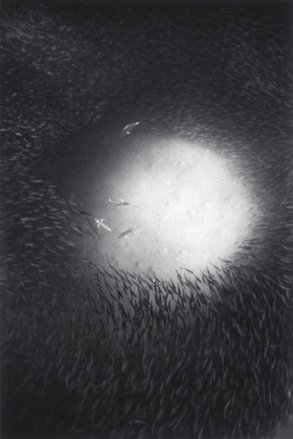
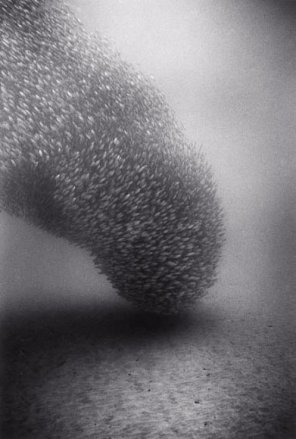
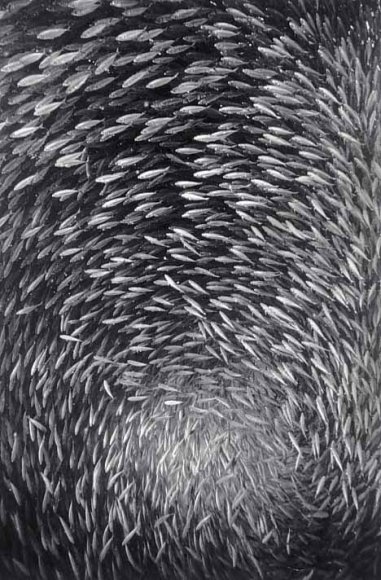
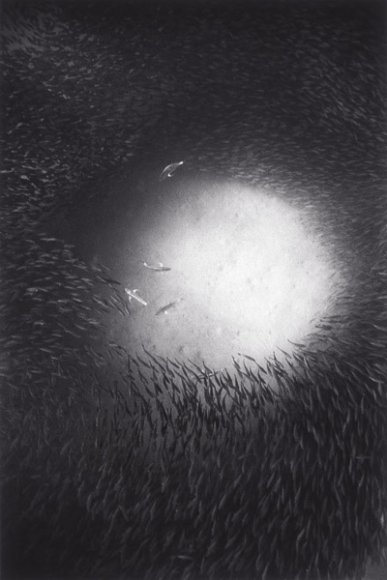
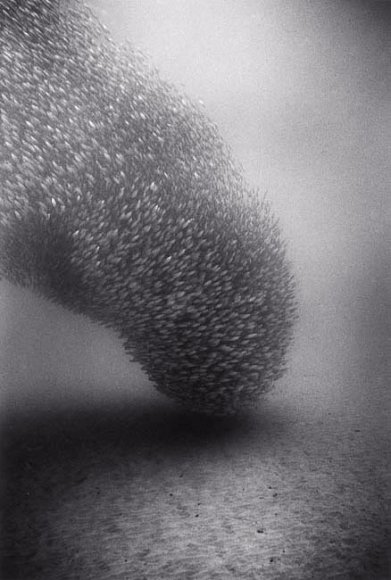
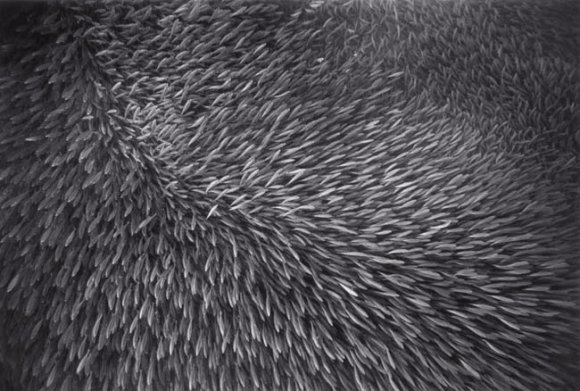
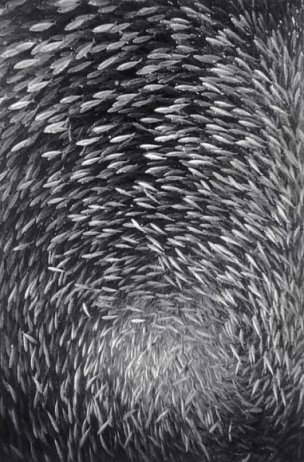
And while we’re on the subject of nature photography, the wonderful Wayne Levin (who I’ve also mentioned before) has just added a lot of new work to his website as part of the lead up to the release of not just one, but two new books next year. Most of the images are black and white underwater shots of the subjects he’s long been fascinated with (bodysurfers, marine animals) but a number were taken on a recent trip to the remote Papahanaumokuakea Marine National Monument as part of a scientific expedition by staff of the US National Oceanic and Atmospheric Administration, and represent a bit of a departure for Levin, not least because some of them aren’t only above water, they’re actually in colour.

Break text

Break text

Running Silent

Mars

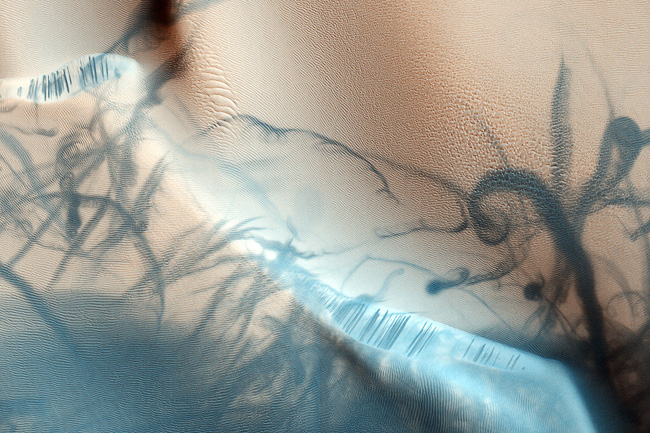
The trails of dust devils on the Martian surface

Just a quick note to say sorry things have been a bit quiet around here, and to apologise in advance for the fact it’s likely to stay that way for another couple of weeks. If it’s any excuse I’m in the midst of something of a perfect storm of work and personal commitments (we moved house last Monday, and my partner is about to give birth to our second child in the next couple of days. And I’m still working at the Uni and have a book to finish, as well as all my normal freelance work, so it really is all a bit silly at present). But with a bit of luck I’ll get a few things up in the next little bit and then get back to posting properly in December.

In the meantime I’ll offer you three little tidbits from the last week. The first is the fact that while I was listening to a lecture about Flannery O’Connor the other day I realized that since she was only 39 when she died in 1964, she’d only be 84 if she were still alive today, which is not that much older than Philip Roth (76), Cormac McCarthy (76), Shirley Hazzard (78) or David Malouf (75) all of whom are not just alive but at the peak of their powers. So if O’Connor hadn’t died young there’s a good chance she’d still be writing, and even if she wasn’t she would have been until very recently. Which is strange, at least to me, since in my mind she’s very much a writer of the mid-20th century, and not the 21st.

The second is this broadcast about intelligent bacteria from the ABC’s All in the Mind program, which is very definitely worth a listen. I’ve long been aware of evidence that colonies of bacteria seem to possess organizational abilities beyond what we’d expect of individual bacteria, but I had never run across the suggestion that they themselves might be intelligent, either collectively or individually, so the talk of nanobrains in the program was exciting stuff. Want a refocussing of your perspective on the place of humans in the universe? I reckon this might be a place to start.

And finally there’s this rather magnificent gallery of images of the Martian surface. You can see black basalt sanddunes, organically curling dust devil tracks and the tracks of the Rovers, and while I’m a bit of a Mars tragic, it’s wonderful, almost painfully beautiful stuff. If you want to see more you might want to check out The University of Arizona at Tucson’s High Resolution Imaging Science Experiment.

Break text

addthisTweet this

A birdless world

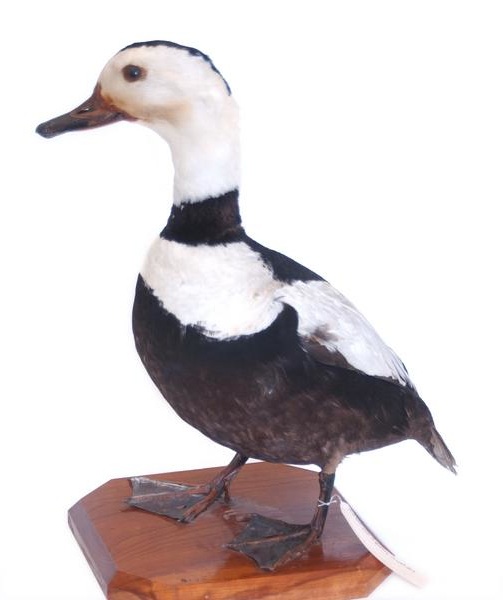
Labrador Duck

Labrador Duck, Museum of Zoology, University of Michigan, © Phil Myers

A couple of weeks ago I reviewed Glen Chilton’s new book about his quest to see every known specimen of the extinct Labrador Duck, The Curse of the Labrador Duck, for The Sydney Morning Herald. It’s an pleasingly oddball little book, and while I don’t think Chilton is interested enough in exploring the larger issues his story raises, there’s something incredibly sad about the spectacle of Chilton making his way from museum to museum to inspect the often misidentified skins and eggs that are all that remain of the species.

But the detail from the book that’s stayed with me is an aside in the middle about the fact that even when kept in perfect conditions in museums stuffed birds last about 500 years. Put them out on display, expose them to daylight and changes in temperature and they perish even more quickly. All of which means that once a species is gone, it’s not just the living bird that’s gone, but, in reasonably short order, all physical trace of them.

Obviously there’s an anthropocentrism at work here, an assumption that somehow our knowledge of a species has larger meaning, but in this context I don’t think it’s wholly misplaced. After all, most of the species that have vanished in the last few centuries, and certainly almost all of the thousands more that are likely to vanish in the near future have been wiped out by humans. But speaking as someone who’s been woken at 4:30am every morning for the last week by the primal whoops and screams of Koels, Black Cockatoos and Channel-Billed Cuckoos, it also seems difficult to reconcile the silence of vanished birds with their raucous, vital presence, or to avoid the feeling a world without them would be a much smaller, and less joyous place.

Break text

addthisTweet this

Whale Sharks

I’ve just noticed my piece from September’s Monthly about diving with whale sharks at Ningaloo is now available online. You can read it (and a pretty impressive selection of other pieces from the magazine) here.

Break text

addthisTweet this

23 years after Chernobyl (or the nuclear fool cycle)

Chernobyl-Today-A-Creepy-Story-told-in-Pictures-funfair

Pripyat Funfair, © Ben Fairless

One of the more bizarre side-effects of the climate change debate is the fact that it’s given new life to the nuclear power lobby. Indeed it sometimes seems that every time I turn on the ABC or open a newspaper there’s some talking head doing his utmost to convince us that not only is nuclear power now safe, it’s also the only technology capable of offering emission-free alternative to fossil fuels. Never mind that we still have no way of dealing with the waste (at least until Generation IV technology becomes a reality), never mind that the emissions generated by extracting and processing uranium far outstrip the emissions generated by coal-fired stations, never mind the possibility of accidents or sabotage, nuclear power is the way to go. (I suppose the one point in their favour is that nuclear technology actually exists, unlike the ludicrous fantasy of “clean” coal).

Of course nuclear power is precisely the sort of boysy technology that appeals to a particular kind of smart man, not least because it allows them to do their “I’m the sort of man who’s prepared to take hard decisions without being fazed by silly, sentimental anxieties about the environment,” routine, but you’d think even they’d be able to hear themselves when they declare that the technology is now foolproof (like that unsinkable ship, the Titanic, I suppose).

Anyway – I thought in the context of that debate it might be worth linking to this remarkable series of photographs of Chernobyl. Gathering together work by a number of photographers, some born in the area, others not, they speak not just to the destructive force of the accident, and the scars it left on the place and its inhabitants, but in their haunting reminder of the way the forest is reclaiming the Exclusion Zone, to the hubris of presuming human society and its creations are anything more than a hiccough in the larger cycle of life and time.

(via io9).

Break text

addthisTweet this

The foulest thing I’ve seen this week

Click to enjoy in more detail

Click to enjoy in more detail

Via my friend Adam comes this photo of a parasite known as Cymothoa exigua, which lives by invading the mouths of fish and attaching itself to their tongues. According to Wikipedia:

“It then proceeds to extract blood through the claws on its front three pairs of legs. As the parasite grows, less and less blood reaches the tongue, and eventually the organ atrophies from lack of blood. The parasite then replaces the fish’s tongue by attaching its own body to the muscles of the tongue stub. The fish is able to use the parasite just like a normal tongue.”

Choice.

Break text

And here's a side view for added viewing pleasure

And here's a side view for added viewing pleasure

Break text

addthisTweet this

Ever worried you’re trapped inside a simulation of reality?

Maybe you are.

Break text

Break text

addthisTweet this

Birds and Sharks and Peter Craven

PEN AnthologyI’ve got pieces in the September issues of The Monthly and Australian Book Review, both of which are out today (and neither of which, sadly, are online). At first glance there’s not a lot to connect them – the Monthly piece is about the trip I took in late June to go diving with whale sharks at Ningaloo, while the Australian Book Review piece is a review of Jeremy Mynott’s delightfully omnivorous book about birds and birdwatching, Birdscapes – but in a way they’re not as disparate as they sound, since both are interested in the question of what we see when we look at animals, and the social context of that observation.

The September issue of Australian Book Review also boasts Peter Craven’s review of the Macquarie PEN Anthology of Australian Literature. To call it a bracing critique is an understatement; it reads more like the critical equivalent of a hand grenade, pointing out omissions, rubbishing the selection and questioning the logic of the anthology’s interaction with what Craven regards as the Australian canon.

I think it’s probably worth pointing out that Craven has long been a champion of the Australian modernist canon, and at least part of his irritation with the collection seems to be a function of his view that this significant part of Australian literary history is not dealt with in a manner which reflects its richness or its diversity. But it’s his criticisms of the anthology’s treatment of Aboriginal writers and writing which are likely to attract the most attention:

“This leaves the final glaring failure of the PEN anthology. It overflows with Aboriginal writing, much of which has no literary value whatever. This is inexplicable, given the availability of the Macquarie PEN Anthology of Aboriginal Writing, of which this collection is a ‘different configuration”. It is hard to see what can have possessed the editors . . . to publish reams and reams of everything from Bennelong’s letter to speeches by Marcia Langton – and every kind of doggerel and naive bit of memoir besides . . . The sheer quantity of Aboriginal writing included in the volume – much of it devoid of literary quality or even literary ambition – is an egregious mistake. It diminishes the importance of Aboriginal culture and obscures the work of serious black writers, such as Alexis Wright, who now constitute a tiny fraction of the whole.”

Not having read the collection in any great detail myself, I don’t feel in a position to comment, but I would say two things. The first is that I feel for the editors, who have, beyond a doubt, taken on a thankless task. As someone who’s edited anthologies before, and is in the early stages of another one at the moment, I know how incredibly difficult it is to satisfy everyone, and there’s no doubt that problem is all the more acute when the collection in question is supposed to be representative of something as vexed as a national literature. The second is to register the fact that Craven’s criticisms, while made from a quite different ideological perspective, echo those made by Ivor Indyk in the Australian Literary Review, who also questioned the collection’s decision to include political speeches and similar works at the expense of writers such as Ruth Park and Dal Stivens, before going on to argue:

“I am happy to embrace the possibility that any kind of writing could have literary qualities but there is a danger here: if, out of a sense of crisis, you include in an anthology of Australian literature all that you think is necessary for its appreciation, then the entity itself might easily go from a state of threatened non-existence to a state in which it included so much that it ceased to be an entity at all.”

Kerryn Goldsworthy, who edited the post-1950 fiction for the collection, has responded to the criticisms Indyk made in the same piece about the under-representation of migrant writers over at Still Life with Cat, but it seems to me that both Indyk and Craven are, in slightly different ways, touching upon a real question about how we define literature in this context. Is Robert Menzies’ ‘Forgotten People’ speech (which is in the collection) literature? No? The what about Ned Kelly and Dan Byrne’s Jerilderie Letter? That seems less problematic at first blush, though Indyk at least finds it a “murderous and . . . maniacal rant”, and compares it to Mein Kampf. And including a petitioner letter of this sort also seems to immediately open the door to the body of similar works by Aboriginal writers, which Craven at least regards as possessing dubious literary merit.

Part of the problem is adopting a position where the notion of “literature” is something that needs defending from the non-literary, since doing so immediately creates a sense of crisis and embattlement.  Yet once that distinction is given away, the emphasis in the title of such a collection quickly falls upon the “Australian”, and the question Indyk poses above becomes particularly acute. My sense (on a pretty cursory read, it must be said) is that the editors have attempted to straddle this divide, presenting a range of writing which seeks to offer a glimpse of the textures and variousness of the Australian experience, and its processing into collective and individual consciousness.

Whether they’ve been successful at this or not is an open question. Indyk and Craven think not, others are more positive. But it seems to me they’ve made the right decision in principle by giving away strict definitions of the “literary”. Because while managing the diversity and competing demands for attention such a decision throws up creates a whole range of new problems, it also opens our minds to just how many ways there are of being Australian, and of the complexities of experience that simple term too often obscures or denies. Does that create an implicit demand that Australian literature be concerned with Australia, or Australians or Australian experience? Probably. Is that appropriate? Perhaps, perhaps not, though as The Man Who Loved Children demonstrates that’s hardly a new problem. But what does matter is that the collection offer something complex and multi-dimensional enough to accommodate the often competing voices with which we speak, and – perhaps just as importantly – to offer a sense of the context out of which these voices speak.

Break text

addthisTweet this

Arctic Dreams

800px-Polar_bears_near_north_poleA while back I did one of those pieces for a newspaper about the books that changed me. Articles of that sort are always slightly weird exercises, as much about selling a version of yourself via your choices as really addressing the question, and I have to confess I don’t remember exactly what books I chose on the day in question (though it’s a fair bet Michael Ondaatje’s In the Skin of a Lion would have been on my list, since the experience of reading it was the thing that set me on the path to becoming a novelist). But I do know that if there’s one book that genuinely has a claim on having changed me, it’s Barry Lopez’s Arctic Dreams, a book which completely altered the way I thought about a whole series of questions about the environment and the way we understand it and our place in it.

Anyway – I wrote the following piece in 2001 for The Australian’s Review of Books, the forerunner to today’s Australian Literary Review, and I recently stumbled on a copy of it on my hard drive while I was working on a review I’ve got in the next issue of Australian Book Review. But what’s frightening about it is that the concerns it expresses were urgent then, eight years ago, yet we don’t seem to have moved any further towards addressing them.

Barry Lopez’s Arctic Dreams begins and ends with the same curious act of respect. A kind of bow, performed before the world he has encountered in the travels through the Arctic. “I took to bowing on these evening walks,” he writes. “I would bow slightly with my hands in my pockets, towards the birds and the evidence of life in their nests – because of their fecundity, unexpected in this remote region, and because of the serene arctic light that came down over the land like breath, like breathing.”

Much later this gesture is repeated, this time on the tip of St Lawrence Island, but in its later incarnation the gesture has moved closer to a kind of stillness, a loss of the self into the land and its rhythms:

“Glaucous gulls fly over. In the shore lead are phalaropes, with their twiglike legs. In the distance I see flocks of oldsquaw against the sky, and a few cormorants. A patch of shadow that could be several thousand crested auklets – too far away to know. Out there are whales – I have seen six or eight grey whales as I have walked this evening. And the ice, pale as the dove-coloured sky.”

The lyric beauty of Lopez’s writing helps transform this simple gesture into a literary artefact of great power and resonance. In his words we glimpse a world that trembles with life, and apprehend, within its detail an otherness we might not otherwise see, a kind of presence which the land embodies, ancient, complete unto itself.

Lopez is first and foremost a visual writer, possessed of a poet’s eye, and his account of the Arctic is anchored in his observation of its terrain, its light, and the animals that inhabit it. Yet it is observation rendered so as to make each moment transcend its detail. Whether it is golden plovers abandoning “their nests in hysterical ploys, artfully feigning a broken wing to distract . . . from the woven grass cups that couched their pale, darkly speckled eggs,” eggs which “glowed with a soft, pure light, like the window light in a Vermeer”, or “herds of belukha whale glid[ing] in silent shoals beneath transparent sheets of young ice”, his writing seeks out the moments when the land reveals itself, where the whole can be glimpsed in the part.

To see in such a way is to contain politics within aesthetics, to transform epiphany into manifesto. It is to suggest a way of seeing that is simultaneously a way of being, as if by seeing clearly we might find connection, and for a moment at least, glimpse the land as something which exists independently of us, possessed of its own meaning. It is, as Lopez puts it, “to be alert for its openings, for that moment when something sacred reveals itself within the mundane, and you know the land knows you are there.”

“You know the land knows you are there.” A notion both simple and strange. Yet this sense of knowing and being known, of seeing and being seen is a way of allowing the imagination to begin conceiving of our relationship with nature as a dialogue, and of nature itself, whether embodied in an owl or the movement of light across the tundra, alive in its own right, “an animal that contains all other animals”, and not something given to us to do with as we desire. This is not science, but in its desire to understand nature, complementary to science, a poetics perhaps, able to contain both the scientific and the moral. Witness Lopez’s description of the intricacy of the polar bear’s physiology and behaviour:

“The interplay here among rest, exertion and nutrition that carries them comfortably through life is something that cannot be broken down into pieces. Like the skater’s long, graceful arc, it is a statement about life, the full exercise of which is beautiful.”

This transformation of aesthetics into politics is central to the tradition of nature writing Lopez is a part of. Ever since Thoreau walked his mile and a half to Walden Pond, writing about nature has been a political act, the expression and the embodiment of a homespun radicalism of peculiarly mystical bent. To see differently, to extend the reach of our imagination through contemplation into other ways of being is to be able to transcend our self, and by moving outside ourselves be granted a new perspective upon our place in the scheme of things. It is to sense the smallness of human history against the story of the planet, and to be made aware of our own impermanence.

There might seem something almost trivial in this appeal to imaginative contemplation given the scale of the environmental catastrophe that surrounds us. The biologist Edward O. Wilson argues that the “maximally optimistic conclusion” is that some 27,000 species become extinct each year, or 74 each day, 3 each hour. Similar estimates put the loss of biodiversity in the next century at somewhere between 25 and 50 per cent, that is to say, one quarter to one half of all species gone forever through human agency within the next 100 years. Given that we have catalogued only the tiniest proportion of this diversity, the vast bulk of these species will vanish unrecorded and unlamented, lost forever.

But it is precisely through the exercise of the imagination that we become able to see the world in such a way as to make sense of this loss, and to understand the cost to ourselves of the failure of imagination that has allowed it to happen. By attending to detail, by learning to see things as they are, we learn to dissolve our selves into the landscape, to become inhabitants of a shared world which exists in its own right, apart from our use of it, one to which we owe a silent respect, and an allegiance.

First published in The Australian’s Review of Books, © James Bradley

Break text

addthisTweet this

Artistic tendencies linked to ‘schizophrenia gene’

PET scans of a schizophrenia sufferer's brain (left) and normal brain (right).

PET scans of a schizophrenia sufferer's brain (left) and normal brain (right).

New Scientist is reporting a fascinating study suggesting a statistical correlation between a gene linked to schizophrenia and creativity. The study, conducted by Szabolcs Kéri, a researcher at Semmelweis University in Budapest, Hungary:

“examined a gene involved in brain development called neuregulin 1, which previous studies have linked to a slightly increased risk of schizophrenia. Moreover, a single DNA letter mutation that affects how much of the neuregulin 1 protein is made in the brain has been linked to psychosis, poor memory and sensitivity to criticism . . .

“To determine how these variations affect creativity, Kéri genotyped 200 adults who responded to adverts seeking creative and accomplished volunteers. He also gave the volunteers two tests of creative thinking, and devised an objective score of their creative achievements, such as filing a patent or writing a book.

“People with two copies of the neuregulin 1 mutation – about 12 per cent of the study participants – tended to score notably higher on these measures of creativity, compared with other volunteers with one or no copy of the mutation. Those with one copy were also judged to be more creative, on average, than volunteers without the mutation. All told, the mutation explained between 3 and 8 per cent of the differences in creativity”.

I’m always a little sceptical of such studies, not least because of the reductive assumptions inherent in their methodology. But this research fits neatly with a number of other studies suggesting a link between mood disorders and creativity (some of which I’ve mentioned before).

You can read more at New Scientist. And while you’re there, take a minute or two to read this story about researchers turning brain scans into sound, a process which not only reveals patterns and rhythms not always visible to the eye, but also allows the “unsteady rhythms and cadences” (a lovely expression) of dysfunctions such as schizophrenia to emerge. Stranger still is the fact the music of the (hemi)spheres sounds just like early Philip Glass.
Break text

addthisTweet this

Bionic penguins

penguinsNew Scientist is reporting that German engineering firm, Festo, has unveiled a flock of bionic penguins at the Hanover Messe Trade Exhibition. Designed around a system of flexible glass fibre rods, which allow them to twist their heads like real penguins, and equipped with sonar and a limited form of autonomy, they can swim as gracefully as their biological counterparts. And there’s even a helium-filled flying version which “swims” through the air.

Go on – tell me the sight of bionic penguins coursing through the water doesn’t make you grin like an idiot as well.

Break text


Break text

addthistwitter-02

On depression and creativity

Griffith ReviewI’ve just realized the full text of my essay about depression and creativity, ‘Never real and always true’ is available for download on the Griffith Review site. Unfortunately it’s only in pdf format, so I’ve taken the liberty of cutting and pasting the text onto this site. And remember you can subscribe to Griffith Review by visiting their website, or purchase individual copies of Essentially Creative online from Gleebooks, Readings or bricks and mortar bookshops everywhere.

‘Never real and always true: on depression and creativity’

Break text

Break text

Break text

addthis

Ngã Uruora (or The Groves of Life)

Geoff Park

Geoff Park

I was deeply saddened last week to learn of the death of the New Zealand ecologist and writer, Geoff Park.

I didn’t know Park, who died on 17 March as a result of a brain tumour, but I did know his work, most particularly his marvellous 1995 book, Ngã Uruora (The Groves of Life): Ecology and History in a New Zealand Landscape, a book I first read after it was pressed on me by Ross Gibson, whose own quietly urgent words about the necessity of coming to understand the landscape we inhabit Park quotes in the book’s introduction.

It’s often difficult to escape the moment, to take the sort of long view which allows one to tell which books and ideas will shape the way we think in years to come, but I think there’s little doubt that Ngã Uruora is one of those books. For while its exploration of the environmental history of New Zealand is ostensibly a small, even parochial subject, it is a book which, in its capaciousness and breadth of vision opens up a new way of understanding the environment, and the deeply complex nature of our relationship to it.

Sadly there doesn’t seem to be any sort of formal obituary to Geoff Park online, but I thought it might be fitting to reproduce a few words which seem to me to capture exactly the quality of attention and generosity which make Ngã Uruora such an important book:

“When you become involved with the landscape . . . it becomes much more than a view. Even to draw a carp, Chinese masters warn, it is not enough to know what the animal looks like, and to understand its anatomy and physiology. It is also necessary to consider the reed which the carp brushes up against each morning, the oblong stone behind which it conceals itself, and the rippling of the water when it comes to the surface. These elements should in no way be constituted as the carp’s environment. They belong to the carp itself. In other words the brush should sketch a life, since a life – like the landscape – is constituted by the traces left behind and imprints silently borne.”

Vale, Geoff Park, go well: you’ll be missed.

Break text

addthis

All hail the Rat-King!

The Rat-King on display in the Mauritianum Museum, Altenburg, Germany

The Rat-King on display in the Mauritianum Museum, Altenburg, Germany

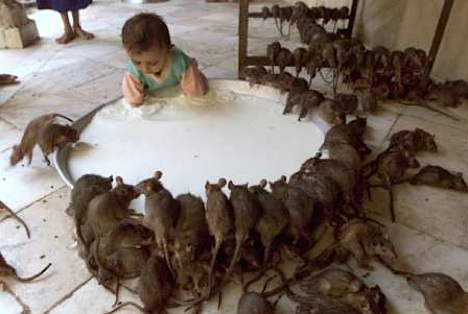
I was reminded last night of one of the more repulsive bits of cryptozoological folklore, the Rat-King. And since the two people I was with had never heard of them, I thought I might share the concept with the world. A Rat-King is created when a rat nest (a horrible concept all on its own) becomes so crowded that the tails of the rats become physically entangled, and slowly but surely, the separate rats begin to fuse into a single organism.

Perhaps not surprisingly the concept of the Rat-King is regarded with some scepticism by contemporary science, but belief in their existence has persisted in European countries, and particularly Germany, since the Middle Ages, and over the years various specimens have been displayed in museums and private collections.

Of these the most famous is probably the one owned by the Mauritianum Museum in Altenburg, which is comprised of the mummified remains of 32 rats, and was reportedly found in a miller’s fireplace in Buchheim in 1828, although specimens from as far afield as Java and New Zealand have also been collected through the years (Wikipedia has a brief survey of the various extant specimens, and you can see images, including x-ray images of one of the Dutch specimens on the Museum Kennis website).

As someone who’s not keen on rats at all, the Rat-King is a thing of nightmares. But I’m not sure you’d need to be as phobic about rats as I am to feel there’s something deeply unsettling about the whole idea, and not just because the thought of all those rats, scrabbling and hissing and seething together is inherently repulsive. Rather I suspect that just as the idea of zombies, and vampires, and the living dead  break down the ontological categories which order our world, the idea of several creatures merging into one super-organism, something smarter and more malign than any of its individual constituents, so offends our most primal suppositions about individual identity that we have few reactions open to us beyond fear, and disgust.

Break text

addthis

Unlocking déjà vu

This week’s New Scientist has a fascinating article about recent research into the cognitive origins of that most unsettling of phenomena, déjà vu:

Déjà vu can happen to anyone, and anyone who has had it will recognise the description immediately. It is more than just a sense that you have seen or done something before; it is a startling, inappropriate and often disturbing sense that history is repeating, and impossibly so. You can’t place where the earlier encounter happened, and it can feel like a premonition or a dream. Subjective, strange and fleeting, not to mention tainted by paranormal explanations, the phenomenon has been a difficult and unpopular one to study.

“Speculations about past lives or telepathy aside, the first biological explanations of déjà vu were based on ideas that two sensory signals in the brain – perhaps one from each eye or each hemisphere of the brain – for some reason move out of sync, so that people have the experience of reliving the same event. “Mental diplopia”, as it was called, is intuitively appealing but the evidence is stacked against it … Now another theory is gaining credibility. Perhaps déjà vu feels like reliving a past experience because we actually are – at least to some extent …”

Read more at New Scientist

Text break

addthis

Follow

Get every new post delivered to your Inbox.

Join 2,497 other followers